


Quick Navigation
Introduction
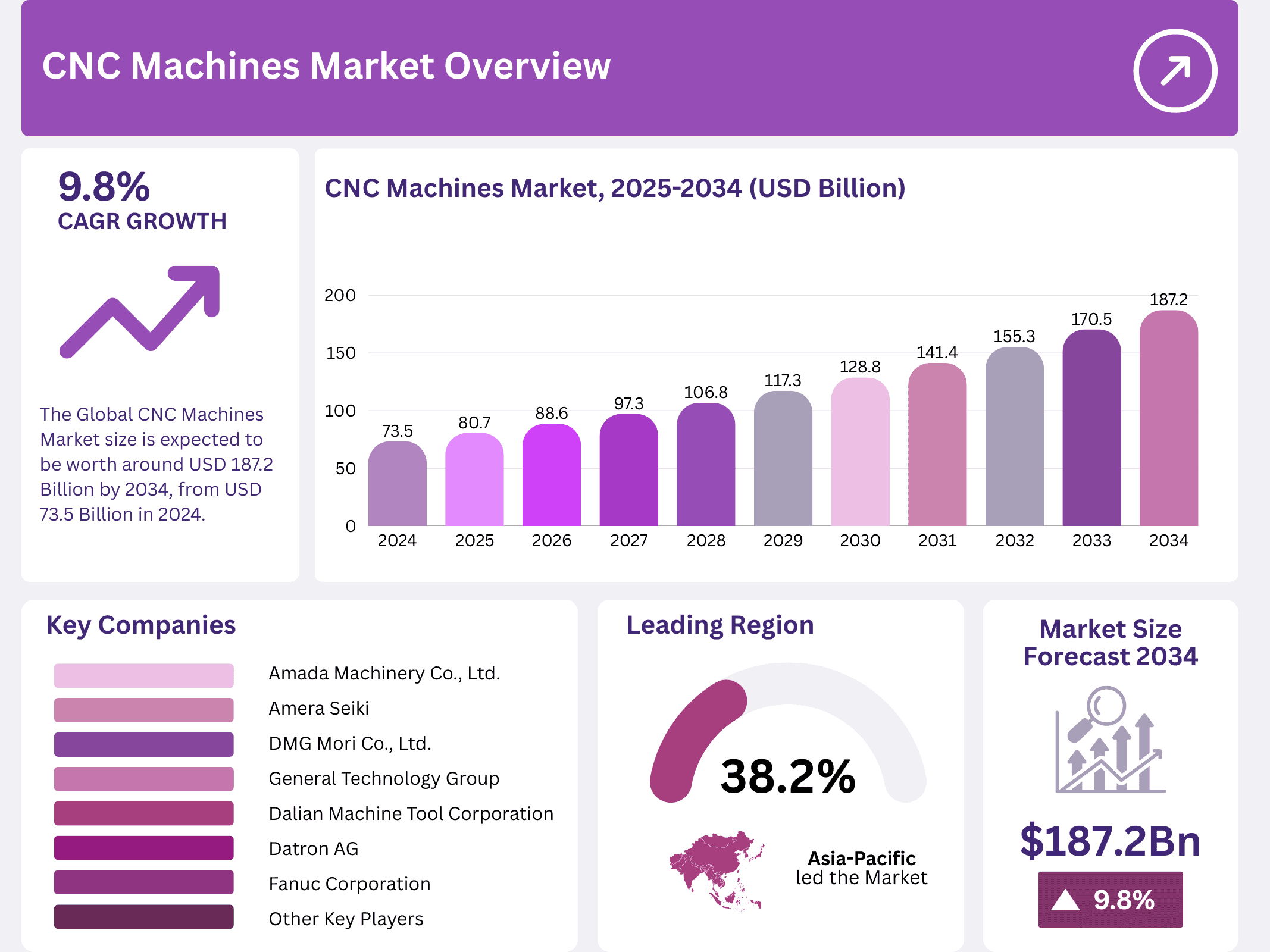
The global CNC Machines Market is entering a period of powerful transformation. Valued at USD 73.5 Billion in 2024, the market is forecast to reach USD 187.2 Billion by 2034. This growth, sustained at a CAGR of 9.8%, reflects the accelerating worldwide shift toward automated, precision-driven manufacturing.
Consequently, industries from aerospace to consumer electronics are turning to CNC technology with urgency. Many manufacturing facilities currently operate at just 60–80% efficiency. CNC machines directly address this gap by eliminating defects, reducing raw material waste, and ensuring precise, repeatable output across high-volume production runs.
Furthermore, the market is being shaped by the rapid adoption of Industry 4.0 principles. Factories are integrating CNC systems with real-time digital controls, enabling smarter, faster, and more cost-effective processes. This convergence of automation and connectivity is redefining what modern manufacturing looks like globally.
Additionally, government initiatives supporting advanced manufacturing and smart factory infrastructure are creating a favorable policy environment. Investments in technology, growing demand for customized production, and competitive market dynamics are collectively reinforcing CNC adoption across both developed and emerging economies worldwide.
Finally, the social impact of CNC technology extends beyond the factory floor. These machines are generating skilled employment opportunities and driving regional economic development. As manufacturing-heavy economies modernize their industrial base, CNC technology serves as a critical enabler of long-term productivity and sustainable growth.
Key Takeaways
- The CNC Machines Market was valued at USD 73.5 Billion in 2024 and is projected to reach USD 187.2 Billion by 2034, growing at a CAGR of 9.8%.
- In 2024, Lathe Machines led the type segment with a 30% share, driven by their widespread use in metal and wood processing.
- In 2024, Industrial Applications accounted for 27% of the end-user segment, driven by automation trends and precision machining requirements.
- In 2024, Asia Pacific dominated with a 37% share and a market value of USD 27.20 Billion, supported by strong industrial manufacturing growth.
Market Segmentation Overview
By type, Lathe Machines hold the leading position with a 30% market share. Their versatility across cutting, sanding, drilling, and knurling operations makes them indispensable in precision metalworking. Their ability to handle complex part geometries ensures continued demand across both industrial and custom manufacturing settings.
Milling and Laser Machines are also gaining significant traction. Milling machines excel at high-precision material removal across diverse substrates, while laser machines offer unmatched speed and fine-detail accuracy. Together, these segments complement the lathe category and drive the overall technological breadth of the CNC market.
On the end-user side, Industrial Applications dominate with a 27% share. The broad reliance on CNC technology across sectors such as automotive, aerospace, construction, and energy underpins this leadership. These industries require consistent quality, high output volumes, and strict adherence to dimensional tolerances that only CNC systems can reliably deliver.
The Automotive and Aerospace segments are particularly noteworthy growth contributors. Automotive manufacturers depend on CNC machines for intricate, durable component production, while Aerospace and Defense applications demand the highest precision standards. Both segments are expanding their CNC investments to keep pace with evolving engineering requirements.
Drivers
The rise of smart manufacturing is a primary driver of market expansion. As Industry 4.0 gains momentum, CNC machines are being integrated with digital monitoring and control systems, enabling real-time performance optimization. This integration significantly enhances throughput, reduces errors, and gives manufacturers a meaningful competitive advantage in fast-moving markets.
The growing demand for mass customization is equally influential. Automotive, electronics, and consumer goods companies are shifting toward flexible, short-run production models. CNC machines allow manufacturers to rapidly switch between product designs without costly retooling, making them central to meeting the increasingly individualized demands of modern end consumers.
Use Cases
In the aerospace industry, CNC machines are used to manufacture highly complex components such as jet engine parts and airframe structures. These parts require tolerances measured in microns, which manual processes cannot reliably achieve. CNC technology ensures that every component meets the stringent quality and safety standards required for flight-critical applications.
In the medical device sector, CNC machining is employed to produce orthopedic implants, surgical tools, and custom prosthetics. The ability to work with biocompatible metals and polymers at extreme precision makes CNC systems essential. As demand for patient-specific medical solutions grows, CNC technology plays an increasingly vital role in healthcare manufacturing.
Major Challenges
High upfront costs remain a significant barrier, particularly for small and mid-sized enterprises. Multi-axis CNC systems require substantial capital investment, and in developing regions, this limits market accessibility. Without adequate financing mechanisms or government incentive programs, many smaller manufacturers are unable to adopt advanced CNC technology, slowing the broader market’s growth potential.
Cybersecurity risks pose another growing challenge. As CNC systems become increasingly connected to industrial networks and the internet, they become vulnerable to cyberattacks. A successful breach could halt production lines, corrupt design data, or compromise sensitive operational information. Addressing these vulnerabilities demands continuous investment in secure software architectures and workforce cybersecurity training.
Business Opportunities
Hybrid manufacturing represents a compelling emerging opportunity. CNC systems that integrate both additive and subtractive processes allow for faster prototyping, reduced material waste, and greater design flexibility. This capability is especially valuable in aerospace and tooling industries where complex, near-net-shape components must be produced quickly and at lower overall production cost.
AI-powered optimization is unlocking another significant avenue for growth. Machine learning algorithms can dynamically adjust tool paths, spindle speeds, and feed rates in real time based on actual cutting conditions. This reduces cycle times and extends tool life. Additionally, cloud-based remote diagnostics are enabling operators to monitor machine health from anywhere, reducing downtime and maintenance costs substantially.
Regional Analysis
Asia Pacific leads the global CNC Machines Market with a 37% share, valued at USD 27.20 Billion in 2024. The region’s dominance is rooted in the expansive manufacturing ecosystems of China, Japan, and South Korea. Rapid industrialization, competitive labor costs, and aggressive government support for automation have established Asia Pacific as the undisputed global hub for CNC adoption.
North America and Europe maintain strong secondary positions. North America benefits from advanced aerospace and defense manufacturing programs that require high-precision CNC solutions. Europe, meanwhile, is characterized by rigorous engineering standards and a robust automotive industry. Both regions are accelerating their adoption of Industry 4.0 technologies, ensuring continued demand growth in the CNC sector.
Recent Developments
- Nidec and Makino Milling Machine (December 2024): Nidec announced an unsolicited tender offer of ¥257 billion (approximately USD 1.6 billion) for Makino Milling Machine, priced at ¥11,000 per share — a 42% premium over Makino’s prior closing price. Following the announcement, Makino’s shares surged by 19%, while Nidec’s shares rose by 4.1%. The tender process was planned to initiate in April 2025.
- ACM Research (2024): ACM Research, a leading provider of semiconductor wafer cleaning systems, reported substantial revenue growth driven primarily by its operations in China, which accounted for 99% of total revenue. The company has outlined plans to expand into the U.S. and other international markets, with a focus on supporting the reshoring of the global semiconductor manufacturing industry.
Conclusion
The global CNC Machines Market is on a trajectory of sustained, multi-decade expansion. Driven by the twin forces of industrial automation and precision engineering demand, the market is projected to grow from USD 73.5 Billion in 2024 to USD 187.2 Billion by 2034. Stakeholders who invest in CNC technology today are positioning themselves at the forefront of the next industrial era, where speed, accuracy, and digital connectivity define competitive success.







