


Quick Navigation
Overview
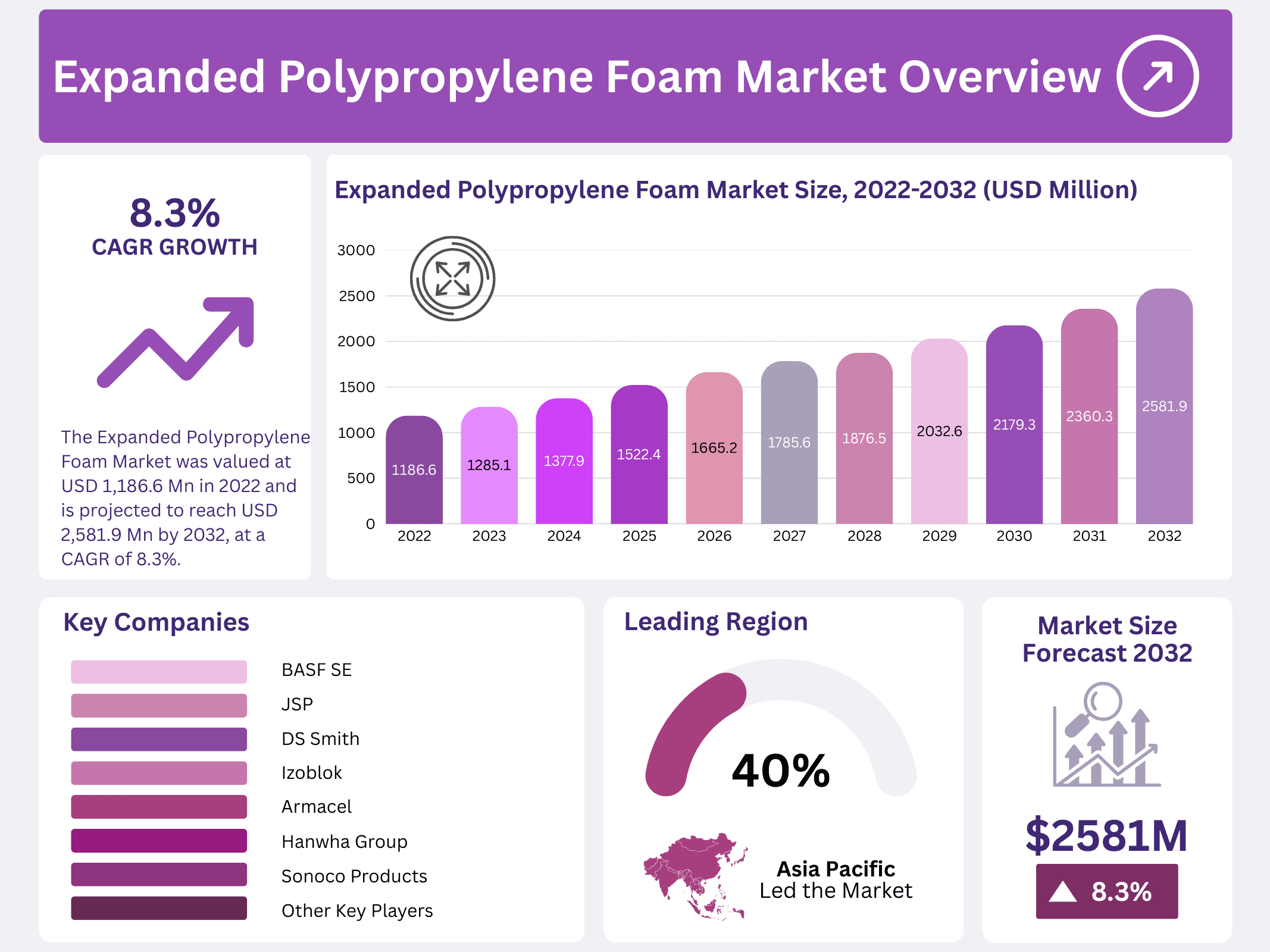
New York, NY – March 02, 2026 – The Global Expanded Polypropylene (EPP) Foam Market, valued at USD 1,186.6 million by 2022, is projected to reach USD 2,581.9 million by 2032, registering a steady CAGR of 8.3% from 2023 to 2032. Strong growth is linked to the material’s versatility and increasing adoption across several industries.
EPP foam is widely used in consumer goods, packaging, building, and construction, where its lightweight nature and structural strength make it ideal for modern design and manufacturing needs. Its rising use in protective packaging—especially for electronics, computer equipment, and circuit boards—comes from its excellent impact resistance and ability to cushion sensitive components during transportation.
Looking ahead, the market is poised for further expansion as EPP foam gains traction in toys, sporting goods, and fitness-related products. With consumers becoming more health-conscious and shifting toward active lifestyles, demand for durable, safe, and lightweight materials is increasing. These trends collectively support strong global demand for expanded polypropylene foam in the coming years.
Key Takeaways
- The Global Expanded Polypropylene Foam Market was valued at USD 1,186.6 million in 2022 and is projected to reach USD 2,581.9 million by 2032. at a steady CAGR of 8.3% during the forecast period 2023–2032.
- High-density EPP foam was the dominant segment, holding 42.0% of the market share in 2022.
- Bumpers’ application led the market by revenue, accounting for 42% of the total share in 2022, largely due to strong automotive demand.
- Asia Pacific was the largest regional market, capturing 40.0% of global revenue in 2022.
Report Scope
| Report Features | Description |
|---|---|
| Market Value (2022) | USD 1186.6 Million |
| Forecast Revenue (2032) | USD 2581.9 Million |
| CAGR (2023-2032) | 8.3% |
| Segments Covered | By Product (High Density, Low Density, Medium Density) By Application (Bumpers, Roof Pillars, Seat Bracing, Armrests, Other Applications) By End-User (Automotive, Packaging, Consumer goods, Appliances, Oil & Gas, and Other End-Users) |
| Competitive Landscape | JSP, BASF SE, Kaneka Corporation, DS Smith, Furukawa Electric Co., Ltd., Hanwha Group, Sonoco Products, Knauf Industries, Izoblok, Dongshin Industry Incorporated, Clark Foam Products Corporation, Paracoat Products Ltd., Molan-Pino South Africa, Signode Industrial Group LLC, Armacel, Furukawa Electric Co., Ltd., Other Market Players. |
Key Market Segments
By Product Analysis
The high-density segment led the market, accounting for over 42% of the global share. High-density EPP foams are widely used in automotive energy-management systems, particularly in safety components such as bumpers, side skirts, and structural inserts, due to their high strength and superior impact resistance. These properties also make them a preferred choice in protective packaging applications. During the forecast period, demand for high-density EPP foam is expected to rise further, supported by the growing shift toward lightweight, durable, and premium-quality materials across automotive and industrial sectors.
By Application Analysis
The bumpers segment dominated the market, contributing to more than 42% of the total share. This dominance is attributed to the increasing adoption of EPP foam in automotive structures where high-impact resistance and energy absorption are essential. EPP bumpers are extensively used in both vehicle interiors and exteriors due to their ability to absorb substantial impact energy without cracking or deforming. They function as crash absorbers, bumper reinforcements, and protective padding, driving their widespread use as automakers continue prioritizing passenger safety and lightweight material solutions.
By End-Users Analysis
The expanded polypropylene foam market is segmented into automotive, packaging, consumer goods, appliances, oil & gas, and other industries, with the automotive sector leading overall demand. EPP foam is widely utilized in automotive manufacturing due to its low cost, strong mechanical performance, and ease of molding. It supports vehicle light-weighting efforts, helping reduce total vehicle weight by up to 10%, which can translate to up to 7% fuel savings. Additionally, EPP foam contributes to lower VOC emissions from interior components and enhances safety when combined with metal inserts for improved energy absorption. These advantages continue to support the growth of eco-friendly and fuel-efficient vehicles across global markets.
Regional Analysis
Asia Pacific led the expanded polypropylene foam market, capturing 40% of the total revenue share. Rapid industrialization across China, Japan, and India, coupled with abundant raw materials and cost-efficient labor, has accelerated the production of electronics and consumer goods. These conditions are expected to drive sustained demand for EPP foam throughout the forecast period.
North America held a 29% revenue share in 2022, supported by strong growth in end-use industries across the United States and Canada. The U.S. automotive sector’s increasing shift toward electric and fuel-efficient vehicles has fueled advancements in vehicle safety components and lightweight materials. As a result, chemically stable and high-performance EPP foam is becoming a preferred choice for automotive applications, particularly where improved fuel efficiency and weight reduction are critical.
Top Use Cases
- Automotive Components: Expanded polypropylene foam is widely used in car parts like bumpers, door panels, and headrests because of its lightweight design and excellent impact absorption. This helps improve vehicle safety during collisions while reducing overall weight to enhance fuel efficiency and performance, making it a top choice for modern automotive manufacturing.
- Protective Packaging: In packaging, expanded polypropylene foam serves as durable cushioning for fragile items such as electronics and medical devices. Its shock-resistant properties protect goods during shipping and handling, allowing for reusable trays that cut down on waste and provide reliable, long-term protection in industrial and consumer supply chains.
- Construction and Insulation: Expanded polypropylene foam is applied in building projects for thermal insulation and soundproofing panels. It helps maintain indoor temperatures efficiently and reduces noise transmission, contributing to energy-saving structures and comfortable living spaces, ideal for both residential and commercial construction needs.
- Sports and Leisure Equipment: This foam is popular in sports gear like helmets, padding, and model aircraft due to its flexibility and resilience. It offers comfort and protection against impacts, enabling lightweight designs that enhance user experience in recreational activities and professional sports without compromising on durability.
- Consumer Electronics: Expanded polypropylene foam is used in casings and protective elements for devices like appliances and gadgets. Its insulating qualities guard against heat and vibrations, ensuring product longevity and safety, which appeals to manufacturers aiming for compact, reliable designs in everyday consumer products.
Recent Developments
1. JSP
- JSP is advancing its sustainability goals with its ARPRO EPP material, particularly for the electric vehicle (EV) market. The company is expanding the use of ARPRO RE, which incorporates recycled polypropylene, to meet growing European demand for eco-friendly automotive components like bumper cores and interior protection pads. By utilizing its European bases in Germany, France, and the Czech Republic, JSP is focusing on closing the loop through better recycling methods and incorporating materials like recycled fishing nets.
2. BASF SE
- BASF continues to be a leader in lightweight automotive solutions with its Neopolen EPP foam. The company is heavily focused on the circular economy, developing grades with reduced carbon footprints and incorporating chemically recycled materials. Their developments aim to enhance energy absorption for EV battery protection and improve insulation properties, supporting the automotive industry’s shift toward lighter, more sustainable vehicles and components.
3. Kaneka Corporation
- Kaneka is leveraging its material science expertise to enhance the performance of its EPP products. Recent developments focus on high-performance grades that offer superior heat and chemical resistance for automotive and industrial applications. As part of its long-term “KAITEKI” vision, the company is likely investing in bio-based or recycled feedstocks for its foam products to help manufacturers reduce the overall environmental impact of their supply chains.
4. DS Smith
- In a notable shift for protective packaging, DS Smith is moving away from Expanded Polyethylene (EPE) foam by developing high-performance fiber-based alternatives. In partnership with Raymarine, the company replaced foam packaging with corrugated cardboard inserts designed with crumple zones and 90-degree angles to absorb shock. This innovation, which is 100% recyclable and reduces CO2 emissions by over 60%, represents a direct substitution of plastic foams with sustainable paper-based materials.
5. Furukawa Electric Co., Ltd.
- Furukawa Electric is applying its expertise in materials to develop high-performance cross-linked polypropylene foam. These foams are engineered for demanding applications where heat resistance and durability are critical, such as in automotive interiors and lightweighting components. Their recent developments likely focus on creating materials that maintain structural integrity at higher temperatures while contributing to the overall weight reduction of vehicles to improve fuel efficiency.
Conclusion
Expanded Polypropylene Foam is a versatile material driving innovation across industries due to its lightweight strength, recyclability, and energy-absorbing features. Its growing adoption in sustainable solutions positions it well for future expansion, meeting demands for eco-friendly alternatives that balance performance with environmental responsibility in a competitive global market.







