


Quick Navigation
Report Overview
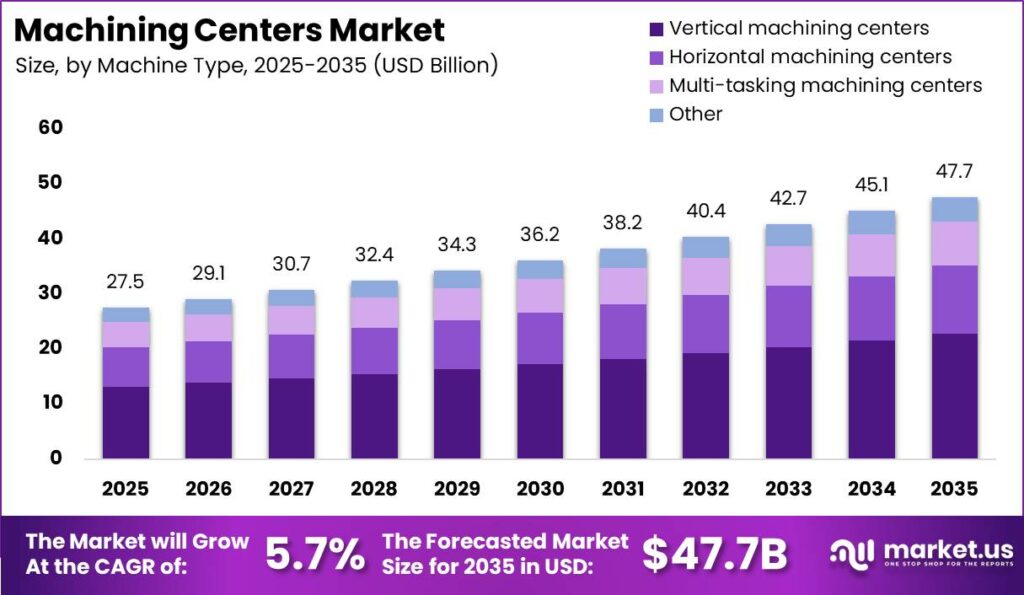
Global Machining Centers Market size is expected to be worth around USD 47.7 Billion by 2035 from USD 27.5 Billion in 2025, growing at a CAGR of 5.7% during the forecast period 2026 to 2035. This expansion reflects steady capital spending on precision metal cutting across vehicle, aircraft, and industrial equipment lines. Buyers treat machining centers as core plant assets that set throughput and quality floors.
Therefore, the market covers computer-controlled milling platforms that cut complex metal parts in one or more setups. Vertical, horizontal, and multi-tasking machines form the main product structure. Axis count and end-use industry further shape purchase criteria, service demand, and aftermarket attach rates for tooling and software.
Key Takeaways
- The market reaches USD 27.5 Billion in 2025 and USD 47.7 Billion by 2035 at a 5.7% CAGR.
- Vertical machining centers lead machine type with a 47.68% share.
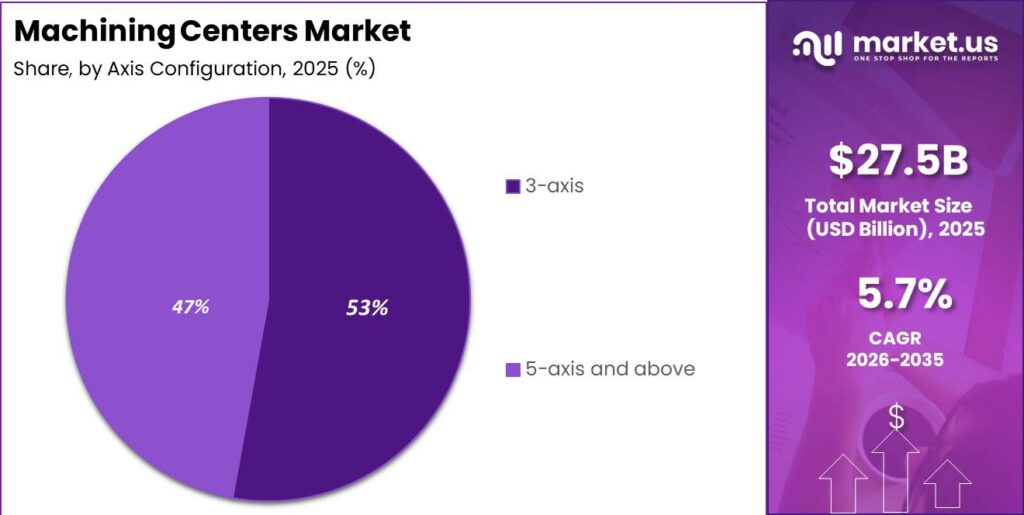
- 3-axis systems lead axis configuration with a 53% share.
- Automotive leads end-use industry with a 36.00% share.
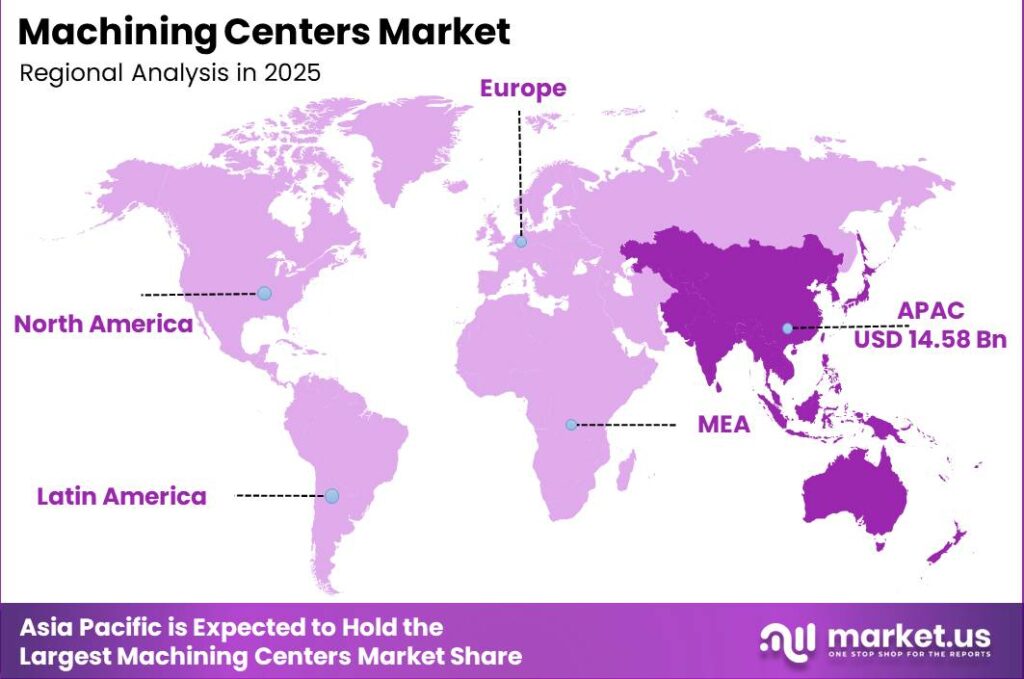
- Asia Pacific leads all regions with a 53.00% share, equal to USD 14.58 Billion.
- Multi-tasking machining centers rank as the fastest growing machine type.
- 5-axis and above systems rank as the fastest growing axis configuration.
As per our research, optimizing CNC toolpaths and combining drilling with chamfering cut cycle time to 9 minutes, a 25% gain. This productivity lift raises parts per shift without new floor space. Plants that standardize combination tooling free budget for more spindle hours and faster order turnaround.
Consequently, a peer-reviewed 2026 machining-energy study found modern machine tools can cut energy use by up to 45% versus older models. Lower kilowatt demand reduces operating cost on multi-shift lines. Investors favor fleets that pair energy savings with measurable cost-per-part declines. In August 2025, DN Solutions agreed to buy all HELLER Group shares, with combined sales expected near EUR 2 billion, signaling scale plays in high-precision capacity.
Machine Type Analysis
Vertical machining centers dominates with 47.68% due to flexible job-shop floor economics.
In 2025, Vertical machining centers held a dominant market position in the By Machine Type segment of Machining Centers Market, with a 47.68% share. Mazak listed the VC-PRIMOS 400 L with rapid-traverse rates of 60 m/min on X, Y, and Z axes. High traverse speed shortens non-cutting moves on mixed batch work. Shops that prioritize changeover speed keep vertical platforms as the default CapEx choice.
Horizontal machining centers serve palletized prismatic work where chip evacuation and four-side access matter most. DMG MORI specifies fourth-generation NHX spindles up to 20,000 rpm and torque up to 250 Nm by spindle option. That power band supports both light alloy finishing and tougher steel cuts. Buyers in high-volume metal removal gain fewer tool changes and more stable unattended runs.
Multi-tasking machining centers combine milling and turning so complex parts leave the cell complete. Mazak’s VERSATECH lists X- and Y-axis feed rates up to 30 m/min and rotary rapid rates of 21,600 degrees per minute. Faster rotary moves cut indexing dead time on large fabrications. Early adopters reduce fixture count and scrap from multi-machine handoffs.
Other machining center formats fill niche envelopes, including specialized bridge and compact cells. Japan’s machine tool production value reached 901.3 billion yen in 2024 per JMTBA data, showing a deep installed base that still refreshes mixed configurations. Vendors who package niche frames with standard controls win replacement orders without full line redesigns.
Axis Configuration Analysis
3-axis dominates with 53% due to proven programming and lower training load.
In 2025, 3-axis held a dominant market position in the By Axis Configuration segment of Machining Centers Market, with a 52.84% share. Figures from the U.S. Bureau of Labor Statistics show about 34,200 annual openings for machinists and tool and die makers through replacement demand. Simple three-axis work matches the largest pool of available operators. Plants under staff pressure keep 3-axis cells as the volume backbone.
5-axis and above systems enable single-setup machining of contoured aerospace and medical geometries. DN Solutions’ DVF 5000 second-generation platform supports magazine capacity up to 120 tools for extended lights-out runs. Large tool inventories cut mid-shift stops on complex jobs. This creates a clear path for shops moving from batch setups to overnight unattended output.
Demand for higher-axis cells also tracks robot density on metal floors. Data from the International Federation of Robotics shows metal and machinery took 16% of industrial robot installations in 2024 among major using industries. Robot-fed 5-axis cells raise spindle utilization when skilled programmers stay scarce. Suppliers that ship open automation interfaces capture this upgrade wave first.
End-use Industry Analysis
Automotive dominates with 36.00% due to high-volume precision powertrain and chassis parts.
In 2025, Automotive held a dominant market position in the By End-use Industry segment of Machining Centers Market, with a 36.00% share. OICA-linked 2025 figures show China alone produced about 34.53 million vehicles, including 16.626 million new-energy units. That scale keeps continuous demand for engine, e-axle, and structural machining capacity. Suppliers aligned to EV component tolerances secure multi-year tooling programs.
Aerospace and defense buyers need tight geometric control on structural and rotating parts. DN Solutions rates the DVF 5000 second-generation spindle at 18,000 rpm for complex single-setup work. High spindle speed supports fine finishing on hard alloys. Tier suppliers who cut setups reduce certificate risk and lead time on flight-critical lots.
General machinery builders order machining centers for pumps, gears, and industrial frames in smaller batches. India’s machine tool consumption reached USD 3.7 billion in FY 2024-25, as noted in CECIMO industry briefings with IMTMA. Rising domestic equipment output pulls standard vertical and horizontal capacity into local job shops. Regional builders who stock service parts nearby win share against long import lead times.
Precision engineering shops chase micron-level repeatability for molds, instruments, and specialty components. Medical devices, energy and power, and other industries hold the remaining share collectively and still require certified process control. Vendors offering thermal-stable frames and validated inspection loops open premium niches without competing only on hourly rate.
Key Market Segments
By Machine Type
- Vertical machining centers
- Horizontal machining centers
- Multi-tasking machining centers
- Other
By Axis Configuration
- 3-axis
- 5-axis and above
By End-use Industry
- Automotive
- Aerospace and defense
- General machinery
- Precision engineering
- Medical devices
- Energy and power
- Other industries
Regional Analysis
Asia Pacific Dominates the Machining Centers Market with a Market Share of 53.00%, Valued at USD 14.58 Billion
Asia Pacific concentrates more than half of global spending because vehicle and electronics plants keep adding precision capacity. China and India anchor volume demand while Japan and South Korea supply high-spec machines. In November 2025, Yamazaki Mazak officially launched the QRX Series in Singapore as a smart-machining and automation platform. Regional buyers gain shorter delivery paths and local automation support that protect uptime.
North America and Europe remain the next priority zones for reshoring and high-mix aerospace work. CECIMO reports European machine tool consumption fell about 17.1% in 2024, with a further decline near 5.2% expected in 2025. Soft European orders push builders to chase export and service revenue. This signals faster share gains for vendors strong in India, Mexico, and U.S. brownfield upgrades.
Latin America and Middle East and Africa trail in absolute spend yet attract selective energy and general machinery projects. Buyers there favor proven 3-axis and vertical platforms with simple service models. Distributors who hold spare spindles and training locally reduce downtime risk and unlock first-time CNC conversions.
Key Regions and Countries
North America
- US
- Canada
Europe
- Germany
- France
- The UK
- Spain
- Italy
- Rest of Europe
Asia Pacific
- China
- Japan
- South Korea
- India
- Australia
- Rest of APAC
Latin America
- Brazil
- Mexico
- Rest of Latin America
Middle East and Africa
- GCC
- South Africa
- Rest of MEA
Market Dynamics
Market Opportunity Analysis - Multi-tasking cells, 5-axis upgrades, and Asia greenfield plants offer clear entry routes
Multi-tasking machining centers remain the fastest growing machine type yet still trail vertical units that hold 47.68% share. Many mid-size shops still run separate lathes and mills for the same part family. New entrants that sell compact multi-tasking cells with simple financing can displace two-machine cells. This creates room where incumbents still lead with traditional vertical catalogs.
5-axis and above systems are the fastest growing axis class while 3-axis still holds 52.84%. The gap shows large under-penetration outside aerospace majors. Regional job shops that win medical and semiconductor work need single-setup contouring but lack capital depth. Suppliers offering certified pre-owned 5-axis packages with training can open that tier.
Asia Pacific already represents 53.00% of the market at USD 14.58 Billion, yet India-centered general machinery demand is still building local capacity. Greenfield plants need standard vertical and horizontal platforms with fast spare-parts loops. Distributors who localize service in secondary Indian and Southeast Asian cities capture orders before global majors fill every district.
By contrast, medical devices and energy and power still sit inside the residual end-use pool behind automotive’s 36.00% lead. These verticals pay for thermal stability and traceable processes rather than pure hourly cost. Focused product lines for implant and turbine geometries let specialists avoid head-on price fights in auto powertrain machining.
Technology and Innovation Landscape - Energy-efficient spindles, single-setup multi-axis work, and automation-ready controls redefine buyer scorecards
Energy performance now sits beside cycle time on many purchase scorecards. According to Yamazen case reporting, a manufacturer that replaced older equipment with Brother SPEEDIO CNC machining centers recorded a 30% reduction in energy costs. Lower utility spend shortens payback on replacement projects. Builders who publish verified kilowatt-per-part data win sustainability-linked CapEx committees.
Single-setup multi-axis machining reduces fixture queues and tolerance stack risk on complex alloys. Controls that support large tool magazines and stable high-speed spindles let shops run lights-out on mixed lots. This means software usability and thermal control matter as much as peak horsepower for bid-critical work.
Automation-ready interfaces for pallet robots and in-machine probing turn standalone CNCs into supervised fleets. Plants standardize on open protocols so one crew can oversee multiple cells. Vendors who ship turnkey cells with remote monitoring lock in multi-year service attachments after the initial hardware sale.
Drivers
Labor gaps in precision plants push buyers toward lights-out machining cells with robotic pallets. The International Federation of Robotics recorded global operational industrial robot stock above 4.2 million units, with automotive and general industry taking most units. JMTBA data show Japan’s NC ratio already at 93.5% in 2024. Programmability is now a purchase baseline, not a luxury option for competitive bids.
As a result, robotic pallet changers can lift spindle utilization from near 35% on a single shift toward 85% or higher in lights-out mode. One asset can approach the output of nearly three manned machines. VDMA noted European production contracted 9.2% in 2024, so cost-per-part cuts of roughly 15% to 25% justify automation CapEx. OEMs shift toward bundled cells, service contracts, and uptime monitoring revenue.
| Driver | (~) % Impact on CAGR Forecast | Geographic Relevance | Impact Timeline |
|---|---|---|---|
| Lights-out automation & robotic pallet integration | +2.1% | Japan, Germany, South Korea, US | Short term (2 years or less) |
| EV & aerospace precision component demand | +1.6% | China, EU, North America | Medium term (2 to 4 years) |
| 5-axis & multitasking machine adoption | +1.3% | Global, led by Western Europe | Medium term (2 to 4 years) |
| Reshoring & supply-chain localization CapEx | +1.1% | US, India, Mexico, EU | Short term (2 years or less) |
| Government manufacturing incentives & PLI schemes | +0.9% | India, US, EU | Short term (2 years or less) |
| CNC retrofit & brownfield modernization | +0.7% | Emerging Asia, Eastern Europe | Medium term (2 to 4 years) |
Restraints
High financing costs remain the strongest brake on new machining-center orders. World Bank and IMF lending-rate indices showed advanced-economy policy rates still far above the pre-2022 baseline through 2024. Most buyers fund cells with leases or term loans. A 300 to 400 basis-point rise in financing cost can stretch payback by 12 to 18 months and push projects past internal hurdle rates.
This pressure hit demand hard across Europe and other mature markets. CECIMO reported a 16% decline in machine-tool consumption across member countries in 2024 and projected a further drop near 3.6% in 2025. Market.us-aligned survey figures show global consumption falling from USD 85.1 billion to USD 80.0 billion. OEMs discount to defend order books while SME brownfield upgrades slip and inventory builds.
| Restraint | (~) % Impact on CAGR Forecast | Geographic Relevance | Impact Timeline |
|---|---|---|---|
| Elevated interest rates freezing capital equipment orders | -1.8% | EU, North America, Japan | Short term (2 years or less) |
| Contraction in European & East Asian consumption | -1.4% | CECIMO countries, Japan | Short term (2 years or less) |
| Automotive ICE tooling demand collapse | -1.0% | Germany, Japan, US | Medium term (2 to 4 years) |
| High upfront CapEx & long payback lock-in | -0.8% | Emerging Asia, SMEs global | Short term (2 years or less) |
| Tariffs & cross-border trade barriers | -0.6% | US, China, EU | Short term (2 years or less) |
Challenges
A lasting shortage of skilled CNC operators and multi-axis programmers caps how fast new machines reach full output. OECD skills analysis and U.S. Bureau of Labor Statistics projections point to tens of thousands of unfilled machining roles each year. The workforce median age exceeds 45 in many plants. Missing programmers leave expensive spindles idle even after installation is complete.
This creates commissioning delays of 3 to 6 months on advanced 5-axis and multitasking cells and higher scrap during ramp-up. VDMA and JMTBA both link weak staffing to slower automation payback. OEMs that embed conversational programming, digital-twin setup, and vendor apprenticeships turn a labor gap into service revenue. Buyers should score training support as hard as spindle specs.
| Challenge | (~) % CAGR Friction Drag | Geographic Relevance | Mitigation Horizon |
|---|---|---|---|
| Skilled CNC operator shortage | -1.2% | US, EU, Japan | Long term (4 years or more) |
| Controller & semiconductor component drag | -0.9% | Global | Medium term (2 to 4 years) |
| Software-hardware integration complexity | -0.7% | Global | Medium term (2 to 4 years) |
| Cybersecurity of connected machines | -0.5% | North America, EU | Long term (4 years or more) |
| Energy costs & decarbonization compliance | -0.4% | EU, Japan | Long term (4 years or more) |
Opportunities
Machining-as-a-Service opens a real white space because most sales still require full capital purchase. A per-spindle-hour or pay-per-part model shifts ownership risk to the OEM and unlocks credit-constrained SMEs flagged by the OECD financing scoreboard. Recurring billing turns a one-time machine sale into an annuity. Vendors who finance and meter output can unlock demand frozen by payback anxiety.
Unit economics support the shift. Usage-based contracts can lift blended gross margins from about 25% to 30% on pure hardware toward 45% to 55% with service and consumables. IoT metering on a highly NC-equipped installed base enables precise billing. This insulating cash flow against order-book swings such as the CECIMO-documented 16% consumption drop in 2024 and rewards early movers with sticky multi-year contracts.
| Opportunity | (~) % Potential CAGR Upside | Geographic Relevance | Execution Window |
|---|---|---|---|
| Machining-as-a-Service & usage-based monetization | +1.9% | North America, EU, India | Medium term (2 to 4 years) |
| Hybrid additive-subtractive machining centers | +1.4% | Aerospace hubs, US, EU | Long term (4 years or more) |
| Emerging-market greenfield capacity (India, Vietnam) | +1.2% | South & Southeast Asia | Medium term (2 to 4 years) |
| AI predictive-maintenance & data monetization | +1.0% | Global | Medium term (2 to 4 years) |
| Fragmented job-shop M&A roll-up consolidation | +0.8% | US, EU | Long term (4 years or more) |
| Medical & semiconductor micro-machining verticals | +0.6% | US, Switzerland, East Asia | Long term (4 years or more) |
Key Company Insights
DMG MORI Co., Ltd. strengthened its horizontal portfolio when it launched the fourth-generation NHX 4000 and NHX 5000 in November 2025. As reported by DMG MORI, rapid-traverse speed rose from 60 m/min to 75 m/min, a 25% gain that cuts non-cutting time. Buyers gain higher spindle utilization on palletized prismatic work. This positions the company to defend share where cycle-time bids decide awards.
Yamazaki Mazak Corporation competes on accuracy and multi-axis productivity for export-heavy shops. Based on Mazak data, the HCN NEO horizontal machining center can achieve positioning accuracy three times better than the relevant ISO standard. Tighter positioning reduces scrap on precision prismatic parts. This creates an advantage in aerospace and die work where tolerance stack-ups erase thin margins.
Key Players
- DMG MORI Co., Ltd.
- Yamazaki Mazak Corporation
- Okuma Corporation
- Makino Milling Machine Co., Ltd.
- Haas Automation, Inc.
- DN Solutions Co., Ltd.
- JTEKT Corporation
- GF Machining Solutions
- GROB-WERKE GmbH & Co. KG
- CHIRON Group SE
- Hyundai WIA Corporation
- Hurco Companies, Inc.
- FANUC Corporation
- EMAG GmbH & Co. KG
- MAG IAS GmbH
Recent Developments
- January 2026: DN Solutions completed the acquisition of HELLER after receiving regulatory approvals in Germany, the United States and the United Kingdom, adding HELLER high-end machining-center technologies and manufacturing capabilities to its portfolio.
- November 2025: Makino India launched the LS22, an agile machining center manufactured in India, during its 30th-anniversary open house in Bengaluru.
- October 2025: Makino launched the F6 next-generation machining center for die-and-mould, medical and semiconductor applications, emphasizing long-term thermal stability and automation readiness.
Geopolitical Impact Analysis
Trade measures on metals directly raise the bill of materials for machining-center frames and fixturing. Policy actions in 2025 included additional tariffs near 25% on steel and aluminum shipments into the United States, lifting input costs for importers and domestic fabricators alike. Machine builders that rely on cross-border castings and weldments face higher landed cost. This creates pressure to dual-source structural components inside free-trade partners.
Consequently, energy price gaps reshape where energy-intensive cutting stays competitive. Data from the IEA shows average EU wholesale electricity near USD 95/MWh in 2025, about 10% higher year on year, while EU prices for energy-intensive industry stayed roughly double U.S. levels. European job shops absorb steeper spindle-hour energy costs than U.S. peers. Buyers shift overtime work toward lower-power machines and regions with cheaper industrial power.
Report Scope
| Report Features | Description |
|---|---|
| Market Value (2025) | USD 27.5 Billion |
| Forecast Revenue (2035) | USD 47.7 Billion |
| CAGR (2026-2035) | 5.7% |
| Base Year for Estimation | 2025 |
| Historic Period | 2020-2024 |
| Forecast Period | 2026-2035 |
| Report Coverage | Revenue Forecast, Market Dynamics, Market Opportunity Analysis, Technology and Innovation Landscape, Competitive Landscape, Recent Developments |
| Segments Covered | By Machine Type (Vertical machining centers, Horizontal machining centers, Multi-tasking machining centers, Other), By Axis Configuration (3-axis, 5-axis and above), By End-use Industry (Automotive, Aerospace and defense, General machinery, Precision engineering, Medical devices, Energy and power, Other industries) |
| Regional Analysis | North America (US and Canada), Europe (Germany, France, The UK, Spain, Italy, and Rest of Europe), Asia Pacific (China, Japan, South Korea, India, Australia, and Rest of APAC), Latin America (Brazil, Mexico, and Rest of Latin America), Middle East and Africa (GCC, South Africa, and Rest of MEA) |
| Competitive Landscape | DMG MORI Co., Ltd., Yamazaki Mazak Corporation, Okuma Corporation, Makino Milling Machine Co., Ltd., Haas Automation, Inc., DN Solutions Co., Ltd., JTEKT Corporation, GF Machining Solutions, GROB-WERKE GmbH & Co. KG, CHIRON Group SE, Hyundai WIA Corporation, Hurco Companies, Inc., FANUC Corporation, EMAG GmbH & Co. KG, MAG IAS GmbH |
| Customization Scope | Customization for segments, region / country-level will be provided. Additional customization can be done based on requirements. |
| Purchase Options | We have three licenses to opt for: Single User License | Multi-User License (Up to 5 Users) | Corporate Use License (Unlimited User and Printable PDF) |





































