Quick Navigation
- Report Overview
- Key Takeaways
- Application System Type Analysis
- Material Type Analysis
- Vehicle Type Analysis
- Propulsion Type Analysis
- Sales Channel Analysis
- Key Market Segments
- Regional Analysis
- Key Regions and Countries
- Market Dynamics
- Drivers
- Restraints
- Challenges
- Opportunities
- Key Company Insights
- Recent Developments
- Geopolitical Impact Analysis
- Report Scope
Report Overview
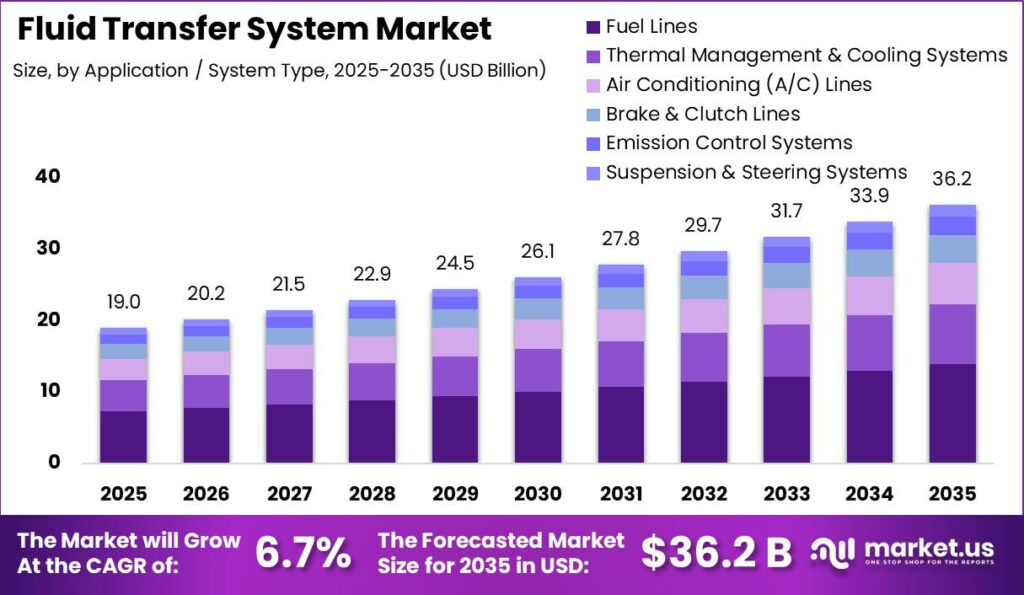
Global Fluid Transfer System Market size is expected to be worth around USD 36.20 Billion by 2035 from USD 19.00 Billion in 2025, growing at a CAGR of 6.7% during the forecast period 2026 to 2035. This expansion reflects rising content per vehicle as thermal loops multiply and industrial fluid handling modernizes. Investors who secure first-fit contracts now lock multi-year volume before the next capacity wave.
Therefore, the market covers hoses, lines, fittings, and pumps that move fuel, coolant, brake fluid, refrigerant, and process media across vehicles and plants. Structure spans application systems, material families, vehicle classes, propulsion platforms, and OEM versus aftermarket channels. Buyers treat these parts as safety-critical, so qualification cycles favor suppliers with proven durability and multi-region tooling.
Key Takeaways
- Market value reaches USD 19.00 Billion in 2025 and USD 36.20 Billion by 2035 at a 6.7% CAGR.
- Fuel Lines lead application mix with a 38.50% share.
- Metals lead material mix with a 36.70% share.
- Commercial Vehicles lead vehicle type with a 58.80% share.
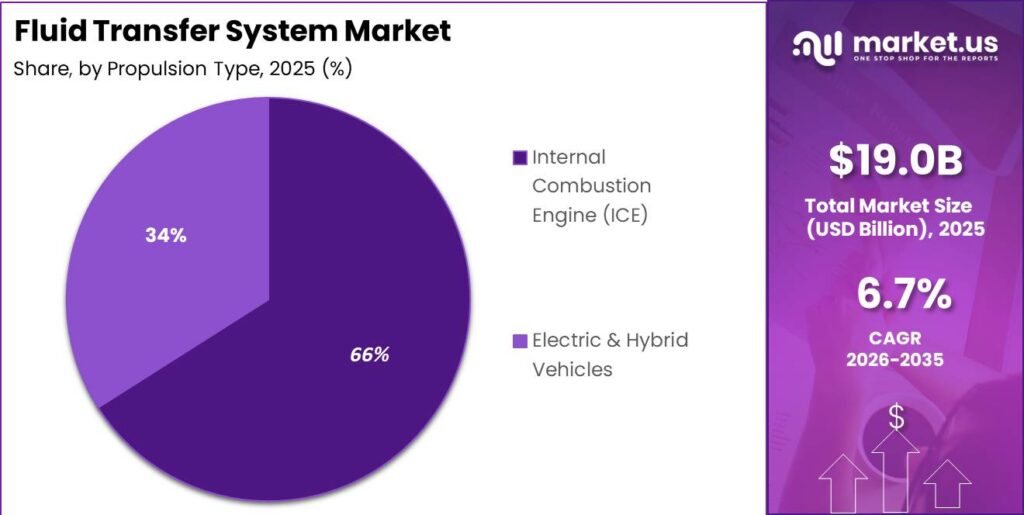
- Internal Combustion Engine platforms lead propulsion with a 66.00% share.
- OEM channel leads sales with a 79.00% share.
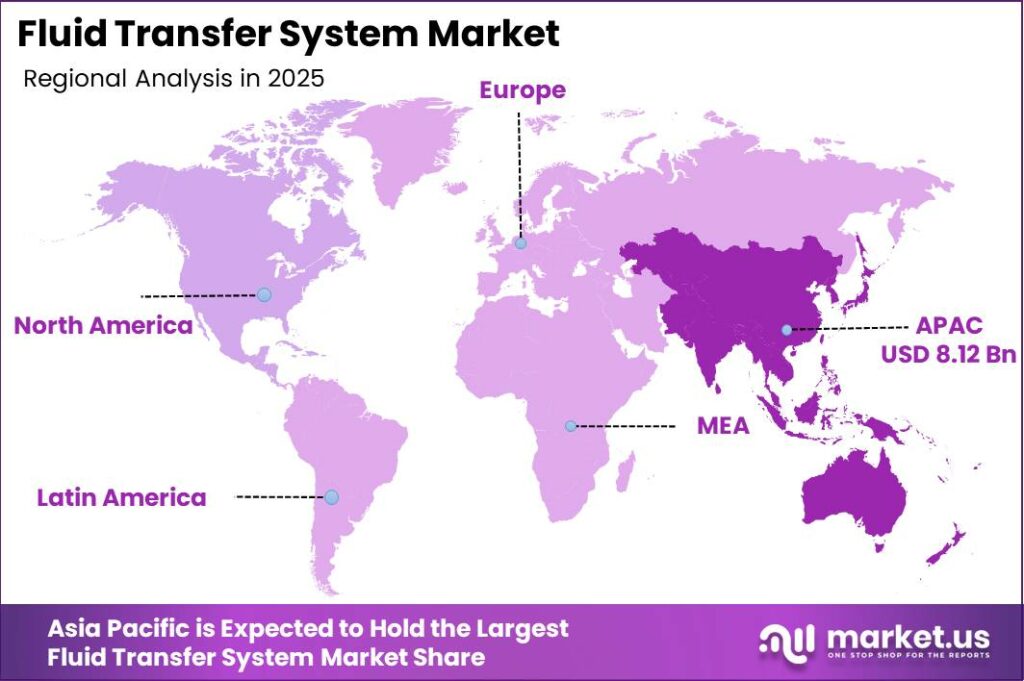
- Asia Pacific leads regions with a 42.83% share valued at USD 8.12 Billion.
As per our research, automation adoption in fluid handling systems rose by 20% as plants added precision transfer, smart sensors, and automated shut-off. This shift cuts manual error and downtime on high-volume lines. Suppliers who embed sensors and digital monitoring into hose and pump packages win preferred-vendor status with OEM and industrial buyers.
Consequently, about 30% of petroleum distribution pump retrofits now ship with automated digital monitoring as standard. This creates recurring software and service attach revenue beyond hardware. Vendors who bundle monitoring with EPA SPCC-ready designs for facilities above 1,320 gallons of aboveground oil storage capture compliance-driven replacement budgets faster than pure hardware rivals.
This means end-use growth in commercial fleets and process industries directly lifts demand for high-pressure lines and sealed couplings. Each new thermal or process circuit adds fittings and hose content per platform. Capital that follows content-per-unit gains outperforms capital chasing pure unit-volume recovery alone.
Application System Type Analysis
Fuel Lines dominates with 38.50% due to high ICE and hybrid fuel circuit density.
In 2025, Fuel Lines held a dominant market position in the By Application System Type segment of Fluid Transfer System Market, with a 38.50% share. OICA data show global vehicle production rose to 96.4 million units in 2025 from 92.7 million in 2024. This volume keeps multi-layer fuel hose and quick-connect demand elevated. Suppliers tied to fuel-line platforms retain scale advantages until battery-electric share erodes ICE circuit counts further.
Thermal Management and Cooling Systems carry rising content as multi-loop battery, motor, and power-electronics architectures spread. IEA figures show electric car sales topped 17 million worldwide in 2024, over 20% of new car sales. Each multi-loop architecture needs extra hoses and fittings versus single-loop ICE cooling. Vendors who qualify dielectric-compatible coolant lines early capture the highest per-vehicle content uplift.
Air Conditioning Lines move refrigerant under tight leak and pressure rules across cabin comfort circuits. Brake and Clutch Lines remain safety-critical with long validation cycles that protect incumbent suppliers. Emission Control, Suspension, and Steering systems hold the remaining share collectively and still need specialized hose and tube sets on regulated diesel and chassis platforms.
Material Type Analysis
Metals dominates with 36.70% due to high-pressure strength and heat resistance.
In 2025, Metals held a dominant market position in the By Material Type segment of Fluid Transfer System Market, with a 36.70% share. World Bank metals analysis projects base-metal price paths that still leave steel and aluminum tubing competitive for high-pressure fuel, brake, and hydraulic runs. Metal lines hold shape under heat and pressure where polymers soften. OEMs keep metal on safety and high-temperature circuits despite weight targets elsewhere.
Rubber and Elastomers supply flexible hose bodies that absorb vibration and allow tight routing in engine bays and underbodies. OICA reports commercial and passenger production together exceeded 96 million units in 2025, sustaining elastomer hose volume. Flexible compounds remain hard to replace on dynamic bend paths. Compounders who raise heat and fluid resistance without cost spikes defend share against engineered plastics.
Plastics and Polymers gain where lightweighting and corrosion resistance matter more than extreme pressure. National manufacturing programs push multi-layer polymer fuel and coolant lines on cost-sensitive platforms. This creates margin pressure on metal tube mills in low-pressure circuits. Material dual-sourcing strategies protect buyers when resin or metal tariffs swing.
Vehicle Type Analysis
Commercial Vehicles dominates with 58.80% due to dense fluid circuits per chassis.
In 2025, Commercial Vehicles held a dominant market position in the By Vehicle Type segment of Fluid Transfer System Market, with a 58.80% share. Light commercial vehicles, heavy commercial vehicles, and buses carry more hydraulic, fuel, brake, and cooling lines per unit than typical passenger cars. OICA splits show commercial vehicle output forms a large share of the 96.4 million global units built in 2025. Fleet operators value durability, so first-fit quality wins multi-year contracts.
Passenger Vehicles span sedans, SUVs, and hatchbacks with high unit counts but lower fluid content per vehicle than heavy platforms. Global sales reached about 99.8 million units in 2025 per OICA-linked industry tallies. SUV mix growth still adds cooling and A/C line length versus compact hatchbacks. Passenger programs reward suppliers who can localize tooling near high-volume assembly plants.
Within commercial classes, heavy trucks and coaches concentrate high-pressure brake, clutch, and SCR fluid hardware. Light commercial vans balance cost and serviceability for urban fleets. Buses and coaches add large cooling and air systems that raise hose meters per chassis. Platform wins in any of these sub-classes lock multi-year aftermarket parts pull-through.
Propulsion Type Analysis
Internal Combustion Engine dominates with 66.00% due to mature multi-fluid architectures.
In 2025, Internal Combustion Engine held a dominant market position in the By Propulsion Type segment of Fluid Transfer System Market, with a 66.00% share. ICE platforms still need fuel, oil, coolant, brake, and emission fluid circuits on most of the global build. OICA production above 96 million units in 2025 keeps ICE hose and tube volumes large even as EV share rises. ICE incumbents defend cash flow while funding EV thermal product lines.
Electric and Hybrid Vehicles raise thermal-loop count even as they remove classic fuel lines. IEA data put 2024 electric car sales above 17 million and project more than 20 million sales in 2025, about one in four new cars. Battery, inverter, and motor cooling add quick-connects and dielectric hoses. In November 2025, Gates Corporation introduced a halogen-free liquid-cooling hose for high-density data-center cooling, signaling adjacent thermal fluid-transfer skills transferable to EV packs.
Hybrid architectures blend ICE fuel circuits with battery thermal loops and temporarily maximize total fluid-transfer content per vehicle. This dual-stack phase favors suppliers with both fuel-line and coolant-line portfolios. Content peaks during the hybrid transition create a multi-year window before pure battery platforms simplify some circuits again.
Sales Channel Analysis
Original Equipment Manufacturer dominates with 79.00% due to factory-fit hose and line integration.
In 2025, Original Equipment Manufacturer held a dominant market position in the By Sales Channel segment of Fluid Transfer System Market, with a 79.00% share. Most hose assemblies and hard lines install on the vehicle or equipment line at first fit. Global production near 96.4 million vehicles in 2025 anchors OEM shipment scale. Long-term OEM contracts stabilize volume but compress unit pricing versus retail aftermarket.
Aftermarket serves repair, retrofit, and performance replacement once vehicles age in the fleet. National fleet age trends stretch service lives and slow mid-life replacement events. Higher aftermarket margins still attract distributors who can stock certified assemblies. Channel partners who pair e-commerce availability with technical fitment data win independent garages.
OEM dominance means innovation budgets follow platform awards and APQP timelines rather than retail branding. Aftermarket players must match OEM specs for safety parts or lose warranty-sensitive work. Dual-channel suppliers balance volume from OEM with margin from service channels to smooth cycle risk.
Key Market Segments
By Application / System Type
- Fuel Lines
- Thermal Management & Cooling Systems
- Air Conditioning (A/C) Lines
- Brake & Clutch Lines
- Emission Control Systems
- Suspension & Steering Systems
By Material Type
- Rubber / Elastomers
- Plastics & Polymers
- Metals
By Vehicle Type
- Passenger Vehicles
- Sedans
- SUVs
- Hatchbacks
- Commercial Vehicles
- Light Commercial Vehicles (LCVs)
- Heavy Commercial Vehicles (HCVs)
- Buses and coaches
By Propulsion Type
- Internal Combustion Engine (ICE)
- Electric & Hybrid Vehicles
By Sales Channel
- Original Equipment Manufacturer (OEM)
- Aftermarket
Regional Analysis
Asia Pacific Dominates the Fluid Transfer System Market with a Market Share of 42.83%, Valued at USD 8.12 Billion
Asia Pacific leads on the back of concentrated vehicle assembly and component export clusters in China, Japan, South Korea, and India. Regional share of 42.83% and value of USD 8.12 Billion give local suppliers scale in fuel lines, cooling hoses, and metal tubes. In August 2025, ContiTech started production at its new USD 90 million hydraulic-hose plant in Aguascalientes, Mexico, which strengthens North American nearshoring rather than Asia capacity. Asia still sets global price benchmarks through high-volume OEM contracts.
North America and Europe together form the next demand pool, with faster growth tied to EV thermal content and industrial hose upgrades. IEA tracking shows strong EV sales momentum in China, Europe, and North America that multiplies coolant-line content. Strict safety and emissions rules in both regions extend validation cycles but protect certified suppliers. Capital spending favors plants that can serve both ICE export platforms and local battery-electric programs.
Latin America and Middle East and Africa add incremental volume through commercial fleets, mining, energy, and water infrastructure fluid systems. These regions often import specialized high-pressure assemblies while building local assembly for standard hose. Suppliers who pair regional distribution with training for installers gain share where OEM density is lower.
Key Regions and Countries
North America
- US
- Canada
Europe
- Germany
- France
- The UK
- Spain
- Italy
- Rest of Europe
Asia Pacific
- China
- Japan
- South Korea
- India
- Australia
- Rest of APAC
Latin America
- Brazil
- Mexico
- Rest of Latin America
Middle East and Africa
- GCC
- South Africa
- Rest of MEA
Market Dynamics
Market Opportunity Analysis - Aftermarket niches, EV thermal white space, and emerging infrastructure open entry lanes
Electric and Hybrid thermal management remains underexploited relative to Fuel Lines despite rising multi-loop content. ICE still holds 66.00% propulsion share, so many suppliers under-invest in dielectric hose and quick-connect lines. New entrants who qualify battery and power-electronics circuits early can win content share before ICE specialists fully pivot. This window favors focused thermal startups over broad ICE hose incumbents.
Aftermarket holds only 21.00% channel share against OEM at 79.00%, yet durable parts and aging fleets leave service white space in emerging regions. Latin America and Southeast Asia still rely on fragmented installers. Roll-up strategies that pair certified assemblies with training can raise attach rates without fighting OEM price locks. Investors gain margin expansion where first-fit contracts stay thin.
Passenger Vehicle sub-segments trail Commercial Vehicles at 58.80% leadership even though global car volumes are large. SUV cooling and A/C line length is rising faster than compact hatch content. Suppliers who modularize passenger thermal kits for regional SUV platforms capture volume without heavy-truck validation cost. This path diversifies revenue away from pure commercial cyclicality.
Plastics and Polymers remain secondary to Metals at 36.70% share even as lightweighting spreads. Cost-sensitive markets in Asia and Latin America still accept metal where polymer certification lags. Firms that pre-certify multi-layer polymer fuel and coolant lines for local OEMs can take share on weight and corrosion grounds. Early polymer tooling pays off when tariff swings raise metal tube costs.
Technology and Innovation Landscape - Electric pumps, precision dosing, and high-spec hoses redefine margins
Graco 2025 QUANTM Electric Double Diaphragm fluid transfer pumps deliver up to 80% higher energy efficiency than traditional pneumatic pumps. Full capital ROI arrives in under 12 months while operating noise falls by up to 90%. Plants that swap air-driven pumps cut energy and noise compliance cost together. Vendors selling efficiency with payback proof displace pneumatic incumbents in industrial transfer cells.
Watson-Marlow 2026 peristaltic cased pumps achieve volumetric dosing and transfer precision within +/-0.5% accuracy with full fluid path isolation. Biopharmaceutical workflows need that stability to protect batch yield. Suppliers who document isolation and accuracy win regulated process lines where leak risk is unacceptable. Precision becomes a premium SKU rather than a commodity hose sale.
Ingersoll Rand L Series lubrication and fluid transfer gear pumps reach fluid pressures of 500 psi and temperatures up to 475°F (246°C) via internal gear design that cuts mechanical energy loss. Eaton AE641 aerospace hose uses convoluted PTFE with stainless braid for nominal pressures under 1,000 psi in tight bends. High-spec industrial and aerospace niches pay for materials that survive heat and flex where standard rubber fails.
Mouvex upgraded G-FLO eccentric disc pumps handle viscous fluids up to 10,000 cP and soft solids up to 20 mm, with flow to 50 m³/h (220 gpm) and pressures to 10 bar (145 psi) at up to 160°C. Alfa Laval reported a 62% cut in operational Scope 1 and Scope 2 emissions versus its 2020 baseline across fluid handling facilities. Buyers now score vendors on both process capability and plant carbon metrics when awarding multi-year transfer equipment contracts.
Drivers
EV battery thermal loop expansion lifts fluid-transfer content as platforms move from single-loop ICE cooling to multi-loop battery, motor, and power-electronics designs. International Energy Agency electrification tracking pushed global electric vehicle sales past a 17% share of new car registrations in 2024, with gains through 2025 and 2026. Each architecture needs between 2 and 4 extra quick-connect fittings, hoses, and coolant lines versus comparable ICE units.
OEM tier-one suppliers cite per-unit content growth of roughly 30% to 40% on these platforms. This means component makers shift mix toward dielectric-compatible and high-pressure hardware. Legacy hose-and-clamp margins compress by an estimated 150 to 200 basis points while blended average selling price per vehicle set rises. Tooling requalification cycles of 12 to 18 months now dominate capital plans for battery direct-cooling parts.
| Driver | (~) % Impact on CAGR Forecast | Geographic Relevance | Impact Timeline |
|---|---|---|---|
| EV battery thermal loop expansion | +1.8% | China, Europe, North America | Short term (2 years or less) |
| SCR after-treatment adoption in diesel fleets | +1.1% | India, Southeast Asia, Latin America | Short term (2 years or less) |
| Lightweighting via engineered plastics and HSS | +0.9% | Global | Medium term (2 to 4 years) |
| Aerospace quick-disconnect retrofit demand | +0.6% | North America, Europe | Medium term (2 to 4 years) |
| Water and wastewater infrastructure spending | +0.5% | North America, Middle East | Short term (2 years or less) |
| Industrial automation and smart fluid monitoring | +0.4% | Global | Medium term (2 to 4 years) |
Restraints
Low replacement rates on durable fluid transfer parts cap aftermarket unit growth. Sealed quick-connect couplings and reinforced hose assemblies now carry service lives exceeding 10 to 12 years in manufacturer warranty filings. Transport ministry fleet data show average retention near 13 years in mature markets as of 2025. Fewer mid-life replacements shrink the higher-margin aftermarket pool inside any single year.
Industry shipment figures show aftermarket gross margins run 8 to 10 percentage points above first-fit OEM contracts. As a result, aftermarket-heavy suppliers delay distribution capital spending and chase long-term OEM awards. Those OEM contracts typically lock pricing 5% to 7% below comparable aftermarket unit economics. Portfolio balance between first-fit volume and service margin becomes a core investor diligence item.
| Restraint | (~) % Impact on CAGR Forecast | Geographic Relevance | Impact Timeline |
|---|---|---|---|
| Low replacement rate of durable fluid transfer parts | -1.2% | Global | Short term (2 years or less) |
| High interest rate drag on OEM capital spending | -0.9% | North America, Europe | Short term (2 years or less) |
| Raw material tariff escalation on steel and aluminum | -0.7% | North America, China | Short term (2 years or less) |
| Explicit combustion-engine sales phase-out mandates | -0.5% | Europe | Medium term (2 to 4 years) |
| Substitution by low-cost plastic piping systems | -0.4% | Southeast Asia, Latin America | Short term (2 years or less) |
Challenges
A skilled sealing engineer shortage slows dielectric-fluid and high-pressure battery cooling circuit design. National engineering society surveys placed roughly 35,000 to 40,000 unfilled precision-manufacturing engineering roles across North America and Europe as of 2025. Tier-one suppliers report coupling qualification timelines stretched by 4 to 6 months versus pre-2023 baselines. Extended validation delays platform launches and ties up working capital in prototype inventory.
This creates pressure to adopt automated leak-test simulation and digital-twin tools. National manufacturing productivity indices suggest these tools can offset roughly 20% to 25% of lost engineering-hour capacity. Software and training outlays must stay elevated through at least 2029 as a share of R&D budgets. Firms that industrialize virtual validation free scarce human experts for only the hardest seal and material problems.
| Challenge | (~) % CAGR Friction Drag | Geographic Relevance | Mitigation Horizon |
|---|---|---|---|
| Skilled sealing engineer shortage | -0.6% | North America, Europe | Medium term (2 to 4 years) |
| Multi-tier component lead time volatility | -0.5% | Global | Short term (2 years or less) |
| Fragmented material certification standards | -0.4% | Global | Medium term (2 to 4 years) |
| Leak detection and warranty liability exposure | -0.3% | North America, Europe | Medium term (2 to 4 years) |
| Cross-vertical design duplication overhead | -0.3% | Global | Long term (4 years or more) |
Opportunities
Immersion and nanofluid direct-cooling systems remain white space outside niche high-performance and off-road uses as of 2026. Sector engineering literature shows immersion can remove heat flux beyond 1000 watts per square centimeter versus about 230 watts per square centimeter for conventional jet-impingement. Component suppliers estimate material cost cuts of 8% to 12% once designs qualify at scale. This path differs from already-scaling multi-loop glycol systems counted under drivers.
First movers who qualify immersion-compatible fittings before an expected OEM and regulatory specification shift between 2028 and 2030 can expand margins by 200 to 300 basis points above current thermal-fluid-hardware blends. Capturing this space needs new dielectric-fluid handling infrastructure and sealed-connector redesign. Early capital in test labs and material science positions suppliers for a sizable untapped share rather than incremental glycol-loop extensions.
| Opportunity | (~) % Potential CAGR Upside | Geographic Relevance | Execution Window |
|---|---|---|---|
| Immersion and nanofluid direct-cooling systems | +1.5% | China, North America, Europe | Long term (4 years or more) |
| Hydrogen fuel cell fluid circuit white space | +1.0% | Europe, Japan, South Korea | Long term (4 years or more) |
| Predictive maintenance data-as-a-service monetization | +0.7% | Global | Medium term (2 to 4 years) |
| Emerging market decentralized water infrastructure | +0.6% | India, Southeast Asia, Africa | Medium term (2 to 4 years) |
| Aftermarket roll-up consolidation of regional installers | +0.4% | Latin America, Southeast Asia | Medium term (2 to 4 years) |
Key Company Insights
Cooper-Standard Holdings Inc. deepens EV and hybrid fluid-handling exposure through platform awards. In February 2025 the company secured new business awards of about USD 55 million in anticipated annualized sales, mainly for fluid-handling and sealing on battery-electric and hybrid vehicles. This mix shift raises content per vehicle as thermal loops expand. Execution risk sits in tooling speed and dielectric material qualification against larger global peers.
TI Fluid Systems plc holds a structural position as a pure-play fluid systems specialist across fuel, brake, and thermal lines for global OEMs. Its focused portfolio aligns with rising thermal content even as classic fuel-line volumes mature. Concentration on automotive OEM cycles creates earnings sensitivity when light-vehicle builds slow. Diversification into multi-loop EV thermal modules is the clear path to defend margins through the propulsion transition.
Key Players
- Cooper-Standard Holdings Inc.
- TI Fluid Systems plc
- Continental AG (ContiTech)
- Gates Corporation
- Sumitomo Riko Company Limited
- Parker-Hannifin Corporation
- Hutchinson S.A.
- Kongsberg Automotive ASA
- AKWEL
- Tristone Flowtech Group
- Sanoh Industrial Co., Ltd.
- Lander Automotive Ltd.
- Castello Italia S.p.A.
- Graco Inc.
- PIRTEK Fluid Systems
Recent Developments
- April 2025: Continental commissioned a new production line at its Korbach facility in Germany for high-pressure hoses used in hydrogen production, transportation, storage, fuel-cell applications and vehicle refueling.
- August 2025: Continental agreed to sell ContiTech Original Equipment Solutions business, including automotive hose lines for combustion-engine and electric vehicles, to Regent.
- February 2026: Continental completed the sale of ContiTech Original Equipment Solutions business, including its automotive hose-line operations, to Regent.
- July 2026: Continental agreed to sell the entire ContiTech industrial business, including its fluid-handling and hose operations, to Lone Star Funds for €4.0 billion, with potential performance-based payments of up to €250 million.
Geopolitical Impact Analysis
According to UNCTAD Review of Maritime Transport 2025, maritime trade growth is set to slow to 0.5% in 2025 after 2.2% growth in 2024 before averaging about 2% annually over 2026 to 2030. Fluid transfer hose, tube, and fitting shipments depend on container and bulk lanes for steel, polymers, and finished assemblies. This signals longer buffer stocks and higher logistics cost for multi-continent OEM programs. Nearshoring of hose plants reduces exposure to slow seaborne recovery.
As reported by trade policy trackers aligned with WTO frameworks, the United States raised steel and aluminium tariffs to 50% from 25% with effect from June 2025 and expanded coverage to over 400 derivative products. Metal fluid lines and reinforced fittings face direct input cost pressure in North America. Therefore, buyers dual-source polymer alternatives and regional tube mills to protect bill-of-materials targets on brake, fuel, and hydraulic circuits.
Report Scope
| Report Features | Description |
|---|---|
| Market Value (2025) | USD 19.00 Billion |
| Forecast Revenue (2035) | USD 36.20 Billion |
| CAGR (2026-2035) | 6.7% |
| Base Year for Estimation | 2025 |
| Historic Period | 2020-2024 |
| Forecast Period | 2026-2035 |
| Report Coverage | Revenue Forecast, Market Dynamics, Market Opportunity Analysis, Technology and Innovation Landscape, Competitive Landscape, Recent Developments |
| Segments Covered | By Application / System Type (Fuel Lines, Thermal Management & Cooling Systems, Air Conditioning (A/C) Lines, Brake & Clutch Lines, Emission Control Systems, Suspension & Steering Systems), By Material Type (Rubber / Elastomers, Plastics & Polymers, Metals), By Vehicle Type (Passenger Vehicles (Sedans, SUVs, Hatchbacks), Commercial Vehicles (Light Commercial Vehicles (LCVs), Heavy Commercial Vehicles (HCVs), Buses and coaches)), By Propulsion Type (Internal Combustion Engine (ICE), Electric & Hybrid Vehicles), By Sales Channel (Original Equipment Manufacturer (OEM), Aftermarket) |
| Regional Analysis | North America (US and Canada), Europe (Germany, France, The UK, Spain, Italy, and Rest of Europe), Asia Pacific (China, Japan, South Korea, India, Australia, and Rest of APAC), Latin America (Brazil, Mexico, and Rest of Latin America), Middle East and Africa (GCC, South Africa, and Rest of MEA) |
| Competitive Landscape | Cooper-Standard Holdings Inc., TI Fluid Systems plc, Continental AG (ContiTech), Gates Corporation, Sumitomo Riko Company Limited, Parker-Hannifin Corporation, Hutchinson S.A., Kongsberg Automotive ASA, AKWEL, Tristone Flowtech Group, Sanoh Industrial Co., Ltd., Lander Automotive Ltd., Castello Italia S.p.A., Graco Inc., PIRTEK Fluid Systems |
| Customization Scope | Customization for segments, region / country-level will be provided. Additional customization can be done based on requirements. |
| Purchase Options | We have three licenses to opt for: Single User License | Multi-User License (Up to 5 Users) | Corporate Use License (Unlimited User and Printable PDF) |