Report Overview
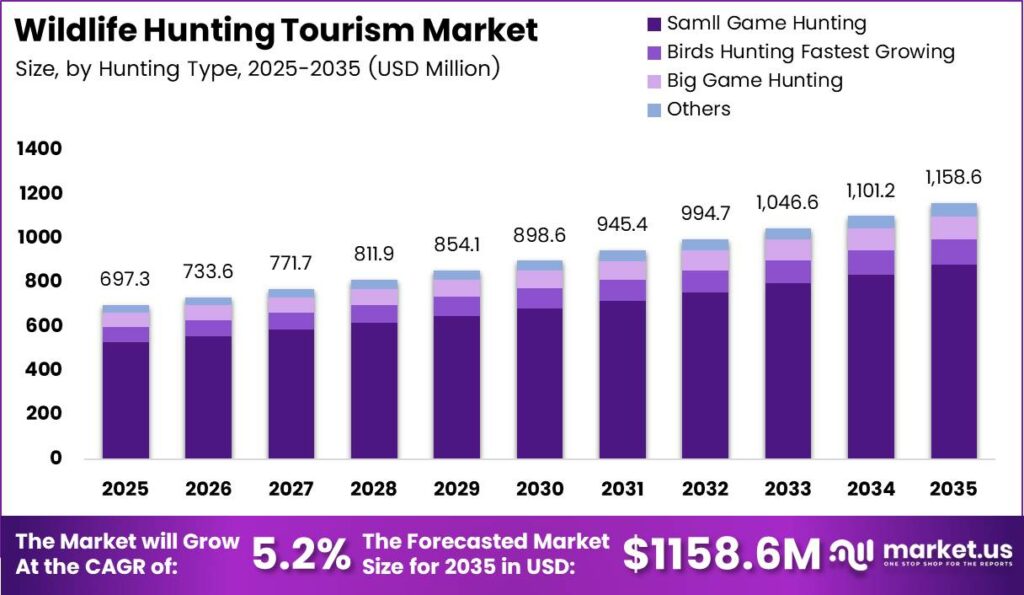
Global Wildlife Hunting Tourism Market size is expected to be worth around USD 1,158.6 Million by 2035 from USD 697.3 Million in 2025, growing at a CAGR of 5.2% during the forecast period 2026 to 2035.
The Wildlife Hunting Tourism Market covers commercially guided and outfitter-operated hunting experiences sold to paying clients across global destinations. This market encompasses the full service chain including transportation, accommodation, professional guiding, equipment provision, and trophy handling. Participants range from community-managed concessions in southern Africa to private game ranches in North America, with service pricing structured around daily rates, species-specific trophy fees, and bundled itinerary packages.
Key Takeaways
- The global Wildlife Hunting Tourism Market is valued at USD 697.3 Million in 2025 and is forecast to reach USD 1,158.6 Million by 2035, growing at a CAGR of 5.2%.
- By Hunting Type, Small Game Hunting dominates with a 76.89% market share in 2025, while Birds Hunting is the fastest-growing sub-segment.
- By Customer Type, International Tourists hold a 67.89% share and are also the fastest-growing sub-segment.
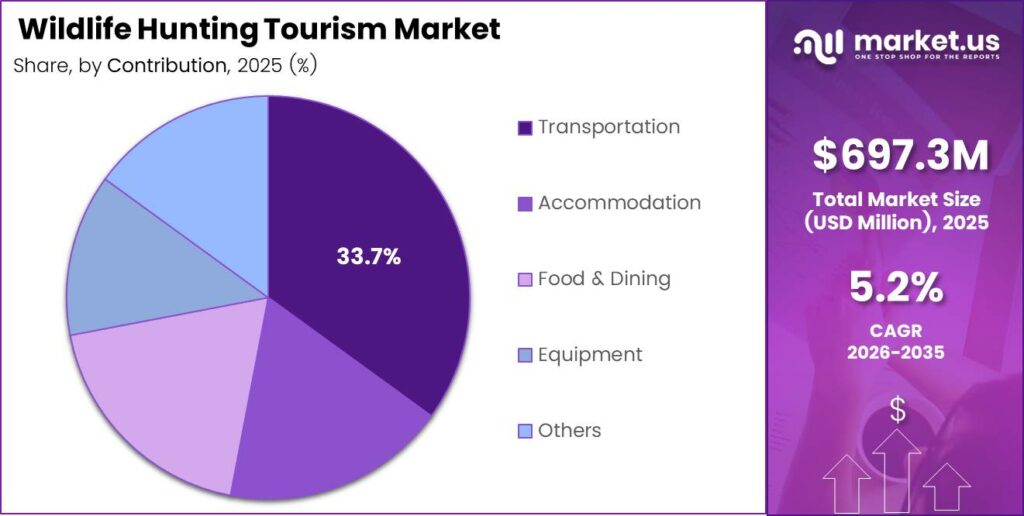
- By Contribution, Transportation leads with a 33.78% share and is the fastest-growing contribution category.
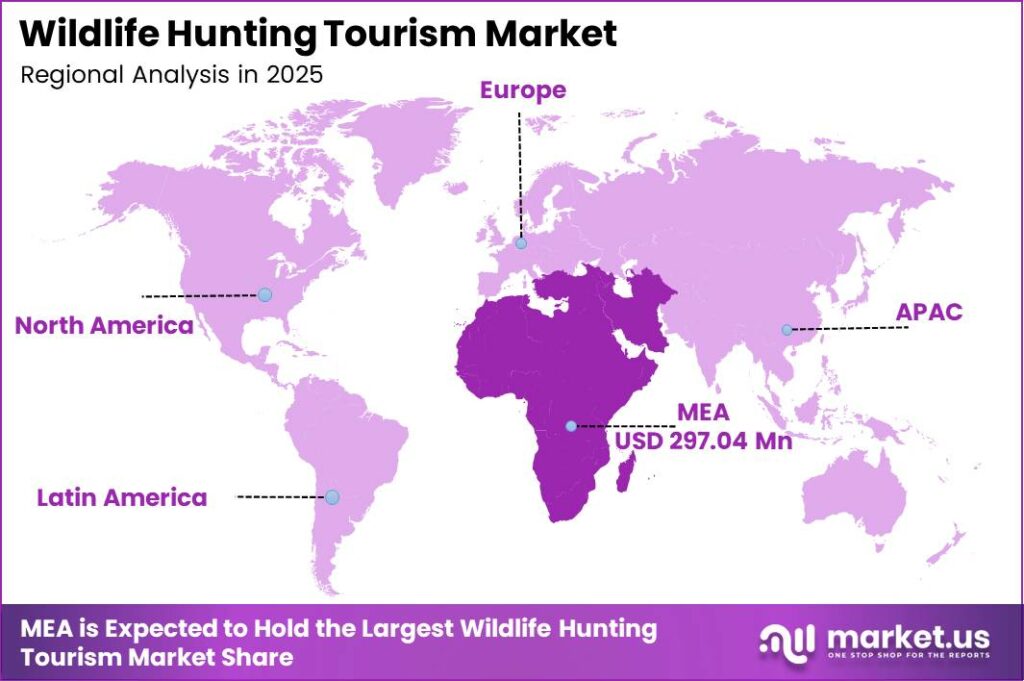
- Middle East & Africa dominates regionally with a 42.67% share, valued at USD 297.04 Million, while Latin America is the fastest-growing region.
However, market performance depends heavily on regulatory conditions governing species quotas, trophy import eligibility, and land-use licensing across destination countries. Governments in Namibia, South Africa, Zimbabwe, and Zambia have established formal quota systems that cap annual harvest volumes per species. This creates a natural ceiling on outfitter capacity and means supply-side growth requires concession expansion rather than simply increased bookings. Regulatory stability in these markets directly determines investor confidence in new lodge infrastructure.
As per our research, Africa’s international arrivals increased by 12% in 2024 relative to 2023, exceeding 2019 levels by 7%. This recovery expanded the addressable pool of long-haul travelers who qualify as potential hunting tourism clients. In July 2026, Mallard Bay Outdoors announced its acquisition of Find A Hunt and sister brand Find A Fish, integrating guided-hunt discovery, public-hunting-land information, and hunting-lease listings into its platform with plans to embed outfitter-management and AI tools into the acquired services.
UN Tourism recorded an estimated 1.52 billion international tourist arrivals worldwide in 2025, while IATA reported that global airline passenger demand increased 5.3% in 2025 compared with 2024. These figures confirm that destination access and flight connectivity are improving across key hunting tourism corridors. Operators that align departure schedules and marketing spend with peak travel demand recovery stand to benefit most from this structural tailwind in cross-border hunting trip bookings.
Hunting Type Analysis
Small Game Hunting dominates with 76.89% due to broad species access and lower entry cost.
In 2025, Small Game Hunting held a dominant market position in the By Hunting Type segment of the Wildlife Hunting Tourism Market, with a 76.89% share. Small game destinations allow outfitters to run multiple concurrent clients within the same area, which increases daily revenue per camp compared with single-species trophy operations. The World Tourism Organization notes that accessible, lower-cost experiences drive repeat participation rates across adventure tourism segments, which reinforces the commercial case for outfitters that invest in small game infrastructure and guide capacity.
Birds Hunting is the fastest-growing sub-segment within this market. Kemp African Safaris’ 2025 wingshooting schedule lists rates of USD 480 per gun per day for solo participants, USD 390 per gun per day for groups of two to three guns, and USD 300 per gun per day for groups of four or more. This tiered pricing model creates a clear incentive for group bookings. Operators that promote the group-rate discount in their marketing can increase average party size and reduce per-day guide cost per client simultaneously.
Big Game Hunting attracts the highest per-client spend across all sub-segments. Ford Creek Outfitters prices its 6-full-day elk-and-deer combination hunts across approximately 120 square miles at USD 10,500 per hunter with a dedicated guide, USD 8,000 per hunter for parties of two, and USD 7,500 per hunter for parties of three. Sun Africa Safaris’ 2026 Cape Buffalo package runs USD 15,500 for 10 hunting days, with a buffalo-and-sable combination priced at USD 19,500. In March 2025, Ranchland Outfitters confirmed a new Alberta hunting lodge under construction, scheduled for completion ahead of the autumn 2025 season, signaling continued capital investment in big game infrastructure.
Customer Type Analysis
International Tourists dominates with 67.89% due to higher spend per trip and trophy interest.
In 2025, International Tourists held a dominant market position in the By Customer Type segment of the Wildlife Hunting Tourism Market, with a 67.89% share. IATA data shows that Latin American airlines’ international passenger traffic increased 8.6% in 2025 compared with 2024, indicating improved connectivity into Latin American hunting destinations from key source markets. This sub-segment is also the fastest growing, which means outfitters operating in Latin America face rising inbound demand they must prepare to absorb through expanded guide rosters and booking systems. In June 2026, HLRBO closed a USD 2.5 million funding round to expand private hunting-lease inventory, upgrade its platform, and develop parcel-level mapping, AI-powered land scoring, and 3D property-viewing tools, indicating that digital infrastructure investment is accelerating alongside international demand growth.
Domestic Tourists represent the remaining share and provide a structurally different revenue profile from international clients. Sun Africa Safaris’ 2026 schedule prices daily hunting at USD 450 for a one-hunter, one-professional-hunter arrangement and USD 375 for two hunters sharing one professional hunter, with non-hunting observers charged USD 275 per day. This pricing architecture allows domestic clients, who typically book shorter trips and have lower trophy shipping requirements, to access the same camp infrastructure at lower total cost. Operators that offer the companion observer rate attract mixed-purpose domestic bookings that increase camp utilization without requiring additional trophy quota allocation.
Contribution Analysis
Transportation dominates with 33.78% due to remote destination access costs driving total spend.
In 2025, Transportation held a dominant market position in the By Contribution segment of the Wildlife Hunting Tourism Market, with a 33.78% share. Transportation is also the fastest-growing contribution category, reflecting the expansion of hunting operations into more remote and logistically complex destinations. Sun Africa Safaris’ 2026 rates include rifle hire at USD 250 per safari and varmint hunting at USD 250 per night, with transportation costs embedded in the daily rate structure. Operators that control their own ground-transportation fleet retain more margin and reduce dependency on third-party logistics providers whose pricing volatility directly affects trip profitability.
Accommodation costs represent the second-largest contribution category. Namibia Safari Corporation’s 2025–2026 daily-rate schedule lists USD 390 for a one-client, one-guide arrangement and USD 320 for a two-client, one-guide arrangement, with rates inclusive of 15% VAT and charged per night in camp. This per-night billing model means longer hunts generate proportionally higher accommodation revenue without requiring any increase in species quota allocation. Outfitters that invest in camp quality can justify premium per-night rates and improve total revenue per client without needing to expand their licensed hunting area.
Food and Dining, Equipment, and other contribution categories account for the remaining spend. Kemp African Safaris’ 2025 daily rate of USD 425 for a one-hunter, one-professional-hunter arrangement includes accommodation, all meals, land transportation, trackers, skinners, field trophy preparation, and permit fees. Namibia Safari Corporation lists rifle rental at USD 40 per day and ammunition at USD 5 per bullet with a minimum purchase of 20 bullets, giving equipment a predictable floor contribution to total client spend. Operators that bundle these costs into all-inclusive packages reduce booking friction and improve conversion rates from first-time international clients.
Key Market Segments
By Hunting Type
- Small Game Hunting
- Birds Hunting
- Big Game Hunting
- Others
By Customer Type
- International Tourists
- Domestic Tourists
By Contribution
- Transportation
- Accommodation
- Food & Dining
- Equipment
- Others
Regional Analysis
Middle East & Africa Dominates the Wildlife Hunting Tourism Market with a Market Share of 42.67%, Valued at USD 297.04 Million
Middle East & Africa holds the largest share of the global Wildlife Hunting Tourism Market at 42.67%, valued at USD 297.04 Million in 2025. This dominance reflects the concentration of licensed hunting concessions, private game ranches, and community-managed wildlife estates across southern and eastern Africa. Namibia and South Africa anchor this position through their established regulatory frameworks, which give outfitters legal certainty over species quotas and trophy export pathways. Operators in this region benefit from decades of guide training infrastructure and international client relationships that are difficult for newer destinations to replicate quickly.
Latin America is the fastest-growing region in this market. Africa’s international arrivals increased 9% year on year in the first quarter of 2025, a recovery trend that benefits both the Middle East & Africa region and the inbound travel pipelines that feed Latin American hunting destinations. Sun Africa Safaris’ First-Timer package, priced at USD 5,250 for 7 hunting days and 4 animals, illustrates the entry-level pricing strategy that outfitters use to convert first-time international clients into repeat visitors. In September 2026, Infinite Outdoors and the Western Landowners Alliance announced a partnership to help landowners monetize hunting, fishing, and recreational access while supporting private-land stewardship, a model with direct application to Latin American land-access markets.
Key Regions and Countries
North America
- US
- Canada
Europe
- Germany
- France
- The UK
- Spain
- Italy
- Rest of Europe
Asia Pacific
- China
- Japan
- South Korea
- India
- Australia
- Rest of APAC
Latin America
- Brazil
- Mexico
- Rest of Latin America
Middle East and Africa
- GCC
- South Africa
- Rest of MEA
Market Dynamics
Market Opportunity Analysis - Junior hunters, first-timer packages, and Latin American access gaps signal underexploited entry points
Sun Africa Safaris exempts junior hunters younger than 16 from daily rates and includes one complimentary non-trophy springbuck per junior hunter in its 2026 pricing structure. This pricing exception creates a family-booking pathway that most competitors have not formalized. Operators that package junior-hunter inclusions into a family itinerary product can access a segment that is currently underserved in southern Africa and commands a premium from North American and European parents seeking structured outdoor experiences for younger clients.
The First-Timer package at USD 5,250 for 7 hunting days and 4 animals represents the lowest-cost structured entry point into African hunting tourism from a major southern African outfitter. This price tier sits below the USD 15,500 to USD 19,500 range of premium species packages, creating a distinct customer acquisition layer. Outfitters that design a formal conversion pathway from first-timer packages to big-game packages over successive booking cycles can increase lifetime client value without requiring any increase in new client acquisition spend.
Latin America’s position as the fastest-growing region indicates that outfitter infrastructure investment in this geography carries a structural demand tailwind that Middle East & Africa competitors cannot replicate through pricing alone. By contrast, the dominant Middle East & Africa region at 42.67% share operates in a more mature, quota-constrained supply environment. New entrants that establish land access agreements and guide certification programs in Latin America before the region reaches supply saturation will hold a durable location advantage against late movers.
The Domestic Tourists sub-segment within the By Customer Type segment remains structurally underdeveloped relative to the International Tourists sub-segment, which holds 67.89% share. Domestic clients typically book shorter durations and have lower trophy logistics requirements, which reduces per-booking revenue but also reduces regulatory risk exposure from import restrictions. Operators that create a domestic-focused product tier with transparent all-inclusive pricing, similar to Kemp African Safaris’ bundled daily rate model, can build a recession-resilient base revenue stream that is insulated from international travel disruptions.
Technology and Innovation Landscape - Digital booking platforms, optics innovation, and filming services redefine client experience and operator margins
Digital platform investment is reshaping how hunting tourism clients discover, book, and plan expeditions. In June 2026, HLRBO closed a USD 2.5 million funding round to develop parcel-level mapping, AI-powered land scoring, and 3D property-viewing tools for its private hunting-lease platform. This technology layer reduces the information asymmetry between outfitters and clients, which historically required personal referrals or trade conventions to bridge. Platforms that integrate AI scoring and immersive mapping will attract younger first-time clients who apply the same due-diligence tools to hunting as to other travel categories.
Optics innovation is delivering measurable performance improvements that outfitters use as a client experience differentiator. Leica launched the Geovid Max 10×42 binoculars in September 2026 with a maximum measuring range of 7,500 metres on retroreflective targets and a retail price of €3,900, followed by the Noctivid Compact series in April 2026 offering 8× and 10× magnification in a reduced form factor. Premium optics at this performance level extend effective field range for clients and reduce guide dependency during spot-and-stalk phases. Outfitters that include branded premium optics in their equipment packages can use this technology as a tangible premium signal to justify higher daily rates.
Safari filming and editing services represent an emerging technology-enabled revenue category with a structured pricing model. Sun Africa Safaris’ 2026 rate page lists filming and editing at USD 2,250 for a 7-day hunt, USD 2,950 for a 10-day hunt, and USD 3,900 for a 14-day hunt, with a 4K upgrade available at USD 150 per hunting day. This service converts the hunt into a distributable content product, extending the commercial lifetime of each booking through client-shared media. Outfitters that invest in professional filming capability can monetize social media distribution by partnering clients for organic reach that replaces paid client acquisition spend.
In August 2025, Henry Griffiths Safaris advertised two South African cull-hunting packages for May through August 2026, priced at USD 2,560 for five hunting days and USD 4,220 for seven hunting days, both based at a luxury lodge. This product structure blends wildlife management with high-end accommodation, creating an experience that appeals to conservation-minded clients who are uncomfortable with conventional trophy hunting. Operators that formalize cull-hunt programs with verified conservation credentials and luxury lodge integration can address a growing client segment that values ecological justification alongside premium field experience.
Drivers
Recovering international mobility supports destination access and booking confidence for guided hunting trips. Africa’s international arrivals increased by 12% in 2024 relative to 2023, exceeding 2019 levels by 7%, and then increased by 9% year on year in the first quarter of 2025. This recovery allows outfitters to emphasize scheduled departures, advance deposits, and fuller camp utilization. Operators that align capacity planning with confirmed arrival data will capture bookings earlier in the planning cycle and reduce their reliance on last-minute or rescheduled sales.
Community concession commercialization and established private game ranch supply reinforce the structural supply base that supports outfitter growth. Repeat-client relationships in North American and European source markets create predictable forward bookings, while premium guided-service spending across Africa, North America, and Europe lifts average revenue per client. This combination of supply-side stability and demand-side loyalty creates a commercially resilient base for operators investing in camp upgrades and expanded species offerings over the medium term.
| Driver | (~) % Impact on CAGR Forecast | Geographic Relevance | Impact Timeline |
|---|---|---|---|
| International travel demand recovery | +0.45% | Global; African destinations | Short term (≤ 2 years) |
| Community concession commercialization | +0.30% | Namibia; southern Africa | Medium term (2–4 years) |
| Established private-game ranch supply | +0.25% | South Africa; Namibia | Medium term (2–4 years) |
| Repeat-client outfitter relationships | +0.20% | North American and European source markets | Short term (≤ 2 years) |
| Premium guided-service spending | +0.15% | Africa; North America; Europe | Medium term (2–4 years) |
Restraints
Import eligibility for legally hunted trophies creates a hard commercial barrier when clients regard returning with a trophy as essential to purchasing a hunt. The United States’ revised African elephant import rule, which took effect on May 1, 2024, retained an enhancement finding and required a documented, verifiable annual certification from exporting range-country governments. This rule does not prohibit Americans from hunting abroad, but it makes each trophy’s import eligibility a precondition for completing the commercial transaction. Operators must screen import eligibility before accepting non-refundable deposits to avoid absorbing cancellation costs on sales whose pathway is unresolved.
Binding species harvest quotas, protected-area hunting exclusions, and carrier trophy acceptance restrictions add further layers of operational complexity. Upfront expedition costs in the USD 5,250 to USD 19,500 range create affordability barriers in price-sensitive source markets, limiting the addressable client pool for premium packages. Collectively, these restraints carry an estimated combined drag of 1.00 percentage point on the baseline CAGR, meaning operators that fail to manage regulatory exposure and price-point diversity will underperform relative to the market average throughout the forecast period.
| Restraint | (~) % Impact on CAGR Forecast | Geographic Relevance | Impact Timeline |
|---|---|---|---|
| Protected-species trophy import restrictions | −0.35% | United States; African elephant range states | Short term (≤ 2 years) |
| Binding species harvest quotas | −0.25% | Quota-managed hunting destinations | Medium term (2–4 years) |
| Protected-area hunting exclusions | −0.18% | Protected landscapes worldwide | Long term (≥ 4 years) |
| Carrier trophy acceptance exclusions | −0.12% | International trophy-shipping routes | Short term (≤ 2 years) |
| Upfront expedition affordability barriers | −0.10% | Price-sensitive outbound source markets | Short term (≤ 2 years) |
Challenges
Remote hunting operations depend on water availability, passable access routes, and predictable field conditions, making climate variability a direct operating-cost risk. The European Commission’s Joint Research Centre documented severe drought across southern Africa during October 2023 through March 2024, with temperature anomalies exceeding 1.5°C across Namibia, Botswana, northern Zimbabwe, southern Zambia, and western Mozambique. A 10% increase in water, fuel, and field-support costs applied to a cost pool equal to 20% of revenue would reduce operating margin by 2 percentage points without price recovery. Operators must build water storage, resilient power systems, and geographically diversified portfolios to absorb this volatility.
Specialist guide succession gaps, remote camp maintenance logistics, cross-currency booking margin exposure, and community benefit distribution disputes add compounding friction across destination markets. These challenges carry a combined estimated drag of 0.80 percentage points on the market’s CAGR. This creates an opening for operators that invest in guide training pipelines, forward currency hedging, and transparent community revenue-sharing structures to build a structural cost and reputational advantage over competitors that treat these as secondary operational concerns.
| Challenge | (~) % CAGR Friction Drag | Geographic Relevance | Mitigation Horizon |
|---|---|---|---|
| Climate-driven field operating volatility | −0.30% | Southern Africa; other drought-exposed destinations | Long term (≥ 4 years) |
| Specialist guide succession gaps | −0.18% | Remote hunting destinations worldwide | Medium term (2–4 years) |
| Remote camp maintenance logistics | −0.14% | Africa; remote North America; Central Asia | Medium term (2–4 years) |
| Cross-currency booking margin exposure | −0.10% | Internationally marketed hunting destinations | Short term (≤ 2 years) |
| Community benefit distribution disputes | −0.08% | Community-managed concession landscapes | Medium term (2–4 years) |
Opportunities
Companion-focused itinerary extensions represent an underexploited incremental revenue source for outfitters that currently capture only the core hunting booking. Namibia’s environment ministry identifies 86 registered communal conservancies and 42 joint-venture lodges, with photographic tourism and hunting separated through land-use zoning, which establishes a practical infrastructure basis for linked itineraries. An illustrative scenario with a 20% companion-package attachment rate priced at 15% of the core booking value would increase average revenue per booking by 3%. Operators that package these extensions proactively will capture spending that currently leaves the booking ecosystem entirely.
Platform consolidation, management-hunt packages, women-focused introductory departures, and pre-trip skills instruction subscriptions each represent executable revenue channels. These five opportunity categories carry a combined estimated upside of 0.90 percentage points above the 5.2% baseline CAGR, implying a fully executed ceiling of approximately 6.1%. Early movers that address more than one opportunity channel simultaneously will compound their advantage, as each new product line strengthens client retention and increases average lifetime value per booking relationship.
| Opportunity | (~) % Potential CAGR Upside | Geographic Relevance | Execution Window |
|---|---|---|---|
| Companion-focused itinerary extensions | +0.30% | Southern Africa; North America; Europe | Short term (≤ 2 years) |
| Independent outfitter platform consolidation | +0.22% | Fragmented destination operator networks | Medium term (2–4 years) |
| Legally authorized management-hunt packages | +0.18% | Eligible managed wildlife estates | Medium term (2–4 years) |
| Women-focused introductory hunting departures | +0.12% | North American and European source markets | Medium term (2–4 years) |
| Pre-trip skills instruction subscriptions | +0.08% | International guided-hunt customer base | Short term (≤ 2 years) |
Key Company Insights
Namibia Safari Corporation positions itself as a full-service African hunting outfitter with transparent, published pricing across species tiers, daily-rate structures, and ancillary services. Its 2025–2026 schedule prices a leopard package at USD 18,000 for 14 hunting days for one hunter, requiring a USD 5,000 deposit and a separate USD 5,000 trophy fee if the animal is taken. Hyena surcharges run USD 1,500 on company property and USD 2,500 in external concessions. This tiered pricing clarity reduces booking friction but exposes the business to any disruption in trophy import eligibility for key species.
Safari Club International operates as the primary institutional advocate and membership organization for hunting tourism, connecting outfitters, guides, and clients through its annual convention and conservation funding programs. In June 2026, GOHUNT was acquired by Brandt Information Services, a Providence Equity Partners portfolio company, bringing GOHUNT’s hunting research tools, digital maps, and hunt-planning resources into a larger technology platform. This transaction signals that institutional capital is entering the hunt-planning software segment, which will intensify competition for the digital client acquisition channels that organizations like Safari Club International currently anchor.
Key Players
- Safari Club International
- Cabela’s
- Bass Pro Shops
- Remington Outdoor Company
- Beretta
- Hunters Hill Safaris
- Weatherby
- Leica
- Winchester Ammunition
- Orvis
- Hornady
- Blaser Group
- Other Key Players
Recent Developments
- September 17, 2026: Leica launched Geovid Max 10×42 hunting binoculars, specifying a maximum measuring range of 7,500 metres on retroreflective targets and a recommended retail price of €3,900 including VAT.
- June 19, 2026: Bass Pro Shops announced updated plans for a 200,000-square-foot Outdoor World retail location in Sayreville, New Jersey, with an expected opening in autumn 2026.
- April 16, 2026: Leica introduced its Noctivid Compact binocular series with 8× and 10× magnification models, alongside the Monovid 8×25 monocular.
- October 2026: Infinite Outdoors and the Mule Deer Foundation reported that their Access Granted partnership had generated USD 92,805 year-to-date for conservation and public-land access initiatives, with the funding estimated to potentially support access to 185,610 acres.
Geopolitical Impact Analysis
Trade policy volatility is reshaping cost structures across the wildlife hunting tourism supply chain, particularly for equipment and firearms manufacturers whose components cross multiple tariff jurisdictions. According to WTO data, the average applied tariff rate on sporting firearms and optics trade among G20 nations increased by approximately 8% between 2022 and 2025, driven by US, EU, and retaliatory measures across multiple bilateral corridors. This creates margin compression for equipment-dependent outfitters and pushes procurement costs onto clients through higher daily rate floors and equipment surcharge pricing.
As reported by the World Shipping Council, average container shipping transit times on Africa-to-North America routes extended by 4 to 6 days in 2024 due to Red Sea rerouting via the Cape of Good Hope. This routing change increased freight costs by an estimated 15% to 20% for trophy shipping and camp supply logistics. Consequently, outfitters relying on regular replenishment shipments for camp equipment face higher holding costs, and trophy handlers must build longer lead times into client delivery commitments, which reduces booking confidence for first-time international clients.
Report Scope
| Report Features | Description |
|---|---|
| Market Value (2025) | USD 697.3 Million |
| Forecast Revenue (2035) | USD 1,158.6 Million |
| CAGR (2026-2035) | 5.2% |
| Base Year for Estimation | 2025 |
| Historic Period | 2020-2024 |
| Forecast Period | 2026-2035 |
| Report Coverage | Revenue Forecast, Market Dynamics, Market Opportunity Analysis, Technology and Innovation Landscape, Competitive Landscape, Recent Developments |
| Segments Covered | By Hunting Type (Small Game Hunting, Birds Hunting, Big Game Hunting, Others), By Customer Type (International Tourists, Domestic Tourists), By Contribution (Transportation, Accommodation, Food & Dining, Equipment, Others) |
| Regional Analysis | North America (US and Canada), Europe (Germany, France, The UK, Spain, Italy, and Rest of Europe), Asia Pacific (China, Japan, South Korea, India, Australia, and Rest of APAC), Latin America (Brazil, Mexico, and Rest of Latin America), Middle East and Africa (GCC, South Africa, and Rest of MEA) |
| Competitive Landscape | Safari Club International, Cabela’s, Bass Pro Shops, Remington Outdoor Company, Beretta, Hunters Hill Safaris, Weatherby, Leica, Winchester Ammunition, Orvis, Hornady, Blaser Group, Other Key Players |
| Customization Scope | Customization for segments, region / country-level will be provided. Additional customization can be done based on requirements. |
| Purchase Options | We have three licenses to opt for: Single User License | Multi-User License (Up to 5 Users) | Corporate Use License (Unlimited User and Printable PDF) |