


Report Overview
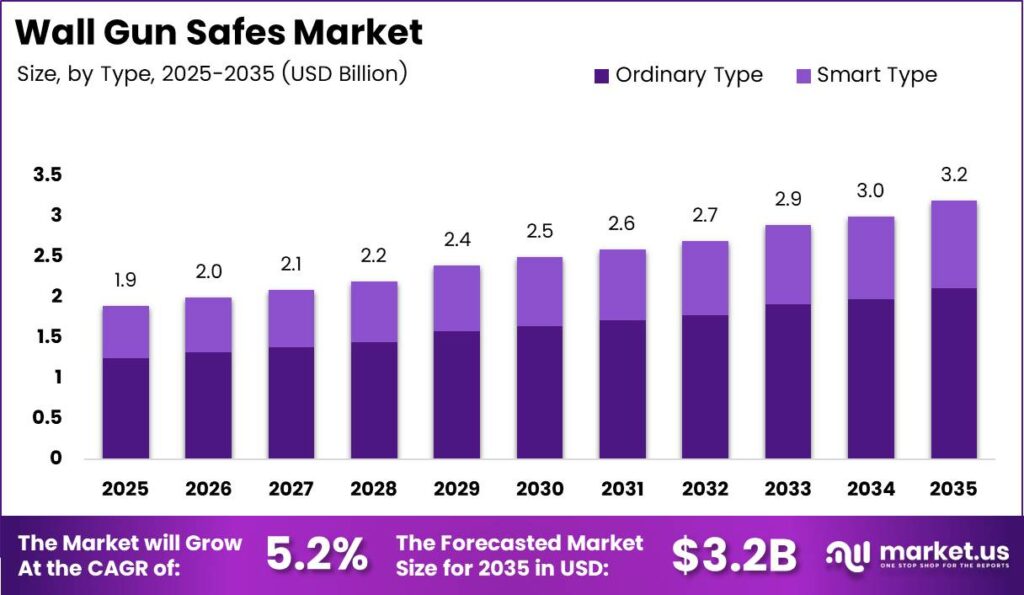
Global Wall Gun Safes Market size is expected to be worth around USD 3.2 Billion by 2035 from USD 1.9 Billion in 2025, growing at a CAGR of 5.2% during the forecast period 2026 to 2035. This trajectory signals a structurally expanding market where compliance pressure, residential demand, and product differentiation are collectively reinforcing purchase volumes across key geographies. Investors entering now face a market where regulatory tailwinds are already embedded in demand forecasts.
The wall gun safes market covers permanently or semi-permanently recessed firearm storage units mounted within wall cavities. Products range from compact handgun vaults to full-depth long-gun configurations, differentiated by lock mechanism, gauge steel, internal capacity, and electronic capability. The market serves residential owners, law enforcement, commercial operators, and military users, each with distinct access-speed and security-certification requirements.
Key Takeaways
- The Global Wall Gun Safes Market was valued at USD 1.9 Billion in 2025 and is forecast to reach USD 3.2 Billion by 2035.
- The market is growing at a CAGR of 5.2% during the forecast period 2026 to 2035.
- By Type, the Ordinary Type segment dominates with a market share of 61.23%.
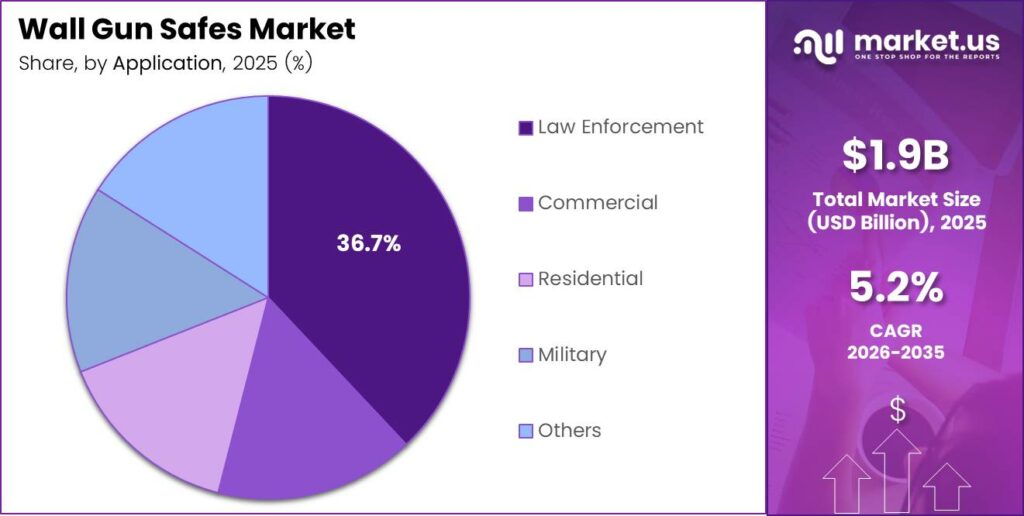
- By Application, the Law Enforcement segment holds the leading share at 36.78%.
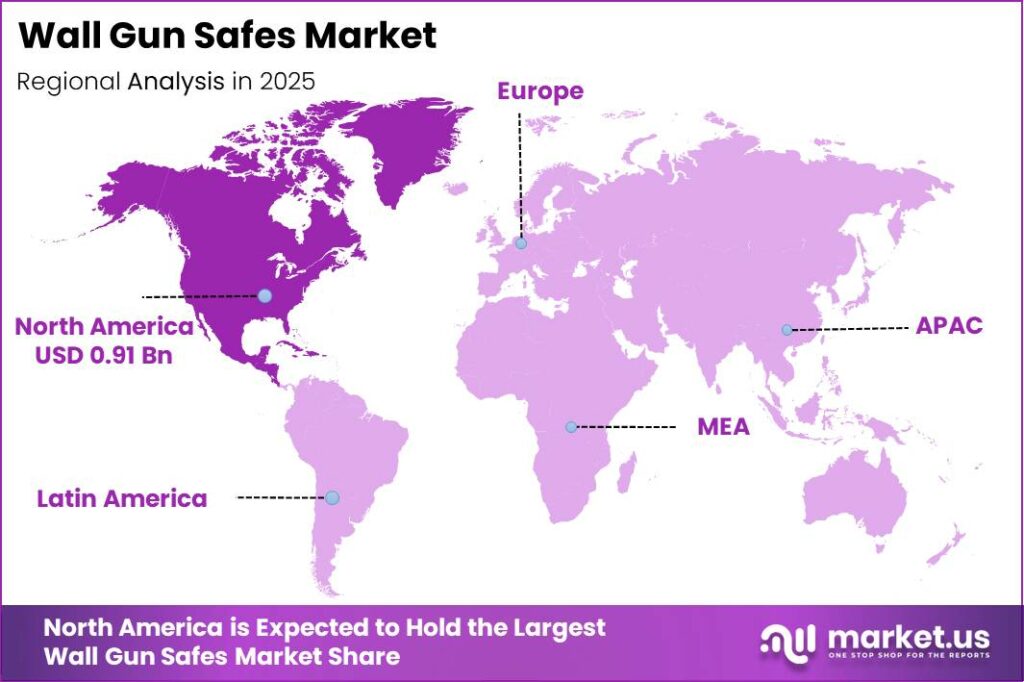
- North America leads all regions with a market share of 48.21%, valued at USD 0.91 Billion.
- Latin America is the fastest-growing regional market during the forecast period.
- Smart Type is the fastest-growing product segment by type.
- Commercial is the fastest-growing application segment.
Government investment in secure-storage infrastructure and evolving state-level firearm legislation directly shape product selection and channel strategy in this market. Active secure-storage laws enacted in Michigan effective February 13, 2024 and in Massachusetts effective October 2, 2024 have shifted firearm storage from a discretionary accessory decision toward a compliance-driven purchase. This means vendors who position wall gun safes as verified legal compliant solutions gain disproportionate shelf placement and dealer recommendation over non-certified alternatives.
Product pricing reveals the accessible entry points and premiumization ceiling within this market. As per our research, V-Line’s Quick Vault in-wall handgun safe carried a sale price of USD 325 per unit against an original listed price of USD 369, while the larger Quick Vault XL carried a list price of USD 508 per unit as of October 9, 2026. This price ladder demonstrates that a defined mid-to-premium range exists within the wall gun safes category, creating room for tiered product strategies targeting both cost-sensitive residential buyers and feature-focused institutional purchasers.
Type Analysis
Ordinary Type dominates with 61.23% due to mechanical reliability and lower purchase cost.
In 2025, Ordinary Type held a dominant market position in the By Type segment of the Wall Gun Safes Market, with a 61.23% share. According to Market.us, mechanical lock configurations eliminate battery dependency and electronic failure risk, giving this segment a practical advantage in long-term residential installations. The OECD reports that owner-occupied housing accounts for a majority of eligible installations in developed markets, and mechanical products serve this base at accessible price points. Vendors holding Ordinary Type SKUs command a larger slice of distributor shelf space across the Americas.
Smart Type wall gun safes are the fastest-growing sub-segment within the By Type classification, driven by biometric and Wi-Fi-enabled access adoption among security-conscious residential buyers. The ITU reports that global internet-connected device penetration crossed 6.4 billion active units in 2024, reinforcing the infrastructure that supports app-controlled firearm storage products. In March 2025, Vaultek Safe initiated the pre-launch rollout of its RS Slider Series Safe powered by the ViSN Wi-Fi connectivity matrix. Manufacturers entering this sub-segment must invest in firmware versioning and battery management to sustain purchase confidence.
Application Analysis
Law Enforcement dominates with 36.78% due to mandatory secure-custody firearms protocols.
In 2025, Law Enforcement held a dominant market position in the By Application segment of the Wall Gun Safes Market, with a 36.78% share. The Bureau of Justice Statistics reports that approximately 18,000 state and local law enforcement agencies operate across the United States, each requiring standardized firearms storage. Wall-mounted secure access units meet both the access-speed and audit-trail requirements demanded by departmental policy. Vendors who secure procurement relationships with municipal and state agencies establish recurring volume purchase patterns that stabilize revenue across economic cycles.
Commercial applications represent the fastest-growing sub-segment within the By Application classification, as security-sensitive businesses including pawnshops, shooting ranges, and licensed dealers expand their in-premises storage infrastructure. The US Small Business Administration reports that licensed firearms dealerships across the United States exceeded 60,000 active federal firearms licensees in 2023. Each licensed dealer with premises-based storage requirements creates a direct procurement opportunity for wall-integrated safe units. Manufacturers offering bulk order pricing and installation support for commercial clients convert single-unit trial purchases into account-level relationships.
Residential and Military sub-segments occupy the remaining share of the By Application market alongside the Others category. The World Bank reports that urban population growth in North America averaged 0.9% annually over the 2020 to 2024 period, increasing the base of urban homeowners eligible for wall-safe installation. Military procurement follows procurement cycle and specification schedules set by defense ministries, producing orders of predictable scale but irregular frequency. Combined, these sub-segments create supplemental demand that stabilizes total application volume when leading segments face budget or regulatory headwinds.
Key Market Segments
By Type
- Ordinary Type
- Smart Type
By Application
- Law Enforcement
- Commercial
- Residential
- Military
- Others
Regional Analysis
North America Dominates the Wall Gun Safes Market with a Market Share of 48.21%, Valued at USD 0.91 Billion
North America commands the largest share of the global wall gun safes market, accounting for 48.21% of total revenue at a value of USD 0.91 Billion in 2025. This concentration reflects the United States’ status as the world’s largest civilian firearms ownership market, where state-level secure-storage legislation and dealer cross-selling infrastructure produce a structurally higher conversion rate from firearm ownership to storage product purchase. Manufacturers with established North American distribution networks hold a durable competitive advantage over later-stage market entrants.
Latin America is the fastest-growing regional market during the forecast period 2026 to 2035. Rising formal firearms registration activity, expanding middle-class homeownership in Brazil and Mexico, and gradual regulatory alignment with North American secure-storage standards are collectively pulling demand upward in this region. As per our research, the regional growth rate exceeds the global CAGR of 5.2%, signaling that early-mover distributors who establish local assembly partnerships or bonded warehouse networks in this region will capture first-wave volume before multinational consolidation compresses margins.
Europe, Asia Pacific, and Middle East and Africa collectively account for the remaining share of global wall gun safes revenue outside North America and Latin America. European markets face structural headwinds from restricted civilian ownership laws that limit the addressable residential buyer pool. Asia Pacific growth is concentrated in Australia and select Southeast Asian markets where legal firearm ownership rates support an eligible installation base. Middle East and Africa purchasing is concentrated in institutional and security-sector channels rather than residential end users, creating a different product specification and sales cycle profile.
Key Regions and Countries
North America
- US
- Canada
Europe
- Germany
- France
- The UK
- Spain
- Italy
- Rest of Europe
Asia Pacific
- China
- Japan
- South Korea
- India
- Australia
- Rest of APAC
Latin America
- Brazil
- Mexico
- Rest of Latin America
Middle East and Africa
- GCC
- South Africa
- Rest of MEA
Market Dynamics
Market Opportunity Analysis - Underserved residential and institutional sub-segments offer structured entry points for focused market participants
The Commercial application sub-segment carries the fastest growth rate within the By Application classification, yet it remains underserved relative to its addressable base. Federal firearms licensees in the United States exceeded 60,000 active dealers, and a meaningful portion operate from premises without wall-integrated secure storage. Vendors who develop commercial-grade SKUs with bulk order pricing and installation scheduling services can convert this fragmented dealer base into recurring account-level volume, separating themselves from residential-focused competitors who lack the procurement infrastructure to serve institutional buyers at scale.
Latin America holds the fastest-growing regional position in the global market, yet distribution infrastructure for wall gun safes remains thin across most of the region. The absence of established specialist distributors means that first-mover entrants who build bonded warehouse capacity and local service networks in Brazil and Mexico will define the channel structure before larger multinational competitors arrive. This reflects a window where geographic investment leads to channel ownership rather than channel competition, which is the structurally superior market entry position for mid-sized manufacturers with flexible logistics capabilities.
By contrast, the Smart Type sub-segment within the By Type classification is the fastest-growing product category but commands a disproportionately small current share against the Ordinary Type segment’s 61.23% dominance. This gap signals that electronics-capable manufacturers who establish early brand recognition in biometric and Wi-Fi-enabled wall safes will occupy the premium shelf position as smart product adoption accelerates. Investors who back product lines with verifiable firmware update pathways and independent reliability certifications will face lower customer acquisition resistance than those entering with uncertified electronic products.
Technology and Innovation Landscape - Mechanical precision engineering and emerging connectivity platforms define the competitive boundary in wall gun safes
Mechanical lock technology sets the performance floor in the wall gun safes market, and product specifications reveal where manufacturers are investing in measurable differentiation. As reported by V-Line product data, the Quick Vault in-wall handgun safe uses a 5-button mechanical SIMPLEX lock offering 1,081 possible combinations, directly addressing concerns about unauthorized access guessing. A 3/8-inch-thick steel lock block welded to the cover guides and reinforces the lock bolt under physical attack. These specifications provide verifiable security claims that support dealer recommendation and compliance-oriented purchasing decisions.
Internal cavity engineering determines whether a wall safe meets residential and commercial installation requirements without structural modification. Data from V-Line product specifications shows the Quick Vault XL carries internal dimensions of 13 × 27⅜ × 2¾ inches within an external envelope of 14 × 28 × 3.5 inches, creating a measurable capacity step-up over compact handgun vaults. This dimensional clarity reduces installation failures caused by cavity-to-product mismatches and allows builders and contractors to specify the correct unit during construction planning rather than after occupancy.
Multi-point locking architecture extends wall safe security beyond single-bolt failure modes, creating a product differentiation axis that mechanical competitors cannot match without redesigning core components. V-Line’s Closet Vault PLUS uses a 3-point locking system with steel deadbolts extending directly into the frame and includes 2 magnetic barrel supports as standard equipment. The unit uses 14 and 16-gauge steel across structural components, with internal dimensions of 49¾ × 13½ × 4¾ inches and a shipping weight of 62 pounds. Manufacturers who publish complete dimensional and gauge specifications build measurable trust with specification-driven institutional buyers.
Drivers
Active secure-storage obligations strengthen the purchase rationale for locking firearm storage products in markets where legislation requires secured unattended storage. Michigan’s secure-storage requirement took effect on February 13, 2024, covering situations where a minor is reasonably likely to be present, while Massachusetts’ firearms-law modernization took effect on October 2, 2024. These legal milestones shift wall gun safes from discretionary accessories toward compliance-oriented purchases, giving vendors who emphasize certified installation guidance and documented operating instructions a measurable sales conversion advantage over unpositioned competitors.
| Driver | (~) % Impact on CAGR Forecast | Geographic Relevance | Impact Timeline |
|---|---|---|---|
| Active secure-storage obligations | +0.45% | United States; regulated firearm-owning jurisdictions | Short term (≤ 2 years) |
| Floor-space-efficient firearm storage | +0.25% | Urban and suburban owner-occupied housing | Short term (≤ 2 years) |
| Concealed household firearm access | +0.20% | North America; selected civilian firearm markets | Short term (≤ 2 years) |
| Existing dealer cross-selling channels | +0.15% | United States; Canada | Short term (≤ 2 years) |
| Mechanical-lock product differentiation | +0.10% | Global addressable civilian markets | Medium term (2–4 years) |
Restraints
Recessed wall safes require compatible wall construction and owner permission to modify the property, creating a physical eligibility barrier that discounts pricing cannot resolve. A tactical wall vault specifies installation between studs on 16-inch centers in nominal 2 × 4 framing, with a cabinet width of 14½ inches and depth of 5¾ inches, illustrating the precision of cavity requirements. The United States homeownership rate stood at 65.0% in the second quarter of 2026, meaning approximately 35.0% of households fall outside owner occupancy. This eligible-pool limitation makes pre-purchase wall compatibility screening more commercially valuable than broad price discounting as a conversion tool.
| Restraint | (~) % Impact on CAGR Forecast | Geographic Relevance | Impact Timeline |
|---|---|---|---|
| Incompatible walls and alteration restrictions | −0.30% | Rental housing; masonry-heavy construction markets | Long term (≥ 4 years) |
| Installed-price affordability barriers | −0.18% | Price-sensitive households globally | Short term (≤ 2 years) |
| Portable safe substitution | −0.12% | North America; mobile households | Short term (≤ 2 years) |
| Limited long-gun collection capacity | −0.09% | Hunting and collecting markets | Long term (≥ 4 years) |
| Restricted civilian firearm ownership | −0.06% | Jurisdictions with narrow lawful ownership | Long term (≥ 4 years) |
Challenges
Electronic-access reliability presents an ongoing engineering challenge because a biometric safe can appear correctly enrolled while still accepting an unauthorized fingerprint during certain failure states. In June 2024, a CPSC recall covered approximately 133,000 biometric gun safes following 77 reports of unintended access. A separate warning issued on January 30, 2025 covered approximately 183,000 biometric safes, pistol vaults, and lock boxes and identified 3 reported access incidents. These events make default-state rejection, battery-state testing, and auditable firmware releases non-negotiable engineering requirements for wall-safe manufacturers deploying electronic access variants. An illustrative planning case reserves 1 to 2% of electronic-product revenue for incremental assurance and service exposure, explicitly as a budgeting assumption rather than an observed industry ratio.
| Challenge | (~) % CAGR Friction Drag | Geographic Relevance | Mitigation Horizon |
|---|---|---|---|
| Electronic access reliability assurance | −0.20% | Global electronic-lock supply chains | Short term (≤ 2 years) |
| Steel input cost volatility | −0.11% | Global steel-fabrication hubs | Short term (≤ 2 years) |
| Installer execution quality variability | −0.09% | Fragmented residential installation networks | Medium term (2–4 years) |
| Bulky shipment damage control | −0.06% | Long-distance and cross-border distribution | Short term (≤ 2 years) |
| Regional certification process fragmentation | −0.04% | Multi-jurisdiction product portfolios | Medium term (2–4 years) |
Opportunities
Builder-integrated procurement programs represent a conditional revenue channel that converts new-home construction activity into structured wall-safe purchase commitments. A currently available wall vault fits nominal 2 × 4 framing with studs on 16-inch centers and protrudes less than 2 inches beyond the finished wall surface, confirming construction compatibility. In an illustrative unit-economic case, repeat builder orders reduce customer-acquisition expense per unit by 15 to 25% and coordinated delivery reduces handling expense by 5 to 10%. These savings raise contribution margin by 2 to 4 percentage points, provided builder discounts do not absorb the full efficiency gain.
| Opportunity | (~) % Potential CAGR Upside | Geographic Relevance | Execution Window |
|---|---|---|---|
| Builder-integrated procurement programs | +0.30% | North American owner-occupied new construction | Medium term (2–4 years) |
| Institutional small-arm custody niches | +0.20% | Authorized security and training facilities | Medium term (2–4 years) |
| Recurring interior accessory ecosystem | +0.15% | Existing compatible installed base | Short term (≤ 2 years) |
| Multi-user access administration packages | +0.12% | Authorized shared-custody customers | Long term (≥ 4 years) |
| Regional distributor consolidation | +0.08% | Fragmented specialist distribution markets | Medium term (2–4 years) |
Key Company Insights
V-Line Industries builds its wall-safe product line around measurable mechanical specifications that translate directly into installer and buyer confidence. The Quick Vault uses 14-gauge steel with a shipping weight of 23 pounds and includes 1 adjustable felt-lined shelf as standard, while the Quick Vault XL steps up to a 40-pound unit with 3 adjustable felt-lined shelves. This quantified product ladder allows V-Line to target both compact handgun storage and longer-term multi-firearm storage within a single, compatible product family, reducing SKU complexity for distribution partners.
Vaultek Safe anchors its competitive position in the Smart Type segment through proprietary connectivity infrastructure rather than hardware specification alone. The January 2025 launch of the Vaultek Intelligent Safe Network at the SHOT Show introduced a Wi-Fi software platform designed to support an expanding product ecosystem. This platform-first approach creates customer lock-in by making each purchased safe a node in a broader connected network. However, ongoing firmware dependency raises service and recall exposure, as any connectivity failure or unauthorized access event directly undermines the brand trust that justifies Vaultek’s premium price positioning.
Key Players
- Liberty Safe
- Fort Knox Vaults
- American Security Products
- Browning Arms Company
- Stack-On Products
- Barska
- V-Line Industries
- Steelwater Gun Safes
- SentrySafe
- Winchester Safes
- Rhino Metals
- Cannon Safe
- SecureIt Tactical
- GunVault
- MESA Safe Company
- Other Key Players
Recent Developments
- January 2026: Vaultek Safe showcased the launch of its high-capacity LifePod XRC series travel case featuring a water-resistant biometric scanner at the SHOT Show, signaling the brand’s extension from fixed wall-mount products into portable secure-transport solutions.
- April 2026: Security gear developer FLINT brought its FLINT Biometric Safe to market, offering rapid bedside and shelf-integrated weapon deployment for residential users requiring speed-accessible secure storage outside of a wall-mount configuration.
Geopolitical Impact Analysis
Global steel price volatility directly affects wall gun safe manufacturing cost structures, as heavy-gauge steel construction is a non-substitutable input across all product tiers. The WTO reports that US Section 232 steel tariffs, maintained at 25% on imports from multiple jurisdictions, have increased domestic hot-rolled coil steel prices by approximately 15 to 20% above pre-tariff benchmarks in affected periods. This cost pass-through compresses margins for safe manufacturers sourcing domestically and creates pricing pressure that makes sub-USD 300 unit retail more difficult to sustain profitably.
Supply chain rerouting driven by US-China trade tensions has extended lead times on electronic lock components and biometric sensor modules used in Smart Type wall safes. The World Bank reports that average container freight rates on trans-Pacific routes remained elevated at more than 3 times pre-2020 baseline levels through parts of 2024 before partially correcting. This logistics cost inflation raises landed cost for electronic sub-assemblies, widening the unit-cost gap between mechanical Ordinary Type products and Smart Type products. Consequently, distributors in price-sensitive markets default toward mechanical units, delaying Smart Type adoption despite end-user demand for connected features.
Report Scope
| Report Features | Description |
|---|---|
| Market Value (2025) | USD 1.9 Billion |
| Forecast Revenue (2035) | USD 3.2 Billion |
| CAGR (2026-2035) | 5.2% |
| Base Year for Estimation | 2025 |
| Historic Period | 2020-2024 |
| Forecast Period | 2026-2035 |
| Report Coverage | Revenue Forecast, Market Dynamics, Market Opportunity Analysis, Technology and Innovation Landscape, Competitive Landscape, Recent Developments |
| Segments Covered | By Type (Ordinary Type, Smart Type), By Application (Law Enforcement, Commercial, Residential, Military, Others) |
| Regional Analysis | North America (US and Canada), Europe (Germany, France, The UK, Spain, Italy, and Rest of Europe), Asia Pacific (China, Japan, South Korea, India, Australia, and Rest of APAC), Latin America (Brazil, Mexico, and Rest of Latin America), Middle East and Africa (GCC, South Africa, and Rest of MEA) |
| Competitive Landscape | Liberty Safe, Fort Knox Vaults, American Security Products, Browning Arms Company, Stack-On Products, Barska, V-Line Industries, Steelwater Gun Safes, SentrySafe, Winchester Safes, Rhino Metals, Cannon Safe, SecureIt Tactical, GunVault, MESA Safe Company, Other Key Players |
| Customization Scope | Customization for segments, region / country-level will be provided. Additional customization can be done based on requirements. |
| Purchase Options | We have three licenses to opt for: Single User License | Multi-User License (Up to 5 Users) | Corporate Use License (Unlimited User and Printable PDF) |





































