Report Overview
Global Upright Exercise Bike Market size is expected to be worth around USD 3.1 Billion by 2035 from USD 1.5 Billion in 2025, growing at a CAGR of 7.3% during the forecast period 2026 to 2035. Upright exercise bikes provide stationary, seated cardiovascular training through adjustable pedaling resistance, giving households and facilities an indoor exercise option without outdoor riding conditions.
Households, fitness facilities, and institutional buyers form distinct purchasing channels with different expectations for durability, comfort, and service. According to WHO, 31% of adults failed to meet recommended physical-activity levels in 2022, establishing a substantial prevention challenge rather than guaranteed equipment sales. Manufacturers must convert that health need into repeatable exercise habits through accessible controls, suitable seating, and practical ownership costs.
Key Takeaways
- Upright Exercise Bike Market size is expected to be worth around USD 3.1 Billion by 2035 from USD 1.5 Billion in 2025, growing at a CAGR of 7.3%
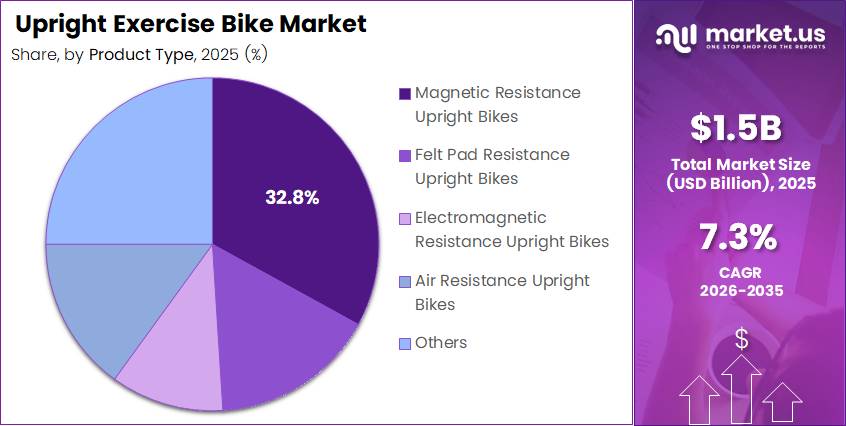
- Magnetic Resistance Upright Bikes lead Product Type with a 32.89% share in 2025.
- Healthcare Club/Gym leads End User with a 46.78% share in 2025.
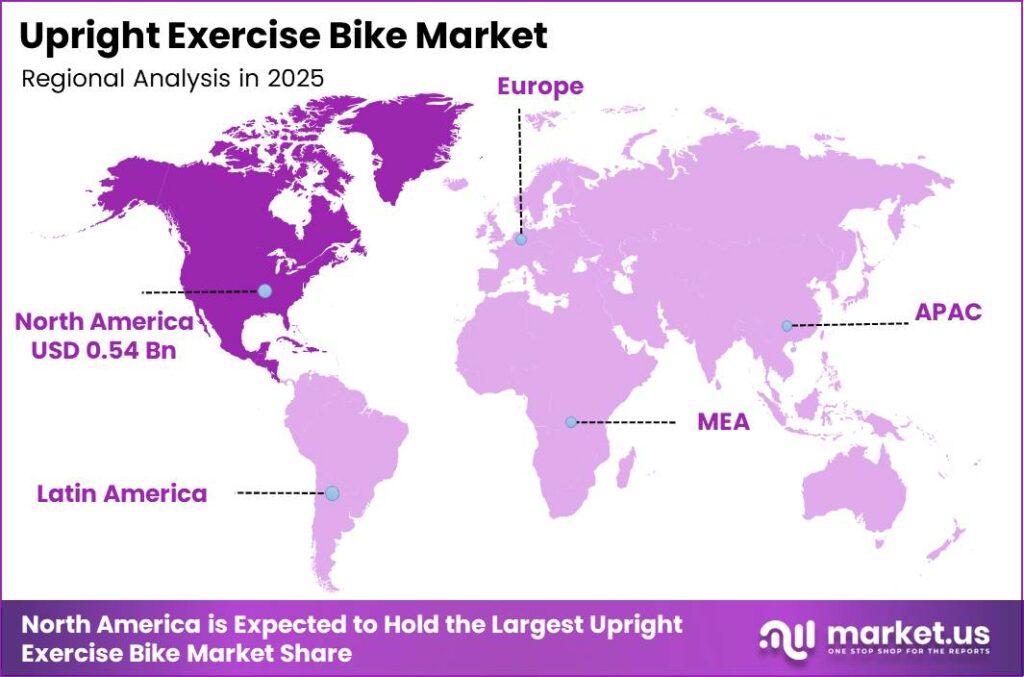
- North America leads regional revenue with a 36.45% share and an approximate USD 0.54 Billion value in 2025.
- Asia-Pacific holds the fastest-growing regional designation.
- Electromagnetic Resistance Upright Bikes and Home Consumer hold the fastest-growing designations within their respective categories.
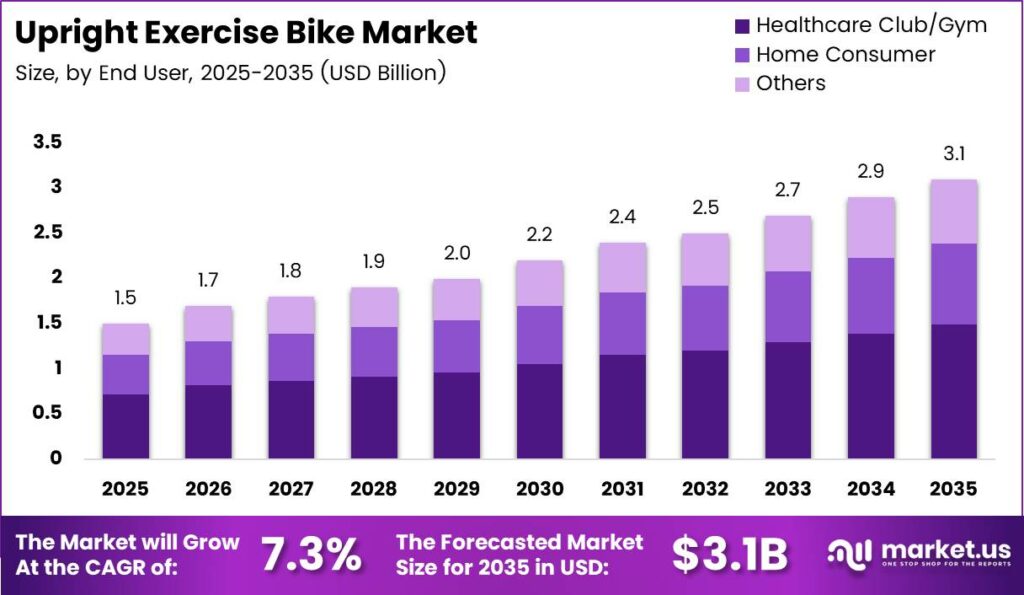
Commercial operators purchase equipment against operating cash flow, member retention, and replacement schedules rather than public-health need alone. As reported by HFA, surveyed operators recorded median revenue growth of 10.7% in 2025, strengthening the financial context for equipment investment. Suppliers can compete for that spending through reliable maintenance, clear financing terms, and evidence that their products improve facility use.
Product development increasingly connects conventional seated cycling with more varied training experiences, raising the importance of mechanical versatility. Data from a manufacturer announcement shows that the March 2024 Symbio debut included four machines and a hybrid upright cycling product with 100 resistance levels. Buyers should distinguish useful versatility from expensive complexity because additional functions create value only when members use them.
North America leads the 2025 market estimate with a 36.45% share, reflecting its central position in commercial and household purchasing. The investment case rests on replacement spending, service availability, and opportunities to attach digital support to equipment ownership. Suppliers should prioritize installation quality and account retention because regional leadership does not remove price competition or guarantee attractive returns on premium hardware.
Product Type Analysis
Magnetic Resistance Upright Bikes dominate with 32.89% share in 2025 due to quiet operation and adjustable workout intensity.
Magnetic Resistance Upright Bikes held a 32.89% share of the Product Type category in 2025. NordicTrack indicates that its upright-design model offers 24 digital resistance levels, illustrating how manufacturers package adjustable training intensity. Magnetic braking changes pedaling load without a friction pad contacting the flywheel, supporting quieter operation. Suppliers can differentiate through resistance consistency and comfortable adjustment rather than screen specifications alone.
Felt Pad Resistance Upright Bikes address buyers who favor straightforward mechanical controls and direct resistance adjustment over connected features. Figures from Sunny Health & Fitness show a 40 lb flywheel on its felt-resistance indoor cycling model, an adjacent rather than identical product category. Pad contact creates braking force through friction, making wear management relevant. Buyers should evaluate replacement-pad access and servicing alongside purchase price.
Electromagnetic Resistance Upright Bikes serve applications where buyers value precise load changes and repeatable exercise settings. According to Precor, its upright-bike specification reaches 750 watts at the stated resistance and cadence conditions, establishing a technical performance benchmark. Electronic load control can support programmed workouts, but that specification alone does not establish segment growth. Investors should assess control accuracy, component support, and service costs.
End User Analysis
Healthcare Club/Gym dominates with 46.78% share in 2025 due to shared equipment use and replacement purchasing.
Healthcare Club/Gym held a 46.78% share of the End User category in 2025. As reported by HFA, surveyed fitness operators recorded median net membership growth of 6.1% in 2025, supporting the commercial-use context. More participating members can increase equipment use, making durability and maintenance access relevant purchasing criteria. Vendors should compete on operating uptime rather than assume membership expansion produces proportional bike orders.
Home Consumer purchasing centers on convenience, available space, and the ability to sustain exercise without a facility visit. Data from iFIT shows that direct-to-consumer channels generated 44% of interactive-hardware revenue in fiscal 2021, a historical distribution measure rather than end-user share. Direct selling gives manufacturers control over product education and after-sales contact. Sellers must balance that control against delivery, returns, and support expenses.
Other end users include institutional settings where supervised movement, accessibility, and equipment suitability matter more than entertainment features. WHO found that an estimated 2.4 billion people lived with conditions that could benefit from rehabilitation, indicating health-service need rather than bike eligibility. Appropriate equipment selection depends on individual capability and professional assessment. Suppliers should establish clear intended uses instead of implying universal rehabilitation suitability.
Key Market Segments
By Product Type
- Magnetic Resistance Upright Bikes
- Felt Pad Resistance Upright Bikes
- Electromagnetic Resistance Upright Bikes
- Air Resistance Upright Bikes
- Others
By End User
- Healthcare Club/Gym
- Home Consumer
- Others
Regional Analysis
North America Dominates the Upright Exercise Bike Market with a Market Share of 36.45% in 2025, Valued at Approximately USD 0.54 Billion
North America combines commercial replacement purchasing with household equipment ownership, supporting its leading revenue position. Based on HFA data, 81 million Americans belonged to fitness facilities in 2025, establishing a substantial U.S. customer base for commercial suppliers. That national figure does not measure all North American buyers or upright-bike purchases. Manufacturers should target facility utilization and replacement schedules rather than infer equipment orders directly from membership.
Asia-Pacific holds the fastest-growing regional designation, but country selection matters more than treating the region as a uniform opportunity. WHO indicates that adult inactivity reached 48% in the high-income Asia-Pacific grouping in 2022, highlighting a prevention challenge within that specific geography. Health need alone does not establish purchasing power. Suppliers should match pricing, service coverage, and product positioning to individual national markets.
Key Regions and Countries
North America
- US
- Canada
Europe
- Germany
- France
- The UK
- Spain
- Italy
- Rest of Europe
Asia Pacific
- China
- Japan
- South Korea
- India
- Australia
- Rest of APAC
Latin America
- Brazil
- Mexico
- Rest of Latin America
Middle East and Africa
- GCC
- South Africa
- Rest of MEA
Market Dynamics
Competition increasingly depends on the cost of converting interest into sustained equipment use, not simply adding digital features. Figures from HFA show that 60.7% of surveyed operators expected higher marketing spending in 2026, signaling greater attention to customer acquisition. That spending does not represent equipment budgets. Manufacturers should demonstrate practical member value and measurable service performance to avoid competing only through discounts and promotional financing.
Drivers
Preventive exercise supports bike purchasing when consumers translate health goals into routines they can maintain at home or in facilities. According to HFA, U.S. fitness-facility membership reached 77 million in 2024, rising 5.6% after a 5.8% gain in 2023. Broader facility participation supports the commercial sales context, but manufacturers still need appropriate product placement and reliable service to capture that activity.
Accessible exercise formats can reduce the practical barriers that separate health intentions from regular participation. The analytical scenario assigns preventive-health adoption a +0.9 percentage-point contribution within the stated 7.3% growth framework, rather than treating that effect as an observed result. Manufacturers can pursue household purchases and commercial replacement business through simple controls, suitable seating, and ownership support that encourages continued use.
| Driver | (~) % Impact on CAGR Forecast | Geographic Relevance | Impact Timeline |
|---|---|---|---|
| Preventive-health exercise adoption | +0.9% | Global | Short term (≤ 2 years) |
| Fitness-facility participation recovery | +0.6% | North America and Europe | Short term (≤ 2 years) |
| Hybrid home-workout routines | +0.5% | Urban markets globally | Medium term (2–4 years) |
| Connected coaching engagement | +0.4% | Developed digital-fitness markets | Medium term (2–4 years) |
| Employer wellness procurement | +0.3% | North America, Europe and Asia-Pacific | Medium term (2–4 years) |
| Indoor climate resilience | +0.2% | Polluted and extreme-weather cities | Long term (≥ 4 years) |
Restraints
Public reimbursement exclusion weakens the argument for treating consumer upright bikes as insurance-funded medical purchases. As reported by CMS, exercise equipment falls outside Medicare durable-medical-equipment coverage because it is not primarily medical in nature. That classification constrains a direct payment route for household ownership. Suppliers must distinguish consumer equipment sales from covered clinical services and avoid suggesting that a medical recommendation automatically secures reimbursement.
Cash-pay purchasing exposes equipment sellers to affordability checks, financing decisions, and discretionary household budgets. The analytical scenario assigns reimbursement exclusion a -0.8 percentage-point effect within the 7.3% growth framework, not a measured causal deduction. Institutional budgets or eligible private-plan benefits may offer alternative routes, but sellers must verify each arrangement. Investors should test margins after financing costs, discounts, and channel incentives rather than evaluate list prices alone.
| Restraint | (~) % Impact on CAGR Forecast | Geographic Relevance | Impact Timeline |
|---|---|---|---|
| Public reimbursement exclusion | -0.8% | United States payer market | Short term (≤ 2 years) |
| Compact-home space limits | -0.6% | Dense urban markets globally | Long term (≥ 4 years) |
| Discretionary-spend sensitivity | -0.5% | Price-sensitive markets globally | Short term (≤ 2 years) |
| Commercial CapEx gatekeeping | -0.4% | Fitness facilities globally | Medium term (2–4 years) |
| Import-tax burden | -0.3% | Import-dependent markets | Medium term (2–4 years) |
| Low-usage purchase hesitation | -0.2% | Home-fitness markets globally | Short term (≤ 2 years) |
Challenges
Bulky equipment shipments expose manufacturers to freight-rate swings that can weaken margins before products reach retailers or households. Container disruption creates particular difficulty when sellers commit to customer prices before securing transport capacity. The freight scenario assigns a -0.7 percentage-point growth drag, an analytical assumption rather than an observed market result. Manufacturers should evaluate landed costs across purchasing cycles instead of relying on factory margins alone.
Inventory timing creates a separate operating problem because delayed shipments can miss sales windows while replacement stock ties up working capital. Regional final assembly, improved packaging, alternative ports, and indexed freight agreements offer potential mitigation paths rather than guaranteed savings. Distributors should match safety stocks to service commitments and product turnover. Investors should assess freight exposure alongside return rates, warehouse costs, and delivery obligations before comparing supplier profitability.
| Challenge | (~) % CAGR Friction Drag | Geographic Relevance | Mitigation Horizon |
|---|---|---|---|
| Bulky-freight cost volatility | -0.7% | Asia-Europe and Asia-Americas lanes | Short term (≤ 2 years) |
| Electronic component obsolescence | -0.5% | Connected-product markets | Medium term (2–4 years) |
| Last-mile service gaps | -0.4% | Dispersed and emerging markets | Medium term (2–4 years) |
| Product-safety governance | -0.3% | North America and Europe | Long term (≥ 4 years) |
| Inventory forecasting mismatch | -0.2% | Global omnichannel market | Short term (≤ 2 years) |
| Connected-data security | -0.2% | Regulated digital markets | Long term (≥ 4 years) |
Opportunities
Rental-and-service bundles can lower the purchase barrier, but subscription profitability does not automatically establish attractive equipment-rental economics. Data from Peloton shows fiscal first-quarter 2025 hardware gross margin of 9.2% versus subscription gross margin of 67.8%, highlighting the appeal of recurring services. Rental operators still carry financing, collection, refurbishment, and resale risks. Investors should evaluate cash recovery per deployed bike rather than apply subscription margins to the entire bundle.
Monthly bundles create a testable expansion route when operators can redeploy returned equipment economically and maintain reliable service. The scenario assumes a 60-75% reduction in initial customer cash requirements and a 6-10 percentage-point lifetime-margin improvement, neither an established industry outcome. The associated +0.7 percentage-point CAGR upside depends on execution. Early movers should validate payment performance, repair costs, and residual values before scaling financed equipment fleets.
| Opportunity | (~) % Potential CAGR Upside | Geographic Relevance | Execution Window |
|---|---|---|---|
| Rental-and-service bundles | +0.7% | Developed consumer markets | Short term (≤ 2 years) |
| Localized emerging-market assembly | +0.5% | India, Southeast Asia and Latin America | Medium term (2–4 years) |
| Senior-living deployment networks | +0.4% | North America, Europe and East Asia | Medium term (2–4 years) |
| Women-specific ergonomic segmentation | +0.3% | Global female consumer segment | Medium term (2–4 years) |
| Certified pre-owned ecosystems | +0.2% | North America and Europe | Short term (≤ 2 years) |
| Self-powered commercial fleets | +0.2% | Commercial facilities globally | Long term (≥ 4 years) |
Key Company Insights
Precor
Precor competes through commercial equipment, connected systems, and the service requirements of shared fitness environments. Peloton indicates that its consolidated portfolio included 178 issued U.S. patents at June 30, 2025, providing parent-level technology context rather than a standalone Precor count. Intellectual property may support product differentiation, but patents do not establish operating performance. Buyers should prioritize service access and documented equipment reliability when evaluating commercial contracts.
Holmes Place selected Precor in April 2026 to replace cardio equipment across 12 clubs in Portugal, according to Precor. The agreement illustrates how standardized equipment and connected consoles can support purchasing across an operator’s estate. The announcement does not identify an upright-bike unit count, so the contract should not become a bike-sales estimate. Suppliers can pursue similar accounts through coordinated installation, training, and maintenance delivery.
NordicTrack
NordicTrack competes within iFIT’s home-fitness portfolio, where hardware and digital coaching support a combined customer proposition. As reported by iFIT’s SEC filing, commissioned research showed more than 91% aided U.S. brand awareness in 2021, indicating historical recognition rather than current bike share. Brand familiarity can support consideration, but conversion still depends on price and ownership experience. Investors should separate awareness from retention and profitable customer acquisition.
NordicTrack unveiled its licensed Tour de France Indoor Bike in March 2025 at a recommended price of €2,999. Data from iFIT’s announcement shows a numbered limited-edition product, positioning the launch around cycling identity and premium ownership. The model belongs to indoor cycling rather than automatically defining conventional upright equipment. Sellers should assess whether licensing supports durable pricing power or mainly creates a temporary promotional distinction.
Key Players
- Cybex
- Precor
- NordicTrack
- ProForm
- Royal Fitness
- SportsArt
- HOIST Fitness
- ICON Health & Fitness
- Bodycraft
- Xiamen Evere Sports Goods
- Other Key Players
Recent Developments
2026
- June 2026: Interactive Strength, Ergatta, and iFIT expanded their content licensing agreement for two years, extending it through mid-2028. The agreement supports continued content distribution across compatible equipment, according to the company announcement.
- March 2026: Interactive Strength completed its Ergatta acquisition with a stated base transaction value of USD 8.8 million. The transaction represents broader connected-fitness consolidation rather than a conventional upright-bike acquisition, according to the corporate release.
- March 2026: Precor and Peloton introduced a Commercial Series with two products designed for facilities recording eight or more hours of daily equipment use. The announcement positioned commercial engineering as a route into heavier-use settings, according to Precor.
2025
- October 2025: Peloton launched its Cross Training Series across five connected devices. The portfolio linked cycling, running, and rowing equipment within a broader training proposition, according to Peloton’s investor announcement.
- October 2025: Peloton announced a distribution partnership with Johnson Fitness & Wellness, a retailer with 100 U.S. locations. The network figure describes the retail partner’s footprint, not confirmed product stocking at every location, according to Peloton.
- July 2025: iFIT and Ergatta expanded their partnership across three cardio modalities: treadmills, bikes, and rowers. The agreement extends gaming content across hardware categories rather than relying on a single equipment format, according to iFIT’s release.
- July 2025: Interactive Strength acquired 100% of Wattbike through an all-stock transaction with up to 60% of consideration linked to performance hurdles. The structure connects part of acquisition value to subsequent execution, according to the company announcement.
- June 2025: iFIT expanded its AI Coach beta to 19 countries. The rollout extended personalized workout recommendations across selected compatible equipment, supporting software differentiation beyond hardware specifications, according to iFIT.
2024
- September 2024: iFIT announced more than 40 smart or smart-enabled products across NordicTrack and ProForm. The launch linked hardware refreshes with software development, increasing the importance of compatibility and ongoing product support, according to iFIT’s announcement.
- September 2024: Precor received a Sourcewell procurement agreement valid through 2028, providing access through a network exceeding 50,000 participating agencies. The contract simplifies an institutional purchasing route but does not represent confirmed equipment orders, according to Precor.
- September 2024: Precor announced its David Lloyd Clubs supply agreement and identified completed installations at four named sites. The announcement illustrates an account-led rollout without establishing the total contracted equipment volume, according to Precor.
Geopolitical Impact Analysis
Red Sea disruption and changing shipping routes create a planning problem for equipment suppliers that depend on internationally sourced components and finished bikes. UNCTAD found that maritime trade grew 2.2% in 2024, while its September 2025 outlook projected only 0.5% growth for 2025. The second figure remains a dated forecast, not an observed result or a current outlook. Upright-bike supply chains combine steel frames, flywheels, resistance assemblies, and electronic controls that require coordinated delivery. Slower trade growth does not guarantee cheaper freight when route disruption restricts effective capacity. Manufacturers should therefore assess component availability and transport commitments together before promising distributor delivery dates or fixed landed prices.
Vessel rerouting can increase inventory exposure even when shipment volumes change only modestly, making route length relevant to equipment working capital. Based on UNCTAD data, shipping carries over 80% of world merchandise trade, while maritime ton-miles increased 5.9% in 2024. Those economy-wide figures do not measure upright-bike freight costs, but they explain why distance matters alongside cargo volume. Longer routes can delay steel components, magnets, circuit boards, and finished equipment moving through linked production schedules. Distributors then face choices between larger inventories and weaker delivery availability. Buyers should compare replenishment commitments, spare-parts access, and freight-adjustment clauses rather than assume the lowest factory price produces the lowest total ownership cost.
Report Scope
| Report Features | Description |
|---|---|
| Market Value (2025) | USD 1.5 Billion |
| Forecast Revenue (2035) | USD 3.1 Billion |
| CAGR (2026-2035) | 7.3% |
| Base Year for Estimation | 2025 |
| Historic Period | 2021-2024 |
| Forecast Period | 2026-2035 |
| Estimate Framework | Market sizes, segment shares, regional shares, fastest-growing designations, and CAGR are working market estimates. Primary-source statistics provide contextual or technical support, not independent validation of those estimates. Rounded revenue endpoints and the stated CAGR should not be treated as a fully reconciled forecast model. |
| Report Coverage | Revenue Forecast, Market Dynamics, Market Opportunity Analysis, Technology and Innovation Landscape, Competitive Landscape, Recent Developments |
| Segments Covered | By Product Type (Magnetic Resistance Upright Bikes, Felt Pad Resistance Upright Bikes, Electromagnetic Resistance Upright Bikes, Air Resistance Upright Bikes, Others), By End User (Healthcare Club/Gym, Home Consumer, Others) |
| Regional Analysis | North America (US and Canada), Europe (Germany, France, The UK, Spain, Italy, and Rest of Europe), Asia Pacific (China, Japan, South Korea, India, Australia, and Rest of APAC), Latin America (Brazil, Mexico, and Rest of Latin America), Middle East and Africa (GCC, South Africa, and Rest of MEA) |
| Competitive Landscape | Cybex, Precor, NordicTrack, ProForm, Royal Fitness, SportsArt, HOIST Fitness, ICON Health & Fitness, Bodycraft, Xiamen Evere Sports Goods, Other Key Players |
| Classification Boundaries | Indoor-cycling products appear as adjacent technical or competitive examples. Their inclusion does not establish their inclusion in upright-bike revenue estimates. The Healthcare Club/Gym label requires a consistent distinction between commercial fitness and clinical rehabilitation users. |
| Customization Scope | Customization for segments, region / country-level will be provided. Additional customization can be done based on requirements. |
| Purchase Options | Single User License | Multi-User License (Up to 5 Users) | Corporate Use License (Unlimited User and Printable PDF) |