Report Overview
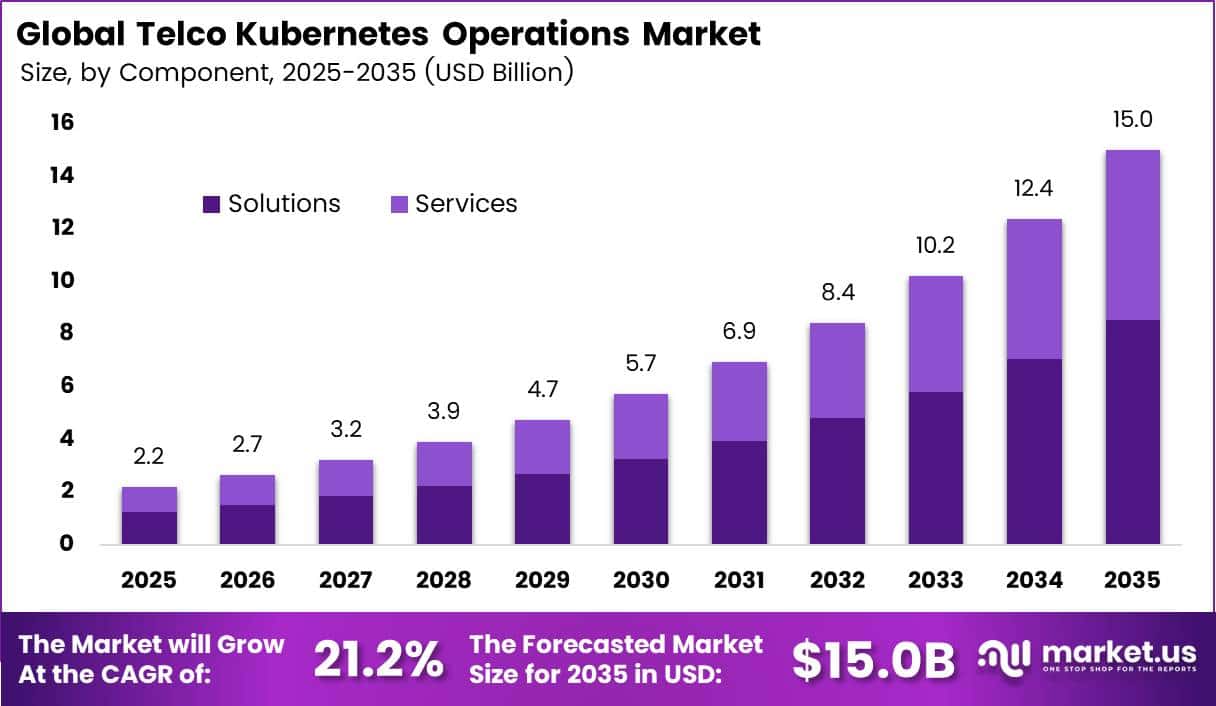
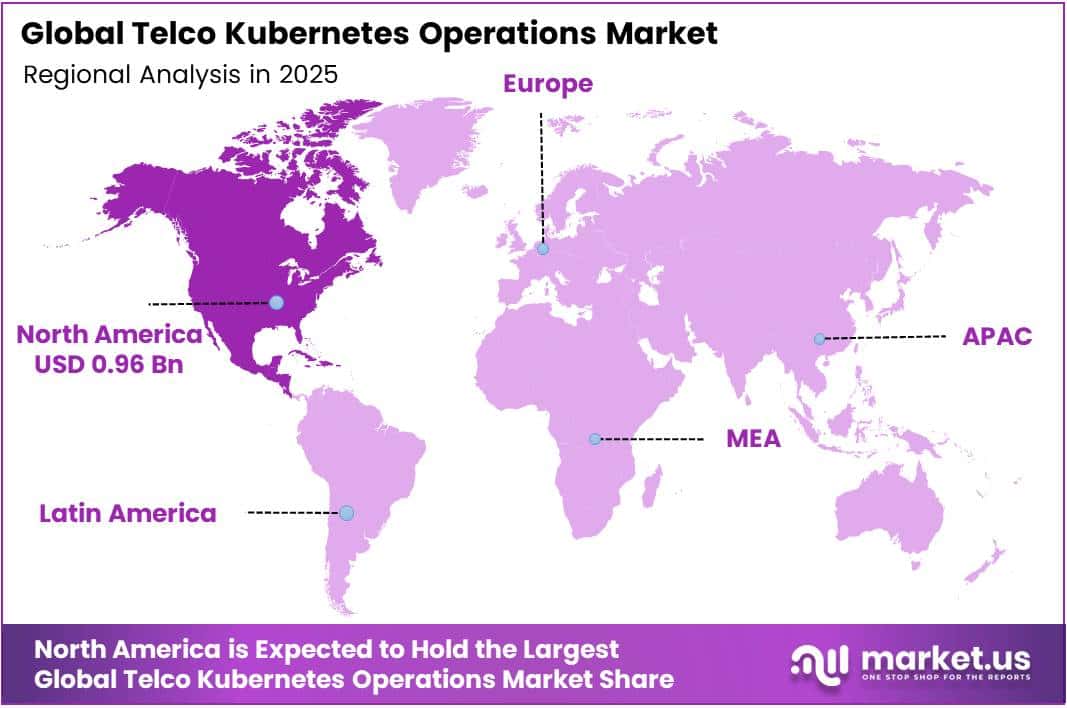
In 2025, the Global Telco Kubernetes Operations Market was valued at USD 2.2 billion. The market is projected to grow at a CAGR of 21.2% during 2026–2035, reaching approximately USD 15.0 billion by 2035. North America dominated the global market in 2025, accounting for more than 43.8% of the total market share and generating approximately USD 0.96 billion in revenue.
Telecom operators are moving their core networks from fixed hardware to cloud-native software, and Kubernetes runs that software in containers at scale. The Ericsson Mobility Report shows that operators added about 660 million 5G subscriptions in 2025. Global 5G subscriptions now stand close to 3.3 billion. Each 5G standalone core runs functions such as AMF, SMF, and UPF as containers.
The North America region has the deepest 5G adoption in the world. Ericsson data shows that 5G reached 79% of all mobile subscriptions in North America at the end of 2025. US operators also run the largest 5G fixed wireless access base in the world, with 11.6 million connections, according to the GSMA. These networks need container platforms that can handle steady growth in users and traffic.
Key Takeaways
- The Telco Kubernetes Operations Market reached USD 2.2 billion in 2025 and will reach USD 15.0 billion by 2035. at a CAGR of 21.2% from 2026 to 2035.
- By component, Solutions lead with a 57.0% share.
- By deployment mode, On-premises leads with a 52.3% share.
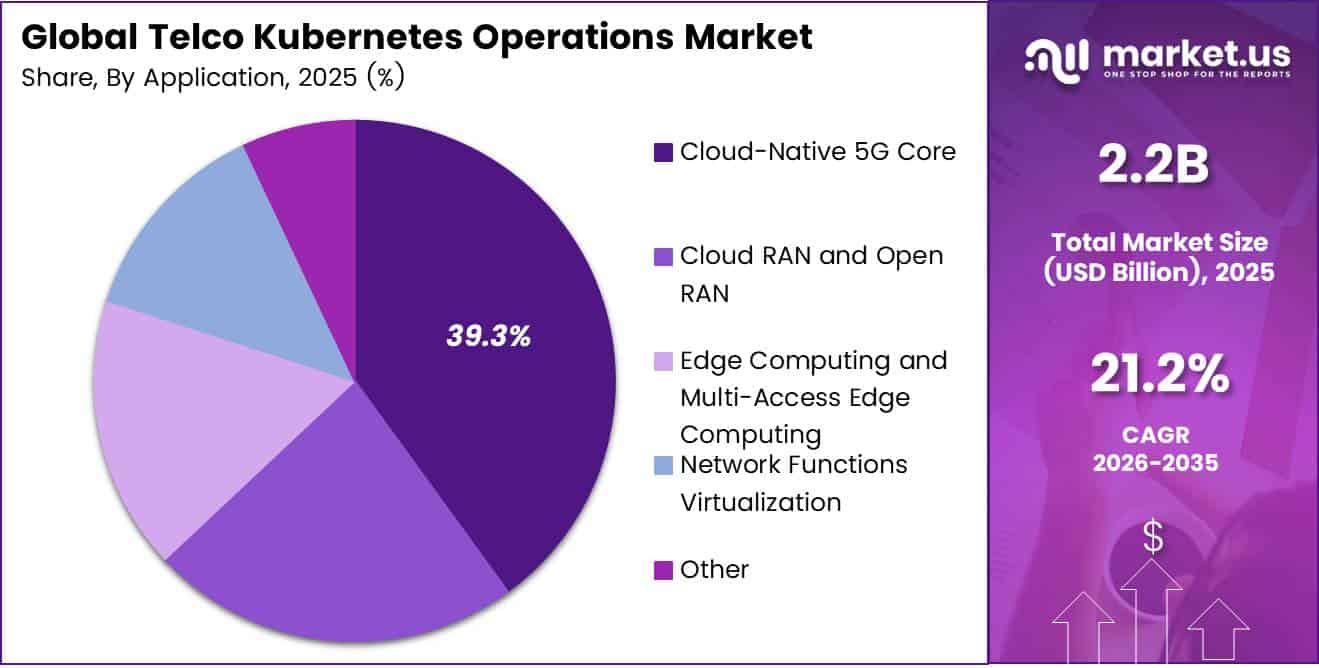
- By application, Cloud-Native 5G Core leads with a 39.3% share.
- By end user, Mobile Network Operators lead with a 68.5% share.
- North America leads with a 43.8% share and USD 0.96 billion in revenue.
By Component
Solutions dominates with 57.0% due to carrier-grade platforms anchoring every telco rollout.
Solutions lead the market because operators must buy a stable software base before they can run any cloud-native network. The Cloud Native Computing Foundation reports that 82% of container users now run Kubernetes in production, up from 66% in 2023. Telecom operators follow the same path.
Services grow the fastest because most operators lack enough in-house Kubernetes skills. The same CNCF survey finds that 98% of organizations have adopted cloud-native methods, so demand for skilled teams now outpaces supply. Operators hire professional services firms to design, test, and move workloads.
By Deployment Mode
On-premises dominates with 52.3% due to operator control over core network data.
On-premises deployment holds the top share because telecom operators want full control over core network data and traffic. The Global Mobile Suppliers Association (GSA) counts 181 operators in 73 countries investing in public 5G standalone networks, and these networks need a cloud-native core. Most operators place that core in their own data centers to meet national data rules, low-delay targets, and strict uptime goals.
Cloud deployment grows the fastest as operators look for flexible capacity and quicker launches. GSA reports that at least 89 operators have launched public 5G standalone services, and Europe, the Middle East, and Africa lead with 40 live networks. Many of these operators now test public and hybrid cloud models for non-critical workloads, test labs, and traffic peaks.
By Application
Cloud-Native 5G Core dominates with 39.3% due to standalone 5G core migration demand.
Cloud-Native 5G Core leads because the core is the first network layer that operators move onto Kubernetes. Ericsson reports that global 5G subscriptions are close to 3.3 billion, and operators added about 660 million of them in 2025. This scale pushes operators to run core functions as small, container-based parts that they can update and scale without service breaks.
Edge Computing and Multi-Access Edge Computing grow the fastest as data demand moves closer to users. Ericsson finds that mobile network data traffic rose 23% between Q2 2025 and Q2 2026. Sending all this traffic to central data centers adds delay and cost. Operators therefore place small Kubernetes clusters at cell sites and local hubs to serve gaming, video, factory automation, and connected vehicles.
By End User
Mobile Network Operators dominate with 68.5% due to large-scale standalone 5G network ownership.
Mobile Network Operators hold the largest share because they run the biggest and most complex networks in telecom. Ericsson notes that around 390 service providers have launched commercial 5G services, and more than 90 of them have launched 5G standalone. Each move to standalone 5G pushes these operators to adopt Kubernetes for core, radio, and edge workloads at large scale.
Cloud Service Providers and Managed Service Providers grow the fastest as more operators shift network tasks to outside partners. Ericsson expects 5G standalone subscriptions to climb from 1,690 million in 2025 to 4,140 million by 2031, a yearly growth rate of 16%.
Many operators cannot build this capacity alone, so they turn to hyperscalers and managed providers that already run Kubernetes worldwide. GSA also tracks 2,750 announced 5G standalone devices, up 30% year on year, which adds demand for flexible cloud capacity.
Key Market Segments
By Component
- Solutions
- Carrier-Grade Kubernetes Distributions
- Cluster Management and Policy Governance
- Network Automation and Orchestration
- Services
- Professional Services
- Managed Kubernetes Operations
By Deployment Mode
- On-premise
- Cloud
By Application
- Cloud-Native 5G Core
- Cloud RAN and Open RAN
- Edge Computing and Multi-Access Edge Computing
- Network Functions Virtualization
- Other
By End User
- Mobile Network Operators
- Fixed-Line Operators
- Mobile Virtual Network Operators and Mobile Virtual Network Enablers
- Cloud Service Providers and Managed Service Providers
- Other
Geopolitical Impact Analysis
Trade tensions are raising the cost of the hardware that Kubernetes runs on. Telco clusters need servers, network cards, chips, and accelerators, and much of this hardware comes from Asian supply chains. UNCTAD reports that the United States added a 10% tariff on most imports from all countries in April 2025.
Higher country-specific rates took effect on 7 August 2025. US tariffs on Chinese goods peaked at 145% in April 2025, which pushed up the price of servers built in China. Shipping routes add further cost and delay. UNCTAD notes that ships that once crossed the Red Sea in days now sail around the Cape of Good Hope. This route adds about 10 to 14 days to Asia-to-Europe trips.
Trade growth has also slowed. UNCTAD expected global container volume to grow only 1.4% in 2025, and ton-miles to rise just 0.3%. The WTO cut its 2025 outlook and warned that merchandise trade volume could fall 0.2%. Slower trade raises freight risk for operators that buy edge servers from overseas makers.
Security policy is changing vendor choice. Many Western governments limit Huawei gear in core networks. This pushes operators toward Western vendors and hyperscaler platforms, and it raises demand for carrier-grade Kubernetes that runs on many types of hardware.
Regional Analysis
North America dominates the Telco Kubernetes Operations Market, holding a 43.8% share and generating USD 0.96 billion in revenue. The US drives most of this demand. Big US carriers have moved from 4G virtual cores to cloud-native 5G standalone cores, and they run their network functions on container platforms.
Nokia’s Network Infrastructure sales rose 23% to EUR 7,986 million in 2025, helped by demand from AI and cloud customers in the region. NVIDIA and Nokia picked T-Mobile US for AI-RAN trials starting in 2026, which will add more Kubernetes workloads at cell sites.
Asia Pacific is the fastest-growing region in the Telco Kubernetes Operations Market. Ericsson data shows that 5G reached 60% of mobile subscriptions in Northeast Asia at the end of 2025. China, Japan, and South Korea run large 5G standalone networks with heavy container use. Rakuten Symphony in Japan built one of the first fully cloud-native mobile networks.
Europe holds a strong position in the market. Ericsson data shows that 5G reached 54% of subscriptions in Western Europe at the end of 2025. Nokia’s sales in Europe came to EUR 6,165 million in 2025, down 3%, which shows that operator budgets remain tight. Germany, France, the UK, Spain, and Italy lead in Open RAN pilots and in moving 5G cores into containers.
Key Regions and Countries
North America
- US
- Canada
Europe
- Germany
- France
- The UK
- Spain
- Italy
- Rest of Europe
Asia Pacific
- China
- Japan
- South Korea
- India
- Australia
- Rest of APAC
Latin America
- Brazil
- Mexico
- Rest of Latin America
Middle East and Africa
- GCC
- South Africa
- Rest of MEA
Market Dynamics
Drivers
| Driver | (~) % Impact on CAGR Forecast | Geographic Relevance | Impact Timeline |
|---|---|---|---|
| 5G Standalone Cloud-Native Core Rollouts | +2.6% | Global, led by North America and APAC | Short term (2 years or less) |
| Open RAN and vRAN Containerization | +1.9% | North America, Europe, Japan, India | Medium term (2 to 4 years) |
| Hypervisor Exit and Bare-Metal Kubernetes Migration | +1.6% | Europe, North America | Short term (2 years or less) |
| GitOps and Intent-Based Automation Adoption | +1.2% | Global | Medium term (2 to 4 years) |
| Hyperscaler–Operator Telco Cloud Partnerships | +0.9% | North America, Middle East, Europe | Short term (2 years or less) |
5G Standalone Cloud-Native Core Rollouts
The root cause is architectural. 3GPP Release 15 to Release 17 specifications define the 5G Standalone core as a service-based architecture, and that design forces control-plane and user-plane functions into microservices running on Kubernetes rather than monolithic VNFs. Ericsson Mobility Report data shows global 5G subscriptions moving toward roughly 2.9 billion by end-2025.
In practical terms, a single SA core deployment now involves hundreds of CNFs spread across regional and edge clusters. Operator CapEx guidance shows network software taking a growing share of budgets that are otherwise flat at around 15–18% capital intensity.
The business model is moving away from perpetual VNF licences bundled with hardware and toward subscription-based Kubernetes platform and operations contracts. Annual recurring support typically runs 18–25% of initial platform value. Lifecycle tooling also cuts upgrade windows from quarterly to near-continuous cadences.
Restraints
| Restraint | (~) % Impact on CAGR Forecast | Geographic Relevance | Impact Timeline |
|---|---|---|---|
| Telco CapEx Contraction Cycle | -1.8% | Global, acute in Europe and North America | Short term (2 years or less) |
| Legacy VNF Sunk-Cost Lock-In | -1.2% | Europe, Latin America, Africa | Medium term (2 to 4 years) |
| High-Vendor Supplier Exclusion Mandates | -0.9% | EU, UK, US, India | Short term (2 years or less) |
| Elevated Cost of Capital | -0.8% | Emerging Markets, Europe | Short term (2 years or less) |
| Data Sovereignty Hosting Restrictions | -0.6% | EU, Middle East, India | Medium term (2 to 4 years) |
Telco CapEx Contraction Cycle
The peak of the 5G RAN build-out has passed, and operators are now cutting spend because revenue growth is weak. GSMA Intelligence data puts global operator revenue growth at roughly 2–3% nominal per year. The 2024 and 2025 annual reports of Ericsson and Nokia show mobile network sales falling by double-digit percentages in several quarters, which confirms a cyclical trough in network spending.
The bottleneck shows up at the approval stage. Operators such as Vodafone and BT Group, in investor guidance, have committed to cutting multi-year costs by £2–3 billion-scale amounts. Discretionary cloud-native transformation programmes are being re-phased, and platform consolidation projects that are already approved face 6–12 month delays before purchase orders are issued.
Vendors face margin compression because operators demand fixed-price outcomes and 20–30% lower per-cluster pricing. As a result, current Kubernetes operations deals are frozen or shrinking even where the technical case is proven. This drag hits brownfield Tier-1 operators most, while greenfield entrants feel it less.
Challenges
| Challenge | (~) % CAGR Friction Drag | Geographic Relevance | Mitigation Horizon |
|---|---|---|---|
| Cloud-Native Telco Talent Gap | -1.5% | Global | Long term (4 years or more) |
| CNF Interoperability and Certification Fragmentation | -1.1% | Global | Medium term (2 to 4 years) |
| Multi-Cluster Edge Observability Complexity | -0.8% | North America, APAC | Medium term (2 to 4 years) |
| Container Supply Chain Security Compliance | -0.7% | EU, US | Medium term (2 to 4 years) |
| Real-Time Performance Tuning Limits | -0.5% | Global | Short term (2 years or less) |
Cloud-Native Telco Talent Gap
The vulnerability comes from mixing two skill sets. Running Kubernetes for telcos requires deep knowledge of 3GPP protocols alongside SRE, GitOps, and platform engineering skills, and today’s labour pool rarely has both. Cloud Native Computing Foundation and Linux Foundation workforce surveys consistently show more than 50% of organisations citing skills shortages as the main barrier to Kubernetes adoption.
The friction shows up in pay and time-to-deployment. Per national labour statistics offices and operator workforce disclosures, salary premiums for platform engineers with telco experience run 25–40% above generalist DevOps roles. Deutsche Telekom and Vodafone transformation updates point to multi-year staff reskilling programmes covering several thousand network engineers.
Closing the gap requires long-term corporate changes. These include in-house platform academies, automation-first operating models that target 30–50% fewer manual interventions per cluster, and a greater reliance on managed operations partners. None of these moves stops current sales, but each limits how fast operators can scale their cloud-native estates.
Opportunities
| Opportunity | (~) % Potential CAGR Upside | Geographic Relevance | Execution Window |
|---|---|---|---|
| AI-Driven Autonomous Cluster Operations | +2.1% | Global | Medium term (2 to 4 years) |
| Edge AI Inference Hosting on Telco Kubernetes | +1.6% | North America, APAC, Middle East | Long term (4 years or more) |
| Sovereign Telco Cloud Platforms | +1.1% | EU, India, GCC | Medium term (2 to 4 years) |
| Tier-2/Tier-3 Operator Managed Kubernetes | +0.9% | Africa, Southeast Asia, Latin America | Medium term (2 to 4 years) |
| Private 5G Enterprise Cluster Services | +0.7% | Europe, North America, Japan | Long term (4 years or more) |
AI-Driven Autonomous Cluster Operations
This is still white space rather than a current driver. Today’s Kubernetes operations depend on rule-based GitOps pipelines, and closed-loop autonomy remains largely at pilot stage. TM Forum autonomous networks benchmarking shows most operators assessing themselves at Level 2–3 of a 5-level scale, and few commercial deployments have reached Level 4 intent-driven self-operation.
The unit-economic gain could be large. Operator earnings calls from AT&T and SK Telecom point to AI-assisted operations targeting 30–40% reductions in network operations OpEx. Applied to Kubernetes estates, that could plausibly cut the cost per managed cluster by 25–35% and mean time to repair by more than 50%.
Vendors that package agentic remediation as outcome-based subscriptions could lift gross margins from services-heavy 30–35% to software-like 60–70%. Doing so would turn a large share of unmonetised operations labour into a new monetisation layer. Capturing this upside will require deliberate investment in telemetry data models, and in the governance frameworks ETSI ZSM specifications are aligning to.
Key Players Analysis
Tier 1 market leaders include Nokia, Ericsson, Huawei, Red Hat, Broadcom, and the major hyperscalers. Nokia posted 2025 net sales of EUR 19,889 million, up 3%, and spent EUR 4,855 million on R&D. That spend equals 24.4% of sales. Nokia also generated EUR 1.5 billion in free cash flow and targets 6% to 8% yearly sales growth through 2028.
Ericsson reported 2025 net sales of SEK 236.7 billion and net income of SEK 28.7 billion. Its adjusted gross margin reached 48.0% in the fourth quarter, helped by its Cloud Software and Services unit. Ericsson also launched a managed 5G core service on Google Kubernetes Engine in June 2025. Broadcom completed its purchase of VMware for about USD 69 billion, which gives it the Tanzu and Telco Cloud Platform stacks.
Hyperscalers are expanding their role in this market. HPE paid USD 14 billion for Juniper Networks and expects at least USD 600 million in yearly savings. NVIDIA put USD 1.0 billion into Nokia for a 2.90% stake to run RAN software on accelerated hardware.
Tier 2 challengers include Wind River, Rakuten Symphony, Cisco, and Hewlett Packard Enterprise. These firms win through carrier-grade edge platforms, Open RAN software, and network automation tools. Wind River focuses on low-latency edge clusters. Rakuten Symphony sells its cloud-native platform to operators outside Japan.
Top Key Players in the Market
- Red Hat, Inc.
- Wind River Systems, Inc.
- Rakuten Symphony, Inc.
- Broadcom Inc.
- Nokia Corporation
- Telefonaktiebolaget LM Ericsson
- Huawei Technologies Co., Ltd.
- Cisco Systems, Inc.
- Hewlett Packard Enterprise Company
- Amazon Web Services, Inc.
- Microsoft Corporation
- Google LLC
Recent Developments
- In November 2026, NVIDIA disclosed that it sold 93.53 million Nokia shares in the third quarter, a 56% cut in its stake. It kept 72.86 million shares worth USD 738.8 million, and the AI-RAN partnership with Nokia continues.
- In July 2025, Hewlett Packard Enterprise closed its USD 14 billion purchase of Juniper Networks. The deal doubled HPE’s networking business for cloud-native, AI-driven operations.
- In August 2025, Ericsson completed the sale of its iconectiv unit for about USD 1 billion. The sale lets Ericsson focus on its core networks and cloud software.
- In February 2025, Nokia completed its USD 2.3 billion purchase of Infinera. The deal added EUR 1,258 million to Nokia’s 2025 net sales.
Report Scope
| Report Features | Description |
|---|---|
| Market Value (2025) | USD 2.2 Billion |
| Forecast Revenue (2035) | USD 15.0 Billion |
| CAGR (2026-2035) | 21.2% |
| Base Year for Estimation | 2025 |
| Historic Period | 2020-2024 |
| Forecast Period | 2026-2035 |
| Report Coverage | Revenue Forecast, Market Dynamics, Competitive Landscape, Recent Developments |
| Segments Covered | By Component (Solutions, Carrier-Grade Kubernetes Distributions, Cluster Management and Policy Governance, Network Automation and Orchestration, Services, Professional Services, Managed Kubernetes Operations); By Deployment Mode (On-premises, Cloud); By Application (Cloud-Native 5G Core, Cloud RAN and Open RAN, Edge Computing and Multi-Access Edge Computing, Network Functions Virtualization, Other); By End User (Mobile Network Operators, Fixed-Line Operators, Mobile Virtual Network Operators and Mobile Virtual Network Enablers, Cloud Service Providers and Managed Service Providers, Other) |
| Regional Analysis | North America – US, Canada; Europe – Germany, France, The UK, Spain, Italy, Rest of Europe; Asia Pacific – China, Japan, South Korea, India, Australia, Singapore, Rest of APAC; Latin America – Brazil, Mexico, Rest of Latin America; Middle East & Africa – GCC, South Africa, Rest of MEA |
| Competitive Landscape | Red Hat, Inc., Wind River Systems, Inc., Rakuten Symphony, Inc., Broadcom Inc., Nokia Corporation, Telefonaktiebolaget LM Ericsson, Huawei Technologies Co., Ltd., Cisco Systems, Inc., Hewlett Packard Enterprise Company, Amazon Web Services, Inc., Microsoft Corporation, Google LLC |
| Customization Scope | Customization for segments, region/country-level will be provided. Moreover, additional customization can be done based on the requirements. |
| Purchase Options | We have three licenses to opt for: Single User License, Multi-User License (Up to 5 Users), Corporate Use License (Unlimited Users and Printable PDF) |