Report Overview
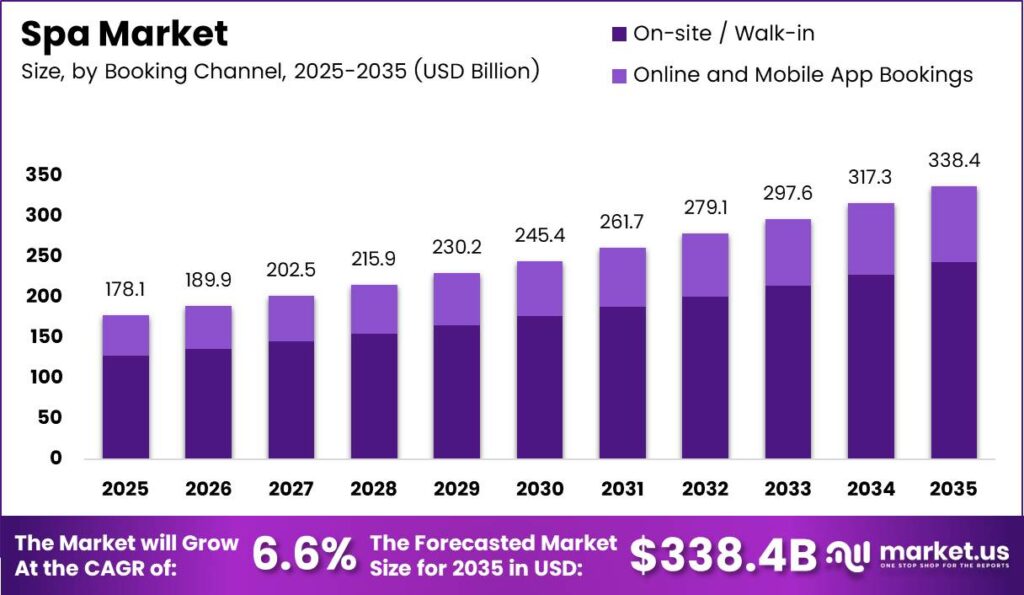
Global Spa Market size is expected to reach USD 338.4 Billion by 2035, compared with USD 178.1 Billion in 2025. The forecast uses a CAGR of 6.6% during 2026 to 2035. Spa businesses provide personal-care, relaxation, and wellness services through dedicated facilities and hospitality properties. Investor returns depend on repeat visits, treatment-room productivity, and the ability to protect service margins.
Hospitality-linked facilities and local service operators compete through different customer-acquisition models, making distribution as important as treatment selection for commercial performance and site economics. According to UN Tourism, international arrivals reached approximately 1.4 billion in 2024, expanding the travel pool available to hospitality operators. Hotels can introduce spa services during an existing stay, while local operators must build repeat relationships. Investors should assess customer conversion rather than equating tourism volumes with spa visits.
Key Takeaways
- Global Spa Market size is expected to reach USD 338.4 Billion by 2035, compared with USD 178.1 Billion in 2025 at a CAGR of 6.6% during 2026 to 2035
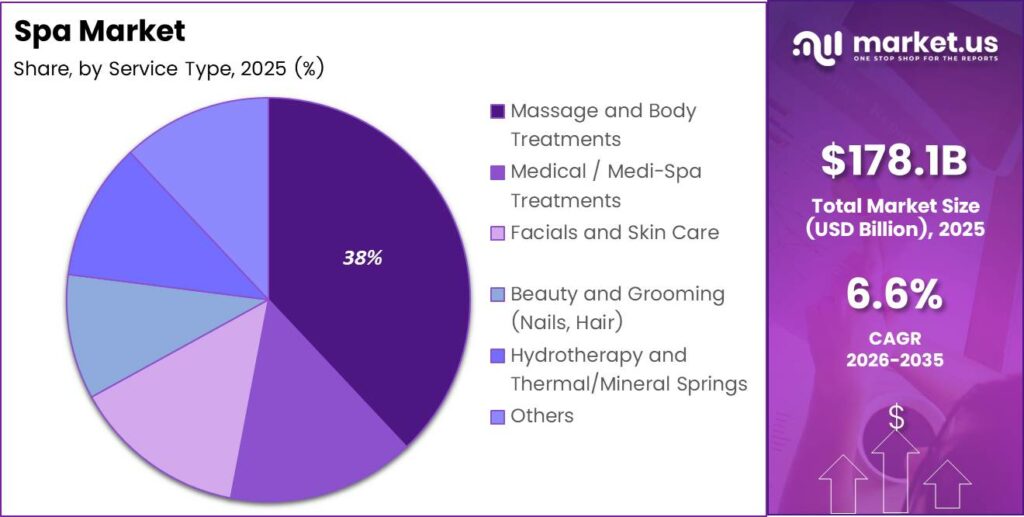
- Massage and Body Treatments lead Service Type with a 37.12% share in 2026.
- Day / Club Spas lead Facility Type with a 43.23% share in 2026.
- On-site / Walk-in leads Booking Channel with a 71.34% share in 2026.
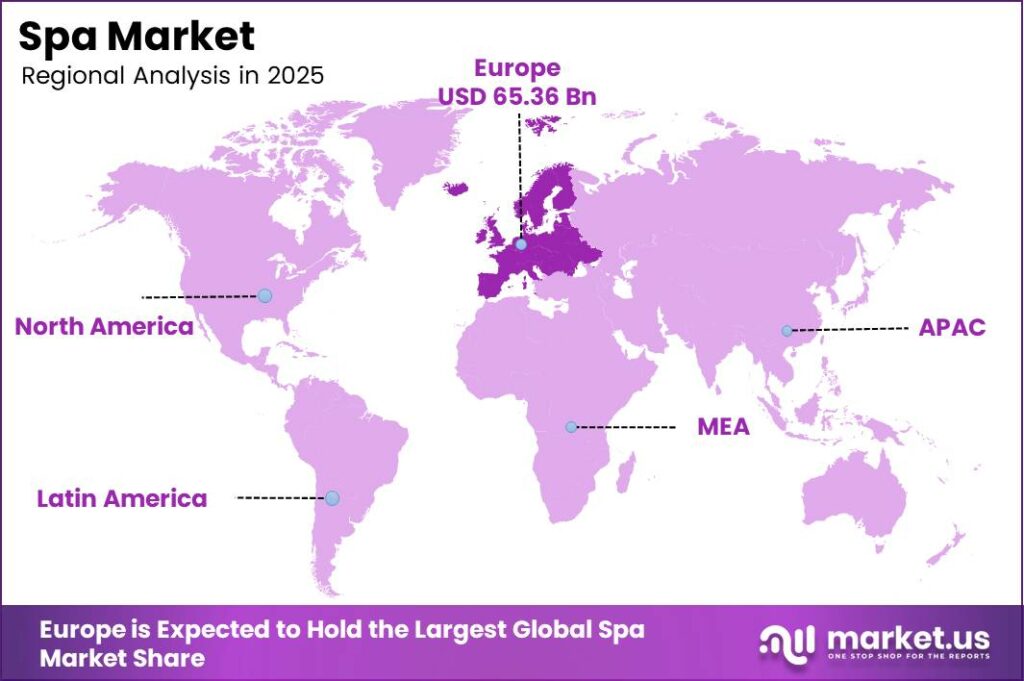
- Europe leads with a 36.78% share in 2026 and a stated value of USD 65.36 Billion.
- Asia-Pacific represents the fastest-growing regional category in the forecast framework.
Personal-care spending provides an adjacent commercial benchmark, while product governance shapes procurement decisions across professional treatment menus and associated retail shelves in spa facilities. As reported by Cosmetics Europe, European cosmetics and personal-care retail sales reached €104 billion in 2024. Those sales represent products rather than spa services, but they indicate an established spending category. Buyers should prioritize compliant formulations, supplier documentation, and traceable purchasing before expanding retail shelves.
Urban hospitality projects continue to allocate space to wellness services, but announced capacity requires careful underwriting before investors treat construction plans as operating assets. Figures from Accor show a planned 10,000-square-foot spa at Fairmont New Orleans within its January 2026 opening programme. Dedicated spa space creates another potential revenue stream alongside accommodation. Investors should distinguish planned facilities from completed operations and test whether local traffic can support the proposed footprint.
Europe holds the leading regional position, representing a 36.78% share in 2026, with a stated regional valuation of USD 65.36 Billion. The region’s investment case depends on converting established hospitality and personal-care spending into repeat service revenue. Operators should favor accessible locations, differentiated treatment menus, and disciplined labor scheduling. Regional leadership alone does not protect an individual facility from weak utilization or excessive property costs.
Service Type Analysis
Massage and Body Treatments dominate with 37.12% share in 2026 due to repeatable services across diverse customer groups.
In 2026, Massage and Body Treatments held a 37.12% share in the Service Type segment of the Spa Market. Data from NIH shows 10.9% of US adults used massage in 2022, demonstrating utilization beyond destination travel. Hands-on delivery ties sales directly to therapist availability, making staffing discipline central to margins. Operators can strengthen returns through repeat appointments and scheduling that reduces otherwise unproductive treatment-room time.
Medical / Medi-Spa Treatments connect aesthetic services with clinical oversight, making governance central to the fastest-growing service category in the forecast framework for this market. According to FDA guidance, approved dermal-filler uses concern adults aged 22 years or older, defining an eligibility boundary rather than treatment volume. Injectable services require different clinical controls from conventional relaxation treatments. Investors should examine practitioner credentials, treatment protocols, and insurance terms before funding expansion.
Facials and Skin Care connect professional treatments with home-care purchases, allowing operators to maintain customer relationships between appointments and support repeat visits over time. As reported by Cosmetics Europe, European skin-care retail sales reached €30.1 billion in 2024, illustrating adjacent product spending rather than facial-service revenue. Personalized product selection can extend the commercial value of a treatment. Sellers should protect credibility through clear recommendations rather than relying on aggressive retail conversion.
Facility Type Analysis
Day / Club Spas dominate with 43.23% share in 2026 due to convenient access and repeat local visits.
In 2026, Day / Club Spas held a 43.23% share in the Facility Type segment of the Spa Market. Figures from Champneys show a day-access offer starting at £99 per person, illustrating packaged pricing rather than a market average. Day access allows facilities to sell wellness services without requiring an overnight booking. Investors should separate resort-hosted day packages from standalone club economics when comparing site performance.
Medical Spas combine treatment delivery with more demanding operating controls, positioning specialist expertise as a commercial asset within the fastest-growing facility category in this market. According to Anantara, Layan Life occupies 1,767 square metres, illustrating the physical commitment of an integrated medical-wellness facility. Clinical spaces and specialized equipment can increase capital requirements before customer volumes stabilize. Buyers should examine practitioner coverage and service profitability rather than treating facility area as evidence of financial success.
Destination and Resort Spas compete through immersive stays, making itinerary design and accommodation integration central to the purchase decision and the overall guest experience. As reported by Hyatt, Miraval The Red Sea features 44 treatment rooms, illustrating substantial dedicated service capacity. Large treatment inventories require coordinated staffing and advance scheduling to convert guest presence into paid appointments. Investors should prioritize occupancy-adjusted spa utilization rather than judging potential from room counts alone.
Booking Channel Analysis
On-site / Walk-in dominates with 71.34% share in 2026 due to immediate access and in-person service guidance.
In 2026, On-site / Walk-in held a 71.34% share in the Booking Channel segment of the Spa Market. OneSpaWorld indicates that pre-booked appointments can generate approximately 30% more revenue than onboard bookings, highlighting potential differences in booking value. Onboard purchasing does not exclusively represent walk-in behavior, but the comparison supports earlier customer engagement. Operators should preserve convenient on-site access while testing advance packages that improve scheduling visibility.
Online and Mobile App Bookings represent the fastest-growing channel category, linking treatment discovery, availability checks, and advance reservations within a digital purchase journey for customers. Data from Eurostat shows 951.6 million accommodation nights booked through major platforms in 2025, illustrating digital-travel scale rather than spa bookings. Earlier reservations give operators more time to align labor with appointments. Sellers should judge booking tools by completed treatments and retained customers, not application downloads.
Key Market Segments
By Service Type
- Massage and Body Treatments
- Medical / Medi-Spa Treatments
- Facials and Skin Care
- Beauty and Grooming
- Nails
- Hair
- Hydrotherapy and Thermal/Mineral Springs
- Others
By Facility Type
- Day / Club Spas
- Medical Spas
- Destination and Resort Spas
- Hotel / Cruise-Ship Spas
- Thermal and Mineral Spring Facilities
By Booking Channel
- On-site / Walk-in
- Online and Mobile App Bookings
Regional Analysis
Europe Dominates the Spa Market with a Market Share of 36.78% in 2026, Valued at USD 65.36 Billion
Europe holds a 36.78% share in 2026, placing established regional operators at the center of the market’s revenue base and competitive landscape for investors. According to Eurostat, EU tourist accommodation recorded approximately 3.14 billion nights in 2025, creating extensive hospitality exposure for wellness services. The EU measure does not cover all European spa activity. Investors should target properties that convert travel traffic into appointments without relying on permanent discounting.
Asia-Pacific represents the fastest-growing regional category, making execution quality more important than assuming every destination will expand at the same pace across the forecast period. As reported by UN Tourism, international arrivals reached 87% of their 2019 level in 2024, indicating remaining travel-recovery headroom. Returning visitors can support hospitality-linked treatments where trained staff and service capacity already exist. Investors should compare local pricing power, therapist availability, and customer acquisition costs.
Key Regions and Countries
North America
- US
- Canada
Europe
- Germany
- France
- The UK
- Spain
- Italy
- Rest of Europe
Asia Pacific
- China
- Japan
- South Korea
- India
- Australia
- Rest of APAC
Latin America
- Brazil
- Mexico
- Rest of Latin America
Middle East and Africa
- GCC
- South Africa
- Rest of MEA
Market Dynamics
Wellness need creates a potential customer base, but operators must distinguish social health concerns from proven willingness to purchase treatments at commercially sustainable price points. Figures from WHO show that 31% of adults did not meet recommended physical-activity levels in 2022, illustrating a broader wellness gap. Spa services do not replace exercise or establish clinical benefits through association. Investors should favor credible service promises, repeat customer behavior, and measurable operating performance.
Drivers
International tourism recovery supports a modeled 0.9-percentage-point contribution to forecast CAGR by expanding potential guest traffic and package sales at hospitality-linked spa facilities worldwide. The operating scenario assumes a 3% to 5% improvement in guest conversion could support roughly 6% to 10% more occupied treatment hours. Those outcomes depend on available capacity, appointment timing, and therapist coverage. Investors should test conversion economics at individual properties before incorporating the upside into valuations.
| Driver | (~) % Impact on CAGR Forecast | Geographic Relevance | Impact Timeline |
|---|---|---|---|
| International Tourism Recovery | +0.9% | Global tourism hubs | Short term (≤ 2 years) |
| Preventive Self-Care Adoption | +0.6% | Global urban markets | Short term (≤ 2 years) |
| Premium Experience Spending | +0.5% | High-income markets | Medium term (2–4 years) |
| Hotel Amenity Integration | +0.4% | Resort and business-travel destinations | Medium term (2–4 years) |
| Booking and CRM Digitization | +0.3% | Digitally mature markets | Short term (≤ 2 years) |
| Recurring Membership Adoption | +0.3% | North America, Europe, urban Asia | Medium term (2–4 years) |
Restraints
Discretionary spending pressure creates a modeled 0.8-percentage-point CAGR drag as customers postpone optional treatments, reduce package sizes, or reconsider memberships when household budgets tighten further. A 5% reduction in visit frequency would reduce treatment revenue proportionately if prices and service mix remained unchanged. The scenario assumes contribution margins could decline by roughly 7% to 10% as fixed costs persist. Operators should protect repeat visits without allowing broad discounts to weaken unit economics.
| Restraint | (~) % Impact on CAGR Forecast | Geographic Relevance | Impact Timeline |
|---|---|---|---|
| Discretionary Spending Pressure | -0.8% | Global mass-premium segments | Short term (≤ 2 years) |
| Property Financing Costs | -0.5% | North America and Europe | Short term (≤ 2 years) |
| Licensing and Zoning Barriers | -0.4% | Fragmented municipal markets | Medium term (2–4 years) |
| Cosmetic Compliance Deadlines | -0.3% | European Union and United States | Short term (≤ 2 years) |
| Liability Insurance Restrictions | -0.2% | Litigation-intensive markets | Medium term (2–4 years) |
| Local Water-Use Restrictions | -0.2% | Drought-exposed destinations | Short term (≤ 2 years) |
Challenges
Therapist talent scarcity creates a modeled 0.9-percentage-point growth drag because an available treatment room generates no service revenue without qualified staff during customer booking periods. The operating scenario assumes compensation and agency costs could rise by 8% to 15% when specialist coverage becomes difficult. Scheduling improvements target a 5 to 8 percentage-point utilization gain, subject to safe workloads. Investors should examine training capacity, retention practices, and peak-period coverage before approving additional treatment rooms.
| Challenge | (~) % CAGR Friction Drag | Geographic Relevance | Mitigation Horizon |
|---|---|---|---|
| Therapist Talent Scarcity | -0.9% | Global tourism and metropolitan hubs | Medium term (2–4 years) |
| Service Quality Consistency | -0.5% | Global multi-site networks | Medium term (2–4 years) |
| Imported Input Volatility | -0.4% | Import-dependent markets | Short term (≤ 2 years) |
| Data Security Exposure | -0.3% | Digitally mature markets | Medium term (2–4 years) |
| Seasonal Utilization Swings | -0.3% | Resort and destination markets | Long term (≥ 4 years) |
| Outcome Measurement Gaps | -0.2% | Medical-wellness ecosystems | Long term (≥ 4 years) |
Opportunities
Corporate wellness subscriptions offer a modeled 0.6-percentage-point CAGR upside by replacing isolated consumer purchases with contracted employee access and more predictable appointment commitments over time. Annual packages covering 6 to 12 sessions per employee could improve weekday scheduling if employers and workers sustain participation. The commercial scenario assumes acquisition-cost savings of 15% to 25%, not guaranteed results. Early movers should prioritize privacy, clear service entitlements, and renewal performance rather than unsupported health-outcome promises.
| Opportunity | (~) % Potential CAGR Upside | Geographic Relevance | Execution Window |
|---|---|---|---|
| Corporate Wellness Subscriptions | +0.6% | Global corporate and urban markets | Medium term (2–4 years) |
| Healthy-Ageing Recovery Programs | +0.4% | Europe, East Asia, North America | Medium term (2–4 years) |
| Clinical Referral Partnerships | +0.3% | Regulated healthcare markets | Long term (≥ 4 years) |
| Emerging-City Roll-Ups | +0.2% | Asia-Pacific, Middle East, Latin America | Long term (≥ 4 years) |
| Mobile Hospitality Treatments | +0.2% | Hotels, residences and cruise markets | Medium term (2–4 years) |
| Low-Water Treatment Platforms | +0.1% | Water-stressed and sustainability-led markets | Long term (≥ 4 years) |
Key Company Insights
Four Seasons Hotels & Resorts
Four Seasons competes through luxury hospitality, where spa services can strengthen the guest experience and support a broader premium positioning across its managed property portfolio. According to its annual progress report, the company managed 133 hotels and resorts at year-end 2024. The figure measures accommodation properties, not operating spas. Investors should examine property-level spa conversion and operating costs rather than assuming the entire hotel footprint produces equivalent wellness revenue.
Four Seasons’ development strategy connects wellness services with high-value resort accommodation, creating potential cross-selling opportunities before operators establish a separate local spa customer base. As reported by Four Seasons in October 2026, the Tangier project includes 99 rooms and suites, including 27 standalone villas. The planned full-service spa adds another component to the resort proposition. Project investors should test seasonal staffing and service uptake rather than treating announced accommodation capacity as realized spa revenue.
Marriott International
Marriott operates a broad hospitality platform, giving spa-equipped properties access to established accommodation distribution while leaving treatment economics dependent on individual locations and operating models. Figures from Marriott show 9,805 system properties at year-end 2025, indicating corporate scale rather than the number of spa facilities. Hospitality reach can support customer discovery, but spa availability varies across properties. Investors should assess participating hotels individually and distinguish brand strength from actual treatment-room profitability.
Marriott’s resort launches illustrate a spa proposition integrated with destination accommodation, where treatment purchases form part of a wider guest itinerary and travel budget. According to its October 2026 corporate announcement, JW Marriott Ranthambore Resort & Spa includes 6 Spa by JW treatment rooms. That capacity supports targeted scheduling rather than an assumption of unlimited guest access. Operators should coordinate appointments with destination activities and protect service quality during concentrated booking periods.
Key Players
- Four Seasons Hotels & Resorts
- Marriott International (Heavenly Spa, Remede)
- Mandarin Oriental Hotel Group
- Hilton Worldwide (Eforea)
- Steiner Leisure (OneSpaWorld)
- Minor International (Anantara Spa)
- Accor Hotels (Fairmont & Sofitel Spas)
- Hyatt Corporation (Miraval, Exhale)
- Six Senses Hotels Resorts Spas
- Banyan Tree Holdings
- Other Key Players
Recent Developments
2026
- October 2026: Marriott International announced the opening of JW Marriott Costa Elena Resort & Spa, including a 16,000-square-foot combined wellness destination. The capacity includes spa, mindfulness, and fitness facilities rather than spa space alone, supporting a broader guest proposition. According to Marriott, the project marks its first JW Marriott all-inclusive resort.
- August 2026: Four Seasons unveiled its refreshed Seattle spa spanning 6,000 square feet, with 8 treatment rooms and a new nail salon. The renovation broadens the service mix within an existing hotel footprint, creating scope for more guest spending without requiring another accommodation property. As reported by Four Seasons, the announcement covered refreshed facilities and treatments.
- August 2026: Minor Hotels announced the Avani Cypress Lakes redevelopment across 340 acres, with 204 rooms and suites and an AvaniWell spa. The phased delivery programme separates announced potential from immediately operating capacity, making construction milestones and service readiness important investment checkpoints. Figures from Minor Hotels identify delivery extending into 2027.
- August 2026: Accor reported the June opening of Bel Hotel Oléron Thalasso & Spa, featuring 27 treatment cabins. The facility adds dedicated thalassotherapy capacity, making staffing and appointment utilization central to converting its physical scale into revenue. According to Accor, the property joined the MGallery Collection during its 2026 expansion programme.
- July 2026: Four Seasons introduced Kai Holo Spa at its Maui resort, including an aquathermal centre with 3 hydrotherapy pools. The facility broadens the wellness experience beyond individual treatment appointments, while adding maintenance and operating requirements. As reported by Four Seasons, the launch centers the spa experience on the island’s setting and wellness offering.
- May 2026: Mandarin Oriental introduced 4 signature 111SKIN treatments at Lago di Como. The product launch links a specialist skin-care partnership with hotel wellness services, offering a potential route to differentiated appointments and related retail purchases. According to Mandarin Oriental, the treatments formed part of the property’s seasonal reopening programme rather than a new standalone spa opening.
- March 2026: IHG announced Six Senses London’s opening, including a 2,300-square-metre spa and a 20-metre indoor pool. The urban project combines accommodation and substantial wellness infrastructure, making local repeat usage relevant alongside hotel guests. Figures from IHG describe the launch as Six Senses’ first UK property.
- March 2026: Four Seasons Resort Mallorca at Formentor introduced 7 facial treatments. The menu expansion creates additional personalization options within the existing service platform, allowing operators to test customer preferences without announcing another property. According to Four Seasons, the treatments address different skin-care needs, making therapist training and clear customer guidance important to commercial execution.
- January 2026: Accor included Raffles Jeddah in its planned opening programme, specifying 142 guest rooms, 40 suites, and a luxury spa. The accommodation figures indicate potential guest exposure rather than treatment capacity or completed spa revenue. As reported by Accor, the project forms part of its anticipated 2026 development programme.
- January 2026: Accor announced Pullman Royal Key Wellness Resort within its anticipated opening programme, specifying 102 rooms and a wellness centre and spa. The Guadeloupe project links accommodation capacity with wellness positioning, creating a need to align treatment staffing with resort occupancy. According to Accor, the announcement concerns planned development rather than a verified operating result.
- January 2026: Hilton included Waldorf Astoria Rabat Salé in its early-year opening programme, specifying 55 rooms and suites and a spa. The accommodation-led project illustrates a focused luxury format where guest conversion matters more than sheer room volume. As reported by Hilton, the announcement established planned capacity, not independent confirmation of completed opening.
Geopolitical Impact Analysis
According to the IMF’s October 2026 outlook, projected global growth of 3.1% and headline inflation of 4.7% create a difficult operating backdrop. Spa buyers face potential pressure on discretionary spending while operators manage procurement budgets for oils, cosmetics, cotton linens, and treatment equipment. The macro forecasts do not measure spa-specific inflation, so procurement teams should avoid applying headline inflation directly to every supplier contract. Importers should compare landed prices, exchange-rate exposure, and replacement cycles before committing to large inventories or premium equipment orders. Manufacturers and distributors can protect customer relationships through transparent quotations and delivery terms, while operators should test expansion budgets against slower revenue conversion.
As reported by UNCTAD, maritime trade grew 2.2% in 2024, while its September 2025 review forecast only 0.5% growth for 2025. The second figure is a historical forecast, not a confirmed outcome or a current prediction for the reporting year. International shipments can carry massage tables, pumps, boilers, ceramic fittings, and packaged consumables, connecting spa fit-outs with wider logistics conditions. Buyers should monitor shipping routes, supplier lead times, and installation dependencies rather than interpreting weaker trade growth as automatic evidence of cheaper freight. Manufacturers should qualify alternative component suppliers, while distributors should hold selective replacement stock where delayed repairs could leave treatment rooms or hydrotherapy facilities unusable.
Report Scope
| Report Features | Description |
|---|---|
| Market Value (2025) | USD 178.1 Billion |
| Forecast Revenue (2035) | USD 338.4 Billion |
| CAGR (2026-2035) | 6.6% |
| Base Year for Market Valuation | 2025 |
| Segment and Regional Share Reference Year | 2026 |
| Historic Period | 2021-2025 |
| Forecast Period | 2026-2035 |
| Report Coverage | Revenue Forecast, Market Dynamics, Market Opportunity Analysis, Technology and Innovation Landscape, Competitive Landscape, Recent Developments |
| Segments Covered | Service Type: Massage and Body Treatments; Medical / Medi-Spa Treatments; Facials and Skin Care; Beauty and Grooming (Nails, Hair); Hydrotherapy and Thermal/Mineral Springs; Others. Facility Type: Day / Club Spas; Medical Spas; Destination and Resort Spas; Hotel / Cruise-Ship Spas; Thermal and Mineral Spring Facilities. Booking Channel: On-site / Walk-in; Online and Mobile App Bookings. |
| Regional Analysis | North America (US and Canada), Europe (Germany, France, The UK, Spain, Italy, and Rest of Europe), Asia Pacific (China, Japan, South Korea, India, Australia, and Rest of APAC), Latin America (Brazil, Mexico, and Rest of Latin America), Middle East and Africa (GCC, South Africa, and Rest of MEA) |
| Competitive Landscape | Four Seasons Hotels & Resorts; Marriott International (Heavenly Spa, Remede); Mandarin Oriental Hotel Group; Hilton Worldwide (Eforea); Steiner Leisure (OneSpaWorld); Minor International (Anantara Spa); Accor Hotels (Fairmont & Sofitel Spas); Hyatt Corporation (Miraval, Exhale); Six Senses Hotels Resorts Spas; Banyan Tree Holdings; Other Key Players |
| Customization Scope | Customization for segments, regions, and countries. Further customization depends on research requirements. |
| Purchase Options | Single User License | Multi-User License (Up to 5 Users) | Corporate Use License (Unlimited User and Printable PDF) |