Report Overview
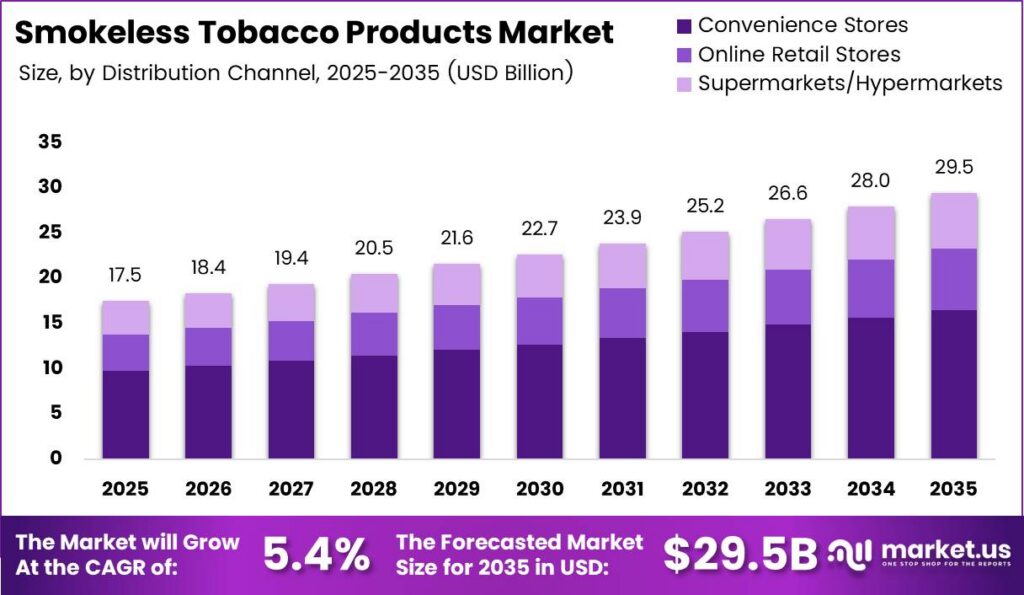
Global Smokeless Tobacco Products Market size is expected to be worth around USD 29.5 Billion by 2035 from USD 17.5 Billion in 2025, growing at a CAGR of 5.4% during the forecast period 2026 to 2035. Smokeless tobacco products include non-combustible oral items such as snuff, chewing tobacco, dipping tobacco, and dissolvable formats that deliver nicotine through oral mucosal absorption without smoke inhalation. Consequently, adult nicotine consumers use these oral formats to avoid combustion toxins and comply with public smoking bans.
Commercial distribution relies on convenience store chains, mass supermarkets, and age-verified digital retail platforms serving adult consumers across urban and rural regions. According to the World Health Organization, global smokeless tobacco prevalence reached 7.0% among adults aged 15 and older in 2025, representing 359 million active users worldwide. Male prevalence stood at 9.4% while female usage reached 4.5%. Therefore, this massive user base guarantees steady recurring cash flows for oral tobacco processors and retail distributors.
Key Takeaways
- The global Smokeless Tobacco Products Market size was valued at USD 17.5 Billion in 2025.
- The global market is projected to reach USD 29.5 Billion by 2035.
- The market is forecast to expand at a CAGR of 5.4% during the forecast period from 2026 to 2035.
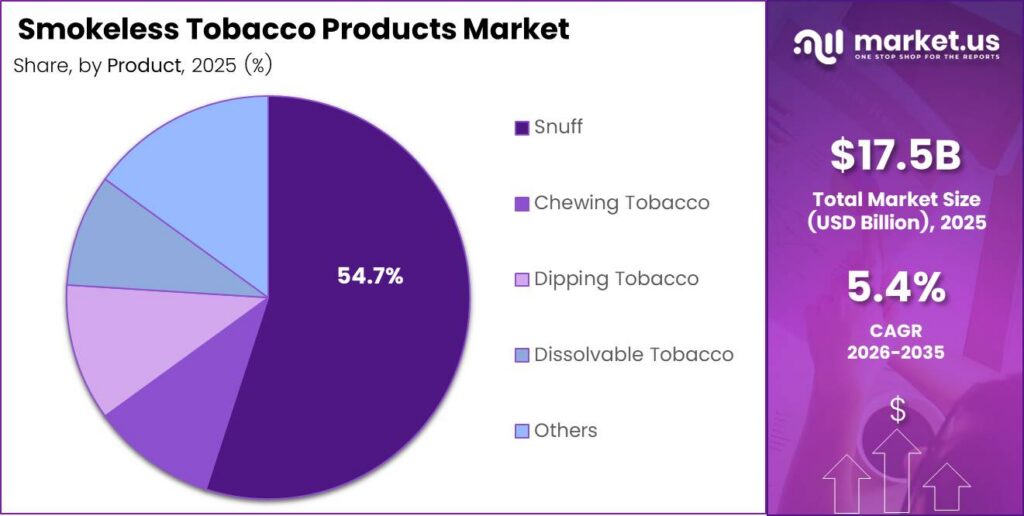
- In the Product segment, Snuff held a dominant 54.78% market share in 2025 and represents the fastest-growing product category.
- In the Packaging segment, Pouches accounted for a leading 78.78% market share in 2025 and stand as the fastest-growing packaging format.
- In the Distribution Channel segment, Convenience Stores captured a dominant 54.89% share in 2025, while Online Retail Stores represent the fastest-growing channel.
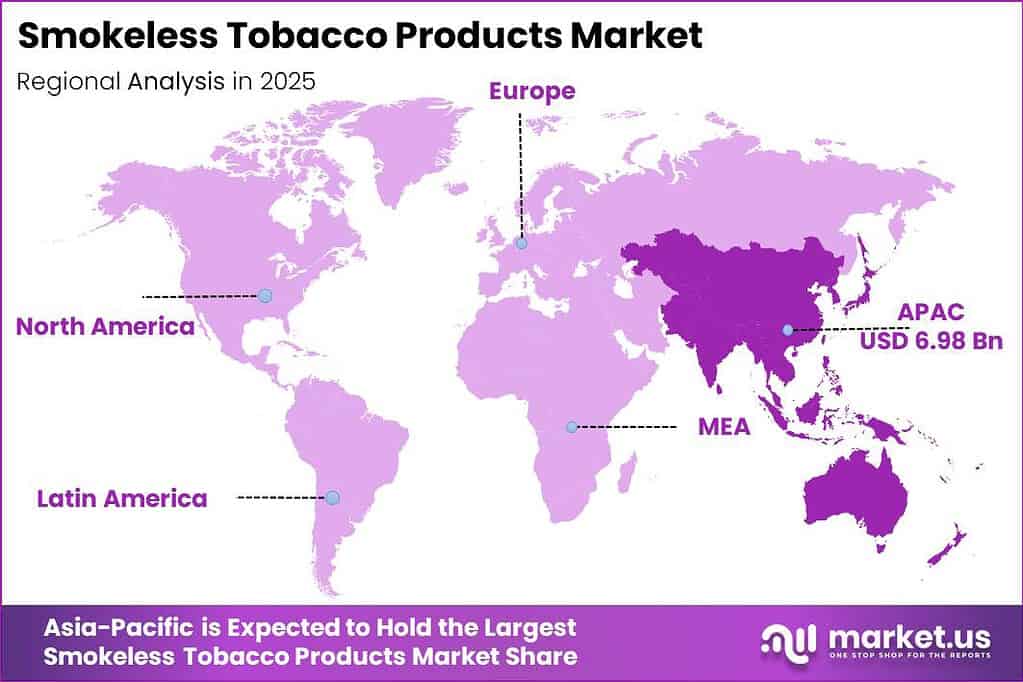
- Asia-Pacific dominated the global market in 2025 with a 39.90% share valued at USD 6.98 Billion, whereas North America is the fastest-growing region.
- The analytical forecast period for this market assessment spans from 2026 to 2035.
Federal health agencies and excise tax authorities strictly regulate product manufacturing, nicotine thresholds, and retail marketing claims across major markets. Data from the Centers for Disease Control and Prevention shows that 2.6% of United States adults, or 6.56 million people, used smokeless tobacco products in 2024 . However, rising cigarette excise taxes push price-sensitive adult smokers toward lower-cost oral alternatives. This signals that manufacturers with approved reduced-risk applications will capture substantial market share from legacy cigarette brands.
Regulatory milestones directly accelerate commercial product adoption across retail channels. In January 2025, the U.S. Food and Drug Administration authorized 20 oral pouch products in 3 mg and 6 mg strengths, with each can holding 15 pouches. As a result, manufacturers gained legal certainty to expand retail shelf space across national convenience chains. Therefore, institutional investors increasingly favor oral tobacco portfolios that secure formal premarket authorizations to protect long-term revenue streams from regulatory enforcement.
Asia-Pacific dominates the global industry and captured a 39.90% market share in 2025, valued at USD 6.98 Billion. Deeply rooted cultural habits in India and neighboring South Asian nations drive high daily consumption of traditional chewing and snuff formats. Meanwhile, North America relies on strong agricultural supply chains to support fastest-growing modern demand. As reported by the United States Department of Agriculture, domestic tobacco production hit 359 million pounds across 171,300 harvested acres in 2025, rising 11% annually. This agricultural scale stabilizes raw leaf costs for producers.
Global product distribution continues to scale across international retail markets as adult smokers seek convenient oral formats. In October 2026, a leading multinational producer expanded its flagship oral pouch distribution to 62 countries and introduced 1.5 mg and 8 mg dry variants . Consequently, third-quarter 2026 United States shipments rose 4.2% to 3.2 billion pouches, while international volumes jumped 20.6% to 0.5 billion pouches . This reflects strong global consumer migration toward portioned oral delivery systems.
Product Analysis
Snuff dominates with 54.78% share in 2025 due to rapid adult smoker format migration.
In 2025, Snuff held a 54.78% share in the Product segment of the Smokeless Tobacco Products Market. Based on Alcohol and Tobacco Tax and Trade Bureau data, United States domestic snuff manufacturing reached 84,471,330 pounds in 2025, while taxable removals hit 83,241,822 pounds . Finely ground pasteurized snuff provides rapid nicotine absorption across the oral mucosa without requiring spitting or combustion. Therefore, manufacturers prioritize moist and portioned snuff capacity to capture high-margin recurring revenues from switching smokers.
Chewing Tobacco serves traditional rural demographics and outdoor industrial workers who prefer long-lasting loose leaf, plug, or twist formats. Figures from the Alcohol and Tobacco Tax and Trade Bureau show that United States domestic chewing tobacco production totaled 11,135,803 pounds in 2024 . Cured whole leaf strips require mechanical mastication to release natural alkaloids and curing sugars over extended periods. Consequently, legacy manufacturers manage chewing tobacco lines as low-capex cash cows that fund modern oral product development.
Dipping Tobacco provides high nicotine satisfaction through moist, fermented dark-fired leaf placed between the lower lip and gum. The Centers for Disease Control and Prevention found that 17.6% of youth pouch users consumed products daily in 2025, with Grizzly holding 9.1% brand share . In May 2026, Universal Corporation recorded USD 43.4 million in inventory write-downs across USD 2.92 billion in revenue due to dark air-cured leaf oversupply . This means leaf buyers can negotiate lower procurement prices to protect dipping margins.
Packaging Analysis
Pouches dominates with 78.78% share in 2025 due to discreet mess-free portion control.
In 2025, Pouches held a 78.78% share in the Packaging segment of the Smokeless Tobacco Products Market. According to Altria Group SEC filings, total United States oral tobacco industry volume grew 14% during the six months ended December 31, 2025, led by pouch formats . Non-woven permeable fleece membranes regulate salivary moisture entry and deliver controlled nicotine release without loose leaf debris. Therefore, packaging suppliers investing in high-speed vertical form-fill-seal pouch machinery will secure long-term contracts with major tobacco brands.
Cans protect sensitive smokeless tobacco formulations from ambient oxygen, humidity fluctuations, and microbial spoilage during transport and retail storage. The United States Environmental Protection Agency indicates that domestic packaging waste generated 1.5 million tons of aluminum and 1.8 million tons of steel in 2025. National recycling rates reached 37% for aluminum and 31% for steel across 5,099 metal recovery facilities. Consequently, smokeless brands adopting recyclable metal tins reduce environmental compliance costs and appeal to sustainability-focused retail chains.
Advanced packaging format innovations integrate moisture-lock seals and waste catch lids to enhance consumer convenience and flavor stability. In May 2025, Japan Tobacco International UK launched 3 high-moisture Nordic Spirit variants in redesigned containers, building on GBP 4.5 million in monthly retail sales . Hermetic polymer can liners prevent volatile flavoring compounds and moisture from evaporating before consumption. This means brands that upgrade container barrier properties can reduce retail product returns caused by dry or stale pouches.
Distribution Channel Analysis
Convenience Stores dominates with 54.89% share in 2025 due to high-frequency impulse retail footfall.
In 2025, Convenience Stores held a 54.89% share in the Distribution Channel segment of the Smokeless Tobacco Products Market. As reported by the U.S. Census Bureau, sales at United States gasoline stations and convenience stores reached USD 68,021 million in September 2026. Revenue rose 6.4% monthly and 28.1% annually across these outlets. Daily commuter refueling trips create habitual point-of-sale purchasing cycles for single-can smokeless products, forcing manufacturers to fund prime backbar display fixtures to defend market share.
Online Retail Stores represent the fastest-growing distribution channel by offering adult consumers bulk multi-can discounts and subscription delivery models. Data from the U.S. Census Bureau shows that quarterly national retail e-commerce sales reached USD 340.2 billion in second-quarter 2026 . Online retail grew 12.2% annually to capture 17.1% of total retail sales . Automated digital age-verification gateways reduce per-unit distribution overhead compared to physical stores, enabling emerging oral brands to scale nationally without paying slotting fees.
Supermarkets/Hypermarkets serve suburban family shoppers who purchase multi-roll smokeless value packs alongside weekly household groceries. Eurostat found that calendar-adjusted retail trade volume for food, drinks, and tobacco in European non-specialized stores increased 1.4% annually in August 2026 . Euro area supermarket volumes rose 1.6% over the same period . Centralized supermarket warehousing requires high-volume inventory turnover and standardized barcode compliance, meaning only well-capitalized manufacturers can meet mass grocery supply requirements.
Key Market Segments
By Product
- Snuff
- Chewing Tobacco
- Dipping Tobacco
- Dissolvable Tobacco
- Others
By Packaging
- Pouches
- Cans
By Distribution Channel
- Convenience Stores
- Online Retail Stores
- Supermarkets/Hypermarkets
Regional Analysis
Asia-Pacific Dominates the Smokeless Tobacco Products Market with a Market Share of 39.90% in 2025, Valued at USD 6.98 Billion
Asia-Pacific led the global market in 2025 with a 39.90% share valued at USD 6.98 Billion. Based on World Health Organization data, 288 million adult smokeless tobacco users live in South-East Asia, representing 80% of global consumers. Lower-middle-income countries record a 16% adult prevalence rate totaling 310 million users. Widespread cultural acceptance of traditional chewing mixtures and dense informal retail networks drive massive regional volume, compelling domestic producers to prioritize low-cost pouch packaging.
North America represents the fastest-growing regional market due to rapid adult smoker migration toward pasteurized snus and portioned pouches. The U.S. Food and Drug Administration indicates that 67 nicotine pouch products held legal marketing authorization as of October 30, 2026 . Strict federal premarket review standards eliminate unauthorized grey-market competitors from retail shelves. Consequently, multinational manufacturers that invest in clinical toxicology dossiers capture dominant shelf space and premium pricing across North American convenience chains.
Europe maintains a highly lucrative regional market centered in Scandinavia, Switzerland, and the United Kingdom, where harm-reduction policies support oral formats. Figures from British American Tobacco show that its Velo brand captured a 63.6% volume share of the European modern oral market in fourth-quarter 2025 . Global volume share across tracked markets reached 41.4% during the same period . Therefore, European product success depends on developing moisture-optimized pouch formulations that match regional flavor preferences.
Key Regions and Countries
North America
- US
- Canada
Europe
- Germany
- France
- The UK
- Spain
- Italy
- Rest of Europe
Asia Pacific
- China
- Japan
- South Korea
- India
- Australia
- Rest of APAC
Latin America
- Brazil
- Mexico
- Rest of Latin America
Middle East and Africa
- GCC
- South Africa
- Rest of MEA
Market Dynamics
Global smokeless tobacco trade dynamics reflect shifting domestic consumption patterns, excise tax differentials, and changing export demand for cured leaf formats. According to the Alcohol and Tobacco Tax and Trade Bureau, United States tax-exempt exports of pipe, chewing, snuff, and roll-your-own tobacco totaled 1,551,160 pounds in 2025 . Export volume declined from 1,815,047 pounds in 2024 as manufacturers localized overseas pouch production . This means multinational producers must build regional processing plants to bypass cross-border tariff barriers.
Drivers
Rising cigarette excise taxes and consumer awareness of lung disease restructured tobacco revenue models between 2024 and 2026. Following U.S. Food and Drug Administration modified-risk renewals in 2024 and European tax changes in 2025, manufacturers shifted over 35% of trade budgets to oral categories. North American and Scandinavian cigarette shipments fell 4.5% to 6.8% annually in 2024 and 2025, while oral pouches grew 7.2% to 9.4%. Oral formats cost 28% to 34% less per use than cigarettes.
This substitution shifts producers from heavily taxed cigarettes toward oral lines generating 62% to 68% gross operating margins. Digital loyalty programs also cut customer acquisition costs by 18% and add +2.1% to the category CAGR forecast. Consequently, tobacco companies that reallocate capital toward oral pouch automation achieve higher operating profitability and stronger cash flow resilience.
| Driver | (~) % Impact on CAGR Forecast | Geographic Relevance | Impact Timeline |
|---|---|---|---|
| Combustible Cigarette Substitution & Oral Format Migration | +2.1% | North America & Western Europe | Short term (≤ 2 years) |
| Indoor Workplace & Public Hospitality Smoking Prohibitions | +1.4% | Global | Short term (≤ 2 years) |
| Pasteurized Portion-Pouch Adoption Over Loose-Leaf Formats | +1.1% | Nordic Region & United States | Medium term (2–4 years) |
| Convenience Store & Age-Gated Direct-to-Consumer Loyalty Programs | +0.8% | North America | Short term (≤ 2 years) |
| Cultural & Demographic Persistence of Traditional Chewing Formats | +0.6% | South Asia & Middle East | Long term (≥ 4 years) |
Restraints
Statutory bans on oral tobacco sales block formal market access across major populations under Article 17 of European Union Directive 2014/40/EU and India Regulation 2.3.4 through 2025 and 2026. These laws freeze legal snus sales across 26 European Union nations and subject South Asian producers to plant seizures and 15% to 25% higher fines. Indian manufacturers also face 40% goods and services tax sin-slab levies plus compensation cess in 2025.
Consequently, producers face a volume lock-out exceeding 38% of European adult nicotine consumers and a 14% to 19% formal retail drop in regulated Indian states. Manufacturers absorb low capacity utilization rates of 58% to 64%, while fragmented packaging runs compress regional margins by 420 to 550 basis points. This regulatory ceiling delays greenfield capital expenditure and deducts -1.6% from the global CAGR forecast.
| Restraint | (~) % Impact on CAGR Forecast | Geographic Relevance | Impact Timeline |
|---|---|---|---|
| Statutory Prohibitions on Oral Snus & Chewing Tobacco Sales | -1.6% | European Union & India | Short term (≤ 2 years) |
| Characterizing Flavor Bans in Sub-National & Municipal Jurisdictions | -1.2% | United States & Canada | Short term (≤ 2 years) |
| Specific & Ad Valorem Excise Tax Escalation on Smokeless Weight | -0.9% | Global | Medium term (2–4 years) |
| Mandatory Graphic Health Warnings & Plain Packaging Directives | -0.6% | Asia-Pacific & Europe | Medium term (2–4 years) |
| Point-of-Sale Display Bans & Minimum Legal Sales Age Increases | -0.4% | North America & Asia-Pacific | Long term (≥ 4 years) |
Challenges
Strict toxicological limits on tobacco-specific nitrosamines, including N-nitrosonornicotine and 4-(methylnitrosamino)-1-(3-pyridyl)-1-butanone, create operational friction across leaf curing and pasteurization supply chains. Meeting GothiaTek standards and proposed limits below 1.0 microgram per gram of dry weight forces processors to replace open-flame barns with indirect-heated, humidity-controlled curing barns. Retrofitting curing farms and running batch liquid chromatography-tandem mass spectrometry tests adds 12% to 17% to raw leaf procurement costs.
These quality controls extend fermentation lead times by 6 to 10 weeks and cause raw leaf batch rejection rates of 8.5% to 11.2% during humid harvests. Producers must sign multi-year grower contracts, absorb a 180 to 240 basis point cost increase per 1,000 cans, and spend 22% to 28% of research budgets on enzymatic reduction. Consequently, nitrosamine compliance imposes a -0.8% drag on market growth.
| Challenge | (~) % CAGR Friction Drag | Geographic Relevance | Mitigation Horizon |
|---|---|---|---|
| Tobacco-Specific Nitrosamine Curing Compliance | -0.8% | Global | Medium term (2–4 years) |
| Dark-Fired Leaf Agronomic Volatility | -0.6% | North America & Latin America | Medium term (2–4 years) |
| Illicit Cross-Border Counterfeit Trade | -0.5% | South Asia & Eastern Europe | Long term (≥ 4 years) |
| Cold-Chain Logistics Moisture Degradation | -0.4% | Global | Short term (≤ 2 years) |
| Master Blender Agronomist Talent Deficit | -0.3% | North America & Europe | Long term (≥ 4 years) |
Opportunities
Securing formal regulatory reduced-risk marketing orders across international jurisdictions offers substantial commercial upside beyond organic consumer migration. Currently, less than 8% of active smokeless tobacco SKUs globally hold formal authorizations such as U.S. Food and Drug Administration Modified Risk Tobacco Product orders. Completing clinical and pharmacokinetic dossiers requires 18 to 30 months of investment per product line, but approved lines qualify for 30% to 50% excise tax reductions in risk-proportionate markets.
Unlocking statutory reduced-risk status also opens restricted digital marketing channels to reach health-conscious adult smokers deterred by standard warning labels. Early movers can implement premium pricing tiers that expand unit gross margins by 450 to 600 basis points and cut retail promotional discounting by 14% per tin. Therefore, commercializing regulatory dossiers delivers +1.5% in incremental CAGR upside above the 5.4% baseline forecast.
| Opportunity | (~) % Potential CAGR Upside | Geographic Relevance | Execution Window |
|---|---|---|---|
| Modified-Risk Harm-Reduction Regulatory Dossier Commercialization | +1.5% | United States & Asia-Pacific | Medium term (2–4 years) |
| Ultra-Low-Moisture Micro-Portion & Dissolvable Lozenge Formats | +1.1% | North America & Western Europe | Medium term (2–4 years) |
| Botanical & Functional Adaptogen Blended Tobacco SKUs | +0.8% | North America & Nordic Region | Short term (≤ 2 years) |
| Biodegradable Plant-Fiber Cans & Non-Woven Pouch Substrates | +0.6% | Western Europe & North America | Long term (≥ 4 years) |
| Consolidation & Roll-Up M&A of Regional Heritage Snuff Producers | +0.5% | South Asia & Latin America | Medium term (2–4 years) |
Key Company Insights
Altria Group, Inc.
Altria Group, Inc. leads the United States smokeless tobacco sector through its U.S. Smokeless Tobacco Company and Helix Innovations subsidiaries, marketing Copenhagen, Skoal, and on! oral pouches. Data from Altria Group SEC Form 8-K filings shows that its Oral Tobacco Products segment generated USD 2,802 million in net revenues in 2025, up 0.9% from USD 2,776 million in 2024, and USD 2,070 million in nine-month 2026 . This steady cash flow funds modern pouch expansion.
In March 2026, Altria Group announced the nationwide retail expansion of 6 FDA-authorized on! PLUS oral nicotine pouch products across the United States . As reported by Altria Group official press releases, the rollout covers Mint, Tobacco, and Wintergreen variants in 6 mg and 9 mg strengths following initial launches in 3 states . Consequently, national distribution allows Altria to defend convenience store shelf space against rival higher-strength pouch brands.
British American Tobacco p.l.c.
British American Tobacco p.l.c. operates a global oral tobacco portfolio anchored by Velo, Grizzly, Camel Snus, and Lundgrens across North America, Europe, and emerging markets. Based on British American Tobacco preliminary results filings, global Modern Oral revenue surged 48.0% at constant currency in 2025 on a 47.1% volume gain . United States Modern Oral revenue jumped 310% at constant rates as volume grew 249% . This rapid scaling drives category profitability.
In September 2026, subsidiary Reynolds American announced the addition of 200 new full-time manufacturing jobs at its 2 million-square-foot facility in Tobaccoville, North Carolina. Figures from Reynolds American press releases show this expansion builds on 800 roles added between 2024 and 2025 and 300 roles announced in March 2025 to scale Velo Plus output. Therefore, domestic production protects the company from import supply bottlenecks.
Key Players
- Altria Group, Inc.
- British American Tobacco p.l.c.
- Imperial Brands PLC
- Universal Corporation
- Reynolds American Inc.
- Philip Morris International Inc.
- Japan Tobacco International AG
- Swisher International Group Inc.
- Scandinavian Tobacco Group A/S
- Other Key Players
Recent Developments
2026
- October 2026: Reynolds American Inc. received regulatory approval from the U.S. Food and Drug Administration through Marketing Granted Orders for 24 VELO Mini Pouch products featuring a 400 mg pouch weight and 4 mg nicotine strength according to Reynolds American official press releases .
- August 2026: Altria Group, Inc. secured regulatory approval from the U.S. Food and Drug Administration for 4 new on! nicotine pouch products in 2 mg and 4 mg strengths under the agency pilot program, bringing total authorized pouches to 30 at the time according to the U.S. Food and Drug Administration .
- July 2026: Philip Morris International Inc. completed a capacity expansion and investment by opening its Aurora, Colorado ZYN manufacturing plant and doubling planned campus investment from USD 600 million to USD 1.2 billion through 2028 to create 500 direct jobs and USD 550 million in annual economic impact according to Reuters .
- June 2026: Philip Morris International Inc. subsidiary Swedish Match USA received regulatory approval from the U.S. Food and Drug Administration via Modified Risk Tobacco Product granted orders for 20 ZYN nicotine pouch products in 3 mg and 6 mg strengths across 10 flavors in 400 mg pouches according to the U.S. Food and Drug Administration .
- February 2026: Swisher International Group Inc. signed an agreement with LIFT JAX under its USD 135 million, 120,000-square-foot Jacksonville factory expansion to allocate at least 60 of the 240 new manufacturing jobs generating USD 11.1 million in annual payroll to residents within 2 miles according to Swisher official releases .
- January 2026: Altria Group, Inc. subsidiary Helix Innovations obtained regulatory approval from the U.S. Food and Drug Administration for 6 on! PLUS nicotine pouch products in 6 mg and 9 mg strengths across 3 flavors as the first approvals under the September 2025 pilot program according to the U.S. Food and Drug Administration .
2025
- December 2025: Swisher International Group Inc. announced a capacity expansion and investment of USD 135 million, including USD 100 million in machinery and a USD 3.5 million city grant, to build its Automated Pouch Operation in Jacksonville and create 240 jobs by 2027 according to JAXUSA .
- November 2025: Imperial Brands PLC executed a product launch and distribution expansion by scaling its Zone oral pouch line of 11 flavors in 6 mg and 9 mg strengths to over 100,000 United States stores in 2025 to reach a 2.8% share and 69.8% Americas next-generation revenue growth while launching Zone in the UK according to the Imperial Brands 2025 Annual Report .
2024
- December 2024: Scandinavian Tobacco Group A/S completed an acquisition of pipe and fine-cut producer Mac Baren for DKK 535 million and acquired the remaining 50% equity stake in oral pouch enterprise !Act A/S on December 18, 2024 to reach 100% ownership according to the Scandinavian Tobacco Group Annual Report 2025 .
- October 2024: Japan Tobacco Inc. completed the acquisition of 100% of United States tobacco producer Vector Group Ltd. at USD 15.00 per share for a total equity value of USD 2.4 billion, or JPY 344.6 billion, on October 7, 2024 according to SEC filings .
Geopolitical Impact Analysis
According to the World Trade Organization, global merchandise trade volume grew 4.6% in 2025 to reach USD 26.26 trillion in export value, up 7%, and is forecast to expand 3.9% in 2026 . However, data from UNCTAD shows that while the global merchant fleet reached 2.5 billion deadweight tons across 116,000 vessels in January 2026, third-quarter 2026 liner shipping connectivity plunged in Qatar by -65.3%, Bahrain by -60.6%, and Iraq by -56.0% . Maritime chokepoint disruptions delay containerized shipments of dark air-cured tobacco leaf, pharmaceutical-grade synthetic nicotine, microcrystalline cellulose fillers, and food-grade flavoring compounds across Asia-Europe trade lanes. Consequently, oral tobacco manufacturers must hold larger buffer inventories of nonwoven pouch fleece and leaf inputs, which increases working capital expenses for regional distributors.
As reported by the International Monetary Fund, global economic growth will slow from 3.5% in 2025 to 3.1% in 2026, while global headline inflation rises from 4.1% in 2025 to 4.7% in 2026 due to conflict-driven commodity shocks . The World Bank found that global goods and services trade growth will decelerate from 3.4% in 2025 to 2.2% in 2026 alongside global output growth slowing to 2.5% as pre-tariff inventory front-loading fades . Higher energy prices and reciprocal import tariffs directly inflate smelting and conversion costs for polypropylene resin cans, aluminum tins, and curing barn fuel. Therefore, smokeless tobacco producers face higher packaging and leaf curing costs, forcing brands to pass price increases to retail buyers or localize pouch manufacturing near end consumers.
Report Scope
| Report Features | Description |
|---|---|
| Market Value (2025) | USD 17.5 Billion |
| Forecast Revenue (2035) | USD 29.5 Billion |
| CAGR (2026-2035) | 5.4% |
| Base Year for Estimation | 2025 |
| Historic Period | 2021-2025 |
| Forecast Period | 2026-2035 |
| Report Coverage | Revenue Forecast, Market Dynamics, Market Opportunity Analysis, Technology and Innovation Landscape, Competitive Landscape, Recent Developments |
| Segments Covered | By Product (Snuff, Chewing Tobacco, Dipping Tobacco, Dissolvable Tobacco, Others), By Packaging (Pouches, Cans), By Distribution Channel (Convenience Stores, Online Retail Stores, Supermarkets/Hypermarkets) |
| Regional Analysis | North America (US and Canada), Europe (Germany, France, The UK, Spain, Italy, and Rest of Europe), Asia Pacific (China, Japan, South Korea, India, Australia, and Rest of APAC), Latin America (Brazil, Mexico, and Rest of Latin America), Middle East and Africa (GCC, South Africa, and Rest of MEA) |
| Competitive Landscape | Altria Group, Inc., British American Tobacco p.l.c., Imperial Brands PLC, Universal Corporation, Reynolds American Inc., Philip Morris International Inc., Japan Tobacco International AG, Swisher International Group Inc., Scandinavian Tobacco Group A/S, Other Key Players |
| Customization Scope | Customization for segments, region / country-level will be provided. Additional customization can be done based on requirements. |
| Purchase Options | We have three licenses to opt for: Single User License | Multi-User License (Up to 5 Users) | Corporate Use License (Unlimited User and Printable PDF) |