Report Overview
Global Rubber Dumbbells Market size is expected to be worth around USD 467.8 Billion by 2035 from USD 230.6 Billion in 2025, growing at a CAGR of 7.3% during the forecast period 2026 to 2035. Rubber dumbbells combine a weighted core with a protective coating that improves grip, limits floor damage, and lowers noise. Their broad weight coverage supports both home routines and commercial strength programs.
Fitness centers, home users, sports facilities, schools, rehabilitation centers, hotels, and corporate wellness programs form a diversified buyer base. According to the Health and Fitness Association, about 77 million Americans used fitness facilities in 2024. That scale supports recurring purchases across fixed racks, beginner sets, and replacement units. Suppliers with clear product tiers can serve several buyer budgets without relying on one end-use channel.
Key Takeaways
- Rubber dumbbells market size was valued at USD 230.6 billion in 2025 and is projected to reach USD 467.8 billion by 2035, growing at a CAGR of 7.3% from 2026 to 2035
- Fixed-weight rubber dumbbells led product type with a 42.00% share in 2026.
- Virgin rubber-coated dumbbells led material type with a 30.00% share in 2026.
- The 10-20 kg range led weight categories with a 29.00% share in 2026.
- Hexagonal dumbbells led design with a 48.00% share in 2026.
- Commercial gyms and fitness centers led end users with a 31.00% share in 2026.
- Online stores and e-commerce led distribution with a 29.00% share in 2026.
- North America led with a 35.00% share valued at USD 80.71 Billion in 2026.
- The forecast period runs from 2026 to 2035.
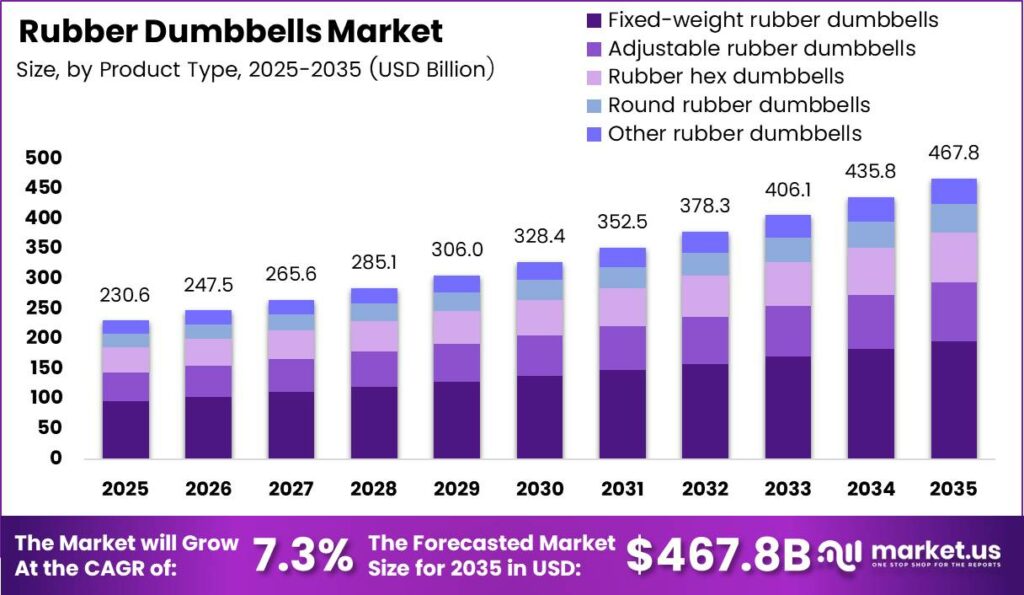
Public health priorities strengthen the market case because resistance exercise supports wider activity goals across adult populations. As reported by the World Health Organization, about 1.8 billion adults, equal to 31% worldwide, missed recommended activity levels in 2022. This gap gives governments, employers, and health providers a reason to fund accessible exercise settings. Vendors can benefit when procurement programs favor simple equipment with low training barriers.
REP Fitness expanded its product-development capability in February 2025 by signing a 6,000-square-foot research and development lease. Data from St. John Properties shows the agreement increased REP’s site footprint to 39,600 square feet and supported plans for 10 additional employees. The investment signals that suppliers see engineering, testing, and faster product iteration as core competitive tools rather than support functions.
North America held a 35.00% share in 2026, equal to USD 80.71 Billion. The region combines large commercial gym networks, established sporting goods retail, and active home fitness purchasing. High facility penetration creates repeat orders for complete racks, while residential buyers support lighter and adjustable formats. This channel depth lowers dependence on any single customer group and gives brands several paths to protect volume during shifts in consumer spending.
Peloton widened the connected-fitness product field in September 2025 by launching a five-device Cross Training Series covering Bike, Bike+, Tread, Tread+, and Row+. The launch did not center on dumbbells, but it shows how digital ecosystems can organize broader strength and cardio routines. Rubber dumbbell sellers can capture more value by pairing physical products with guided training, progress tracking, and bundled memberships.
Product Type Analysis
Fixed-weight rubber dumbbells dominate with 42.00% share in 2025 due to immediate use and commercial durability.
In 2025, fixed-weight rubber dumbbells held a 42.00% share in the Product Type segment of the Rubber Dumbbells Market. According to Rogue Fitness, its standard rubber hex set spans 5-50 lb in 5 lb steps and totals 550 lb. Fixed heads remove adjustment delays and withstand repeated handling. Gym operators gain faster member turnover, while sellers secure larger rack-based orders.
Adjustable rubber dumbbells serve buyers who value weight variety without a full storage rack. As reported by BowFlex, each Results Series 552 unit offers 15 settings from 5 to 52.5 lb and replaces 15 weight sets. A selector mechanism concentrates resistance levels into one footprint. Home users save space, while brands can charge for convenience, engineering, and integrated training support.
Rubber hex dumbbells combine fixed resistance with a stable head shape for busy training areas. Data from REP Fitness shows its Ergo Rubber Hex range spans 2.5 to 125 lb with a stated 3% weight tolerance. Six-sided heads resist rolling and protect floors during repeated placement. Commercial buyers reduce trip risks, while distributors can build broad assortments around one recognizable design platform.
Material Type Analysis
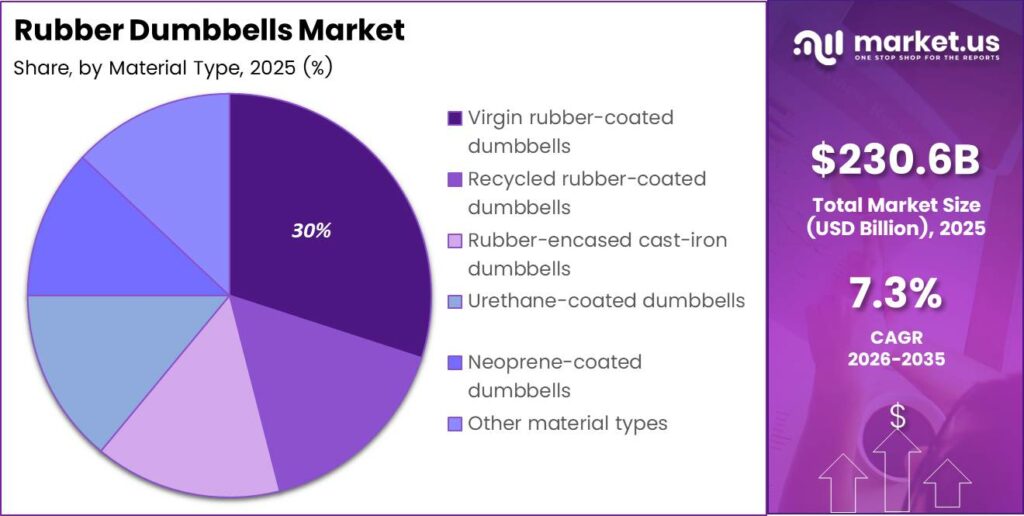
Virgin rubber-coated dumbbells dominate with 30.00% share in 2025 due to controlled finish and material consistency.
In 2025, virgin rubber-coated dumbbells held a 30.00% share in the Material Type segment of the Rubber Dumbbells Market. Rogue Fitness indicates a Shore A hardness of 90, within 2 points, for comparable virgin-rubber weight equipment. Consistent compounds improve surface feel, odor control, and molding repeatability. Premium suppliers can defend pricing through predictable appearance and lower quality-rejection risk.
Recycled rubber-coated dumbbells convert secondary material streams into impact-resistant product surfaces. Figures from the U.S. Environmental Protection Agency show an estimated 1.7 million tons of tire rubber entered recycling channels in 2018. Recovered feedstock can lower virgin-material use, but variable composition requires tighter compound screening. Suppliers that prove chemical consistency can target sustainability-led contracts without exposing buyers to avoidable odor or compliance problems.
Rubber-encased cast-iron dumbbells pair dense metal cores with coatings that protect floors and reduce contact noise. According to CAP Barbell, one cast-iron hex package contains pairs from 5 to 50 lb in 5 lb increments and totals 550 lb. Cast iron keeps unit dimensions manageable as resistance rises. Sellers can offer complete commercial sets at clear package prices.
Weight Range Analysis
10-20 kg dominates with 29.00% share in 2025 due to versatile compound exercise coverage.
In 2025, the 10-20 kg range held a 29.00% share in the Weight Range segment of the Rubber Dumbbells Market. As reported by BowFlex, its 552 platform includes five settings near this band at 10.2, 11.4, 13.6, 15.9, and 18.2 kg. This range supports presses, rows, lunges, and progression work. Retailers benefit from broad exercise relevance per unit.
The 5-10 kg band serves beginners, group classes, rehabilitation programs, and higher-repetition workouts. PowerBlock found that its Sport 24 provides 3-24 lb resistance in 3 lb steps, including four settings near this range. Smaller jumps let users progress without abrupt loading changes. Buyers gain safer progression, while brands can reach entry-level customers before moving them toward heavier systems.
The up-to-5 kg segment supports mobility work, light strength sessions, older users, and studio classes. Based on CAP Barbell data, its 20 lb neoprene package contains three pairs at 2, 3, and 5 lb per dumbbell. Low loads reduce grip and joint barriers while allowing repeated movement. Sellers can package color coding and storage racks as convenience features.
Design Analysis
Hexagonal dumbbells dominate with 48.00% share in 2025 due to stable placement and safer storage.
In 2025, hexagonal dumbbells held a 48.00% share in the Design segment of the Rubber Dumbbells Market. According to CAP Barbell, its rubber-coated hex line reaches from 10 to 120 lb, while six-sided heads resist rolling. Flat contact surfaces improve floor stability between sets and during dumbbell-supported exercises. Facilities reduce handling risk, while vendors gain a design that spans beginner and advanced loads.
Round dumbbells fit premium racks where balanced geometry and compact head profiles matter. As reported by Rogue Fitness, its urethane round dumbbell range spans 5-150 lb in 5 lb increments with a stated tolerance of 3%. Circular heads support consistent movement around the body, while urethane limits abrasion. Premium gyms can standardize appearance across larger weight rooms and longer replacement cycles.
Square and block dumbbells focus on space efficiency, fast selection, and controlled storage. Data from PowerBlock shows its Pro 50 measures about 13 by 7 inches, adjusts from 5 to 50 lb, and replaces 19 pairs. Nested plates compress many resistance levels into one station. Urban households and compact studios gain more usable floor area per training option.
End User Analysis
Commercial gyms and fitness centers dominate with 31.00% share in 2025 due to rack-scale recurring procurement.
In 2025, commercial gyms and fitness centers held a 31.00% share in the End User segment of the Rubber Dumbbells Market. The Health and Fitness Association found that U.S. facility memberships reached 72.9 million in 2023, up 5.8% from 2022. More members increase simultaneous equipment use and wear. Operators need complete weight runs, spare units, and planned replacement budgets.
Individual consumers and home users prioritize compact storage, broad exercise coverage, and manageable purchase costs. According to PowerBlock, a conventional 5-50 lb dumbbell set with a rack costs at least USD 1,200, while an adjustable Pro 50 package costs about half as much. Consolidated resistance reduces space and delivery needs. Direct sellers can convert value-conscious households through clear replacement and footprint comparisons.
Sports training facilities require durable equipment that supports repeated strength work across teams and performance levels. Life Fitness indicates that facilities seeking Official Hammer Strength Training Center recognition must carry at least 20 qualifying products. Recognition standards encourage coordinated equipment packages rather than isolated purchases. Suppliers that combine dumbbells, racks, benches, and service can win larger contracts and deepen institutional relationships.
Distribution Channel Analysis
Online stores and e-commerce dominate with 29.00% share in 2025 due to direct comparison and broad availability.
In 2025, online stores and e-commerce held a 29.00% share in the Distribution Channel segment of the Rubber Dumbbells Market. U.S. Census Bureau data shows electronic shopping and mail-order revenue rose USD 546.7 billion, or 106%, between 2017 and 2022. Digital catalogs make weight, coating, and price comparisons immediate. Sellers gain national reach, but freight pricing and damage controls remain essential.
Specialty fitness-equipment stores serve buyers who need product testing, facility planning, installation, and after-sales support. As reported by Life Fitness, the company operates 7 global experience hubs where customers can evaluate commercial equipment. Physical demonstrations reduce uncertainty around grip, balance, coating feel, and rack layout. Dealers can defend margins through technical advice and project services rather than competing only on unit price.
Sporting goods stores combine local availability with established consumer traffic and broad fitness assortments. Figures from the U.S. Census Bureau show sporting goods, hobby, musical instrument, and bookstore sales reached USD 99.321 billion in 2024. Large category traffic creates cross-selling opportunities with benches, mats, racks, and recovery products. Retailers that manage heavy-item inventory carefully can turn immediate pickup into a clear advantage.
Key Market Segments
Product Type
- Fixed-weight rubber dumbbells
- Adjustable rubber dumbbells
- Rubber hex dumbbells
- Round rubber dumbbells
- Other rubber dumbbells
Material Type
- Virgin rubber-coated dumbbells
- Recycled rubber-coated dumbbells
- Rubber-encased cast-iron dumbbells
- Urethane-coated dumbbells
- Neoprene-coated dumbbells
- Other material types
Weight Range
- Up to 5 kg
- 5-10 kg
- 10-20 kg
- 20-30 kg
- Above 30 kg
Design
- Hexagonal dumbbells
- Round dumbbells
- Square dumbbells
- Other designs
End User
- Individual consumers and home users
- Commercial gyms and fitness centers
- Sports training facilities
- Health clubs
- Educational institutions
- Rehabilitation centers
- Hotels and corporate wellness centers
- Other end users
Distribution Channel
- Online stores and e-commerce
- Specialty fitness-equipment stores
- Sporting goods stores
- Supermarkets and hypermarkets
- Direct-to-consumer channels
- Distributors and wholesalers
- Other distribution channels
Regional Analysis
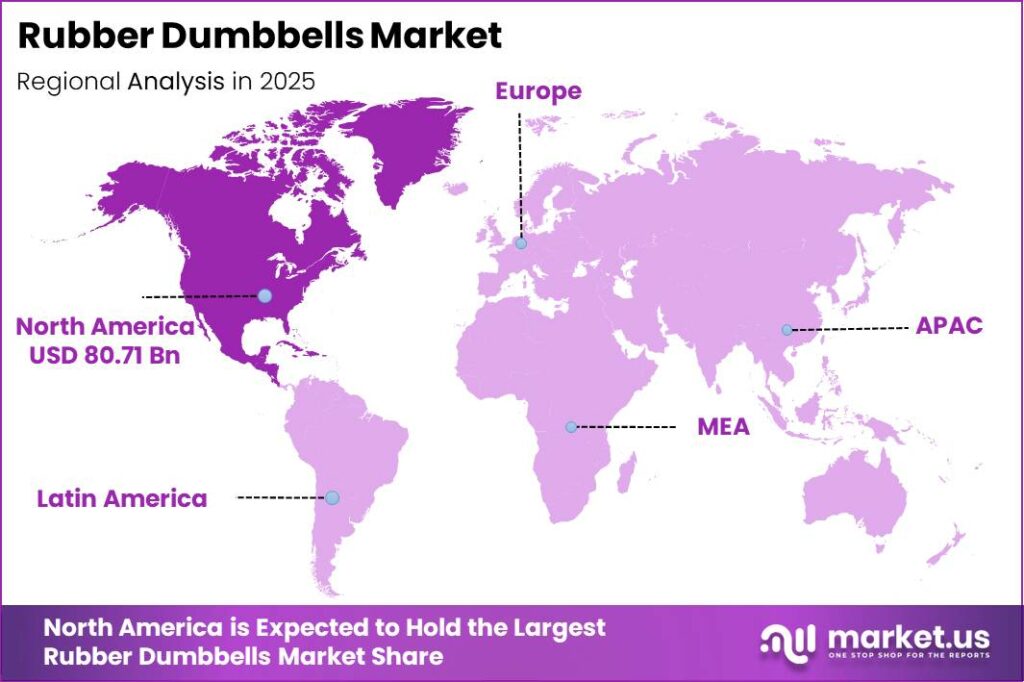
North America Dominates the Rubber Dumbbells Market with a Market Share of 35.00% in 2025, Valued at USD 80.71 Billion
North America held a 35.00% share valued at USD 80.71 Billion in 2025. According to the Health and Fitness Association, a record 23.7% of the U.S. population belonged to a fitness facility in 2023, the highest rate across 17 markets. Dense facility participation supports full dumbbell racks, replacement purchases, and premium materials. Suppliers gain scale through commercial and household channels.
Europe combines established club networks with public interest in regular exercise. Eurostat found that 44% of EU residents aged 15 or older practiced sport at least weekly in 2019, while about one-third completed 150 minutes of weekly aerobic activity. Consistent participation supports entry weights and commercial sets. Manufacturers that meet chemical and durability expectations can serve both regulated retail markets and institutional buyers.
Asia Pacific benefits from large populations and expanding fitness access, while the World Health Organization recorded 15% adult inactivity and 74% adolescent inactivity in South-East Asia. Latin America and the Caribbean faced projected GDP growth of 2.2% in 2026. The IMF placed Sub-Saharan African growth at 4.3%. These regions reward affordable ranges, local distribution, and disciplined inventory investment.
Key Regions and Countries
North America
- US
- Canada
Europe
- Germany
- France
- The UK
- Spain
- Italy
- Rest of Europe
Asia Pacific
- China
- Japan
- South Korea
- India
- Australia
- Rest of APAC
Latin America
- Brazil
- Mexico
- Rest of Latin America
Middle East and Africa
- GCC
- South Africa
- Rest of MEA
Market Dynamics
Physical inactivity creates a durable need for accessible strength tools across homes, gyms, workplaces, and care settings. According to the World Health Organization, unchanged activity levels could produce nearly 500 million preventable noncommunicable disease cases from 2020 through 2030 and about USD 300 billion in healthcare costs. Rubber dumbbells offer low-complexity resistance training, giving buyers a practical way to support prevention programs at different budgets.
Drivers
Fitness facility expansion raises initial fit-out orders and shortens replacement cycles for high-use dumbbell racks. According to the Health and Fitness Association, global memberships rose 6% in 2024, facility counts increased nearly 4%, and revenue advanced 8% on average. Facility growth concentrates procurement among repeat commercial buyers. Suppliers can lower acquisition costs through standardized sets, phased rollouts, and replacement contracts across multi-site operators.
Traditional strength training also ranked number 5 in a 2025 survey of 2,000 fitness professionals. The combination of new facilities and sustained strength participation supports a modeled +1.4 percentage-point contribution within the 7.3% baseline CAGR. Buyers gain broader product choice, while manufacturers can prioritize commercial-grade coatings, rack compatibility, and predictable replenishment schedules to protect recurring revenue.
Market Drivers
| Driver | (~) % Impact on CAGR Forecast | Geographic Relevance | Impact Timeline |
|---|---|---|---|
| Fitness Facility Expansion | +1.4% | Global urban markets | Short term (≤ 2 years) |
| Strength Training Adoption | +1.0% | North America, Europe, Asia-Pacific | Short term (≤ 2 years) |
| Hybrid Home Training | +0.6% | North America, Europe, developed Asia | Medium term (2–4 years) |
| Corporate Wellness Procurement | +0.4% | North America, Europe, Gulf markets | Medium term (2–4 years) |
| Digital Retail Penetration | +0.3% | Global consumer markets | Short term (≤ 2 years) |
| Sports Performance Investment | +0.2% | North America, Europe, Asia-Pacific | Medium term (2–4 years) |
Restraints
Weight-based freight economics restrict profitable coverage because rubber dumbbells carry high mass relative to selling value. UN Trade and Development found that the China Containerized Freight Index rose about 120% from October 2023 through June 2024. Red Sea and Suez disruption added an estimated 148 percentage points to that movement. Importers face margin pressure when freight costs rise faster than achievable retail prices.
Rerouting also lifted container-ship demand by about 12% and increased some cargo travel distances by up to 53%. These pressures support a modeled -1.2 percentage-point CAGR deduction. Sellers may raise minimum order sizes, delay replenishment, or narrow geographic service. Buyers face higher delivered prices and fewer low-volume options, while local assembly and regional warehousing become more valuable competitive tools.
Market Restraints
| Restraint | (~) % Impact on CAGR Forecast | Geographic Relevance | Impact Timeline |
|---|---|---|---|
| Weight-Based Freight Economics | -1.2% | Global import corridors | Short term (≤ 2 years) |
| Consumer Affordability Pressure | -0.8% | Europe, Latin America, emerging Asia | Short term (≤ 2 years) |
| Commercial Financing Costs | -0.5% | North America, Europe | Short term (≤ 2 years) |
| Residential Storage Limitations | -0.4% | Dense urban markets | Long term (≥ 4 years) |
| Floor and Noise Liability | -0.3% | Multifamily residential markets | Medium term (2–4 years) |
| Used Equipment Substitution | -0.2% | North America, Europe | Medium term (2–4 years) |
Challenges
Rubber chemistry consistency creates batch-level exposure to odor, surface breakdown, and restricted chemical content. European rules applying since 27 December 2015 cap each listed polycyclic aromatic hydrocarbon at 1 mg/kg in relevant consumer-contact rubber or plastic components. Recycled rubber can introduce these substances through feedstock, oils, pigments, and carbon black. Manufacturers must control formulas before finished goods reach regulated channels.
The compliance workload produces a modeled -0.7 percentage-point drag on maximum growth potential. Suppliers need traceable recipes, approved compound sources, independent batch tests, controlled curing, and incoming-material quarantine. These controls raise operating costs but protect distributors from recalls, odor complaints, and rejected shipments. Investors should favor producers with documented material governance because low-cost sourcing alone cannot offset repeated quality failures or lost retail access.
Market Challenges
| Challenge | (~) % CAGR Friction Drag | Geographic Relevance | Mitigation Horizon |
|---|---|---|---|
Rubber Chemistry Consistency |
-0.7% | Europe, North America, export manufacturers | Medium term (2–4 years) |
| Weight Calibration Tolerance | -0.5% | Global commercial segment | Medium term (2–4 years) |
| SKU Forecasting Complexity | -0.4% | Global distribution networks | Short term (≤ 2 years) |
| Coating Bond Durability | -0.3% | Humid and high-use markets | Medium term (2–4 years) |
| Molding Workforce Safety | -0.2% | Asia-Pacific manufacturing hubs | Long term (≥ 4 years) |
| Omnichannel Returns Control | -0.2% | North America, Europe | Short term (≤ 2 years) |
Opportunities
Active-aging strength kits create future white space because standard assortments rarely address low-load progression, grip access, rehabilitation guidance, and senior-living deployment together. United Nations data places the population aged 60 or older at about 1.22 billion in 2025 and 2.1 billion by 2050. U.S. participation remains low because only 13.9% of adults aged 65 or older met both activity guidelines in 2022.
A targeted kit-and-program model could add about +1.0 percentage point above the 7.3% baseline CAGR. Standardized handles, progression sets, institutional packaging, and digital instruction could lift gross margin by 3-5 percentage points. The same design could lower delivered cost per complete kit by 8-12% versus separate fulfillment. Early movers can build relationships with senior housing, rehabilitation, healthcare, and family-care channels before assortments become standardized.
Market Opportunities
| Opportunity | (~) % Potential CAGR Upside | Geographic Relevance | Execution Window |
|---|---|---|---|
| Active-Aging Strength Kits | +1.0% | North America, Europe, Japan, South Korea | Medium term (2–4 years) |
| Connected Coaching Bundles | +0.5% | North America, Europe, developed Asia | Medium term (2–4 years) |
| Clinical Rehabilitation Channels | +0.3% | North America, Europe, Gulf markets | Long term (≥ 4 years) |
| Equipment Subscription Programs | +0.4% | North America, Europe | Medium term (2–4 years) |
| Certified Circular Product Lines | +0.2% | Europe, sustainability-led markets | Long term (≥ 4 years) |
| Ergonomic Entry-Weight Series | +0.2% | Global consumer markets | Medium term (2–4 years) |
Key Company Insights
Rogue Fitness
Rogue Fitness holds a strong position in strength and conditioning equipment through dumbbells, barbells, racks, sleds, and related accessories. According to Rogue Fitness, the company employs more than 700 people worldwide. Its Columbus manufacturing base supports direct control over metalwork, product testing, and domestic fulfillment. That operating model helps Rogue serve individual athletes, training facilities, and institutional buyers with a consistent strength-focused brand.
Rogue Fitness announced a major capacity expansion in January 2025. As reported by Rogue Fitness, the planned addition covered 400,000 square feet and would take its Columbus building beyond 1 million square feet. The project expands room for manufacturing, warehousing, and distribution. Greater internal capacity can improve production scheduling and product availability, giving Rogue more control over lead times as commercial and direct orders scale.
Life Fitness
Life Fitness serves commercial gyms, hospitality venues, health facilities, and home users through Life Fitness, Hammer Strength, Cybex, SCIFIT, and related brands. Life Fitness found that its workforce exceeds 2,350 employees across 14 countries and 40 U.S. states, with average tenure above 9 years. This footprint supports global sales, installation, and service coverage. Buyers gain access to coordinated cardio and strength portfolios.
Life Fitness introduced the Symbio cardio collection in March 2024 at the IHRSA Convention. Data from the launch shows the line contained 4 machines covering a treadmill, cross-trainer, upright bike, and recumbent bike. The company also presented strength and digital solutions around the launch. A coordinated portfolio helps Life Fitness compete for complete facility fit-outs, where dumbbell racks can enter wider equipment and service contracts.
Key Players
- Rogue Fitness
- Life Fitness
- Technogym S.p.A.
- CAP Barbell
- Bowflex / Nautilus, Inc.
- PowerBlock, Inc.
- iFIT Inc. / NordicTrack
- REP Fitness
- Eleiko Group AB
- American Barbell
- Body-Solid, Inc.
- Titan Brands / Titan Fitness
- Yes4All LLC
- XMark Fitness
- Jerai Fitness Private Limited
Recent Developments
2026
- October 2026: PureGym signed an acquisition agreement for NonStop Gym’s 47 Swiss sites at GBP 235 million, creating a combined Swiss network expected to exceed 100 gyms, as reported by PureGym.
- September 2026: NRG Gyms secured GBP 18.7 million in funding from HSBC UK to open 7 gyms and expand its estate from 13 to 20 sites, according to NRG Gyms.
- September 2026: Fitness Ventures invested USD 5 million to open a 40,000-square-foot Crunch Fitness gym in Vancouver, Washington, as reported by the company.
- March 2026: Peloton launched commercial Bike and Tread products for high-traffic gyms across 6 countries, with shipments planned for late 2026, according to Peloton.
- March 2026: Cult.fit completed a funding round of INR 440 crore, about USD 47 million, from Temasek through MacRitchie, according to its company filing.
- May 2026: Rogue Fitness expanded manufacturing with plans for 8 tube lasers and 6 flat lasers, raising planned steel-processing capacity above 250,000 lb daily, according to Rogue Fitness.
- January 2026: The Gym Group announced an investment program covering about 75 new gyms over 3 years and a GBP 10 million share buyback, as reported by the company.
- September 2026: Strongway Gym Supplies completed a product launch covering adjustable dumbbell packages in 32 kg and 40 kg configurations for its UK home-gym range.
2024
- April 2024: Johnson Health Tech completed an acquisition agreement covering substantially all BowFlex assets for USD 37.5 million in cash after court approval, according to BowFlex.
- March 2024: Eleiko completed a facility expansion by opening a 1,000-square-meter sport center at its global headquarters, according to Eleiko.
Geopolitical Impact Analysis
Trade expansion supports equipment sales but exposes rubber dumbbell suppliers to policy shocks across long international supply chains. According to UN Trade and Development, global trade increased about 7%, or USD 2.2 trillion, in 2025. Total trade was set to exceed USD 35 trillion for the first time. The World Trade Organization projected merchandise trade volume growth of 1.9% in 2026 under its baseline scenario. The projection fell to 1.4% under a high-energy-price case, while continued artificial intelligence investment could add 0.5 percentage point. Rubber dumbbell manufacturers depend on cross-border flows of natural and synthetic rubber, cast iron, steel handles, packaging, and finished products. Tariff changes or energy shocks can therefore raise compound, molding, casting, and ocean freight costs at the same time. Manufacturers need regional suppliers and flexible purchase contracts, while distributors need enough inventory to absorb border delays without overloading working capital.
Maritime reliability remains central because dumbbells carry high weight relative to their selling price. As reported by the World Shipping Council, carriers moved more than 280 million containers in 2025. Operators lost 1,478 containers, equal to about 0.0005% of global movements. The low loss rate confirms physical reliability, but route disruption and insurance costs still affect landed economics. International Monetary Fund data placed world economic growth at 3.1% in 2026 and 3.4% in 2027. Global headline inflation reached a projected 4.7% in 2026. Slower growth can restrain discretionary home-equipment purchases, while inflation raises rubber, steel, labor, and warehouse expenses. Producers should shorten supply paths for high-volume weights and reserve imports for specialized products. Distributors can protect margins through regional stocking, freight-linked pricing, and bundled commercial orders. Buyers may favor complete rack purchases when suppliers can lock delivered prices and replacement terms.
Report Scope
| Report Features | Description |
|---|---|
| Market Value (2025) | USD 230.6 Billion |
| Forecast Revenue (2035) | USD 467.8 Billion |
| CAGR (2026-2035) | 7.3% |
| Base Year for Estimation | 2026 |
| Historic Period | 2021-2025 |
| Forecast Period | 2026-2035 |
| Report Coverage | Revenue Forecast, Market Dynamics, Market Opportunity Analysis, Technology and Innovation Landscape, Competitive Landscape, Recent Developments |
| Segments Covered | By Product Type (Fixed-weight rubber dumbbells, Adjustable rubber dumbbells, Rubber hex dumbbells), By Material Type (Virgin rubber-coated dumbbells, Recycled rubber-coated dumbbells, Rubber-encased cast-iron dumbbells), By Weight Range (Up to 5 kg, 5-10 kg, 10-20 kg), By Design (Hexagonal dumbbells, Round dumbbells, Square dumbbells), By End User (Individual consumers and home users, Commercial gyms and fitness centers, Sports training facilities), By Distribution Channel (Online stores and e-commerce, Specialty fitness-equipment stores, Sporting goods stores) |
| Regional Analysis | North America (US and Canada), Europe (Germany, France, The UK, Spain, Italy, and Rest of Europe), Asia Pacific (China, Japan, South Korea, India, Australia, and Rest of APAC), Latin America (Brazil, Mexico, and Rest of Latin America), Middle East and Africa (GCC, South Africa, and Rest of MEA) |
| Competitive Landscape | Rogue Fitness, Life Fitness, Technogym S.p.A., CAP Barbell, Bowflex / Nautilus, Inc., PowerBlock, Inc., iFIT Inc. / NordicTrack, REP Fitness, Eleiko Group AB, American Barbell, Body-Solid, Inc., Titan Brands / Titan Fitness, Yes4All LLC, XMark Fitness, Jerai Fitness Private Limited |
| Customization Scope | Customization for segments, region / country-level will be provided. Additional customization can be done based on requirements. |
| Purchase Options | We have three licenses to opt for: Single User License | Multi-User License (Up to 5 Users) | Corporate Use License (Unlimited User and Printable PDF) |