Report Overview
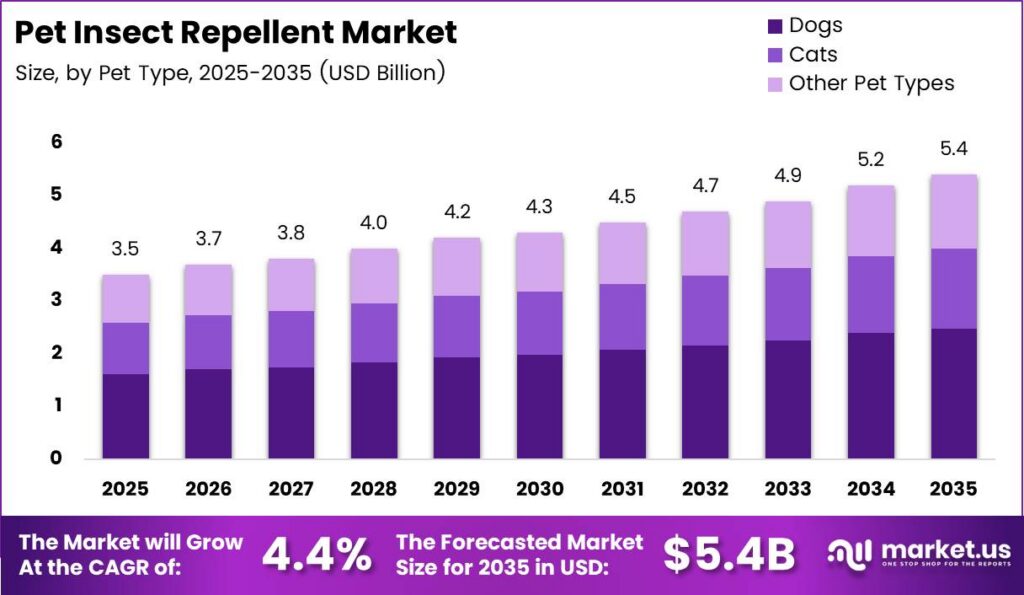
Global Pet Insect Repellent Market size is expected to be worth around USD 5.4 Billion by 2035 from USD 3.5 Billion in 2025, growing at a CAGR of 4.4% during the forecast period 2026 to 2035. Pet insect repellents are specialized chemical and botanical formulations that deter blood-feeding arthropods such as fleas, ticks, mosquitoes, and biting flies from attaching to companion animals. Consequently, these products prevent vector transmission and lower household veterinary disease expenses.
Veterinary clinics, retail chains, and grooming networks anchor the commercial structure of this industry. According to American Pet Products Association (APPA), total U.S. pet expenditure reached USD 158 Billion in 2024 across 94 million households, representing 71% of all homes. This high household penetration expands the baseline customer pool for recurring preventive parasite care. Therefore, manufacturers who secure shelf space across both clinical and retail channels capture steady annual replenishment revenue.
Key Takeaways
- The global Pet Insect Repellent Market was valued at USD 3.5 Billion in 2025.
- The market is forecast to reach USD 5.4 Billion by 2035.
- The global market is expanding at a CAGR of 4.4% during the forecast period from 2026 to 2035.
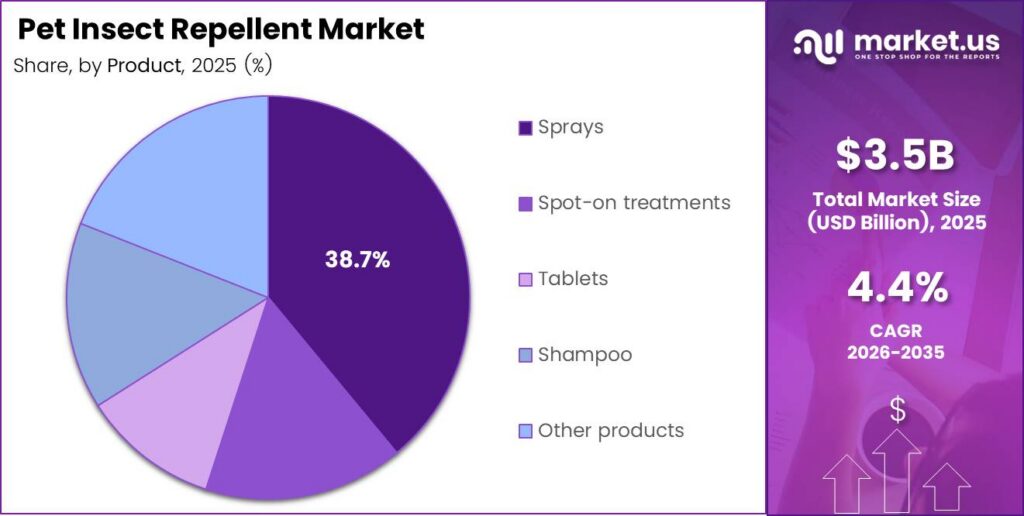
- By Product, sprays led the market in 2025 with a 38.78% share, while shampoo represents the fastest-growing product category.
- By Pet Type, dogs captured the largest share at 45.78% in 2025 and also register the fastest growth rate.
- By Application, external applications dominated with a 65.78% market share in 2025, whereas internal applications are the fastest-growing segment.
- By Distribution Channel, veterinary clinics accounted for the leading share of 66.89% in 2025, while online pharmacies are the fastest-growing channel.
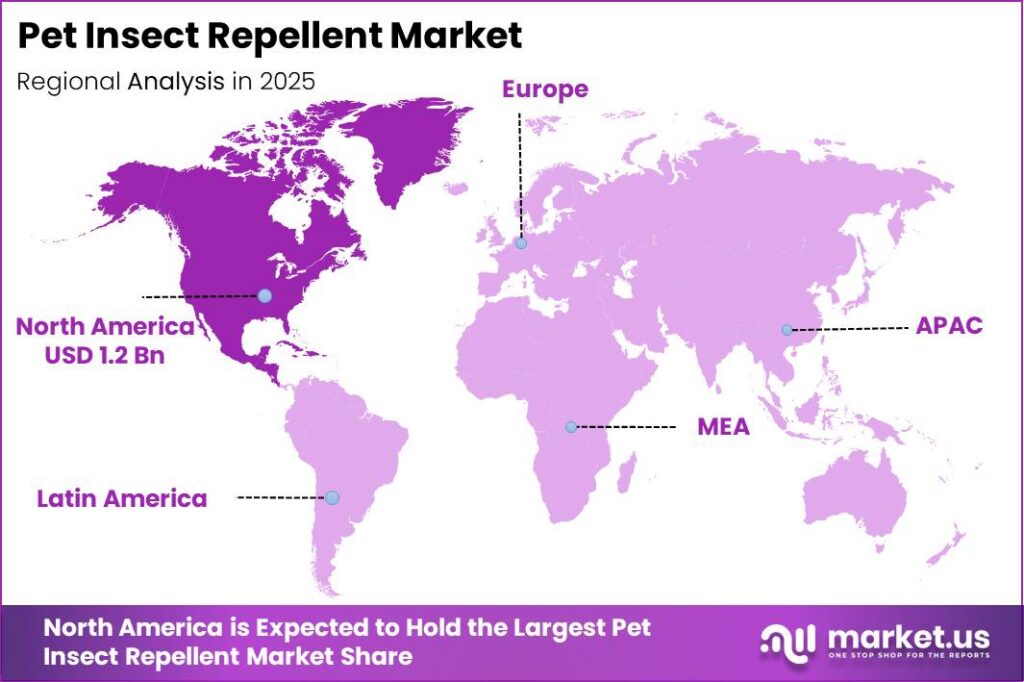
- North America dominated the global landscape with a 36.56% share valued at USD 1.2 Billion in 2025, while Asia-Pacific is the fastest-growing region.
Strict European regulatory standards and expanding companion animal populations shape product formulation strategies across multi-country markets. As reported by European Pet Food Industry Federation (FEDIAF), 139 million households, or 49% of homes across 41 European countries, owned 299 million pets, generating EUR 29.3 Billion annually at 9% growth . High urban pet density increases parasite transmission risk in public spaces. Consequently, formulators must align active ingredients with regional biocide rules to access European retail networks.
Regulatory label expansions and multi-parasite product launches directly accelerate clinic and pharmacy prescription turnover. In July 2025, veterinary pharmaceutical manufacturers secured European Medicines Agency marketing authorisation extensions for oral afoxolaner formulations to cover 2 new vector-borne disease indications in dogs, alongside January 2025 U.S. commercial rollouts of 6-parasite chewables that reached USD 100 Million in net sales and 14% clinic share by June 2025. As a result, broad-spectrum claims allow producers to command premium unit pricing.
North America holds the leading position in the global market with a 36.56% share in 2025, valued at USD 1.2 Billion. Data from UK Pet Food shows that comparable mature western markets such as the United Kingdom recorded 17.2 million pet-owning households, or 60% of homes, caring for 36 million non-aquatic pets including 13.5 million dogs and 12.5 million cats in 2024 . High canine and feline ownership concentration in suburban environments drives consistent spending on preventive topical and oral repellents.
Product Analysis
Sprays dominates with 38.78% share in 2025 due to immediate coat coverage and affordability.
In 2025, Sprays held a 38.78% share in the Product segment of the Pet Insect Repellent Market. European Chemicals Agency (ECHA) and Statistics Netherlands found that under EU Biocidal Products Regulation Product-Type 19 for invertebrate repellents, non-professional consumer products represented 88% of authorizations, or 90 out of 102 registered biocides. Pressurized and pump sprays disperse active molecules evenly across hair shafts to create an instant vapor barrier against biting insects. Therefore, consumer brands prioritize spray SKUs for mass-market retail distribution.
Spot-on treatments serve as high-margin, monthly preventive solutions applied directly to the dorsal skin between the animal’s shoulder blades. Based on U.S. Environmental Protection Agency (US EPA) data, consumer-reported adverse pet incidents for spot-on flea and tick products reached 44,263 cases in 2008, a 53% rise from 28,895 incidents in 2007, prompting mandatory quarterly dose reporting . Dermal lipid diffusion requires exact weight-calibratedpipette dosing to prevent neurotoxic overdose. Consequently, manufacturers invest heavily in weight-specific packaging and child-resistant applicators.
Tablets provide systemic parasite protection for owners who prefer mess-free oral dosing without topical residue on household furniture. U.S. Food and Drug Administration (FDA) indicates that its Center for Veterinary Medicine met review-time targets for 613 of 636 animal drug submissions in FY 2024 and 434 of 445 in FY 2025, totaling 536 pioneer drug approvals under ADUFA . Predictable gastrointestinal absorption eliminates wash-off losses caused by rain or swimming. This signals strong margin stability for pharmaceutical firms holding patented chewable formulations.
Pet Type Analysis
Dogs dominates with 45.78% share in 2025 due to daily outdoor vector exposure.
In 2025, Dogs held a 45.78% share in the Pet Type segment of the Pet Insect Repellent Market and represents the fastest-growing category. Figures from American Pet Products Association (APPA) show that U.S. dog ownership rose from 51% (68 million households) in 2024 to 53% (71 million households) in 2025, adding 4 million households as Gen X ownership jumped 12% . Daily outdoor walks expose canines to questing ticks and mosquitoes in grass and woodland habitats. Therefore, canine product lines generate the highest repeat purchase frequency for retailers.
Cats require specialized, pyrethroid-free repellent formulations because feline livers lack the glucuronosyltransferase enzymes needed to metabolize permethrin safely. According to European Pet Food Industry Federation (FEDIAF), cats form Europe’s largest pet population at 108 million animals across 26% of households, exceeding the canine population of 90 million dogs across 25% of homes . Because cats groom their fur constantly, topical repellents must remain non-toxic upon oral ingestion. Consequently, formulators developing feline-safe botanical oresafoxolaner topicals capture a large, underserved European customer base.
Other Pet Types include ornamental birds, rabbits, ferrets, guinea pigs, and reptiles that suffer from mites, lice, and mosquito-borne myxomatosis. As reported by European Pet Food Industry Federation (FEDIAF), European households owned 102 million non-dog and non-cat companion animals, comprising 48 million birds, 25 million small mammals, 18 million aquaria, and 11 million terraria . High surface-area-to-body-mass ratios in small mammals and birds require ultra-dilute aerosol sprays to prevent dermal toxicity. This creates specialized niche revenue for exotic veterinary suppliers.
Application Analysis
External dominates with 65.78% share in 2025 due to direct dermal barrier action.
In 2025, External held a 65.78% share in the Application segment of the Pet Insect Repellent Market. Data from Centers for Disease Control and Prevention (CDC) shows that over 80,000 Lyme disease cases are reported annually through national surveillance, while insurance claims indicate 476,000 Americans receive Lyme treatment each year . External sprays, collars, and spot-ons contact arthropod tarsal receptors directly to repel ticks before skin attachment occurs. As a result, external barriers remain the primary defense against vector saliva transmission.
Internal applications represent the fastest-growing application segment as pet owners shift toward systemic oral chewables and palatants. European Medicines Agency (EMA) found that its veterinary committee recommended 30 veterinary medicines for marketing authorisation in 2025, marking a record annual high for the 2nd consecutive year . Systemic active compounds circulate in the animal’s bloodstream and disrupt parasite neurotransmission immediately upon feeding without leaving greasy coat residues. Therefore, pharmaceutical companies are shifting R&D capital toward multi-active internal combination tablets.
Topical cleansing and surface wash protocols support external parasite management for sensitive animals prone to focal skin irritation. Based on National Institutes of Health (NIH) data, clinical surveillance of 708 companion animal pesticide incidents affecting 821 animals, including 305 cats and 217 dogs, revealed that over 75% of adverse reactions involved concentrated spot-on solutions . Dilute insecticidal shampoos and leave-in foams remove ectoparasites mechanically and chemically with minimal systemic absorption. Consequently, grooming salons and OTC brands use wash-off external formats to attract safety-conscious buyers.
Distribution Channel Analysis
Veterinary Clinics dominates with 66.89% share in 2025 due to prescription diagnostics and trust.
In 2025, Veterinary Clinics held a 66.89% share in the Distribution Channel segment of the Pet Insect Repellent Market. U.S. Securities and Exchange Commission (SEC) filings indicate that PetIQ generated USD 1,101.96 Million in FY 2023 net sales, comprising USD 968.15 Million in product sales and USD 133.81 Million in clinic services, plus USD 637.38 Million in H1 2024 . Veterinarians perform weight screening and blood parasite testing during wellness visits before dispensing high-potency preventives. This means manufacturers must maintain dedicated veterinary sales forces to drive clinical adoption.
Online Pharmacies represent the fastest-growing distribution channel as pet owners adopt automated home delivery subscriptions for monthly parasite doses. Figures from U.S. Census Bureau show that U.S. retail e-commerce sales reached USD 1,192.6 Billion in 2024, rising 8.1% to capture 16.1% of total retail, and hit USD 340.2 Billion in Q2 2026, up 3.8% quarter-over-quarter . Digital prescription verification and auto-ship discounts lower per-dose costs and reduce missed monthly applications. Therefore, brands that optimize digital pharmacy partnerships improve customer retention.
Other Distribution Channels encompass mass supermarkets, pet specialty superstores, agricultural feed stores, and neighborhood grooming shops. According to Eurostat, 74% of European Union individuals aged 16 to 74 purchased goods or services online in 2025, up 9 percentage points from 65% in 2020 . In response to digital competition, brick-and-mortar pet retailers integrate click-and-collect ordering with immediate in-store access to over-the-counter sprays and botanical collars. Consequently, omnichannel retail chains protect their market share by capturing urgent seasonal walk-in purchases.
Key Market Segments
By Product
- Sprays
- Spot-on treatments
- Tablets
- Shampoo
- Other products
By Pet Type
- Dogs
- Cats
- Other Pet Types
By Application
- Internal
- External
By Distribution Channel
- Veterinary Clinics
- Online Pharmacies
- Other Distribution Channels
Regional Analysis
North America Dominates the Pet Insect Repellent Market with a Market Share of 36.56% in 2025, Valued at USD 1.2 Billion
North America leads the global Pet Insect Repellent Market with a 36.56% share valued at USD 1.2 Billion in 2025. As reported by Centers for Disease Control and Prevention (CDC), residential tick surveillance between November 2024 and August 2025 revealed that blacklegged ticks accounted for 76.9% (287 of 373) of collected specimens, with 39.6% of adults carrying Borrelia burgdorferi . Severe backyard tick pressure compels North American pet owners to purchase year-round preventive protection. Therefore, premium multi-parasite brands achieve their highest revenue per animal in the United States and Canada.
Asia-Pacific represents the fastest-growing regional market as rising disposable incomes and urban apartment living expand companion animal ownership across India, China, Japan, and Southeast Asia. Data from UN Trade and Development (UNCTAD) shows that developing Asia and Oceania merchandise exports grew 8.7% and imports rose 8.2% in 2025, outpacing developed economy export growth of 5.9% and generating a USD 956 Billion trade surplus . Expanding regional trade capacity lowers active ingredient import costs and supports local retail chain expansion. Consequently, global animal health firms are localizing manufacturing and packaging across Asia-Pacific.
Key Regions and Countries
North America
- US
- Canada
Europe
- Germany
- France
- The UK
- Spain
- Italy
- Rest of Europe
Asia Pacific
- China
- Japan
- South Korea
- India
- Australia
- Rest of APAC
Latin America
- Brazil
- Mexico
- Rest of Latin America
Middle East and Africa
- GCC
- South Africa
- Rest of MEA
Market Dynamics
Warmer global temperatures and expanding urban habitats are extending the geographic range and seasonal activity of disease-carrying ectoparasites. World Health Organization (WHO) found that vector-borne diseases account for over 17% of all infectious diseases worldwide and cause more than 700,000 deaths annually, while global dengue cases hit a record 14.6 million across over 100 countries in 2024. Because companion animals share indoor spaces with humans, veterinary authorities emphasize continuous parasite deterrence under One Health initiatives. This signals sustained long-term revenue expansion for compliant repellent manufacturers.
Drivers
Veterinary clinics increasingly promote parasite deterrence as continuous year-round care rather than a warm-weather purchase. A 2024 sector parasite-control publication documented year-round protocols, while a 2025 manufacturer-sponsored survey of 4,072 pet owners and 582 veterinarians across 15 countries revealed that 47% of veterinarians view flea-and-tick season as year-round compared to only 10% of owners, with 44% of owners linking it strictly to summer. Closing this compliance gap directly expands unit volume for label-approved topical repellents and collars.
Expanding annual protection from 6 to 7 purchased months raises annual purchasing intensity by 16.7% among converting households. This compliance shift moves commercial strategy toward recurring subscription models and clinical reminder systems. Year-round veterinary recommendations contribute an estimated +0.40% impact toward the +1.10 percentage points of active drivers embedded within the 4.4% baseline CAGR from 2026 to 2035. Consequently, manufacturers who equip veterinarians with client compliance tools capture higher lifetime customer value.
| Driver | (~) % Impact on CAGR Forecast | Geographic Relevance | Impact Timeline |
|---|---|---|---|
| Year-round veterinary prevention recommendations | +0.40% | Global; North American and European emphasis | Short term (≤ 2 years) |
| Expanding companion-animal ownership | +0.25% | North America; urban Asia-Pacific | Medium term (2–4 years) |
| Widening parasite exposure geography | +0.20% | North America; Europe; temperate transition zones | Medium term (2–4 years) |
| Established online retail availability | +0.15% | North America; Europe; developed Asia-Pacific | Short term (≤ 2 years) |
| Premiumization of existing repellent formats | +0.10% | Higher-income urban markets | Medium term (2–4 years) |
Restraints
Species-specific physiological toxicity places a hard ceiling on addressable product volume across multi-pet households. Environmental Protection Agency rules require buyers to apply products strictly to the species and weight class stated on the label. For example, an EPA-approved canine topical label dated August 12, 2025 prohibits application on cats, excludes puppies under 8 weeks of age, and mandates separating treated dogs from household cats for 24 hours. These biological boundaries prevent single-formula inventory consolidation.
When 20% of prospective animal demand falls outside a canine formulation’s approved label population, that product can serve only 80% of the total prospect pool. Capturing the excluded 20% requires separate feline-safe registrations, distinct packaging lines, and segregated retail shelf space. Species-specific label exclusions create a -0.30% drag within the -1.00 percentage point of total restraints already factored into the 4.4% baseline CAGR. Therefore, portfolio managers must fund parallel R&D tracks to serve multi-species homes safely.
| Restraint | (~) % Impact on CAGR Forecast | Geographic Relevance | Impact Timeline |
|---|---|---|---|
| Species-specific label exclusions | -0.30% | Global; formulation-dependent | Short term (≤ 2 years) |
| Substitution by systemic parasiticides | -0.25% | North America; Europe; Australasia | Short term (≤ 2 years) |
| Mandatory pesticide registration gates | -0.20% | United States; European Union; regulated import markets | Medium term (2–4 years) |
| Household affordability ceilings | -0.15% | Price-sensitive emerging markets | Short term (≤ 2 years) |
| Minimum-risk disease-claim prohibitions | -0.10% | United States | Short term (≤ 2 years) |
Challenges
Inconsistent owner application after purchase undermines real-world repellent efficacy and damages brand reputation. Environmental Protection Agency guidance warns that improper dosing exposes companion animals to unnecessary pesticide risk, while approved canine topical labels forbid splitting single applicators across multiple pets, applying more than 1 tube per dose, or retreating more than once every 30 days. When owners misapply topicals or under-dose large dogs, breakthrough parasite attachment occurs and triggers product efficacy complaints.
In a service-quality model, cutting improper owner applications from 10% down to 7% lifts successful treatments from 90% to 93%, representing a 3.3% relative gain in treatment reliability. Owner application consistency gaps impose a -0.25% CAGR friction drag within the -0.65 percentage points of total operational challenges embedded in the 4.4% baseline forecast. Consequently, producers must invest in pre-measured single-dose applicators, color-coded weight packaging, and QR-linked video instructions to protect customer retention.
| Challenge | (~) % CAGR Friction Drag | Geographic Relevance | Mitigation Horizon |
|---|---|---|---|
| Owner Application Consistency Gaps | -0.25% | Global | Short term (≤ 2 years) |
| Variable Residual Performance Validation | -0.15% | Humid and high-bathing-frequency markets | Medium term (2–4 years) |
| Botanical Ingredient Batch Variability | -0.10% | Global botanical supply chains | Medium term (2–4 years) |
| Seasonal Inventory Forecasting Errors | -0.10% | Temperate markets; seasonal retail channels | Short term (≤ 2 years) |
| Fragmented Adverse Event Reporting | -0.05% | Global; multichannel distribution | Medium term (2–4 years) |
Opportunities
Structured B2B supply contracts with commercial boarding kennels, animal shelters, and grooming franchises offer B2B volume growth beyond individual household retail sales. Environmental Protection Agency rules on species-appropriate and weight-specific dosing create a clear operational need for standardized institutional kits that bundle approved repellents, dosing logs, and staff safety protocols. Early movers that establish direct institutional accounts lock in predictable bulk order volumes and bypass crowded retail shelf competition.
In an institutional contract model, bulk shipments cut fulfillment expense per unit by 8% to 12%, while account-level sales lower customer acquisition cost per treated pet by 10% to 15%. When fulfillment represents 15% of net revenue, these efficiencies yield 1.2 to 1.8 percentage points of contribution-margin expansion. Institutional service contracts provide +0.25% upside within the +0.80 percentage points of total opportunities, lifting the 4.4% baseline toward an illustrative 5.2% CAGR for agile suppliers.
| Opportunity | (~) % Potential CAGR Upside | Geographic Relevance | Execution Window |
|---|---|---|---|
| Institutional repellent service contracts | +0.25% | North America; Europe; urban Asia-Pacific | Medium term (2–4 years) |
| Underserved secondary-city distribution partnerships | +0.20% | India; Southeast Asia; Latin America | Medium term (2–4 years) |
| Validated refillable dispensing systems | +0.15% | Europe; North America | Medium term (2–4 years) |
| Acquisition-led local brand consolidation | +0.10% | Fragmented regional markets | Long term (≥ 4 years) |
| Pet-travel repellent kit partnerships | +0.10% | Europe; North America; Australasia | Short term (≤ 2 years) |
Key Company Insights
Boehringer Ingelheim
Boehringer Ingelheim operates as a top global veterinary pharmaceutical manufacturer with an extensive portfolio of prescription and over-the-counter companion animal ectoparasiticides distributed across North America, Europe, and Asia-Pacific. Based on Boehringer Ingelheim Annual Report data, its Animal Health division generated net sales of EUR 4,875 Million (USD 5.5 Billion) in FY 2025, representing 17.6% of group revenue and 6.5% currency-adjusted growth, led by NexGard at EUR 1,404 Million (up 8.5%), Frontline at EUR 370 Million, and Heartgard at EUR 216 Million . This multi-brand structure captures both clinic and retail price tiers.
Continuous capital deployment into North American research and biological production strengthens the company’s pipeline against emerging tick and insect vectors. In October 2024, Boehringer Ingelheim inaugurated an expanded animal health R&D and manufacturing facility in Athens, Georgia following a USD 66.1 Million capital investment that added 63,000 square feet of administrative space, over 28,000 square feet of laboratory space, and 63 specialized jobs, according to Boehringer Ingelheim official press releases . Consequently, expanded domestic R&D capacity accelerates regulatory submissions for next-generation companion animal parasiticides.
Central Garden & Pet
Central Garden & Pet commands a leading position in North American over-the-counter pet insect control through its Adams Pet Care and Farnam brands, supplying sprays, spot-ons, collars, and shampoos to mass retailers and e-commerce platforms. Central Garden & Pet SEC Form 10-K filings indicate that consolidated net sales reached USD 3,129.1 Million with gross profit of USD 997.3 Million (a 31.9% gross margin, up 240 basis points) in FY 2025, while its Pet segment generated USD 1.80 Billion (58% of revenue) on USD 941.1 Million in segment assets .
Restructuring logistics networks toward specialized joint ventures allows the company to prioritize high-margin branded repellent manufacturing over low-margin third-party distribution. In April 2026, Central Garden & Pet formed a strategic pet distribution joint venture with Phillips Pet Food & Supplies covering all 50 U.S. states across 11 distribution centers, receiving cash proceeds while retaining a 20% ownership stake alongside Phillips and Axar Capital at 80%, as reported by Central Garden & Pet press releases . As a result, streamlined national fulfillment lowers working capital requirements and improves operating margins.
Key Players
- Adams Pet Care
- Boehringer Ingelheim
- Central Garden & Pet
- Durvet Animal Health Products
- Elanco Animal Health
- Gurez
- Heads Up for Tails
- Mad About Organics
- Pet Naturals
- PetIQ
- The Hartz Mountain
- Other Key Players
Recent Developments
2026
- August 2026: Elanco Animal Health capacity expansion completed a 25,000 square foot biologics manufacturing facility expansion in Elwood, Kansas backed by a USD 120 Million capital investment, scaling to USD 150 Million through 2028 to increase production capacity more than 4 fold according to Elanco Official Press Release .
- July 2026: Central Garden & Pet acquisition signed a definitive agreement to acquire an 80% majority equity stake in European pet supplies leader TRIXIE Heimtierbedarf GmbH & Co. KG for EUR 340 Million in cash plus up to EUR 60 Million in earn-out payments totaling up to EUR 400 Million according to Central Garden & Pet SEC Form 8-K .
- March 2026: Boehringer Ingelheim regulatory approval received U.S. FDA supplemental approval under NADA 141–406 for NexGard afoxolaner chewable tablets to treat and control Amblyomma maculatum Gulf Coast tick infestations for 1 month in dogs aged 8 weeks and older weighing 4 pounds or more according to U.S. Food and Drug Administration .
- February 2026: Boehringer Ingelheim regulatory approval secured 2 U.S. FDA Emergency Use Authorizations for NexGard chewables in dogs weighing 4 pounds or more and NexGard COMBO topical solution in cats weighing 1.8 pounds or more to treat New World screwworm infestations according to U.S. Food and Drug Administration .
- January 2026: Elanco Animal Health investment launched the Elanco Ventures corporate venture capital fund with a USD 25 Million multi-year commitment to fund early-stage animal health innovations alongside securing USDA approval for its TruCan Ultra Lyme-L4 canine vaccine according to Elanco Animal Health Filings .
2025
- December 2025: Elanco Animal Health regulatory approval obtained U.S. FDA conditional approval under NADA 141–619 for Credelio Quattro-CA1 chewable tablets to treat New World screwworm myiasis in dogs and puppies aged at least 8 weeks and weighing at least 3.3 pounds according to U.S. Food and Drug Administration .
- December 2025: Heads Up for Tails funding round raised USD 25 Million in Series B funding led by Apparel Group India after achieving INR 400 Crore in annual recurring revenue across 115 retail stores, 95 pet spas, and 13,000 SKUs in 18 cities according to Company Press Release .
- October 2025: Elanco Animal Health regulatory approval received U.S. FDA supplemental approval under NADA 141–494 for Credelio lotilaner chewable tablets for 1 month treatment and control of Haemaphysalis longicornis longhorned ticks and prevention of Lyme disease infections in dogs weighing 4.4 pounds or greater according to U.S. Food and Drug Administration .
- October 2025: Boehringer Ingelheim investment committed EUR 300 Million through 2028 to expand its Yamagata manufacturing plant in Japan as an Asia-Oceania hub, building on its Stop Rabies initiative that supplied over 65 million canine and feline vaccine doses across 5 Southeast Asian countries according to Boehringer Ingelheim Press Release .
2024
- November 2024: Pet Naturals parent company FoodScience LLC acquisition was completed by private equity funds managed by Morgan Stanley Capital Partners from Wind Point Partners, marking the firm’s 3rd platform investment in the pet and animal health sector according to Morgan Stanley Official Press Release .
- October 2024: Boehringer Ingelheim regulatory approval secured U.S. FDA supplemental approval under NADA 141–554 for NexGard PLUS chewable tablets to treat and control Haemaphysalis longicornis longhorned tick infestations in dogs aged 8 weeks and older weighing at least 4 pounds according to U.S. Food and Drug Administration .
- September 2024: Heads Up for Tails capacity expansion opened its 100th retail store in India at New Delhi Indira Gandhi International Airport Terminal 3, following the launch of its 1st international retail store in Singapore in May 2024 according to Company Press Release .
- August 2024: PetIQ acquisition entered into a definitive agreement with private equity firm Bansk Group in an all-cash buyout valued at USD 1.5 Billion, paying stockholders USD 31.00 per share for a 51% premium according to U.S. Securities and Exchange Commission Form DEFA14A .
Geopolitical Impact Analysis
Maritime chokepoint conflicts and shifting tariff regimes directly disrupt the cross-border supply of synthetic pyrethroids, fipronil, isoxazoline intermediates, and botanical essential oils such as geraniol and citronella. Figures from World Trade Organization (WTO) show that global merchandise trade volume rose 4.6% in 2025 as merchandise value grew 7% to USD 26.3 Trillion and total goods and services trade rose 8% to USD 34.89 Trillion, while 2026 merchandise trade growth was revised to 3.9% amid Middle East hostilities . Simultaneously, according to World Shipping Council (WSC), containers lost at sea nearly tripled from 576 in 2024 to 1,478 in 2025 out of 280 million transported containers (with 128 recovered) following a 191% surge in Cape of Good Hope vessel rerouting . Longer transit times between Asian chemical plants and Western formulators force manufacturers to hold higher safety stocks of active ingredients and pressurized aerosol valves.
Macroeconomic divergence and energy price volatility alter production costs for plastic pipettes, laminated blister foils, and pet retail freight. As reported by UN Trade and Development (UNCTAD), global seaborne trade hit 12,720 million tons in 2024 (up 2.2%, with containerized cargo up over 6%), while global goods and services trade exceeded USD 35 Trillion in 2025 and goods trade reached USD 13.7 Trillion in H1 2026, up 12.5% . However, data from World Bank and International Monetary Fund (IMF) shows that conflict-driven energy spikes will slow global GDP growth to 2.5% in 2026 under World Bank projections, while IMF projects 3.3% growth in 2026 and 3.2% in 2027 (with emerging economies at 3.7%) . Higher petrochemical feedstock costs squeeze margins on entry-level sprays, prompting brands to dual-source active ingredients and nearshore packaging.
Report Scope
| Report Features | Description |
|---|---|
| Market Value (2025) | USD 3.5 Billion |
| Forecast Revenue (2035) | USD 5.4 Billion |
| CAGR (2026-2035) | 4.4% |
| Base Year for Estimation | 2025 |
| Historic Period | 2021-2025 |
| Forecast Period | 2026-2035 |
| Report Coverage | Revenue Forecast, Market Dynamics, Market Opportunity Analysis, Technology and Innovation Landscape, Competitive Landscape, Recent Developments |
| Segments Covered | By Product (Sprays, Spot-on treatments, Tablets, Shampoo, Other products), By Pet Type (Dogs, Cats, Other Pet Types), By Application (Internal, External), By Distribution Channel (Veterinary Clinics, Online Pharmacies, Other Distribution Channels) |
| Regional Analysis | North America (US and Canada), Europe (Germany, France, The UK, Spain, Italy, and Rest of Europe), Asia Pacific (China, Japan, South Korea, India, Australia, and Rest of APAC), Latin America (Brazil, Mexico, and Rest of Latin America), Middle East and Africa (GCC, South Africa, and Rest of MEA) |
| Competitive Landscape | Adams Pet Care, Boehringer Ingelheim, Central Garden & Pet, Durvet Animal Health Products, Elanco Animal Health, Gurez, Heads Up for Tails, Mad About Organics, Pet Naturals, PetIQ, The Hartz Mountain, Other Key Players |
| Customization Scope | Customization for segments, region / country-level will be provided. Additional customization can be done based on requirements. |
| Purchase Options | We have three licenses to opt for: Single User License | Multi-User License (Up to 5 Users) | Corporate Use License (Unlimited User and Printable PDF) |