Report Overview
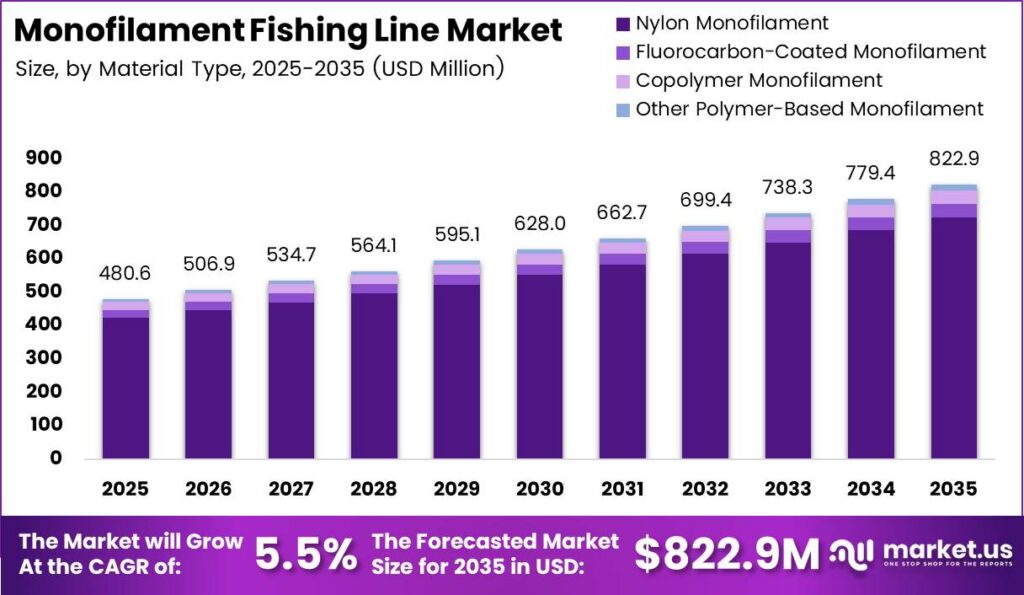
Global Monofilament Fishing Line Market size is expected to be worth around USD 822.9 Million by 2035 from USD 480.6 Million in 2025, growing at a CAGR of 5.5% during the forecast period 2026 to 2035. Monofilament fishing line is a single extruded polymer strand, mostly nylon, that connects the angler’s reel to the hook. Its stretch, knot strength, and low cost make it the default line for entry-level and general fishing.
The market serves recreational anglers and commercial fishers. The UN World Ocean Assessment found that about 300 million people fish recreationally each year, spending at least USD 47 billion. According to FAO, global capture fisheries production reached 93.2 million tonnes in 2024. Both groups need cheap, strong, replaceable line, so retail re-spooling and commercial bulk orders smooth each other’s seasonal demand swings.
Key Takeaways
- The Global Monofilament Fishing Line Market was valued at USD 480.6 Million in 2025.
- The market is forecast to reach USD 822.9 Million by 2035.
- The market will grow at a CAGR of 5.5% from 2026 to 2035.
- By Material Type, Nylon Monofilament dominated with an 88.0% share in 2025.
- By Line Strength, 10-20 lb led with a 31.0% share in 2025.
- By Line Diameter, 0.31-0.40 mm led with a 28.0% share in 2025.
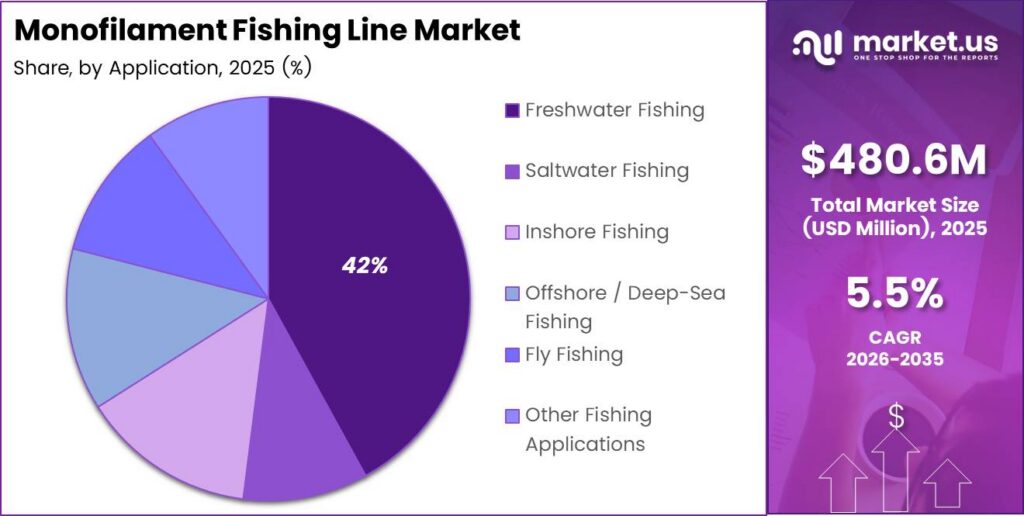
- By Application, Freshwater Fishing led with a 42.0% share in 2025.
- By End User, Recreational Anglers led with a 61.0% share in 2025.
- By Distribution Channel, Specialty Fishing and Tackle Stores led with a 29.0% share in 2025.
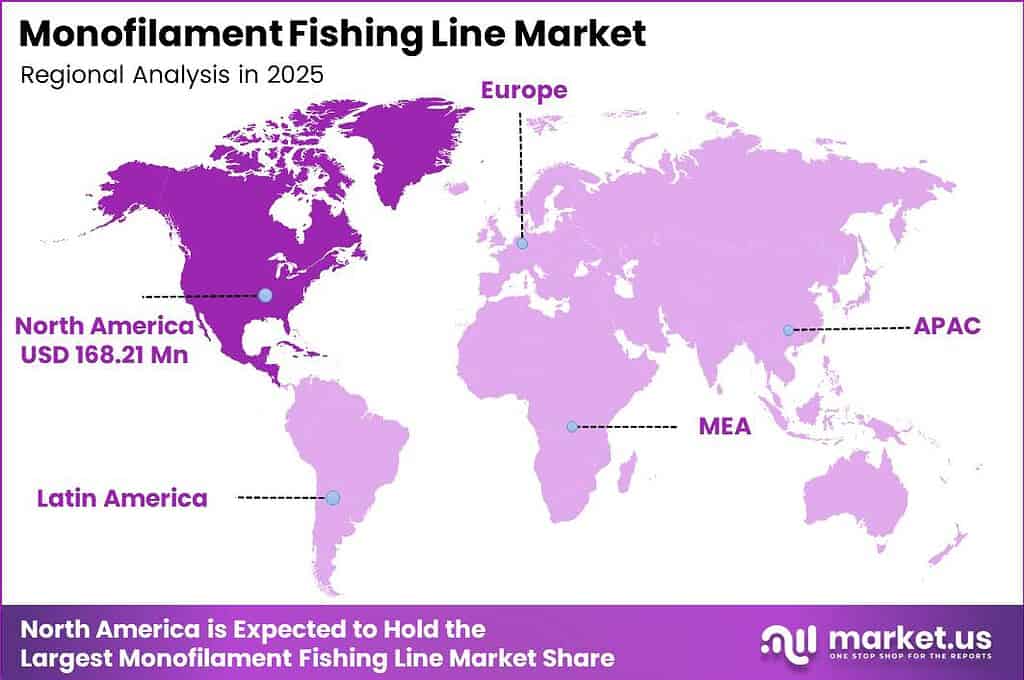
- North America dominated with a 35.0% share in 2025, valued at USD 168.21 Million.
- The forecast period covers 2026 to 2035.
Trade policy now shapes cost and supply across this market. As reported by SinoBTD using GTM customs data, China exported USD 1.978 billion of fishing tackle under HS 9507 in 2025, up 2.3%. China also accounts for over 70% of global fishing tackle production. Therefore, any tariff or trade restriction on Chinese goods moves landed costs for brands and retailers in every importing market.
Upstream resin capacity is also expanding. In April 2026, Kureha Corporation completed a PVDF capacity expansion at its Iwaki Factory in Japan. Based on Kureha data, the PVDF expansion added ¥12.0 billion to property, plant, and equipment in FY2025. This matters because PVDF is the fluoropolymer behind fluorocarbon line, so premium low-visibility lines gain more secure resin supply.
North America held a 35.0% share in 2025, valued at USD 168.21 Million. According to the American Sportfishing Association, 57 million Americans went fishing in 2025, or about 18% of the population. Participation dipped from 2024 for the first time since 2021, yet stays well above pre-pandemic levels. As a result, mass retailers and specialty shops still carry the largest monofilament inventories worldwide.
Material Type Analysis
Nylon Monofilament dominates with 88.0% share in 2025 due to low cost and reliable stretch.
In 2025, Nylon Monofilament held an 88.0% share in the Material Type segment of the Monofilament Fishing Line Market. According to Toray, its Fibers and Textiles revenue, which includes nylon, rose 4.0% to ¥1,051.1 billion in the year to March 2026. Nylon 6 extrudes into uniform strands and stretches under load, which cushions hook sets. Therefore, brands gain stable resin supply from integrated fiber producers and keep cost leadership in mass-market spools.
Fluorocarbon-Coated Monofilament pairs a nylon core with a low-visibility outer layer for anglers who want stealth at mono prices. Data from Kureha shows its Seaguar fishing line revenue rose 5% to ¥5.8 billion in FY2025. Fluorocarbon bends light close to water’s refractive index and resists abrasion, while the nylon core keeps stretch and knot strength. This means brands can charge a premium for coated mono with little added resin cost.
Copolymer Monofilament blends polymers to cut stretch and memory compared with standard nylon. Figures from Rapala VMC show net sales of €227.5 million in 2025, with its own factories making about 42% of products sold. Rapala’s Sufix Advance line combines HMPE with a hyper copolymer to raise abrasion resistance and sensitivity. Consequently, brands with in-house extrusion control copolymer recipes and protect margins against private-label copies.
Line Strength Analysis
10-20 lb dominates with 31.0% share in 2025 due to fit with general freshwater fishing.
Below 10 lb line serves light-tackle anglers chasing trout, panfish, and fly-fishing tippet setups. As reported by the American Sportfishing Association, US fly fishing participation reached 7.9 million in 2025. Fine, low-strength mono lets small flies and lures drift naturally and stays hard for wary fish to see. This means makers of thin, high-precision strands serve a loyal niche that pays more per meter.
In 2025, 10-20 lb held a 31.0% share in the Line Strength segment of the Monofilament Fishing Line Market. Data from the Recreational Boating and Fishing Foundation shows 5.1 million Americans tried fishing for the first time in 2024, or 9% of participants. New anglers start on spinning and spincast combos pre-spooled with mid-strength nylon. Therefore, brands that win starter-kit contracts lock in this range’s highest volume.
21-40 lb line serves inshore saltwater anglers targeting redfish, snook, striped bass, and small tuna. According to the American Sportfishing Association, US saltwater fishing reached a record 15.5 million participants in 2025, up 400,000. Saltwater species run harder and live around rocks and oyster beds, so anglers need thicker, tougher nylon. As a result, brands can price heavier saltwater mono higher because buyers value toughness over cost.
Line Diameter Analysis
0.31-0.40 mm dominates with 28.0% share in 2025 due to balance of strength and castability.
In 2025, 0.31-0.40 mm held a 28.0% share in the Line Diameter segment of the Monofilament Fishing Line Market. Data from the American Sportfishing Association shows total US fishing outings rose 3% to 918 million in 2025. This diameter matches the mid-strength line most general anglers use, so every extra outing adds wear on the most common spools. Consequently, extruders tune production to this band first to keep unit costs lowest.
0.20-0.30 mm line suits light spinning setups used by young anglers and finesse fishers in clear water. Figures from the American Sportfishing Association show participation among US teens aged 13 to 17 rose from 5.2 million to 5.4 million in 2025. Thinner nylon cuts water drag and casts light lures farther on short youth rods. This creates steady demand for small, low-cost finesse spools sold through mass retail.
0.41-0.60 mm line covers heavier saltwater and big freshwater species where abrasion and shock loads run high. The Outdoor Industry Association indicates that US saltwater fishing outings rose 2% to 183 million in 2025. Thicker nylon spreads load across more polymer and survives contact with rocks, pilings, and teeth. Therefore, coastal retailers gain from higher unit prices and faster line wear in salt conditions.
Application Analysis
Freshwater Fishing dominates with 42.0% share in 2025 due to large inland angler base.
In 2025, Freshwater Fishing held a 42.0% share in the Application segment of the Monofilament Fishing Line Market. According to the Recreational Boating and Fishing Foundation, more than 43 million Americans went freshwater fishing in 2024, holding steady for a third straight year. Lakes and rivers lack reef abrasion, so low-cost nylon performs well without braid. As a result, freshwater demand anchors mass-retail volume and stable re-spooling cycles.
Saltwater Fishing demands line that resists salt, UV light, and abrasion from structure and fish. NOAA Fisheries found that US saltwater anglers generated USD 145.4 billion in sales impacts and USD 78.4 billion in GDP in 2023. Salt and sun degrade nylon faster, so saltwater anglers replace line more often. This means brands with UV-stabilized formulas can win frequent repeat sales in coastal markets.
Fly Fishing uses monofilament mainly as leaders and tippet that connect the fly line to the fly. Data from the Recreational Boating and Fishing Foundation shows US fly fishing topped 8 million participants for a second straight year in 2024. Tapered nylon leaders turn over the fly smoothly and wear out after a few trips. Consequently, tippet spools give specialty fly shops high-margin repeat purchases.
End User Analysis
Recreational Anglers dominate with 61.0% share in 2025 due to large casual fishing population.
In 2025, Recreational Anglers held a 61.0% share in the End User segment of the Monofilament Fishing Line Market. Based on American Sportfishing Association data, 6.3 million Americans tried fishing for the first time in 2025, or 11% of all participants. New anglers choose mono because it is cheap, forgiving, and easy to knot. Therefore, entry-level combo kits pre-spooled with nylon remain a key sales channel for line brands.
Commercial Fishing Operators buy monofilament in bulk for longlines, handlines, and gillnets. FAO indicates that world aquatic animal production should reach 205 million tonnes by 2032, with 94 million tonnes from capture fisheries. Nylon’s high strength-to-cost ratio and low visibility make it the standard for mass-scale gear. This creates large contract volumes for extruders, but commercial buyers negotiate hard on price per kilogram.
Fishing Charter and Tourism Operators re-spool guide gear often because many clients use the same rods each season. As reported by the UN World Ocean Assessment, about 121 million people worldwide take part in marine recreational fishing. Guides favor durable, low-cost mono because inexperienced clients tangle and break line often. As a result, charter operators buy bulk spools and value supplier reliability over brand.
Distribution Channel Analysis
Specialty Fishing and Tackle Stores dominate with 29.0% share in 2025 due to expert advice and spooling.
In 2025, Specialty Fishing and Tackle Stores held a 29.0% share in the Distribution Channel segment of the Monofilament Fishing Line Market. According to the American Sportfishing Association, the Dingell-Johnson program has raised more than USD 12 billion since 1950 through a 10% manufacturer excise tax. That money restocks fisheries and builds access, which feeds traffic to local tackle shops. Consequently, specialty stores win repeat visits through on-site line spooling services.
Sporting Goods Stores reach mainstream shoppers who buy fishing gear alongside camping and outdoor products. The Outdoor Industry Association found that anglers fishing only 1 to 3 times a year rose from 22% to 32% of participants. Occasional anglers shop big-box aisles where value-priced mono sells best. This means brands need clear packaging and simple strength labels to win quick buying decisions.
Online Retail and E-Commerce lets anglers compare line specs and prices across many brands in seconds. Data from SinoBTD shows Chinese fishing tackle exports reach 150 countries, with the US taking 27.41% of export value in 2025. Marketplaces let Chinese factories sell direct to these buyers with little brand spending. As a result, Western brands must compete online on verified specs, reviews, and fast domestic delivery.
Key Market Segments
By Material Type
- Nylon Monofilament
- Fluorocarbon-Coated Monofilament
- Copolymer Monofilament
- Other Polymer-Based Monofilament
By Line Strength
- Below 10 lb
- 10-20 lb
- 21-40 lb
- 41-80 lb
- Above 80 lb
By Line Diameter
- Below 0.20 mm
- 0.20-0.30 mm
- 0.31-0.40 mm
- 0.41-0.60 mm
- Above 0.60 mm
By Application
- Freshwater Fishing
- Saltwater Fishing
- Inshore Fishing
- Offshore / Deep-Sea Fishing
- Fly Fishing
- Ice Fishing
- Other Fishing Applications
By End User
- Recreational Anglers
- Professional Anglers
- Commercial Fishing Operators
- Fishing Charter and Tourism Operators
- Other End Users
By Distribution Channel
- Specialty Fishing and Tackle Stores
- Sporting Goods Stores
- Supermarkets and Hypermarkets
- Online Retail / E-Commerce
- Direct-to-Consumer Brand Websites
- Other Distribution Channels
Regional Analysis
North America Dominates the Monofilament Fishing Line Market with a Market Share of 35.0% in 2025, Valued at USD 168.21 Million
North America leads because it combines a huge recreational angler base with dense mass-retail and specialty tackle networks. As reported by the Recreational Boating and Fishing Foundation, a record 57.9 million Americans fished in 2024, or 19% of the population. Each angler re-spools cheap nylon several times a year, which turns participation into recurring volume. Therefore, brands that secure big-box replenishment contracts here lock in the largest steady revenue pool.
Europe ranks as a major market built on carp, coarse, and sea angling traditions. The UN World Ocean Assessment indicates that more than 40% of Norwegians fish recreationally, mainly in marine waters. However, the WTO expects European merchandise imports to grow just 0.5% in 2026. This means European line demand rests on loyal core anglers, while importers face slow volume growth and tight retail budgets.
Asia Pacific acts as both the global supply hub and a major demand base led by Japan and China. According to the Japan Fishing Tackle Manufacturers Association, Japanese domestic tackle shipments fell 1.7% to ¥137.4 billion in 2025, with ¥140.08 billion forecast for 2026. Based on SinoBTD data, China exported USD 722 million of fishing rods in 2025, up 8.97%. Consequently, Japan anchors premium line demand while China supplies volume.
Latin America, the Middle East, and Africa show sharply different demand paths in 2026. Figures from the WTO show merchandise imports growing 8.9% in Africa and 4.6% in South America, but falling 15.4% in the Middle East. Small-scale fishers in Africa and Latin America rely on cheap nylon handlines and gillnets. Therefore, exporters should push distribution into Africa and South America while treating Gulf markets cautiously until the conflict eases.
Key Regions and Countries
North America
- US
- Canada
Europe
- Germany
- France
- The UK
- Spain
- Italy
- Rest of Europe
Asia Pacific
- China
- Japan
- South Korea
- India
- Australia
- Rest of APAC
Latin America
- Brazil
- Mexico
- Rest of Latin America
Middle East and Africa
- GCC
- South Africa
- Rest of MEA
Market Dynamics
Monofilament demand rests on how many anglers stay active each year. The American Sportfishing Association found that 19 million people dropped out of fishing in 2025, the highest churn on record. High churn forces brands to replace lost buyers with new ones every season. Therefore, retention programs, starter kits, and replenishment deals now decide which line makers grow faster than the 5.5% market CAGR.
Angler frequency matters as much as angler count. According to the Outdoor Industry Association, 68% of US anglers fish 11 times a year or fewer, while weekly anglers fell below 6%. Occasional anglers re-spool less often and buy mostly on price. As a result, brands that sell pre-spooled combos and small low-cost spools capture this casual majority, while premium lines depend on frequent anglers.
Drivers
Post-pandemic angler retention is the strongest growth lever for monofilament. US participation reached record levels after 2020 and eased only slightly in 2025. The angler base is also widening, with 21.1 million women and a record 6.9 million Hispanic Americans fishing in 2025. These new buyers start with cheap nylon, so retaining them turns trial purchases into recurring sales.
Industry pricing estimates put mono spools at USD 4-12, against USD 15-35 for braid and fluorocarbon. A retained angler who re-spools 2-3 times a year adds steady volume. Manufacturers are shifting to replenishment programs, bulk 1,000-3,000 yard service spools, and subscription bundles that cut repeat acquisition costs by about 20-30%. As a result, this driver adds roughly 1.4% to the 5.5% baseline CAGR.
| Driver | (~) % Impact on CAGR Forecast | Geographic Relevance | Impact Timeline |
|---|---|---|---|
| Post-Pandemic Recreational Angler Retention | +1.4% | North America, Europe | Short term (≤ 2 years) |
| Asia-Pacific Sport Fishing Participation Growth | +1.2% | China, Japan, India, Southeast Asia | Medium term (2–4 years) |
| High-Frequency Line Replacement Cycles | +0.9% | Global | Short term (≤ 2 years) |
| Commercial Longline and Gillnet Demand | +0.8% | Asia-Pacific, Latin America, West Africa | Medium term (2–4 years) |
| Direct-to-Consumer E-Commerce Penetration | +0.7% | North America, Europe, China | Short term (≤ 2 years) |
| Copolymer and Fluorocarbon-Coated Upgrades | +0.5% | North America, Japan, Western Europe | Medium term (2–4 years) |
Restraints
Braided and fluorocarbon lines are pulling premium anglers away from nylon. UHMWPE braids deliver about 3-4x the strength per diameter of nylon with almost no stretch, while mono stretches 15-25%. Industry estimates suggest braid has captured about 30-35% of line value in US bass and inshore saltwater fishing since 2022. Each converted angler moves most of their line spending out of nylon, so mono loses share outright.
This pressure keeps average selling prices flat at the top of the mono range in mature markets. Manufacturers also delay new nylon extrusion lines and shift capital toward PE braiding and PVDF capacity, which earn higher margins. Consequently, this restraint pulls roughly 1.3% off the baseline CAGR. Mono makers must defend share through value pricing and entry-level positioning in mass retail.
| Restraint | (~) % Impact on CAGR Forecast | Geographic Relevance | Impact Timeline |
|---|---|---|---|
| Substitution by Braided and Fluorocarbon Lines | -1.3% | North America, Japan, Europe | Short term (≤ 2 years) |
| Gillnet and Driftnet Use Bans | -0.8% | EU, Coastal Asia, Oceania | Short term (≤ 2 years) |
| Import Tariffs on Chinese-Origin Line | -0.6% | United States | Short term (≤ 2 years) |
| Seasonal and Spatial Fishing Closures | -0.4% | North America, EU, India | Short term (≤ 2 years) |
| Discretionary Spending Compression | -0.3% | Global | Short term (≤ 2 years) |
Challenges
Nylon feedstock volatility squeezes monofilament margins. Most mono uses nylon 6 or nylon 6,6, which trace back to caprolactam and adipic acid chains held by a few integrated producers. Nylon 6,6 supply suffered force majeure events and European plant closures in 2023 and 2024. Industry cost models put resin at about 40-55% of spool cost, so a 20% resin spike lifts unit costs by roughly 8-11%.
Retail price points such as USD 4.99 and USD 9.99 are hard to move, so makers recover cost increases only after several quarters. Upstream supply shows some stability, as Toray forecasts revenue rising 9.5% to ¥2,830.0 billion in the year to March 2027. However, mass-market brands still need diversified resin sourcing, hedged inventory, index-linked contracts, and recycled PA6 to protect margins.
| Challenge | (~) % CAGR Friction Drag | Geographic Relevance | Mitigation Horizon |
|---|---|---|---|
| Nylon Feedstock Price Volatility | -0.9% | Global | Medium term (2–4 years) |
| Ghost Gear Environmental Scrutiny | -0.6% | EU, North America, Oceania | Long term (≥ 4 years) |
| Low-Cost Commodity Price Erosion | -0.5% | Asia-Pacific, Latin America, Africa | Medium term (2–4 years) |
| Counterfeit Branded Line Proliferation | -0.3% | China, Southeast Asia, Online Marketplaces | Medium term (2–4 years) |
| Precision Extrusion Talent Gaps | -0.2% | Japan, Germany, United States | Long term (≥ 4 years) |
Opportunities
Biodegradable and bio-based monofilament remains largely untapped white space. Degradable PBS, PHA, and additive-modified nylon lines hold a very small share of 2026 volume because of weaker knots and uneven degradation. However, the EU Single-Use Plastics Directive began Extended Producer Responsibility rules for plastic fishing gear on 31 December 2024. Global ghost-gear policy also pushes buyers toward lower-persistence materials, even before any biodegradable mandate exists.
Bio-based resins still cost much more than virgin PA6, but they can command clearly higher retail prices per spool. As compounding scale narrows that resin gap, gross margins could widen well beyond commodity nylon. Therefore, early movers that pair certified marine-degradability claims with EPR fee advantages could add roughly 1.3% above the 5.5% baseline. They can also lock in retailer shelf space before rivals scale.
| Opportunity | (~) % Potential CAGR Upside | Geographic Relevance | Execution Window |
|---|---|---|---|
| Biodegradable and Bio-Based Monofilament | +1.3% | EU, North America, Japan, Oceania | Medium term (2–4 years) |
| Recycled Nylon Closed-Loop Programs | +0.8% | EU, North America | Medium term (2–4 years) |
| Organized Retail Entry in India and Africa | +0.7% | India, Sub-Saharan Africa | Long term (≥ 4 years) |
| Industrial and Trimmer Line Adjacencies | +0.5% | Global | Short term (≤ 2 years) |
| Regional Brand Roll-Up Acquisitions | +0.4% | Europe, Southeast Asia, Latin America | Medium term (2–4 years) |
Key Company Insights
Shimano Inc.
Shimano Inc. is a Japanese tackle leader selling reels, rods, and lines across Asia, North America, Europe, and Oceania. According to Shimano, Fishing Tackle segment sales reached ¥110,832 million in 2025, up 5.6%, while operating income fell 18.9% to ¥8,865 million. Strong reel brands give Shimano deep specialty dealer networks that its line products share. However, falling segment profit shows rising cost and inventory pressure despite healthy sales growth.
Based on its February 2026 filing, Shimano set a share buyback cap of ¥50 billion and 2,950,000 shares, or 3.4% of issued shares. As reported by Investing.com, the program was 83% complete by October 2026, while third-quarter fishing sales rose 8% to ¥31.1 billion. This signals that fishing now delivers steadier returns than cycling. Therefore, investors can treat the fishing segment as a stabilizing cash engine.
Kureha Corporation / Seaguar
Kureha Corporation is a Japanese specialty chemicals group that owns Seaguar, the brand that invented fluorocarbon fishing line in 1971. According to Kureha, group revenue reached ¥161.7 billion in FY2025, the year to March 2026. Kureha makes its own fluoro resins in-house, which gives Seaguar full control over line chemistry and quality. This means Seaguar can launch new premium lines faster than brands that buy resin from outside suppliers.
As reported by Kureha in May 2026, Seaguar fishing line revenue is forecast to rise 20% to ¥7.0 billion in FY2026. Kureha also expects segment profit to fall because of higher promotion spending and rising raw material and fuel prices. Its forecast assumes Brent crude at USD 100 per barrel, up from USD 70. Consequently, Seaguar is buying share through marketing, which signals tougher price competition for rival premium line brands.
Key Players
- Pure Fishing, Inc.
- Sunline Co., Ltd.
- Sufix International
- Toray Industries, Inc.
- Shimano Inc.
- Globeride, Inc. / Daiwa
- Momoi Fishing Net Mfg. Co., Ltd.
- Kureha Corporation / Seaguar
- Maxima Fishing Line
- Ande Monofilament
- P-Line
- Cortland Line Company
- DUEL Co., Inc. / Yo-Zuri
- Ultima Line
- Gosen Co., Ltd.
Recent Developments
2026
- October 2026: Globeride’s Daiwa brand completed a product launch of the Seaborg 300J electric reel at an MSRP of USD 1,199.99 with 35 lb maximum drag, according to Daiwa US.
- July 2026: Kureha’s Seaguar brand gained an innovation award when BRAWLR monofilament won Best Non Braided Fishing Line at ICAST 2026, one of 37 category awards, as reported by Fishing Tackle Retailer.
- July 2026: Globeride’s Daiwa brand gained an innovation award when JBRAID Grand X8 Ocean Splash, an 8 carrier braid, won Best Braided Fishing Line at ICAST 2026, according to ICAST.
- May 2026: Globeride announced an investment plan for a ¥15.0 billion mother factory in Tokyo, alongside a 12% ROE target and a total payout ratio of about 50%, as reported by Filingreader.
- March 2026: Pure Fishing’s Berkley brand completed a product launch of its Lab Series, debuting with 3 soft baits after the Bassmaster Classic, as reported by The Water Wire.
2025
- November 2025: Globeride announced a capacity expansion with a new Daiwa factory at its Tokyo head office, costing about ¥15 billion to build plus about ¥16.5 billion for equipment and renovation, with completion by 2032, as reported by Angling International.
- August 2025: Diamond Fishing Products completed a product launch of APEX Micro Braid in 1,500 yard bulk spools at ICAST 2025, as reported by Florida Sportfishing.
2024
- March 2024: Seaguar completed a product launch bringing 3 Japan market lines, R18 Fluorocarbon, PEX8 Braid, and Grand Max Leader, to North America, according to Seaguar.
Geopolitical Impact Analysis
The Middle East conflict is resetting cost inputs for monofilament makers. According to the WTO, world merchandise trade volume should still grow 3.9% in 2026, up from an earlier 1.9% forecast. The WTO also expects global inflation of 4.7% this year. The World Bank found that energy prices could jump 24% in 2026, with overall commodity prices up 16%. Higher oil lifts benzene, the base of caprolactam and nylon 6 resin. Figures from the IMF show global growth slowing to 3.1% from 3.5%. Therefore, line makers face costlier resin while anglers face tighter budgets, so price increases must stay small and staged.
Shipping disruption adds a second cost layer. As reported by UNCTAD, seaborne trade grew 2.2% in 2024 but was set to slow to 0.5% in 2025. Data from the IEA shows Brent crude surged to USD 113.48 a barrel on 9 September 2026. The WTO notes that about 20 million barrels a day crossed the Strait of Hormuz before the conflict. This shock hits bunker fuel and polymer feedstock at the same time. Longer routes and costlier fuel raise freight costs for Asian-made spools bound for North America and Europe. Consequently, distributors should hold larger safety stocks of fast-moving spools, while brands move extrusion closer to end markets.
Report Scope
| Report Features | Description |
|---|---|
| Market Value (2025) | USD 480.6 Million |
| Forecast Revenue (2035) | USD 822.9 Million |
| CAGR (2026-2035) | 5.5% |
| Base Year for Estimation | 2025 |
| Historic Period | 2021-2025 |
| Forecast Period | 2026-2035 |
| Report Coverage | Revenue Forecast, Market Dynamics, Market Opportunity Analysis, Technology and Innovation Landscape, Competitive Landscape, Recent Developments |
| Segments Covered | By Material Type (Nylon Monofilament, Fluorocarbon-Coated Monofilament, Copolymer Monofilament, Other Polymer-Based Monofilament), By Line Strength (Below 10 lb, 10-20 lb, 21-40 lb, 41-80 lb, Above 80 lb), By Line Diameter (Below 0.20 mm, 0.20-0.30 mm, 0.31-0.40 mm, 0.41-0.60 mm, Above 0.60 mm), By Application (Freshwater Fishing, Saltwater Fishing, Inshore Fishing, Offshore / Deep-Sea Fishing, Fly Fishing, Ice Fishing, Other Fishing Applications), By End User (Recreational Anglers, Professional Anglers, Commercial Fishing Operators, Fishing Charter and Tourism Operators, Other End Users), By Distribution Channel (Specialty Fishing and Tackle Stores, Sporting Goods Stores, Supermarkets and Hypermarkets, Online Retail / E-Commerce, Direct-to-Consumer Brand Websites, Other Distribution Channels) |
| Regional Analysis | North America (US and Canada), Europe (Germany, France, The UK, Spain, Italy, and Rest of Europe), Asia Pacific (China, Japan, South Korea, India, Australia, and Rest of APAC), Latin America (Brazil, Mexico, and Rest of Latin America), Middle East and Africa (GCC, South Africa, and Rest of MEA) |
| Competitive Landscape | Pure Fishing, Inc., Sunline Co., Ltd., Sufix International, Toray Industries, Inc., Shimano Inc., Globeride, Inc. / Daiwa, Momoi Fishing Net Mfg. Co., Ltd., Kureha Corporation / Seaguar, Maxima Fishing Line, Ande Monofilament, P-Line, Cortland Line Company, DUEL Co., Inc. / Yo-Zuri, Ultima Line, Gosen Co., Ltd. |
| Customization Scope | Customization for segments, region / country-level will be provided. Additional customization can be done based on requirements. |
| Purchase Options | We have three licenses to opt for: Single User License | Multi-User License (Up to 5 Users) | Corporate Use License (Unlimited User and Printable PDF) |