Report Overview
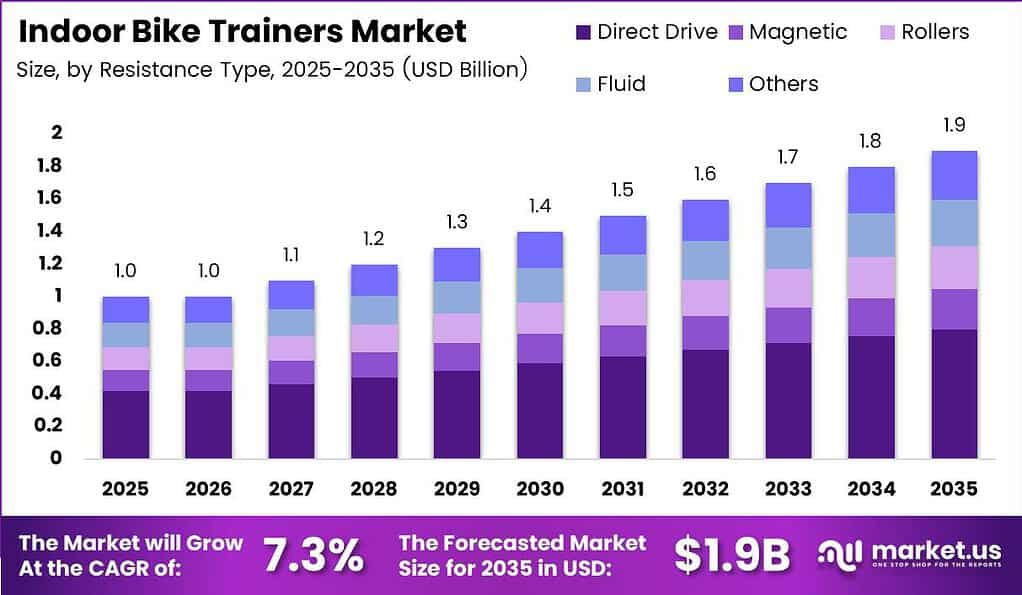
Global Indoor Bike Trainers Market size is expected to be worth around USD 1.9 Billion by 2035 from USD 1.0 Billion in 2025, growing at a CAGR of 7.3% during the forecast period 2026 to 2035.
The indoor bike trainers market encompasses stationary resistance devices that allow cyclists to ride their own bicycles indoors. Products range from basic magnetic trainers to fully connected direct-drive units with real-time power measurement, virtual platform integration, and automated gradient simulation. This creates a wide hardware and price spectrum for consumer and institutional buyers.
Key Takeaways
- The global Indoor Bike Trainers Market is valued at USD 1.0 Billion in 2025 and is forecast to reach USD 1.9 Billion by 2035.
- The market grows at a CAGR of 7.3% during the forecast period 2026 to 2035.
- By Type, Smart Bike Trainers dominate with a 62.11% share, driven by connected platform demand.
- By Resistance Type, Direct Drive holds a 41.23% share as the leading resistance category.
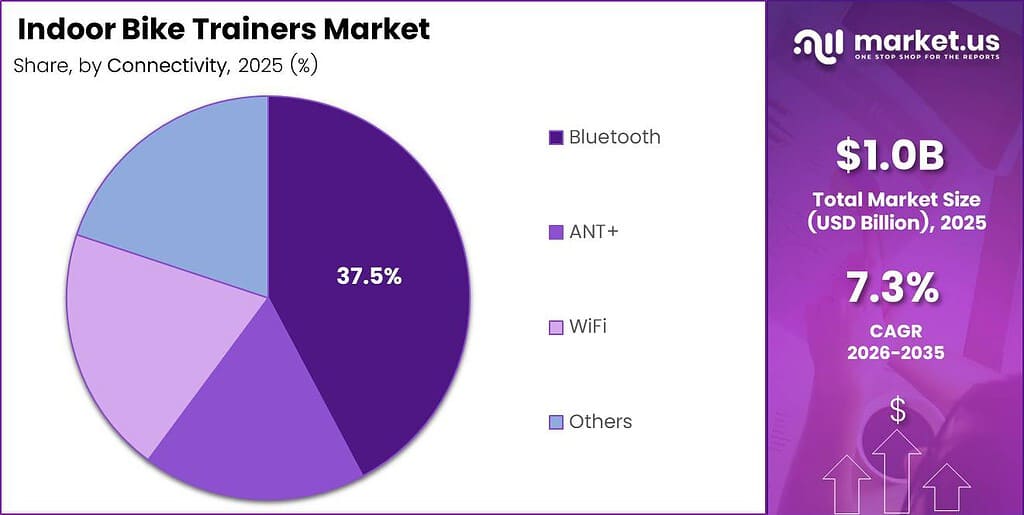
- By Connectivity, Bluetooth leads with a 37.56% share as the primary connection standard.
- By Application, Exercise dominates with a 67.34% share, reflecting the broad consumer fitness base.
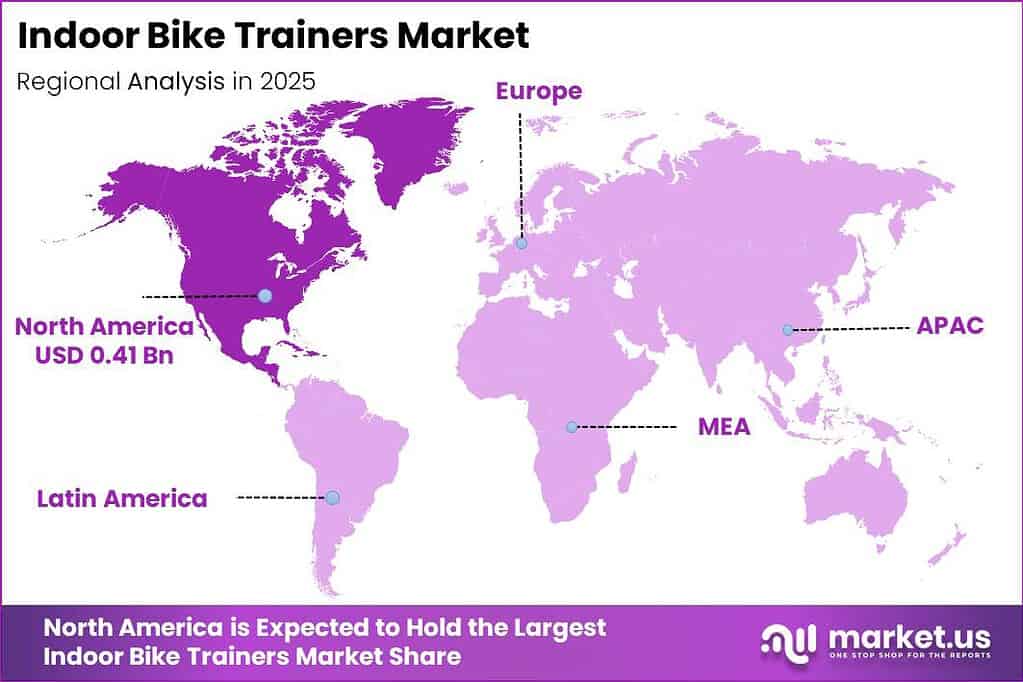
- North America leads all regions with a 41.23% share, valued at USD 0.41 Billion.
- Europe is the fastest-growing regional market across the forecast period.
However, the market’s growth trajectory is shaped by more than hardware upgrades. Platform integration has become a commercial anchor, with trainer bundles now combining hardware, virtual software access, and recurring subscriptions. This model shifts revenue from one-time equipment sales toward ongoing engagement, raising lifetime customer value for manufacturers that execute it well.
As per our research, entry-level smart trainer pricing has compressed. The Elite Rivo launched in June 2025 at under €500, while the Wahoo KICKR CORE 2 carried a retail price of $549 with a promotional price of $439, representing a 20% discount. These price points signal that performance hardware is entering a volume-accessible range, expanding the addressable buyer pool beyond dedicated athletes.
In August 2026, Wahoo Fitness launched a three-tier subscription platform for the Wahoo App, priced from $4.99 to $17.99 per month. This move confirms that leading manufacturers are building recurring revenue streams alongside hardware sales, a structural shift that increases platform switching costs and deepens brand retention across the forecast period.
Type Analysis
Smart Bike Trainers dominate with 62.11% due to connected platform and virtual training demand.
In 2025, Smart Bike Trainers held a dominant market position in the By Type segment of the Indoor Bike Trainers Market, with a 62.11% share. Virtual platforms such as Zwift have made connectivity a baseline expectation rather than a premium feature. Trainers without app compatibility lose relevance quickly as platform-integrated bundles become the standard purchase format in key markets.
Classic Bike Trainers retain a meaningful share among price-sensitive and entry-level buyers who do not require app connectivity. These units serve cyclists who want consistent resistance without subscription commitments. However, as smart trainer pricing falls toward mass-market thresholds, the functional case for classic alternatives continues to narrow across developed market segments.
Resistance Type Analysis
Direct Drive dominates with 41.23% due to superior power accuracy and wheel-off riding convenience.
In 2025, Direct Drive held a dominant market position in the By Resistance Type segment of the Indoor Bike Trainers Market, with a 41.23% share. Direct drive units eliminate rear-wheel contact, reducing tire wear and noise while delivering cleaner power data. This performance profile has made direct drive the reference standard for structured training among serious cyclists and competitive riders.
Magnetic trainers serve riders who prioritize portability and low cost over data precision. These units require no power source and are widely available at entry-level price points. By contrast, their fixed resistance curves limit training structure, making them less viable as virtual training adoption increases among fitness-oriented buyers.
Fluid trainers offer a progressive resistance curve that more closely mirrors outdoor riding feel compared to magnetic alternatives. This characteristic attracts cyclists who value ride quality over connectivity. However, fluid units lack electronic resistance control, which excludes them from virtual platform integration and limits their relevance as connected training becomes the purchase norm.
Rollers and other resistance formats collectively hold the remaining share. Rollers appeal to advanced riders focused on balance and pedaling technique. These sub-segments serve specialized training needs rather than mainstream demand, and their growth is constrained by the skill level required for safe and effective use.
Connectivity Analysis
Bluetooth dominates with 37.56% due to universal device compatibility and low setup friction.
In 2025, Bluetooth held a dominant market position in the By Connectivity segment of the Indoor Bike Trainers Market, with a 37.56% share. DC Rainmaker data from November 2025 confirmed the Wahoo KICKR CORE 2 transmitted power data at 10 Hz over Bluetooth when used with Zwift, and supported 3 concurrent Bluetooth connections. This multi-device capability removes a key setup barrier for households running multiple training apps simultaneously.
ANT+ retains relevance among performance cyclists who use dedicated cycling computers and head units built around the ANT+ protocol. Its low-power transmission and one-to-many broadcast capability makes it preferable for competitive setups requiring simultaneous data feeds. This positions ANT+ as a complementary rather than competing standard for buyers who already own compatible devices.
Wi-Fi is the fastest-growing connectivity sub-segment, reflecting demand for higher-bandwidth, lower-latency data transfer during structured training sessions. Elite’s June 2025 Rivo announcement specified dual-channel Bluetooth connectivity alongside 2 stand-alone operating modes for riding without connected apps. Wi-Fi adoption expands training functionality without requiring a paired smartphone, which lowers the technical barrier for platform-based workouts.
Application Analysis
Exercise dominates with 67.34% due to broad consumer fitness adoption beyond competitive cycling.
In 2025, Exercise held a dominant market position in the By Application segment of the Indoor Bike Trainers Market, with a 67.34% share. General fitness buyers represent the largest and most accessible demand pool, purchasing trainers as cardio equipment rather than cycling-specific performance tools. This broad base supports volume sales at mid-range price points and sustains demand independent of competitive cycling season cycles.
Competitive Riding is the fastest-growing application sub-segment, driven by athletes seeking structured indoor training with real-time power metrics and virtual race environments. In April 2026, Zwift acquired ROUVY to expand its virtual training ecosystem, signaling platform investment in race-simulation experiences. This acquisition deepens content libraries available to competitive riders, accelerating trainer adoption within performance-focused cycling communities. Elite’s Rivo Zwift Ready configuration offered 24 virtual gears and supported 8 to 12-speed drivetrains, reducing hardware friction for competitive users entering virtual platforms.
Key Market Segments
By Type
- Smart Bike Trainers
- Classic Bike Trainers
By Resistance Type
- Direct Drive
- Magnetic
- Rollers
- Fluid
- Others
By Connectivity
- Bluetooth
- ANT+
- WiFi
- Others
By Application
- Exercise
- Competitive Riding
- Others
Regional Analysis
North America Dominates the Indoor Bike Trainers Market with a Market Share of 41.23%, Valued at USD 0.41 Billion
North America holds a 41.23% share of the global Indoor Bike Trainers Market, valued at USD 0.41 Billion in 2025. High consumer spending power, dense urban fitness culture, and established virtual training platform adoption position this region as the primary revenue generator. The concentration of key hardware brands and direct-to-consumer distribution infrastructure reinforces North America’s structural lead throughout the forecast period.
Europe is the fastest-growing regional market across the forecast period. Cycling infrastructure investment, a strong competitive cycling culture, and high smart trainer penetration rates create durable demand across major European markets. Northern European countries in particular combine weather-driven indoor training necessity with high household disposable income, making them an accelerating revenue contributor as platform-integrated bundles gain mainstream traction.
Key Regions and Countries
North America
- US
- Canada
Europe
- Germany
- France
- The UK
- Spain
- Italy
- Rest of Europe
Asia Pacific
- China
- Japan
- South Korea
- India
- Australia
- Rest of APAC
Latin America
- Brazil
- Mexico
- Rest of Latin America
Middle East and Africa
- GCC
- South Africa
- Rest of MEA
Market Dynamics
Market Opportunity Analysis - Competitive riding, Wi-Fi connectivity, and European expansion offer entry points for performance-focused brands
The Competitive Riding application sub-segment is the fastest-growing demand category within the Indoor Bike Trainers Market yet commands a smaller base than the Exercise segment. This gap between growth velocity and current penetration signals that performance-oriented buyers remain underserved relative to general fitness consumers. New entrants that build product lines targeting structured training, race simulation, and data analytics will find less direct competition than in the mass fitness tier.
Wi-Fi connectivity is the fastest-growing sub-segment within the connectivity category but holds a smaller share than Bluetooth at present. This divergence between growth rate and installed base creates a first-mover window for brands that standardize Wi-Fi as a baseline feature before the broader market catches up. Brands that lead on Wi-Fi capability will also be better positioned as virtual platform data demands increase and Bluetooth bandwidth constraints become more apparent.
Europe is the fastest-growing regional market across the forecast period, yet North America holds a dominant 41.23% share. This regional gap reflects an earlier adoption curve in Europe relative to North America. Distributors and brands that expand into Northern European markets now will benefit from compounding adoption as weather-driven indoor training demand and virtual platform penetration accelerate through the forecast window.
Classic Bike Trainers retain a share among price-sensitive buyers but face structural pressure as smart trainer pricing falls toward mass-market thresholds. This compression creates a transition window for manufacturers that bridge the gap with entry-level smart products priced to convert classic trainer owners. Capturing this migration early locks in platform subscribers who then generate recurring software revenue throughout the product replacement cycle.
Technology and Innovation Landscape - Connected hardware, power accuracy, and firmware automation define the competitive technology frontier
Direct drive technology has established power accuracy as a competitive differentiator in the indoor trainer market. Elite’s Avanti trainer specified ±1% power-meter accuracy, while the Rivo specified ±2.5% accuracy with simulated gradients up to 18%. These precision benchmarks set buyer expectations across the performance segment and pressure all connected trainer brands to publish and defend their own accuracy specifications.
Virtual gear systems represent a hardware innovation that reduces the friction between trainer purchase and platform activation. Elite’s Rivo Zwift Ready configuration delivered 24 virtual gears through Zwift Click and supported 8 to 12-speed bicycle drivetrains through Zwift Cog. This compatibility breadth reduces the drivetrain-specific decisions a buyer must make before purchasing, which shortens the consideration cycle and increases conversion among platform-ready buyers.
Automated firmware management is emerging as an operational technology advantage for connected trainer brands. The KICKR CORE 2 automatically checked for new firmware every 11 hours when connected to Wi-Fi, according to the November 2025 review. This background update cycle reduces the user action required to maintain calibration and compatibility, lowering support demand and extending the effective product life of hardware already in the field.
Gradient simulation capability has expanded as a performance specification battleground across leading brands. The Wahoo KICKR CORE 2 simulated gradients up to 16%, while Elite’s Rivo reached 18% and the Tacx Alpine accessory extended positive gradient simulation to 25%. Brands that push gradient ceiling specifications attract competitive and enthusiast buyers training for real-world climbing events, a high-value cohort with above-average willingness to pay for performance hardware.
Drivers
Platform-integrated trainer bundles have removed the setup complexity that previously prevented sustained trainer use after purchase. Zwift’s trainer-based Ride system, announced on 12 June 2024, and Elite’s firmware expansion in May 2025 extending virtual shifting across its direct-drive range illustrate a commercial shift already embedded in the market. Compatibility now spans almost any 8 to 13-speed bicycle with 24 virtual gears, simplifying purchase decisions for buyers without specialized drivetrain knowledge.
This integration model raises purchase conversion among setup-sensitive buyers and ties hardware revenue to recurring software engagement. An analyst scenario estimates a 3 to 5% relative improvement in conversion among this cohort, contributing a modeled 0.55 percentage points to the 7.3% baseline CAGR. The separate opportunity envelope totals 1.30 percentage points, implying an illustrative upside ceiling of 8.60%, while combined restraint and challenge sensitivities total 1.90 percentage points, implying a downside stress case of 5.40%.
| Driver | (~) % Impact on CAGR Forecast | Geographic Relevance | Impact Timeline |
|---|---|---|---|
| Platform-integrated trainer bundles | +0.55% | North America, Europe, Australia | Short term (≤ 2 years) |
| Weather-independent training demand | +0.30% | Northern Europe, North America, monsoon Asia | Short term (≤ 2 years) |
| Power-based endurance coaching | +0.25% | Global competitive cycling hubs | Medium term (2–4 years) |
| Time-efficient home workouts | +0.20% | Global urban markets | Short term (≤ 2 years) |
| Connected-equipment replacement demand | +0.15% | North America, Western Europe | Medium term (2–4 years) |
Restraints
Upfront purchase cost remains the primary barrier for budget-constrained households despite genuine interest in indoor training. As a historical financing benchmark, the European Central Bank reported an average new consumer-loan rate of 7.71% in June 2024, confirming that installment financing adds meaningful cost rather than eliminating the affordability gap. Affordability-sensitive customers represent an estimated 20 to 25% of prospective buyers, and their conversion rate falls 8 to 12% below an unconstrained baseline.
This conversion shortfall translates into a modeled -0.40 percentage-point drag on the 7.3% forecast CAGR. Manufacturers who respond through promotional discounting of 5 to 8% would compress an assumed initial gross margin of 35% to approximately 29 to 32% at unchanged unit cost. Lower-cost product architecture therefore offers a structurally sounder response than indiscriminate promotional spending for brands targeting price-sensitive segments.
| Restraint | (~) % Impact on CAGR Forecast | Geographic Relevance | Impact Timeline |
|---|---|---|---|
| Upfront household affordability barrier | -0.40% | Global; price-sensitive households | Short term (≤ 2 years) |
| Dedicated indoor-space limitations | -0.25% | Dense Asian and European cities | Long term (≥ 4 years) |
| Used-equipment purchase substitution | -0.20% | North America, Western Europe | Short term (≤ 2 years) |
| Outdoor-bicycle ownership prerequisite | -0.15% | Emerging consumer cycling markets | Medium term (2–4 years) |
| Apartment vibration restrictions | -0.10% | Global multifamily housing markets | Long term (≥ 4 years) |
Challenges
Cross-platform firmware validation creates an ongoing operational burden for connected trainer manufacturers. Bluetooth’s Fitness Machine Service standard governs training-data exchange, but compliance also requires mandatory Errata Correction 23224, meaning shared protocol support does not eliminate release-management obligations. An illustrative test matrix of 4 trainer models, 3 operating-system families, 4 applications, and 2 firmware branches generates 96 compatibility combinations before accounting for peripheral variants.
Assuming 1 to 2 engineer-hours per combination, a full regression cycle requires 96 to 192 hours. A hypothetical 2 to 4% initial-session failure rate would increase support costs and threaten user activation. This challenge underpins a conservative modeled friction drag of -0.30 percentage points against the 7.3% baseline, and manufacturers that invest in automated protocol testing and staged firmware releases will contain support cost exposure without slowing launch cadence.
| Challenge | (~) % CAGR Friction Drag | Geographic Relevance | Mitigation Horizon |
|---|---|---|---|
| Cross-platform firmware validation complexity | -0.30% | Global connected-trainer ecosystem | Medium term (2–4 years) |
| Power measurement calibration drift | -0.20% | Global performance-training markets | Medium term (2–4 years) |
| Heavy-unit reverse logistics costs | -0.15% | Global cross-border distribution | Short term (≤ 2 years) |
| Seasonal inventory forecasting errors | -0.10% | Northern Hemisphere retail markets | Short term (≤ 2 years) |
| Electromechanical component sourcing concentration | -0.05% | Asian manufacturing, global sales | Medium term (2–4 years) |
Opportunities
Clinician-supervised home conditioning represents a distinct institutional channel that trainer suppliers have not yet systematically developed. WHO reported on 26 June 2024 that 31% of adults did not meet recommended activity levels in 2022, an increase of approximately 5 percentage points since 2010. Its recommendation of 150 minutes of moderate activity weekly establishes a public-health need that supports clinical and institutional trainer adoption.
An illustrative service design could divide clinician-approved weekly activity into 5 sessions of 30 minutes each. Institutional cohort acquisition could lower customer-acquisition cost per activated user by 15 to 25%, while monitoring and support contracts could produce a blended gross-margin improvement of 2 to 4 percentage points after service costs. A conservative +0.40 percentage-point upside above the 7.3% baseline applies, with durable value dependent on adherence evidence and service profitability rather than equipment shipment volume alone.
| Opportunity | (~) % Potential CAGR Upside | Geographic Relevance | Execution Window |
|---|---|---|---|
| Clinician-supervised home conditioning | +0.40% | North America, Europe, developed Asia-Pacific | Medium term (2–4 years) |
| Employer-sponsored trainer programs | +0.30% | North America, Europe, urban Asia | Medium term (2–4 years) |
| Hospitality endurance-training amenities | +0.25% | Global business-travel and cycling destinations | Medium term (2–4 years) |
| School and university cycling labs | +0.20% | Europe, North America, Australia | Long term (≥ 4 years) |
| Para-cycling adaptive trainer systems | +0.15% | Global specialist sports networks | Long term (≥ 4 years) |
Key Company Insights
Wahoo Fitness holds a performance credibility advantage supported by independently verified hardware metrics. DC Rainmaker’s November 2025 review accumulated more than 1,000 km across 2 riders and confirmed the KICKR CORE 2 reached a 450 W ERG target in approximately 2 seconds. Power agreement across the KICKR CORE 2, SRAM Force crankset, and Garmin Rally RS-210 pedals remained within a 1.5% spread, a level of cross-device consistency that strengthens the brand’s position among data-dependent competitive riders.
Elite competes on precision and compatibility with a product line engineered for both entry and performance tiers. The Avanti trainer specified ±1% power-meter accuracy with 4.5° Flex Feet lateral movement, while the Rivo specified ±2.5% accuracy and simulated gradients up to 18%. The KICKR CORE 2 by contrast handled gradients up to 16% with a maximum resistance of 1,800 W and a rider weight limit of 113 kg, defining a clear head-to-head capability comparison that gives performance buyers a specific basis for choosing between platforms.
Key Players
- Wahoo Fitness
- Peloton Interactive
- Tacx
- Elite
- Minoura
- Kurt Kinetic
- CycleOps
- Saris
- BKOOL
- Stages Cycling
- Other Key Players
Recent Developments
- June 2025 – Garmin expanded its hardware accessories lineup by releasing the Tacx Alpine gradient simulator and steering device, offering up to 25% positive and -10% negative gradient simulation exclusively for the Tacx NEO 3M and NEO 2T.
- August 2026 – Garmin announced a product expansion by releasing a factory-bundled variant of the Tacx NEO 2T with Zwift Cog and Click pre-installed, offering instant virtual shifting across 8 to 13-speed bike frames.
Report Scope
| Report Features | Description |
|---|---|
| Market Value (2025) | USD 1.0 Billion |
| Forecast Revenue (2035) | USD 1.9 Billion |
| CAGR (2026-2035) | 7.3% |
| Base Year for Estimation | 2025 |
| Historic Period | 2020-2024 |
| Forecast Period | 2026-2035 |
| Report Coverage | Revenue Forecast, Market Dynamics, Market Opportunity Analysis, Technology and Innovation Landscape, Competitive Landscape, Recent Developments |
| Segments Covered | By Type (Smart Bike Trainers, Classic Bike Trainers), By Resistance Type (Direct Drive, Magnetic, Rollers, Fluid, Others), By Connectivity (Bluetooth, ANT+, WiFi, Others), By Application (Exercise, Competitive Riding, Others) |
| Regional Analysis | North America (US and Canada), Europe (Germany, France, The UK, Spain, Italy, and Rest of Europe), Asia Pacific (China, Japan, South Korea, India, Australia, and Rest of APAC), Latin America (Brazil, Mexico, and Rest of Latin America), Middle East and Africa (GCC, South Africa, and Rest of MEA) |
| Competitive Landscape | Wahoo Fitness, Peloton Interactive, Tacx, Elite, Minoura, Kurt Kinetic, CycleOps, Saris, BKOOL, Stages Cycling, Other Key Players |
| Customization Scope | Customization for segments, region/country-level will be provided. Additional customization can be done based on requirements. |
| Purchase Options | We have three licenses to opt for: Single User License, Multi-User License (Up to 5 Users), Corporate Use License (Unlimited User and Printable PDF) |