Report Overview
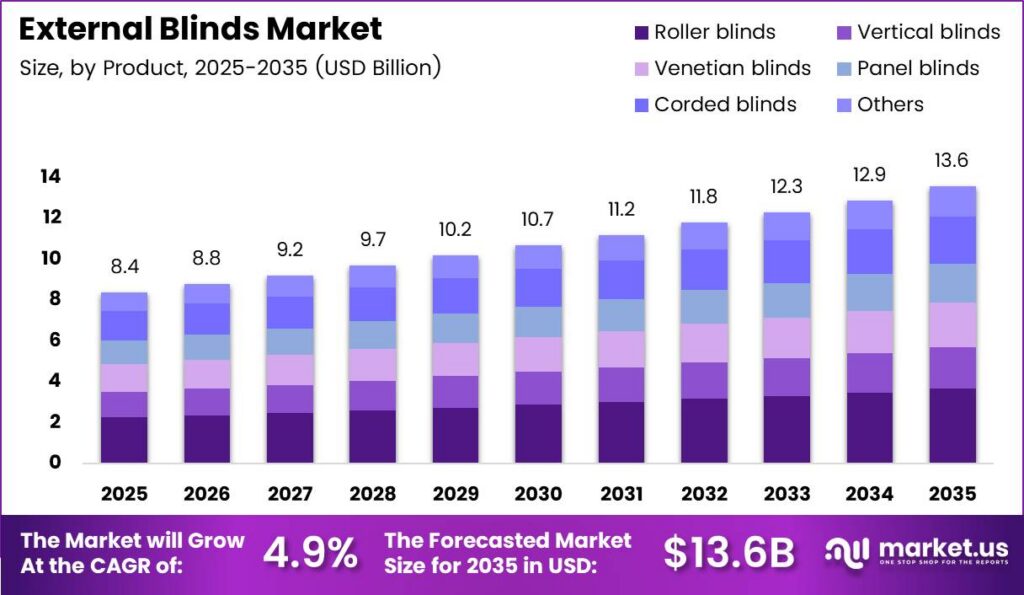
Global External Blinds Market size is expected to be worth around USD 13.6 Billion by 2035 from USD 8.4 Billion in 2025, growing at a CAGR of 4.9% during the forecast period 2026 to 2035. External blinds are exterior building shading systems mounted outside glass windows and facades to block solar heat, control glare, and protect indoor occupant comfort before sunlight strikes glazing.
Commercial offices, hotels, institutional campuses, and residential housing form the core purchasing structure of this industry. According to IEA, global cooled floor area in buildings will expand from 105 billion square meters in 2022 to 140 billion square meters by 2030 and 250 billion square meters by 2050. Consequently, property developers specify exterior shading hardware early to downsize mechanical chillers and lower peak cooling loads across glazed structures.
Key Takeaways
- The global External Blinds Market was valued at USD 8.4 Billion in 2025.
- Global market revenue will reach USD 13.6 Billion by 2035.
- The market expands at a CAGR of 4.9% during the forecast period from 2026 to 2035.
- Roller blinds led the product segment with a 26.56% market share in 2025, while vertical blinds represent the fastest-growing product category.
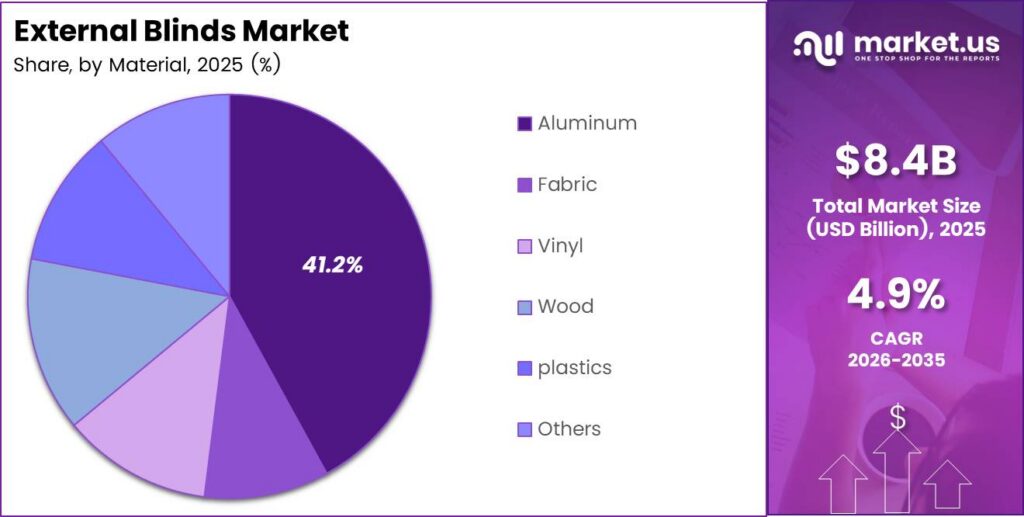
- Aluminum dominated the material segment at 41.23% share in 2025 and also stands as the fastest-growing material.
- Manual systems held a 54.34% share of the operation mode segment in 2025, while automatic systems record the fastest expansion.
- Retro-fit projects accounted for 56.34% of the installation type segment in 2025, whereas new construction grows fastest.
- Residential applications captured 46.34% of the end-use segment in 2025, while commercial end use expands fastest.
- Offline channels generated 63.78% of distribution revenue in 2025, while online channels represent the fastest-growing route to market.
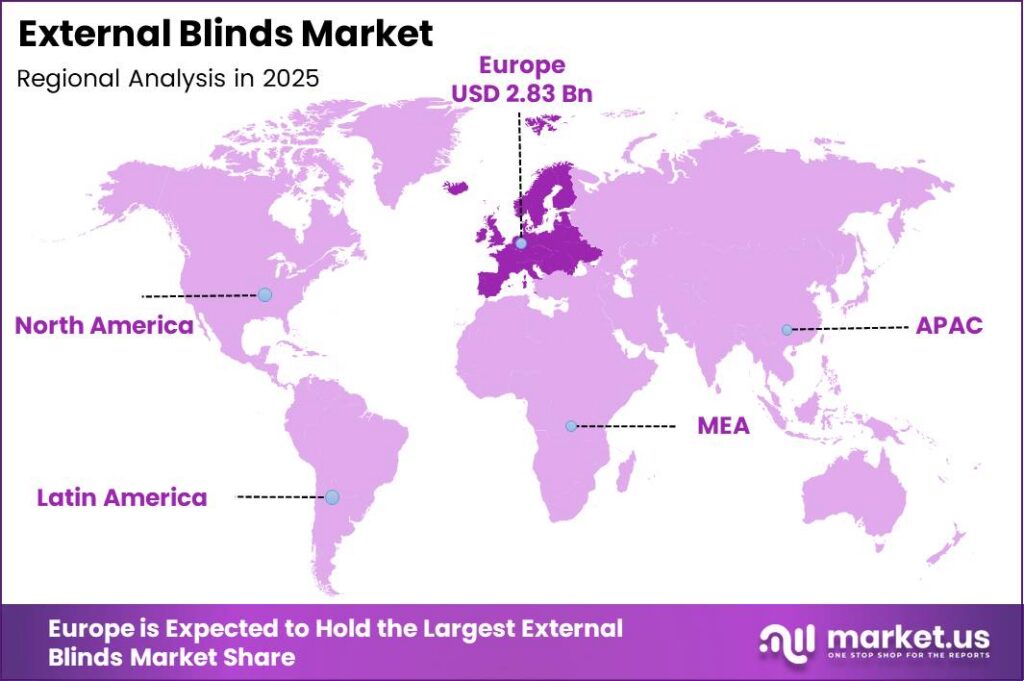
- Europe dominated regional revenue in 2025 with a 33.89% share valued at USD 2.83 Billion, while Asia-Pacific grows fastest from 2026 to 2035.
However, national climate mandates now dictate how builders manage solar heat gain across urban property portfolios. As reported by UNEP, deploying passive cooling and exterior building shading globally can protect 3.5 billion people from heat stress and save USD 1 trillion annually in energy bills by 2050. Therefore, municipal green building codes reward exterior solar control, turning facade blinds into compliance assets for institutional real estate owners.
This creates consolidation momentum among regional component suppliers seeking scale in aluminum extrusion and weather-resistant technical textiles. In September 2024, a major European aluminum systems group completed a net PLN 394.9 million acquisition of 100% equity in a Polish sun protection producer generating PLN 280 million in annual revenue. As a result, integrated facade suppliers capture higher project margins by bundling structural curtain walls with factory-fitted exterior blinds.
Europe holds the largest share of the global External Blinds Market at 33.89% in 2025, supported by mature architectural manufacturing ecosystems and strict summer overheating codes. Data from CSIL shows global home furnishings and interior decor production reached USD 471 billion in 2024, while cross-border trade rose 2% to USD 174 billion . Consequently, European fabricators use established cross-border distribution hubs to export high-margin motorized shading systems worldwide.
Instead of managing fragmented textile mills, leading European manufacturers are centralizing technical fabric supply chains to protect delivery speed. In February 2024, a global window coverings group invested EUR 20 million to unify 4 European solar fabric producers employing 450 workers and opened an 8,000 square meter central warehouse in Belgium. This signals that inventory centralization will separate top-tier contract suppliers from smaller regional assemblers.
Product Analysis
Roller blinds dominates with 26.56% share in 2025 due to compact wind-guided cassette housing performance.
In 2025, roller blinds held a 26.56% share in the Product segment of the External Blinds Market. US Department of Energy found that optimized interior and exterior roller solar shades deliver whole-home summertime cooling energy savings between 15% and 25% in field evaluations . Zip-guided side channels lock tensioned fabric tubes against wind uplift while sealing perimeter light gaps across wide glass panes. Therefore, manufacturers focusing on compact cassette profiles win high-volume apartment and office facade tenders.
Vertical blinds serve floor-to-ceiling commercial curtain walls and wide patio sliders as the fastest-growing product category. Based on US Consumer Product Safety Commission data, 40% of investigated window-cord strangulation cases involved continuous loop cord or chain mechanisms common to legacy vertical blind tracks . Strict safety enforcement eliminates exposed loop chains and forces facility managers to specify wand-driven or motorized exterior vertical louvres. Consequently, commercial suppliers earn higher unit prices by upgrading legacy vertical tracks to motorized operation.
Venetian blinds give architects precise daylight redirection through tiltable horizontal exterior slats across sun-exposed elevations. US EPA indicates that standard double-pane glass admits 75% of solar heat, whereas upgrading solar control performance lowers household energy bills by up to 13% nationwide . Curved exterior slats bounce intense midday radiation outward while reflecting soft daylight onto interior office ceilings to cut artificial lighting loads. This means specification-led manufacturers can defend premium margins on commercial green building projects.
Material Analysis
Aluminum dominates with 41.23% share in 2025 due to corrosion resistance and structural rigidity.
In 2025, aluminum held a 41.23% share in the Material segment of the External Blinds Market and leads segment growth. Figures from International Aluminium Institute show global primary aluminum production rose 1.1% to reach 73.78 million tonnes in 2025, with China supplying 44.2 million tonnes . Roll-formed and extruded aluminum alloys resist ultraviolet degradation, salt corrosion, and high wind pressure without warping across multi-story facades. Therefore, blind fabricators must lock in regional low-carbon aluminum supply contracts to protect gross margins.
Fabric materials power tensioned exterior zip screens and architectural drop-arm blinds where outward visibility remains essential. According to UN Comtrade, United States imports of synthetic awnings and sunblinds reached USD 197.9 million in 2024, with China supplying USD 152.1 million or 76.8% of total value . Fiberglass and polyester yarns coated with weatherproof polymers hold dimensional tension under thermal expansion while filtering harsh solar glare. Consequently, Western assemblers face tariff exposure unless they diversify technical textile sourcing across multiple regions.
Vinyl materials cater to budget-conscious residential buyers seeking moisture-proof exterior slats in humid and coastal climates. As reported by US Department of Energy, over 80% of homes and small commercial buildings install window attachments, and horizontal vinyl blinds represent over 80% of installed stock . Extruded polyvinyl formulations eliminate painting maintenance and resist rot, though high facade heat limits wide-span structural stiffness compared with metal. As a result, vinyl blind producers compete primarily on high-volume retail price efficiency rather than architectural customization.
Operation Mode Analysis
Manual dominates with 54.34% share in 2025 due to zero electrical wiring retrofit simplicity.
In 2025, manual held a 54.34% share in the Operation Mode segment of the External Blinds Market. Data from ACEEE shows that upgrading window thermal resistance from R3 to R5 cuts average building heat loss by 40% alongside manually operated passive shading attachments . Crank-rod and spring-balanced gearboxes eliminate exterior electrical conduit trenching and electrician labor fees during single-window residential replacements. Therefore, dealers serving cost-sensitive homeowners rely on manual gear drives to close quick-turn retrofit orders without permitting delays.
Automatic operation stands as the fastest-growing mode as smart motors connect exterior facades to weather sensors and home hubs. WIPO found that global innovators filed a record 3.725 million patent applications in 2024, up 4.9%, alongside 1.6 million industrial design filings . Automated sun and wind algorithms retract or tilt exterior blinds autonomously before storm gusts damage slats or afternoon heat enters unoccupied rooms. Consequently, motor manufacturers capture recurring software and sensor pull-through revenue far above bare mechanical hardware.
Connected in-wall controls bridge legacy wired motors and cross-platform smart home ecosystems across residential and light commercial buildings. Based on Eve Systems data, the company launched its Matter-certified Eve Shutter Switch in Europe in October 2025 at EUR 99.95 to automate existing blind switches . Universal Matter-over-Thread radio chips let property owners group exterior blinds by compass orientation without locking buyers into proprietary vendor clouds. This signals that open-protocol control compatibility will become mandatory for European and North American distribution partnerships.
Installation Type Analysis
Retro-fit dominates with 56.34% share in 2025 due to aging unshaded building stock upgrades.
In 2025, retro-fit held a 56.34% share in the Installation Type segment of the External Blinds Market. Eurostat indicates that 85% of European Union buildings were built before 2000 and 75% show poor energy performance, while annual energy renovations remain at 1% . Surface-mounted exterior cassette boxes bolt directly onto existing masonry reveals or window frames without tearing open interior plaster walls. Therefore, manufacturers offering slim cassette profiles and solar-battery motors win upgrade business in occupied apartments.
New construction represents the fastest-growing installation segment as architects embed concealed blind lintels directly into insulated wall cavities. Figures from US Census Bureau show privately-owned United States housing permits reached an annual rate of 1,400,000 units and starts hit 1,221,000 units in September 2026 . Designing recessed shading pockets during structural framing eliminates thermal bridges, hides guide rails, and lowers per-window electrician wiring costs. Consequently, suppliers that provide building information modeling files to architects lock in multi-unit specifications early.
Integrated commercial facade installations pair low-voltage power buses with structural glazing mullions on modern multi-story developments. According to Coulisse, the company launched its flagship 24V DC wired smart motor line in May 2025 following the April 2025 release of its CM 55 Matter Bridge . Low-voltage DC distribution lets commercial contractors wire dozens of facade blinds safely before licensed high-voltage commissioning begins on site. As a result, shading vendors that simplify electrical rough-in reduce contractor labor bottlenecks and win larger commercial bids.
End Use Analysis
Residential dominates with 46.34% share in 2025 due to heatwave comfort and privacy upgrades.
In 2025, residential held a 46.34% share in the End Use segment of the External Blinds Market. As reported by IEA, roughly 2 billion air conditioning units operate worldwide today, and residential dwellings account for nearly 70% of installed cooling units . Homeowners install exterior blinds on south-facing bedrooms and patios to block radiative glass heat before room air conditioners spike summer electricity bills. Therefore, residential dealers that bundle exterior blinds with outdoor living screens increase average order value per household.
Commercial buildings represent the fastest-growing end-use category as corporate landlords upgrade glass towers to meet binding carbon caps. Data from European Commission shows revised building rules mandate renovating the 16% worst-performing non-residential buildings by 2030 and the 26% worst-performing by 2033 . Automated exterior blinds cut cooling plant capital expenditure on glazed office facades while preventing screen glare at employee workstations. Consequently, institutional landlords treat dynamic exterior shading as an asset-value protection tool to avoid stranded commercial buildings.
Hotels invest heavily in exterior shading across guestroom balconies, poolside cabanas, and resort dining terraces to elevate guest comfort. UNWTO found that global international tourist arrivals grew 4% to reach 1.52 billion overnight visitors in 2025 and rose 2% to 307 million in Q1 2026 . Blackout-capable external blinds block early morning sunlight and exterior street noise while expanding revenue-generating al fresco dining seating during peak afternoon heat. This means hospitality refurbishment contractors prioritize durable, quiet-motor exterior systems backed by multi-year service agreements.
Distribution Channel Analysis
Offline dominates with 63.78% share in 2025 due to custom site measurement and fitting.
In 2025, offline held a 63.78% share in the Distribution Channel segment of the External Blinds Market. Based on Eurostat data, euro area non-food retail volume increased 0.5% month-over-month and 1.7% year-over-year in August 2026, lifting European Union retail 1.2% . Custom exterior blinds require millimeter-accurate lintel measurement, substrate anchor inspection, and wind-sensor calibration that buyers evaluate inside physical dealer showrooms. Therefore, brands with dense certified installer networks maintain stronger pricing power and fewer warranty claims than unassisted sellers.
Supermarkets and hypermarkets distribute standardized, cut-to-size manual exterior roll-up blinds to do-it-yourself suburban shoppers. US Census Bureau indicates that United States general merchandise stores recorded USD 80,388 million in August 2026 sales, including USD 66,986 million at supercenters and warehouse clubs . Big-box seasonal garden aisles move high volumes of entry-level vinyl and fabric sunblinds during late-spring heatwaves through promotional pallet displays. However, custom architectural manufacturers avoid hypermarket shelves to protect specialist dealer margins from retail price erosion.
Specialty stores anchor premium residential and light commercial sales through consultative fabric sampling, home automation demos, and turnkey installation packages. Figures from US Census Bureau show building material and garden dealers generated USD 44,570 million while specialty home furnishings stores hit USD 10,559 million in August 2026 . Trained showroom consultants upsell motorized wind protection, custom powder-coated cassette colors, and multi-window smart controls during in-home visits. Consequently, leading manufacturers invest in dealer training academies and digital quoting tools to lock in showroom loyalty.
Key Market Segments
By Product
- Roller blinds
- Vertical blinds
- Venetian blinds
- Panel blinds
- Corded blinds
- Others
By Material
- Aluminum
- Fabric
- Vinyl
- Wood
- Plastics
- Others
By Operation Mode
- Manual
- Automatic
By Installation Type
- Retro-fit
- New construction
By End Use
- Residential
- Commercial
- Hotels
- Institutional
- Corporate
- Others
By Distribution Channel
- Offline
- Supermarket/hypermarket
- Specialty stores
- Others
- Online
- E-commerce
- Company website
Regional Analysis
Europe Dominates the External Blinds Market with a Market Share of 33.89% in 2025, Valued at USD 2.83 Billion
Europe leads global revenue at 33.89% share in 2025 because low residential air-conditioning penetration and strict building thermal codes make exterior solar shading standard equipment. According to Eurostat, seasonally adjusted construction production rose 1.2% in the euro area and 1.3% across the European Union in November 2024, led by specialized construction trades . Dense specialist installer networks in Germany, Switzerland, Austria, France, and Benelux convert energy-renovation subsidies directly into motorized venetian and zip-screen orders.
Asia-Pacific stands as the fastest-growing regional market between 2026 and 2035 as tropical metropolises and Australian cities combat extreme urban heat islands. As reported by World Bank, developing East Asia and Pacific GDP grew 5.0% in 2025 and will expand 4.5% in 2026, with urban residents reaching 65% of regional population . High-rise apartment towers and glazed commercial districts increasingly pair Chinese tubular motor manufacturing scale with wind-rated exterior screens to curb peak grid cooling loads.
North America and Rest of World markets exhibit diverging construction trajectories shaped by interest rates and regional energy security. Data from US Census Bureau shows United States construction spending hit USD 2,186.1 billion annualized in September 2026, including USD 848.8 billion in private residential projects . By contrast, World Bank found Latin America GDP will grow 2.2% in 2026 while Middle East and North Africa output contracts 2.1% under shipping disruptions . Consequently, exporters prioritize Sunbelt North American patio retrofits over volatile Gulf tenders.
Key Regions and Countries
North America
- US
- Canada
Europe
- Germany
- France
- The UK
- Spain
- Italy
- Rest of Europe
Asia Pacific
- China
- Japan
- South Korea
- India
- Australia
- Rest of APAC
Latin America
- Brazil
- Mexico
- Rest of Latin America
Middle East and Africa
- GCC
- South Africa
- Rest of MEA
Market Dynamics
Electric grid strain from mechanical air conditioning is reshaping how regulators, utilities, and property investors value passive exterior facade shading worldwide. IEA indicates that global peak electricity demand will climb 40% by 2035, while space cooling electricity consumption will jump nearly 1,500 terawatt-hours without stronger building envelope and shading policies . However, high installed system prices and skilled trade shortages limit immediate mass-market adoption. Therefore, suppliers must balance motorized product innovation against installation speed and lifecycle payback transparency.
Drivers
Rising summer heatwaves turn external blinds from optional decor into essential passive cooling equipment across residential and commercial buildings. Europe recorded its hottest year in 2024, with 60% of the continent facing above-average strong heat stress days according to an April 2025 climate assessment. Closed external Venetian blinds block up to 98% of solar radiation before sunlight strikes window glass, according to the British Blind and Shutter Association.
An overheating-driven segment representing 15% of baseline sales and expanding 3.0 percentage points faster annually contributes roughly 0.45 percentage points toward the 4.9% baseline CAGR from 2026. Therefore, manufacturers and dealers win higher margins when they pitch climate-specific glazing compatibility and measurable indoor comfort gains rather than competing on bare blind hardware pricing.
| Driver | (~) % Impact on CAGR Forecast | Geographic Relevance | Impact Timeline |
|---|---|---|---|
| Overheating-led passive cooling demand | +0.45% | Global; strongest in Southern Europe, Australia and hot-climate cities | Short term (≤ 2 years) |
| Building energy-performance policy implementation | +0.30% | European Union; selected regulated construction markets | Medium term (2–4 years) |
| Motorized product premiumization | +0.20% | Europe, North America and developed Asia-Pacific | Short term (≤ 2 years) |
| Urban residential privacy demand | +0.15% | Dense metropolitan markets worldwide | Medium term (2–4 years) |
| Factory-new replacement purchases | +0.15% | Mature installed-base markets in Europe and Australia | Short term (≤ 2 years) |
| Commercial daylight and glare management | +0.10% | Glazed office and institutional buildings worldwide | Medium term (2–4 years) |
Restraints
High upfront installed costs cause households and property owners to cancel or defer external blind quotes when full turnkey packages exceed approved renovation budgets. A Department of Energy assessment highlights custom sizing, facade integration, and motorization expenses as adoption barriers, noting historical stakeholder retrofit payback hurdles of 3 years to 5 years. A 7 year simple payback requires annual energy savings of 14.3% of installed cost, versus 20.0% for a 5 year hurdle.
When the most price-sensitive 10% of baseline volume grows 3.5 percentage points below potential, total market growth absorbs a 0.35 percentage point drag within the 4.9% baseline CAGR. Consequently, suppliers face constant pressure to value-engineer specifications, offer selective discounts, or walk away from low-conversion residential bids to protect contribution margins.
| Restraint | (~) % Impact on CAGR Forecast | Geographic Relevance | Impact Timeline |
|---|---|---|---|
| Upfront installed-cost affordability barrier | -0.35% | Global; strongest in price-sensitive residential retrofits | Short term (≤ 2 years) |
| Protected-façade alteration restrictions | -0.18% | Historic districts in Europe and other conservation markets | Long term (≥ 4 years) |
| Landlord and co-owner consent barriers | -0.15% | Rental housing and jointly owned apartment buildings | Medium term (2–4 years) |
| Unsuitable fixing substrates and clearances | -0.12% | Existing buildings with constrained exterior installation space | Long term (≥ 4 years) |
| Interior-covering substitution at purchase | -0.10% | North America, Asia-Pacific and budget-led residential channels | Short term (≤ 2 years) |
| Fire-safety and escape-route exclusions | -0.05% | Regulated high-rise façades and designated escape openings | Long term (≥ 4 years) |
Challenges
Shortages of trained exterior installation technicians cap how fast booked orders convert into billed revenue across skilled-trade markets. The European Labour Authority report published in 2025 covering 2024 identified shortages of building electricians in 22 countries and sheet-metal workers in 19 countries. Raising crew installation time per order from an index of 100 to 110 cuts fixed-crew completion capacity by roughly 9.1% before overtime.
A capacity-restricted segment representing 10% of baseline volume expanding 2.5 percentage points below unconstrained demand creates 0.25 percentage points of operational friction already reflected in the 4.9% CAGR. Therefore, manufacturers must invest in plug-and-play pre-wired cassettes, cross-trade installer apprenticeships, and route-optimization software to prevent summer backlog cancellations and overtime margin erosion.
| Challenge | (~) % CAGR Friction Drag | Geographic Relevance | Mitigation Horizon |
|---|---|---|---|
| Specialist installation workforce shortages | -0.25% | Europe; skilled-trade-intensive markets worldwide | Medium term (2–4 years) |
| Bespoke manufacturing complexity | -0.12% | Global made-to-measure production networks | Medium term (2–4 years) |
| Cross-platform controls interoperability | -0.10% | Connected residential and commercial installations worldwide | Medium term (2–4 years) |
| Weathering durability validation | -0.08% | Coastal, high-ultraviolet and humid climates | Long term (≥ 4 years) |
| Wind-response commissioning complexity | -0.06% | Exposed façades and wind-prone regions | Medium term (2–4 years) |
| Seasonal order concentration | -0.04% | Temperate-climate residential distribution networks | Short term (≤ 2 years) |
Opportunities
Certified recovery, refurbishment, testing, and resale networks for used external blinds unlock circular construction revenue beyond routine repairs or factory-new replacements. University circularity studies confirm active shading refurbishment alongside premature disposal of serviceable hardware, validating take-back and component harvesting models. While a new blind at price index 100 and cost 65 yields a 35% gross margin, a certified remanufactured blind sold at 80 with cost 46 earns 42.5%, expanding margin by 7.5 percentage points at a 20% buyer discount.
Capturing this +0.30 percentage point upside alongside other circular and solar-slat innovations could lift market expansion by 1.05 percentage points toward a 5.95% CAGR above the 4.9% baseline. Consequently, early movers that build reverse-logistics collection, part traceability, and factory-backed resale warranties will win sustainability-mandated commercial tenders.
| Opportunity | (~) % Potential CAGR Upside | Geographic Relevance | Execution Window |
|---|---|---|---|
| Certified remanufactured-blind resale networks | +0.30% | Europe, United Kingdom and mature circular-construction markets | Medium term (2–4 years) |
| Electricity-generating photovoltaic blind slats | +0.22% | Innovation-led façade markets in Europe and Asia | Long term (≥ 4 years) |
| Licensed local-fabricator expansion | +0.18% | Underpenetrated urban markets in Asia, Latin America and the Middle East | Medium term (2–4 years) |
| Regional dealer-network consolidation | +0.15% | Fragmented distribution markets in Europe and North America | Medium term (2–4 years) |
| Embodied-carbon procurement differentiation | +0.12% | Lifecycle-assessed commercial construction markets | Medium term (2–4 years) |
| Integrated insect-screen package upselling | +0.08% | Warm-climate residential markets worldwide | Short term (≤ 2 years) |
Key Company Insights
Hunter Douglas
Hunter Douglas leads the global window coverings and architectural exterior solar shading industry with manufacturing and dealer networks spanning North America, Europe, Latin America, Asia, and Australia. Based on Fitch Ratings data, Hunter Douglas generated USD 4.7 billion in global revenue and USD 874 million in adjusted EBITDA in 2025 while cutting adjusted leverage from 7.1x in 2024 to 5.8x . Strong cash generation lets the company fund fabric automation and custom dealer programs simultaneously.
In July 2025, Hunter Douglas rolled out Matter 1.2 smart home interoperability across its PowerView Gen 3 Automation platform via firmware v3.2.46, as reported by Hunter Douglas . The update connects more than 20 motorized shade styles directly to Apple Home, Google Home, and Amazon Alexa, supporting up to 15 shades per standard Gateway and 30 units per Gateway Pro . Consequently, custom integrators can specify PowerView shades into multi-brand luxury homes without complex third-party drivers.
Somfy
Somfy operates as the world leader in tubular motors, weather sensors, and automated controls for external blinds, roller shutters, and awnings across residential and commercial facades. Figures from Somfy Group show consolidated 2024 sales reached EUR 1,513 million, up 4.8% in real terms, delivering EUR 226 million in current operating profit across 59 countries backed by 2,117 patents . Scale across motors and radio protocols embeds Somfy components inside thousands of independent blind fabricators.
In February 2025, Somfy entered a product engineering collaboration with Universal Electronics Inc. to co-develop the Ysia Zigbee remote family and photovoltaic Sunteis io outdoor solar and temperature sensors, according to Universal Electronics Inc., which backs operations with a USD 75 million credit facility . Autonomous solar-powered facade sensors adjust external blinds automatically when sunlight intensity spikes. Therefore, Somfy strengthens pull-through attachment rates for climate-driven automation on energy-regulated European buildings.
Key Players
- Hunter Douglas
- Somfy
- Warema
- Renson
- Griesser
- Lutron
- Markilux
- Dooya
- Alulux
- Soltec
- Other Key Players
Recent Developments
2026
- October 2026: Somfy Group completed a capacity expansion by inaugurating a 25,000 square meter energy-efficient factory in Felgueiras, Portugal with 80 initial workers producing 250,000 motors in 2026 and scaling toward 4 million shutter motors annually and 700 jobs within 6 years according to Somfy Group.
- October 2026: Somfy Group and VoltR formed an industrial partnership to equip Sonesse 28 shade motors with French-remanufactured lithium batteries, cutting battery production greenhouse gas emissions by 68% in Europe where 94% of lithium cells are imported according to VoltR and Somfy Group .
- June 2026: Griesser AG executed a product launch of the upgraded Soloscreen IV vertical facade awning system with new manual and motorized guide variants covering openings up to 12 square meters and certified to Wind Resistance Class 3 up to 48 km/h according to Griesser AG .
- May 2026: WAREMA Group signed an acquisition agreement via Novaco Invest GmbH to purchase Polish pergola and outdoor shading manufacturer Tarasola, adding roughly EUR 30 million in 2025 annual revenue, 200 employees, and 15,000 completed project installations according to WAREMA Group .
- March 2026: Nice S.p.A. and elero completed a product launch of the mains-powered elero Son sun-shading control series at Fensterbau Frontale 2026 in Nuremberg, supported by Nice Group’s global network of 15 R&D centers and 15 production plants across 100 countries according to Nice S.p.A. .
- February 2026: Lutron Electronics completed an acquisition of Rhode Island architectural metal coatings and custom finishes specialist Tanury Industries, bringing in-house a precision hardware finishing supplier that partnered with Lutron for over 25 years according to Lutron Electronics .
- February 2026: markilux GmbH + Co. KG executed a product launch of its FineLine solar protection fabric collection featuring 10 architectural designs across 4 color families alongside expanded standard rail-guided shading frame colors effective February 1, 2026 according to markilux .
- February 2026: Schlotterer Sonnenschutz Systeme GmbH announced a plant investment of EUR 8 million for 2026 after investing EUR 4 million and adding 34 staff to reach 630 employees in 2025 as external blind and shutter turnover rose 7% to EUR 112 million according to Schlotterer corporate disclosures .
2025
- December 2025: WAREMA Group completed an innovation product launch by securing official Matter-over-Thread certification and opening orders for its first 2 flush-mounted smart controllers, the Xeenos Go roller shutter and venetian blind actuators, ahead of 230 volt outdoor models according to WAREMA .
- October 2025: Griesser Holding AG completed a sustainability manufacturing investment converting shutter production at its Nenzing, Austria plant to 95% renewable-powered green aluminum across 160 tonnes annually, cutting carbon emissions by up to 30% to 3.3 kg CO2 per kilogram according to Griesser AG .
Geopolitical Impact Analysis
Tariff escalations and energy-corridor conflicts directly pressure cross-border trade in aluminum blind slats, polymer-coated solar screen fabrics, and electronic tubular motors. According to WTO, world merchandise trade volume grew 4.6% in 2025 with Asian exports driving 71% of expansion, yet trade growth will drop to 1.9% in 2026 or 1.4% under sustained Middle East energy shocks . Meanwhile, IMF indicates that global economic growth will slow to 3.1% in 2026 as headline inflation reaches 4.7% . Elevated energy and import duties raise smelting costs for extruded aluminum cassette housings and fiberglass-PVC yarns shipped from East Asian mills to European and American blind fabricators. Consequently, made-to-measure shading manufacturers are nearshoring motor assembly and aluminum powder coating inside Europe and North America to shield contractor quotes from sudden tariff surcharges.
Maritime chokepoint detours simultaneously lengthen lead times for imported steel spring mechanisms, lithium battery packs, and container-shipped synthetic sunblind rolls. Data from UNCTAD shows global container port throughput rose 6.9% to reach 920 million TEUs in 2024 with developing Asian ports handling 60%, while Red Sea rerouting around the Cape of Good Hope pushed shipping ton-miles up nearly 6% and slowed 2025 seaborne trade growth to 0.5% . As reported by World Shipping Council, maritime weather and routing hazards caused 1,478 containers lost at sea in 2025 out of over 280 million transported, with 128 containers recovered . Longer ocean voyages force Western blind distributors to carry higher peak-season buffer stock of tubular motors and screen rolls, tying up working capital ahead of summer installation spikes.
Report Scope
| Report Features | Description |
|---|---|
| Market Value (2025) | USD 8.4 Billion |
| Forecast Revenue (2035) | USD 13.6 Billion |
| CAGR (2026-2035) | 4.9% |
| Base Year for Estimation | 2025 |
| Historic Period | 2021-2025 |
| Forecast Period | 2026-2035 |
| Report Coverage | Revenue Forecast, Market Dynamics, Market Opportunity Analysis, Technology and Innovation Landscape, Competitive Landscape, Recent Developments |
| Segments Covered | By Product (Roller blinds, Vertical blinds, Venetian blinds, Panel blinds, Corded blinds, Others), By Material (Aluminum, Fabric, Vinyl, Wood, Plastics, Others), By Operation Mode (Manual, Automatic), By Installation Type (Retro-fit, New construction), By End Use (Residential, Commercial [Hotels, Institutional, Corporate, Others]), By Distribution Channel (Offline [Supermarket/hypermarket, Specialty stores, Others], Online [E-commerce, Company website]) |
| Regional Analysis | North America (US and Canada), Europe (Germany, France, The UK, Spain, Italy, and Rest of Europe), Asia Pacific (China, Japan, South Korea, India, Australia, and Rest of APAC), Latin America (Brazil, Mexico, and Rest of Latin America), Middle East and Africa (GCC, South Africa, and Rest of MEA) |
| Competitive Landscape | Hunter Douglas, Somfy, Warema, Renson, Griesser, Lutron, Markilux, Dooya, Alulux, Soltec, Other Key Players |
| Customization Scope | Customization for segments, region / country-level will be provided. Additional customization can be done based on requirements. |
| Purchase Options | We have three licenses to opt for: Single User License | Multi-User License (Up to 5 Users) | Corporate Use License (Unlimited User and Printable PDF) |