


Report Overview
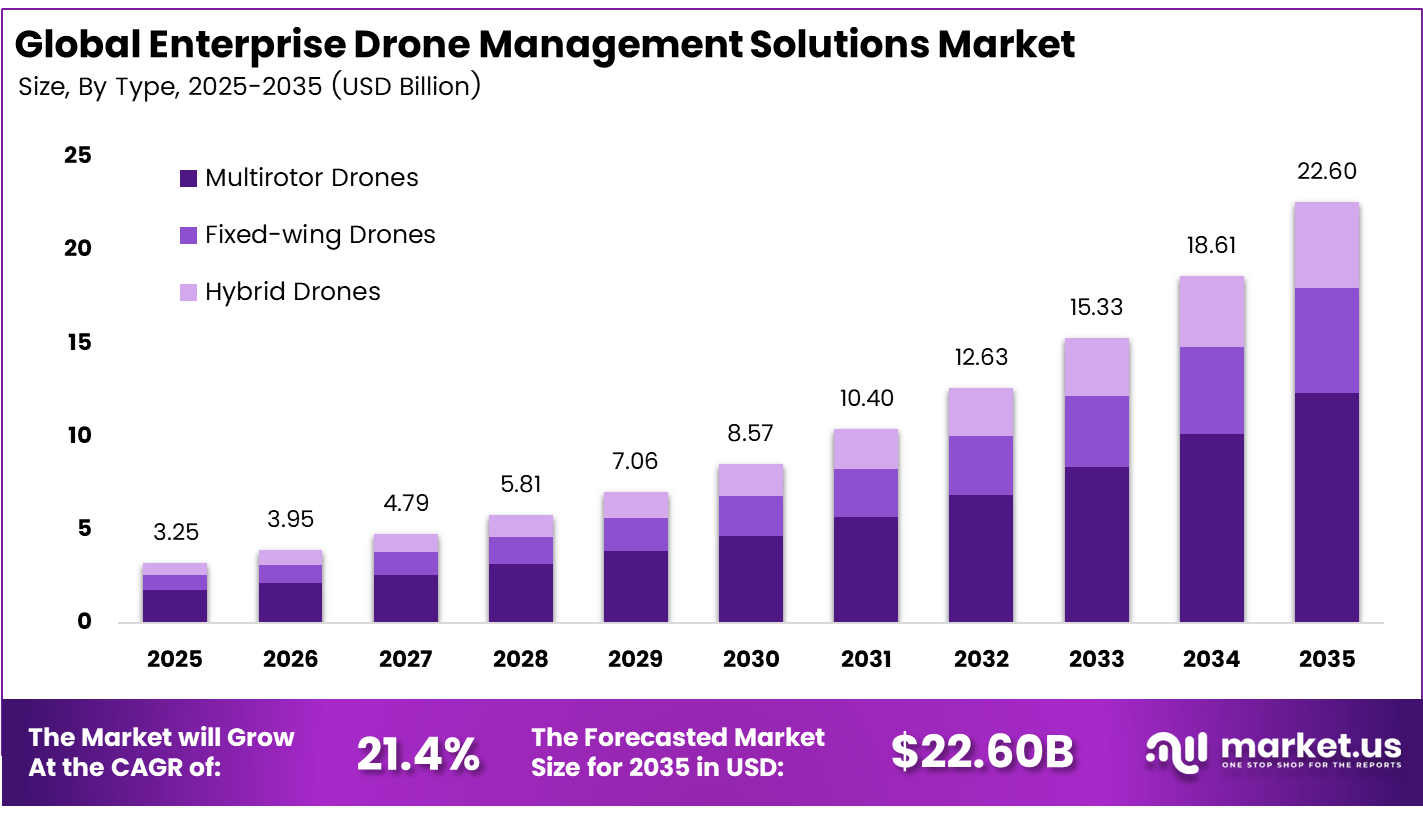
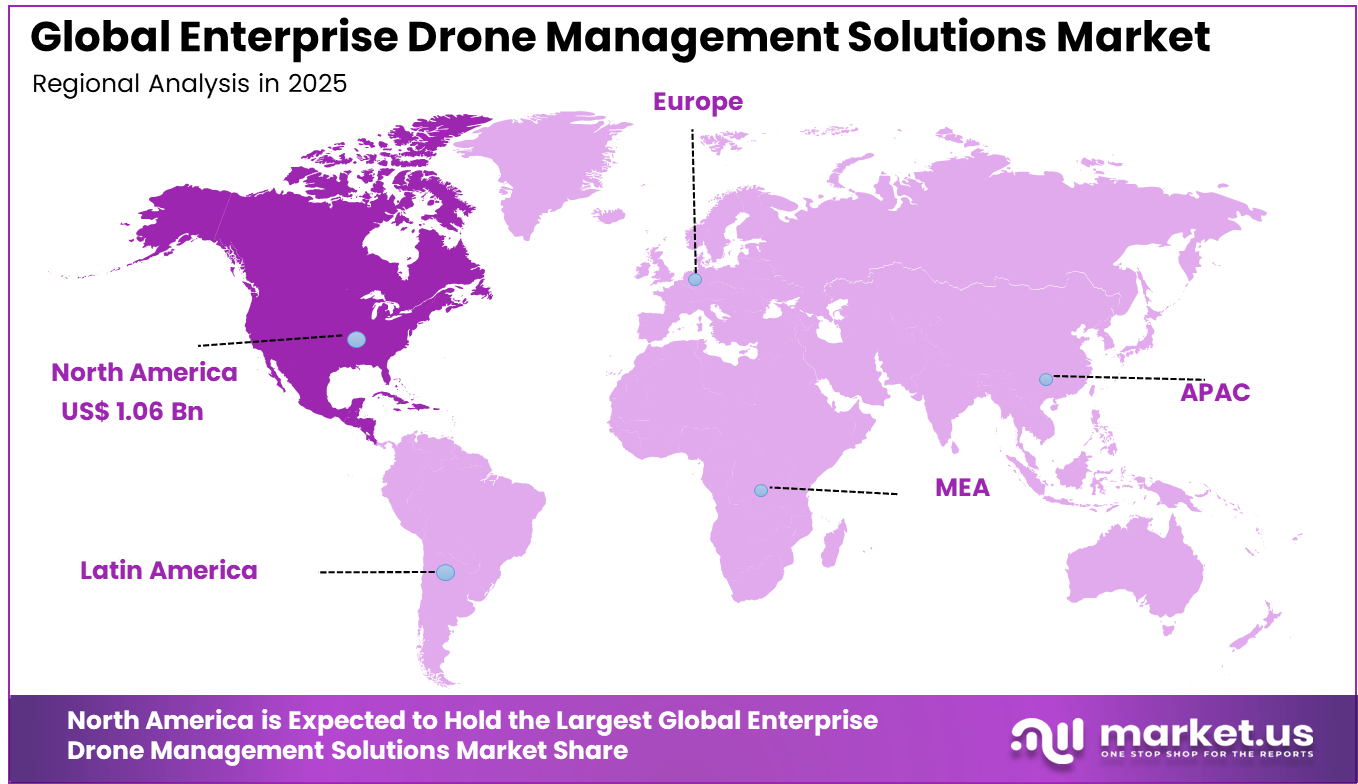
The Global Enterprise Drone Management Solutions Market size is expected to be worth around USD 22.60 billion by 2035, from USD 3.25 billion in 2025, growing at a CAGR of 21.4% during the forecast period from 2025 to 2035. North America held a dominant market position, capturing more than a 32.7% share, holding USD 1.06 billion in revenue.
Enterprise Drone Management Solutions are software platforms that let big companies run fleets of drones from one central spot. They handle flight planning, live tracking, data review, upkeep schedules, and rule checks all in real time. This turns single drones into smart teams for jobs like site scans, deliveries, or watch tasks.
Top driving factors include the need for safer operations in risky areas. Companies want to cut down on human involvement where dangers exist. 72% of firms report better data from these tools. Tech advances let drones fly on their own more. This saves time and lowers mistakes. Better tracking helps teams respond fast to issues. Overall, these push businesses to upgrade their drone handling.
The market for Enterprise Drone Management Solutions is driven by the increasing use of drones across industries for inspection, monitoring, mapping, and data collection activities. Organizations are adopting drone platforms to improve worker safety, reduce manual inspection costs, and capture real-time aerial intelligence. Growing demand for automation in sectors such as construction, energy, agriculture, and logistics is encouraging enterprises to implement structured drone management systems to streamline operations and maintain regulatory compliance.
Demand analysis shows a steady rise in business use for these systems. Firms need fast ways to scan large areas or tough spots. 37% of drones now serve work tasks, not just fun flights. Ground stations manage many drones at once well. This meets the call for reliable control. More jobs in construction and farming fuel this want. Teams seek simple oversight for daily runs. Clear shifts from manual work boost this pull across sectors.
For instance, in February 2026, Ventana Medical Systems, Inc. (Roche subsidiary) rolled out AI-enhanced drone management for pathology lab logistics, featuring autonomous payload delivery. This cuts turnaround times by 30% for tissue samples, keeping pace with U.S. advancements in automated enterprise operations.
Key Takeaway
- In 2025, the Multirotor Drones segment held a dominant market position, capturing a 54.7% share of the Global Enterprise Drone Management Solutions Market.
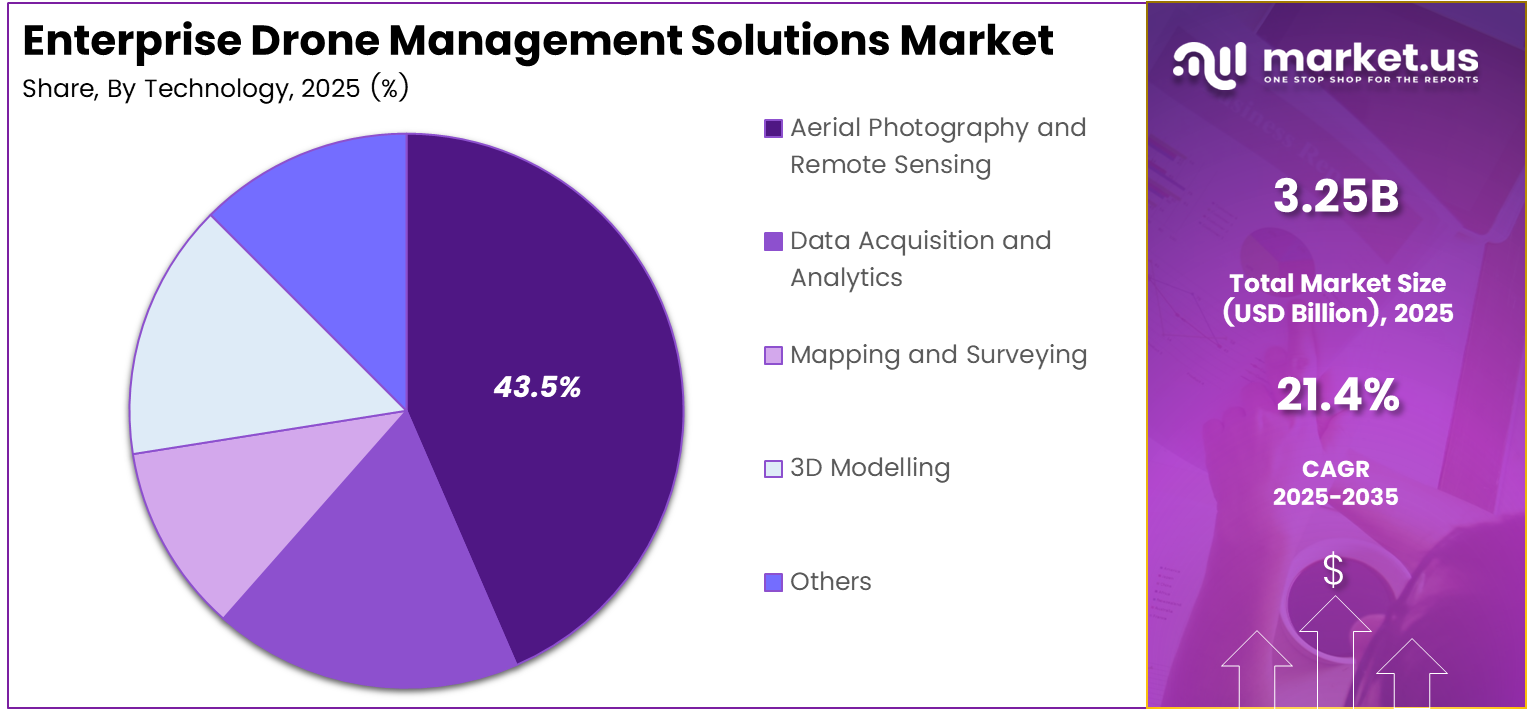
- In 2025, the Aerial Photography and Remote Sensing segment held a dominant market position, capturing a 43.5% share of the Global Enterprise Drone Management Solutions Market.
- In 2025, the Agriculture segment held a dominant market position, capturing a 32.6% share of the Global Enterprise Drone Management Solutions Market.
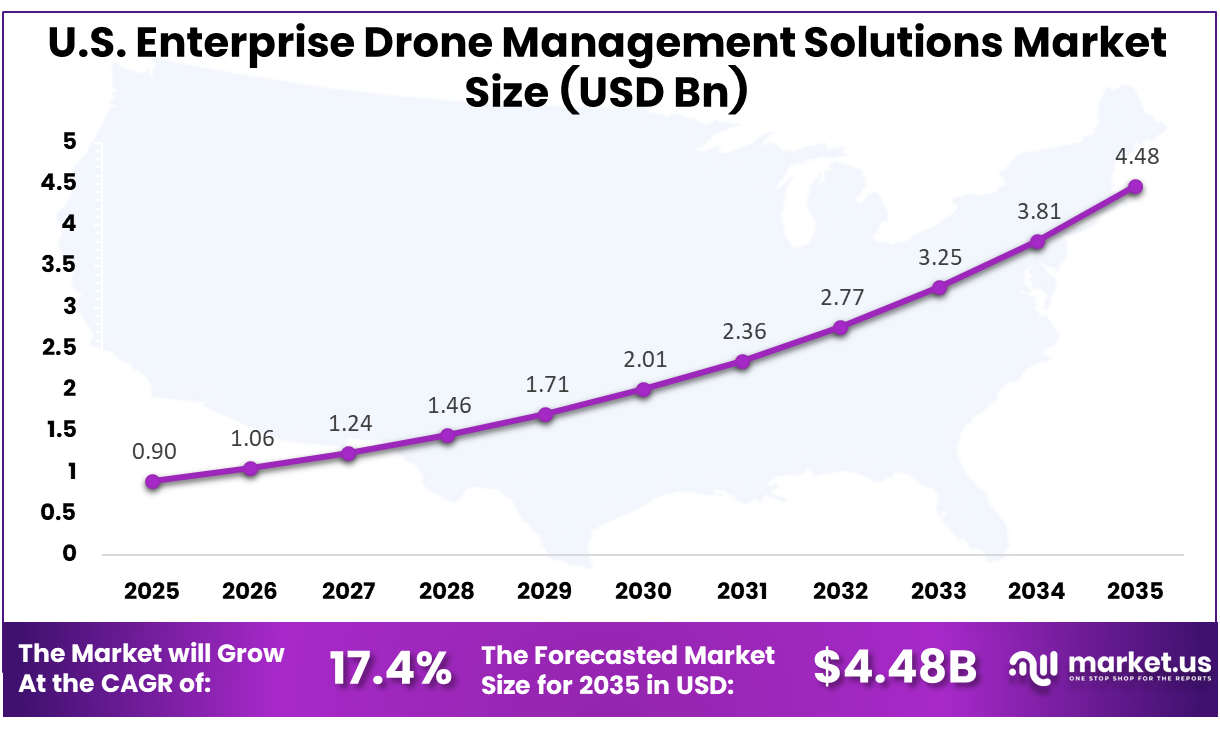
- The U.S. Enterprise Drone Management Solutions Market was valued at USD 0.90 Billion in 2025, with a robust CAGR of 17.4%.
- In 2025, North America held a dominant market position in the Global Enterprise Drone Management Solutions Market, capturing more than a 32.7% share.
Role of Generative AI
Generative AI is transforming enterprise drone management by automating mission planning and predictive maintenance, allowing systems to generate optimal flight paths and schedules based on real-time data patterns. It enhances data analysis from drone sensors, producing actionable insights like anomaly detection summaries and condition reports in natural language, reducing manual review time.
In fleet operations, generative AI enables autonomous decision-making for multi-drone coordination, including adaptive rerouting around obstacles and prioritizing inspections in high-risk areas. It also supports synthetic data generation for training models on rare scenarios, improving overall system reliability and scalability across industries like logistics and infrastructure.
Investment and Business Benefits
Investment opportunities lie in strong fleet software builds. Secure tools handle growing drone groups well. Drone rental services cut start-up costs for users. AI add-ons boost auto flights and checks. Safety features draw steady cash, too. Cloud options scale with business needs. Backing training for pilots pays off quickly. Service packs for upkeep add value. These areas grow as more firms join in.
Business benefits hit hard on cost cuts, saving 50-60% on routine checks over the old ways. Jobs wrap faster, like full site maps in hours flat. Data stays sharp for solid choices every time. Injury rates drop in rough spots thanks to remote views. Teams share insights live for better teamwork. Logs build trust with full records of each flight path.
Regional analysis
In 2025, North America held a dominant market position in the Global Enterprise Drone Management Solutions Market, capturing more than a 32.7% share, holding USD 1.06 billion in revenue. This dominance is due to the early adoption of commercial drone technologies across industries such as construction, energy, agriculture, and public safety for inspection and monitoring tasks. The presence of structured airspace regulations for enterprise drone usage, along with increasing investments in automation and aerial data analytics, has encouraged organizations to integrate drone management platforms into daily operations to improve efficiency and reduce manual risk exposure.
For instance, in February 2026, Abbott Laboratories rolled out smart AI-driven drone teams to keep tabs on their drug supply lines and check factories in North America. These drones deliver instant updates on stock levels and safety rules, helping the company stay ahead in blending drone tech with health product operations and boosting North America’s strength in this field.
U.S. Enterprise Drone Management Solutions Market Size
The market for Enterprise Drone Management Solutions within the U.S. is growing tremendously and is currently valued at USD 0.90 billion; the market has a projected CAGR of 17.4%. The market is growing due to the increasing use of drones across industries such as agriculture, construction, energy, and logistics for inspection, monitoring, and data collection activities. Supportive regulatory frameworks from the Federal Aviation Administration for commercial drone operations have also enabled wider enterprise adoption. Additionally, the growing need for real-time aerial intelligence to improve operational efficiency and workplace safety continues to drive demand across industrial applications.
For instance, in June 2025, Ondas’ American Robotics secured a key purchase order from a major U.S. urban public safety agency for its Kestrel drone detection system. This counter-UAS solution bolsters airspace security at high-profile events with FAA BVLOS approvals, underscoring U.S. leadership in enterprise drone management for critical infrastructure.
Key Regions and Countries
North America
- US
- Canada
Europe
- Germany
- France
- The UK
- Spain
- Italy
- Russia
- Netherlands
- Rest of Europe
Asia Pacific
- China
- Japan
- South Korea
- India
- Australia
- Singapore
- Thailand
- Vietnam
- Rest of APAC
Latin America
- Brazil
- Mexico
- Rest of Latin America
Middle East & Africa
- South Africa
- Saudi Arabia
- UAE
- Rest of MEA
Type Analysis
In 2025, the Multirotor Drones segment held a dominant market position, capturing a 54.7% share of the Global Enterprise Drone Management Solutions Market. This dominance is due to their operational flexibility and ease of deployment. These drones are capable of vertical takeoff and landing, which makes them suitable for use in confined industrial sites, urban areas, and remote locations without runway infrastructure. Their ability to hover steadily at a fixed point allows enterprises to capture detailed images and videos for inspections, monitoring, and surveillance tasks.
Enterprises prefer multirotor platforms for infrastructure inspection, construction site monitoring, power line assessment, and warehouse surveillance because of their stable flight control and precise navigation systems. The lower complexity in operations compared to fixed-wing drones also reduces training requirements and operational risks. This practical usability continues to support their strong adoption across multiple commercial industries.
For Instance, in January 2026, Enzo Life Sciences, Inc. launched a new multirotor drone model for lab facility inspections. The compact design with stable hovering helps teams check hard-to-reach equipment spots quickly. This boosts safety and cuts manual checks, fitting enterprise needs for reliable fleet management in daily operations.
Technology Analysis
In 2025, the Aerial Photography and Remote Sensing segment held a dominant market position, capturing a 43.5% share of the Global Enterprise Drone Management Solutions Market. Organizations increasingly rely on high-resolution aerial data for decision-making. Drone-mounted sensors, including thermal and multispectral cameras, enable enterprises to capture accurate imagery and geospatial information across large operational areas. This technology supports mapping, terrain analysis, structural inspections, and environmental monitoring activities.
Enterprises use remote sensing data to detect infrastructure faults, assess land conditions, and monitor assets in real time. The ability to generate 3D maps and digital surface models improves planning accuracy and enhances preventive maintenance programs. As businesses move toward data-driven operations, aerial photography and remote sensing technologies remain central to enterprise drone management strategies.
For instance, in June 2022, Abbott Laboratories used aerial photography from multirotor drones to survey its nutrition plant in Michigan. High-res images revealed site conditions for expansion planning. Remote sensing data sped up assessments, aiding precise renovations during high-demand times.
Application Analysis
In 2025, the Agriculture segment held a dominant market position, capturing a 32.6% share of the Global Enterprise Drone Management Solutions Market. Enterprise farming operations increasingly integrate drone-based monitoring systems for precision agriculture. Drones are used for crop health monitoring, irrigation planning, and pesticide spraying across large farmland areas. They help in capturing real-time aerial data that allows farmers to assess crop conditions and manage farm resources more efficiently.
This technology also supports early detection of pest infestations and soil nutrient deficiencies through aerial analysis. By replacing manual field inspections, enterprises engaged in commercial farming are able to optimize fertilizer use and improve irrigation planning. This leads to better yield management and supports sustainable farming practices across large-scale agricultural operations.
For Instance, in July 2025, Bio-Rad Laboratories piloted drone remote sensing in crop trials for precision agriculture. Multispectral cameras tracked plant health across test fields, optimizing inputs like water and nutrients. Farmers gained real-time insights, reducing waste and improving yields in managed plots.
Key Market Segments
By Type
- Multirotor Drones
- Fixed-wing Drones
- Hybrid Drones
By Technology
- Aerial Photography and Remote Sensing
- Data Acquisition and Analytics
- Mapping and Surveying
- 3D Modelling
- Others
By Application
- Agriculture
- Aerial Surveillance
- Disaster Relief
- Oil & Gas Exploration
- Environment Monitoring
- Production
- Manufacturing
- Supply Chain & Logistics
- Others
Emerging trends
Enterprise drone management solutions are increasingly integrating AI and machine learning to enable autonomous operations, real-time object detection, and edge computing for faster decision-making without cloud dependency. Platforms now support swarm intelligence, allowing multiple drones to coordinate seamlessly for large-scale inspections and monitoring.
Unified fleet management systems are emerging to connect drones with robots, sensors, and ground infrastructure under a single control interface, bridging visibility gaps in multi-asset operations. Enhanced regulatory compliance tools, including automated airspace authorization and geo-fencing, are simplifying beyond-visual-line-of-sight (BVLOS) deployments across industries.
Growth Factors
Enterprise drone management solutions are propelled by rapid technological advancements in AI, machine learning, and IoT integration, enabling smarter automation, precise data analytics, and efficient fleet coordination. Expanding commercial applications across industries like logistics, agriculture, construction, and public safety drive demand for scalable platforms that optimize operations and enhance safety.
Regulatory support and evolving frameworks for safe drone operations, including BVLOS permissions, encourage broader enterprise adoption while ensuring compliance. The shift toward cloud-native and autonomous systems further supports seamless real-time monitoring, data processing, and integration with enterprise resource planning tools.
Market Dynamics
Drivers - Growing Demand for Industrial Inspection Automation
Industries are increasingly adopting drone-based inspection to improve workplace safety and operational control. Commercial drone usage in the United States has expanded significantly under structured aviation guidelines, reflecting broader enterprise acceptance across infrastructure, utilities, and construction. Drones allow organizations to inspect bridges, pipelines, transmission lines, and large industrial sites without sending workers into high-risk areas.
This shift toward automated inspection helps companies reduce manual labor exposure and improve maintenance planning accuracy. Real-time aerial visibility supports faster fault detection and better asset management. As businesses focus on safety compliance and operational efficiency, enterprise drone management systems are becoming important tools to coordinate flights, store inspection records, and manage mission data in a structured manner.
For instance, in June 2022, Abbott used drone imagery to survey its Nutrition plant in Sturgis, Michigan, after a shutdown. The aerial shots helped assess the site and plan a safe restart of infant formula production, showing how drones aid industrial inspections without risking worker safety. This practical step highlights growing reliance on such tech for facility checks.
Restraint - Complex Airspace Regulations
Enterprise drone deployment is often affected by strict regulatory policies that control commercial drone usage in different regions. Organizations must follow defined aviation rules related to flight permissions, pilot certifications, and operational limitations before carrying out drone-based tasks. These compliance requirements can slow down deployment timelines, especially in urban or restricted airspace areas.
Enterprises operating across multiple project sites may also face administrative challenges while securing approvals for drone missions. In sectors such as telecommunications and infrastructure, obtaining flight clearances in sensitive locations can require additional planning and documentation. These regulatory conditions continue to influence the speed of enterprise drone adoption across industries.
For instance, in October 2025, Thermo Fisher paused a drone pilot for warehouse inspections amid complex FAA approvals for beyond-visual-line-of-sight flights. The regulatory waits slowed data collection on storage assets, revealing ongoing challenges in aligning management solutions with airspace limits.
Opportunities - Expansion of Precision Agriculture Practices
Modern farming operations are gradually integrating drone technology to improve crop monitoring and land assessment processes. Enterprise drones are being used to scan agricultural fields and collect aerial data that helps identify crop health issues, irrigation gaps, and soil conditions. This information supports better farm management decisions and improves overall resource utilization.
Drone-assisted agriculture also enables targeted application of fertilizers and pesticides instead of applying them across entire fields. This approach helps reduce chemical wastage and promotes sustainable farming practices. As the agricultural sector moves toward technology-supported cultivation methods, enterprise drone solutions are creating new opportunities in precision farming activities.
For instance, in December 2025, Agilent Technologies, Inc. partnered on drone platforms for farm soil sampling, integrating sensors with its analytics tools. Trials showed precise data from aerial scans aiding nutrient mapping, pointing to fresh chances in agrotech where lab expertise meets drone management.
Challenges - Managing Large Volumes of Aerial Data
Enterprise drone deployments generate a significant amount of aerial imagery and site mapping data during inspections and monitoring activities. Handling this information requires proper storage, processing, and analysis systems. Without structured data management processes, organizations may find it difficult to extract meaningful insights from drone-captured visuals. Industries such as mining and infrastructure development rely on detailed mapping outputs for planning and maintenance. Processing drone-generated data into usable reports often demands technical expertise and software integration. As drone usage continues to expand, managing large volumes of operational data remains a practical challenge for enterprise users.
For instance, in September 2025, Ventana Medical Systems, Inc. struggled with processing terabytes of drone-captured pathology slide images from facility scans. The volume overwhelmed initial storage, prompting cloud upgrades in their management system to handle and analyze the influx for quality checks.
Key Players Analysis
One of the leading players in January 2026, Thermo Fisher Scientific Inc. partnered with Skydio to integrate enterprise drone management software into its lab automation platforms, enabling real-time aerial monitoring of pharmaceutical manufacturing sites. This collaboration enhances supply chain visibility and compliance tracking for life sciences firms, solidifying North American leadership in drone-enabled enterprise solutions.
Top Key Players in the Market
- Abbott Laboratories
- F.Hoffmann-La Roche Ltd.
- Thermo Fisher Scientific Inc.
- Ventana Medical Systems, Inc.
- Bio Rad Laboratories Inc.
- Enzo Life Sciences, Inc.
- Abcam plc
- BioGenex
- Cell Signalling Technology, Inc.
- Agilent Technologies, Inc.
- Others
Recent Developments
- In October 2025, Agilent Technologies, Inc. launched the CrossLab Drone Analytics Suite, a new enterprise drone management tool for precision lab inspections and asset tracking. The platform uses AI-driven fleet management to optimize instrument maintenance workflows, helping biotech companies cut downtime.
- In November 2025, Abbott Laboratories expanded its diagnostics division with PrecisionHawk’s enterprise drone platform for field testing and inventory management. The partnership supports faster deployment of point-of-care devices across North America, improving operational agility amid growing demand.
Report Scope
| Report Features | Description |
|---|---|
| Market Value (2025) | USD 3.25 Billion |
| Forecast Revenue (2035) | USD 22.60 Billion |
| CAGR (2026-2035) | 21.4% |
| Base Year for Estimation | 2025 |
| Historic Period | 2020-2024 |
| Forecast Period | 2026-2035 |
| Report Coverage | Revenue Forecast, Market Dynamics, Competitive Landscape, Recent Developments |
| Segments Covered | By Type (Multirotor Drones, Fixed-wing Drones, Hybrid Drones), By Technology (Aerial Photography and Remote Sensing, Data Acquisition and Analytics, Mapping and Surveying, 3D Modelling, Others), By Application (Agriculture, Aerial Surveillance, Disaster Relief, Oil & Gas Exploration, Environment Monitoring, Production, Manufacturing, Supply Chain & Logistics, Others) |
| Regional Analysis | North America (US and Canada), Europe (Germany, France, The UK, Spain, Italy, and Rest of Europe), Asia Pacific (China, Japan, South Korea, India, Australia, and Rest of APAC), Latin America (Brazil, Mexico, and Rest of Latin America), Middle East & Africa (GCC, South Africa, and Rest of MEA) |
| Competitive Landscape | Abbott Laboratories, F.Hoffmann-La Roche Ltd., Thermo Fisher Scientific Inc., Ventana Medical Systems, Inc., Bio Rad Laboratories Inc., Enzo Life Sciences, Inc., Abcam plc, BioGenex, Cell Signalling Technology, Inc., Agilent Technologies, Inc., Others |
| Customization Scope | Customization for segments and region/country levels will be provided. Moreover, customization can be tailored to the requirements. |
| Purchase Options | We have three licenses to opt for: Single User License, Multi-User License (Up to 5 Users), Corporate Use License (Unlimited Users and Printable PDF) |





























