Report Overview
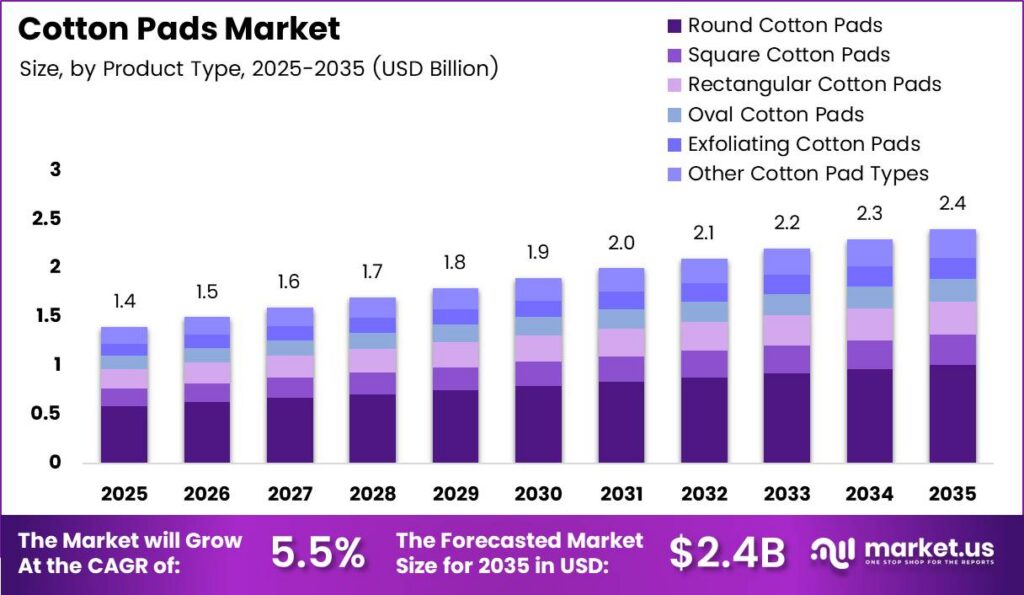
Global Cotton Pads Market size is expected to be worth around USD 2.4 Billion by 2035 from USD 1.4 Billion in 2025, growing at a CAGR of 5.5% during the forecast period 2026 to 2035. Cotton pads are compressed, hydroentangled nonwoven substrates manufactured from bleached cotton fibers that absorb and release liquids for facial cleansing, toner application, makeup removal, baby hygiene, and clinical wound preparation. Consequently, converters operating high-speed water-jet spunlace lines capture recurring replacement volume across consumer and institutional channels.
The market structure links agricultural fiber processors directly with mass retail and clinical buyers across beauty, baby care, and medical sectors. According to Personal Care Products Council (PCPC), the U.S. personal care products industry generated USD 495.6 Billion in total economic output and contributed USD 242.4 Billion to U.S. GDP in 2024. Therefore, high consumer spending on liquid skincare formulations forces retail chains to expand shelf space for absorbent cotton substrates, guaranteeing baseline capacity utilization for nonwoven converters.
Key Takeaways
- The global Cotton Pads Market reached a valuation of USD 1.4 Billion in 2025.
- Market revenue will climb to USD 2.4 Billion by 2035.
- The market expands at a compound annual growth rate of 5.5% during the forecast period from 2026 to 2035.
- Round Cotton Pads lead the Product Type segment with a 42.00% market share in 2025.
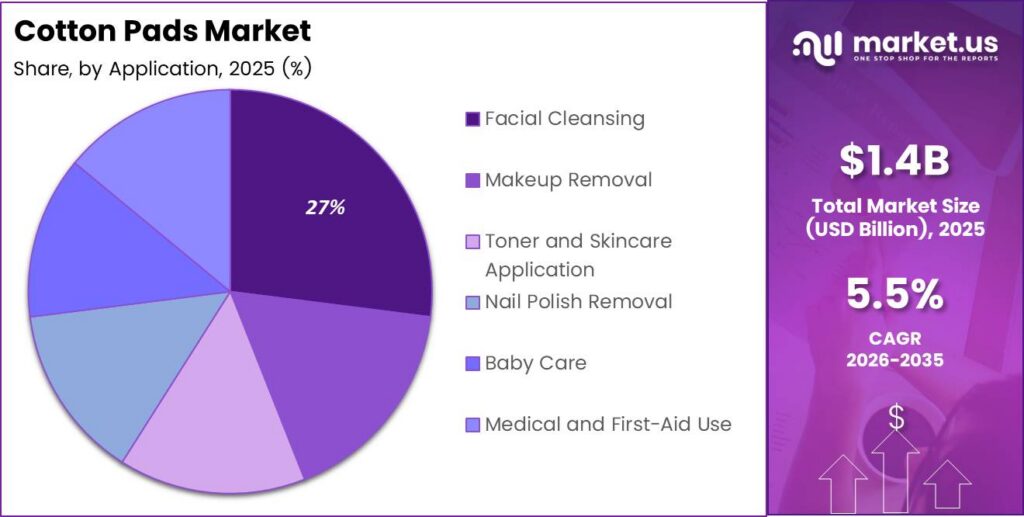
- Facial Cleansing represents the largest Application segment at a 27.00% share in 2025.
- Individual Consumers account for the leading End User share at 73.00% in 2025.
- Supermarkets and Hypermarkets hold the top Distribution Channel position with a 29.00% share in 2025.
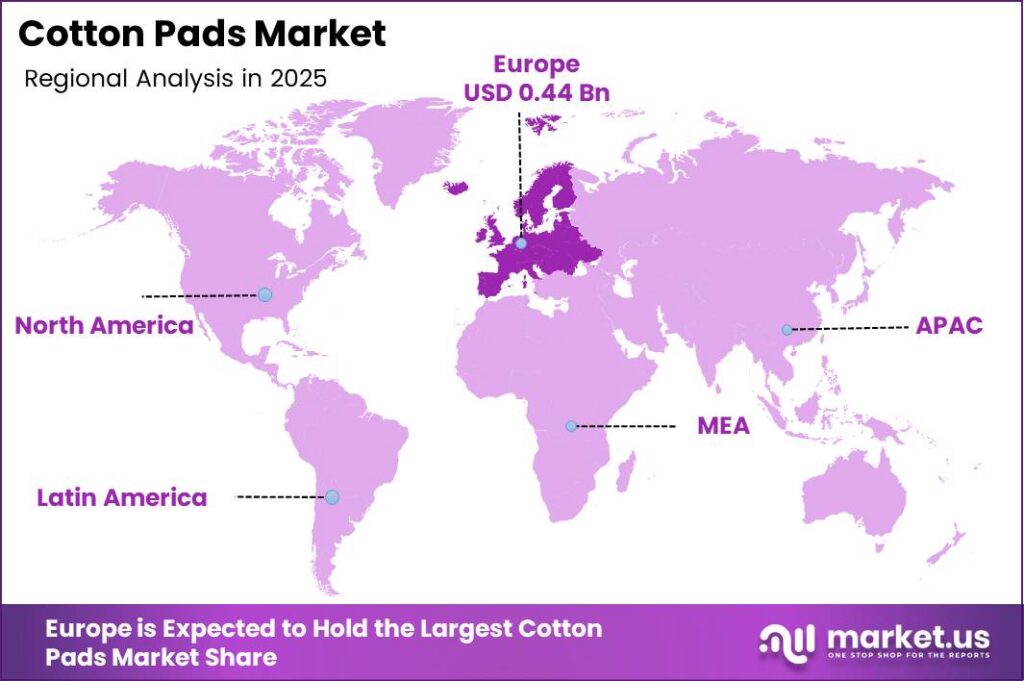
- Europe dominates the regional landscape in 2025 with a 32.00% share valued at USD 0.44 Billion.
Agricultural trade policies and farm support programs directly govern raw material availability and converter gross margins in this sector. As reported by United States Department of Agriculture (USDA), global raw cotton production increased 2% year-over-year to reach 121.87 Million 480-lb bales in the 2025/2026 marketing year, up from 119.34 Million bales in 2024/2025 . This means expanded lint harvesting temporarily eases spot fiber cost pressure, allowing vertically integrated pad manufacturers to lock in multi-quarter supply contracts at stable prices.
Downstream retail chain expansion accelerates global product velocity and private-label contracting. In January 2026, beauty retailer Watsons launched a HKD 3.8 Billion investment program to open 1,000 new offline-plus-online stores across 31 markets, building on a network of over 17,000 outlets and 180 Million loyalty members. Consequently, physical store additions in urban Asian and European corridors create immediate shelf-fill requirements for high-turnover consumables, favoring suppliers capable of delivering large-volume private-label multipacks on tight lead times.
Europe leads the global market and holds a 32.00% share valued at USD 0.44 Billion in 2025. Data from Cosmetics Europe shows that retail sales of cosmetics and personal care products in Europe reached EUR 110 Billion in 2025 . High per-capita usage of micellar water, toners, and dermocosmetic liquids across Western European households drives daily pad consumption. As a result, regional converters maintain high operating margins by supplying certified organic and biodegradable cotton pads to European drugstores.
Upstream textile spinners are simultaneously integrating forward into finished hygiene goods to capture higher value. In July 2026, Indian cotton processor Precot Limited incorporated a 100% wholly owned subsidiary in Dubai after spending Rs. 70.1 Crore on fiscal 2026 capital expenditure, lifting consolidated revenue to Rs. 888.71 Crore . This signals that yarn spinners are bypassing intermediary converters to supply duty-free cotton pads directly to international retail accounts, intensifying price competition for standalone pad finishers.
Product Type Analysis
Round Cotton Pads dominates with 42.00% share in 2025 due to high rotary die-cutting speed and ergonomic facial coverage.
In 2025, Round Cotton Pads held a 42.00% share in the Product Type segment of the Cotton Pads Market. UN Comtrade and World Bank WITS found that China exported USD 15.19 Million across 2,634,800 kilograms of cotton wadding and articles thereof under code 560121 to Vietnam in 2024 . Circular die-cutting punches sealed-edge rounds from spunlace webs with minimal trim waste and prevents loose lint shedding during facial wiping. Therefore, high-volume Asian exporters standardize on round formats to maximize line throughput and capture mass-market retail tenders.
Square Cotton Pads serve consumers and estheticians who fold pads to target narrow facial contours or wrap nails during polish removal. Based on UN Comtrade and World Bank WITS data, European Union exports of cotton wadding and articles thereof under code 560121 to Vietnam reached USD 2.87 Million and 313,675 kilograms in 2024 . Zero-lattice slitting allows converters to cut square pads cleanly along both web axes without inter-pad matrix scrap, lowering raw fiber usage per pack. Consequently, manufacturers use square formats to protect gross margins when raw cotton fiber prices rise.
Rectangular Cotton Pads provide an elongated surface area designed for Japanese lotion-masking techniques and multi-finger grip during toner patting. U.S. Food and Drug Administration (FDA) indicates that mandatory MoCRA compliance drove a nearly 3-fold increase in registered cosmetic facilities and a 30-fold rise in product listings from prior baselines of 5,176 facilities and 35,102 listings . Because liquid essence and toner brands must register new skincare formulations, they increasingly co-pack stretchable multi-layer rectangular pads to differentiate regulated product launches. As a result, converters with multi-ply carding lines win high-margin contract manufacturing agreements from prestige beauty brands.
Application Analysis
Facial Cleansing dominates with 27.00% share in 2025 due to twice-daily consumer usage with liquid cleansers.
In 2025, Facial Cleansing held a 27.00% share in the Application segment of the Cotton Pads Market. Figures from Cosmetics Europe show that toiletries generated EUR 26.4 Billion, representing a 24.1% share of European personal care retail sales in 2025 . Surfactant micelles in liquid facial cleansers require the mechanical capillary friction of hydroentangled cellulose fibers to lift sebum and particulate matter from skin pores. This means steady toiletries consumption guarantees year-round baseline order volumes for private-label pad suppliers.
Makeup Removal requires high wet-tensile strength and dual-textured surfaces to dissolve long-wear foundation, mascara, and lip pigments without tearing. According to Cosmetics Europe, decorative cosmetics reached EUR 13.6 Billion and accounted for a 12.4% share of European retail sales in 2025 . Removing water-resistant polymers and waxes requires embossed cotton pads that hold biphasic solvents while providing mechanical scrubbing action across the eyelids and cheeks. Therefore, pad manufacturers that invest in thermal-embossing calendars capture premium pricing from color-cosmetics consumers.
Toner and Skincare Application involves saturating pads with exfoliating acids, botanical waters, and hydrating essences for controlled dermal transfer. As reported by European Chemicals Agency (ECHA), REACH restrictions limit cyclic siloxanes D4, D5, and D6 to below 0.1% in cosmetics after June 6, 2026, cutting emissions by up to 90%. Reformulating toners without volatile silicones increases liquid surface tension, which requires low-retention spunlace cotton pads that release expensive active ingredients onto the skin rather than trapping them inside the core. Consequently, converters engineering rayon-blended low-absorption pads secure supply deals with reformulating skincare brands.
End User Analysis
Individual Consumers dominates with 73.00% share in 2025 due to high household repeat purchases for personal hygiene.
In 2025, Individual Consumers held a 73.00% share in the End User segment of the Cotton Pads Market. Data from Cosmetics Europe shows that 91% of European consumers maintain a regular personal care routine, using over 7 different cosmetic products daily and nearly 13 products weekly . Multi-product daily routines require single-use absorbent applicators at multiple stages to prevent cross-contamination of bacteria between skin and liquid bottles. As a result, household buyers treat cotton pads as a non-discretionary grocery staple, insulating manufacturers from broader retail downturns.
Beauty Salons and Spas consume bulk quantities of lint-free cotton pads during professional facials, chemical peels, manicure prep, and waxing services. U.S. Census Bureau found that U.S. beauty salon establishments under code 812112 generated USD 27,479,664 thousand, or USD 27.48 Billion, in annual revenue in 2024. Professional estheticians require unbleached or reinforced spunlace pads that do not leave cellulose micro-fibers on client skin prior to applying professional serums or UV gel polish. Therefore, converters offering institutional 500-count to 1,000-count polybag formats capture predictable B2B distribution margins.
Hospitals and Clinics utilize sterile and medical-grade absorbent cotton pads for pre-injection skin antisepsis, venipuncture compression, and minor wound exudate management. Based on Eurostat data, available hospital beds across the European Union totaled 2.3 Million, averaging 507 beds per 100,000 inhabitants in 2024, led by Germany with 634,000 beds . Inpatient admission volumes directly dictate daily consumption of pharmacopoeia-compliant cotton pads saturated with 70% isopropyl alcohol or chlorhexidine for skin disinfection. This creates stable public hospital tender opportunities for manufacturers certified under European medical device regulations.
Distribution Channel Analysis
Supermarkets and Hypermarkets dominates with 29.00% share in 2025 due to aggressive private-label pricing and high footfall.
In 2025, Supermarkets and Hypermarkets held a 29.00% share in the Distribution Channel segment of the Cotton Pads Market. U.S. Census Bureau indicates that U.S. retail sales at supermarkets and other grocery stores under code 44511 reached USD 874,990 Million in 2025, up from USD 846,778 Million in 2024 . High weekly grocery traffic enables big-box retailers to merchandise bulky, low-unit-price cotton pad sleeves as impulse basket builders in health and beauty aisles. Consequently, industrial converters must maintain automated high-speed bagging lines to meet strict supermarket private-label cost targets.
Pharmacies and Drugstores serve health-conscious shoppers seeking dermatologically tested, hypoallergenic, and organic cotton pads placed adjacent to dermo-cosmetic liquids. Figures from U.S. Census Bureau show that U.S. health and personal care stores under code 446 recorded USD 340,615 Million in sales during the first 9 months of 2026, with pharmacies and drugstores generating USD 32,699 Million in August 2026 . Consumers buying pharmacist-recommended cleansers for sensitive or acne-prone skin select hydrogen-peroxide-bleached cotton pads sold in pharmacy aisles to avoid chemical irritation. This allows suppliers to command higher wholesale prices on certified pure cotton lines in drugstore channels.
Online Retail and E-Commerce channels enable consumers to purchase multi-pack cotton pad bundles and recurring subscription boxes directly to their homes. According to Eurostat, 78% of European Union internet users aged 16 to 74 shopped online in 2025, with 20% purchasing cosmetics and wellness products online . Because dry cotton pads have a high volume-to-weight ratio that penalizes single-pack parcel shipping economics, e-commerce platforms bundle 3 to 6 packs per order or cross-sell pads with liquid skincare. Therefore, brands optimizing compression packaging for parcel fulfillment reduce last-mile freight costs and expand direct-to-consumer margins.
Key Market Segments
By Product Type
- Round Cotton Pads
- Square Cotton Pads
- Rectangular Cotton Pads
- Oval Cotton Pads
- Exfoliating Cotton Pads
- Other Cotton Pad Types
By Application
- Facial Cleansing
- Makeup Removal
- Toner and Skincare Application
- Nail Polish Removal
- Baby Care
- Medical and First-Aid Use
- Other Applications
By End User
- Individual Consumers
- Beauty Salons and Spas
- Hospitals and Clinics
- Hotels and Hospitality
- Other Commercial End Users
By Distribution Channel
- Supermarkets and Hypermarkets
- Pharmacies and Drugstores
- Specialty Beauty Stores
- Convenience Stores
- Online Retail / E-Commerce
- Direct-to-Consumer Brand Websites
- Other Distribution Channels
Regional Analysis
Europe Dominates the Cotton Pads Market with a Market Share of 32.00% in 2025, Valued at USD 0.44 Billion
Europe holds a 32.00% share of the global Cotton Pads Market in 2025, valued at USD 0.44 Billion. As reported by Cosmetics Europe, European skin care retail sales reached EUR 32.3 Billion, representing a 29.4% category share in 2025, led by Germany at EUR 18.0 Billion and the United Kingdom at EUR 14.7 Billion . Widespread adoption of no-rinse micellar cleansing waters and strict European Union bans on plastic-containing wet wipes compel consumers to rely on 100% cellulosic cotton pads. Therefore, European nonwoven converters benefit from protected domestic demand and premium eco-certified product pricing.
North America represents a high-value regional market driven by omnichannel beauty retailing and integrated cross-border manufacturing supply chains. Data from U.S. Census Bureau and PCPC shows that U.S. fourth-quarter 2024 retail e-commerce sales reached USD 352.9 Billion, while trilateral USMCA personal care trade rose 39% from 2020 to reach USD 10.1 Billion in 2024 . Duty-free movement of bleached U.S. raw cotton and finished personal care goods across North American borders lowers landed production costs for domestic pad converters. Consequently, North American suppliers successfully defend retail shelf space against Asian imports through faster replenishment cycles.
Asia Pacific functions as both the primary raw cotton production engine and the fastest-expanding consumption hub due to multi-step beauty regimens. United States Department of Agriculture (USDA) found that China produced 32.0 Million bales and India produced 25.0 Million bales of cotton in 2024/2025 . Direct proximity to domestic lint and comber noil supplies eliminates ocean freight expenses on raw materials for Chinese and Indian spunlace manufacturers. This cost advantage enables Asia Pacific converters to dominate global export tenders while simultaneously capturing domestic urban demand for premium multi-layer facial pads.
Key Regions and Countries
North America
- US
- Canada
Europe
- Germany
- France
- The UK
- Spain
- Italy
- Rest of Europe
Asia Pacific
- China
- Japan
- South Korea
- India
- Australia
- Rest of APAC
Latin America
- Brazil
- Mexico
- Rest of Latin America
Middle East and Africa
- GCC
- South Africa
- Rest of MEA
Market Dynamics
Operating profitability in the Cotton Pads Market depends heavily on agricultural fiber supply balances, energy-intensive hydroentanglement processing, and retail private-label contract structures. Based on United States Department of Agriculture (USDA) data, global cotton production will fall 5%, or 6.6 Million bales, to 116.0 Million bales in 2026/2027 while global consumption rises to 121.7 Million bales . This structural deficit between harvested lint supply and mill demand tightens raw fiber availability. Consequently, converters must adopt comber-noil blending and cost-indexed retail pricing to protect operating margins.
Drivers
Multi-step K-beauty and J-beauty skincare regimens have brought toner, micellar water, and essence application into mainstream households, where each step consumes 1 to 2 cotton pads. Consequently, regular multi-step users consume 40 to 60 pads monthly, compared with 15 to 20 pads for cleanser-only users. Between 2024 and 2025, urban Asia-Pacific personal-care consumable volumes grew 6% to 8% annually, while dermocosmetic liquid bundles lifted pad attach rates by 10% to 15%.
This consumption shift turns cotton pads from an occasional commodity purchase into a fast-moving replenishment item. Retailers and brands are transitioning toward 100-count to 150-count multipacks and subscription bundles, which reduces repeat-purchase customer acquisition costs by 20% to 30%. Therefore, beauty brands that pair cotton pads directly with liquid skincare products capture 3 to 5 percentage points higher gross margin than converters selling standalone commodity pads.
| Driver | (~) % Impact on CAGR Forecast | Geographic Relevance | Impact Timeline |
|---|---|---|---|
| Expansion of Daily Skincare and Makeup-Removal Routines | +1.4% | Global, with Asia-Pacific and North America leading | Short term (≤ 2 years) |
| Organic and Biodegradable Cotton Product Demand | +1.1% | Europe, North America | Medium term (2–4 years) |
| Quick-Commerce and E-Retail Penetration of Personal Care | +0.9% | India, Southeast Asia, China | Short term (≤ 2 years) |
| Rising Clinical and Wound-Care Consumption | +0.7% | Global | Medium term (2–4 years) |
| Private-Label Growth in Modern Retail | +0.6% | Europe, North America, GCC | Short term (≤ 2 years) |
| Growth in Male Grooming Usage | +0.4% | Asia-Pacific, North America | Medium term (2–4 years) |
Restraints
Sustainability-conscious shoppers increasingly replace single-use cotton pads with washable bamboo-terry and microfiber rounds sold in mainstream beauty retail. A 10-piece to 16-piece reusable set costs roughly the same as 3 to 4 months of disposable pads and replaces 1,500 to 2,000 single-use units over a 12-month to 24-month lifespan. Every household that switches eliminates approximately 90% of its disposable cotton pad demand permanently.
By 2025, an estimated 8% to 12% of eco-motivated consumers in Western Europe had switched to reusable pads, flattening unit volume growth in high-price markets. As a result, regional converters face 2 to 4 percentage points of margin compression because fixed spunlace and punching lines operate below 75% capacity utilization. This underutilization forces manufacturers to delay capital expenditure on new disposable pad lines in mature Western markets.
| Restraint | (~) % Impact on CAGR Forecast | Geographic Relevance | Impact Timeline |
|---|---|---|---|
| Substitution by Reusable Washable Pads | -1.0% | Europe, North America | Short term (≤ 2 years) |
| Shift to Wipes and Rinse-Off Cleansers | -0.7% | Global | Short term (≤ 2 years) |
| Single-Use Product Restrictions and EPR Fees | -0.5% | European Union, UK | Medium term (2–4 years) |
| Consumer Downtrading in Discretionary Personal Care | -0.4% | Latin America, Africa, South Asia | Short term (≤ 2 years) |
| Low Rural Category Penetration | -0.3% | South Asia, Sub-Saharan Africa | Long term (≥ 4 years) |
Challenges
Bleached cotton fiber accounts for 45% to 60% of a cotton pad’s ex-factory production cost, leaving converters highly exposed to agricultural commodity swings. Benchmark cotton prices fluctuated by 20% to 30% between 2023 and 2025, while India raised its minimum support price by about 7% for the 2025 to 2026 season. These fiber movements drive unit input-cost spikes of 8% to 12% within a single quarter.
Because retail prices remain locked into annual private-label agreements, mid-sized converters experience EBITDA margin swings of 3 to 5 percentage points when fiber costs surge. To protect profitability, manufacturers must hedge 6 to 9 months of fiber supply, blend 10% to 20% recycled or comber-noil fiber, and negotiate cost-indexed retail contracts. Backward integration into ginning and bleaching also secures 2 to 3 percentage points of margin protection.
| Challenge | (~) % CAGR Friction Drag | Geographic Relevance | Mitigation Horizon |
|---|---|---|---|
| Raw Cotton Price Volatility | -0.8% | Global, with India, US and China most exposed | Medium term (2–4 years) |
| Climate-Driven Cotton Yield Risk | -0.5% | India, Pakistan, US, Brazil | Long term (≥ 4 years) |
| Organic Certification Traceability Gaps | -0.4% | India, Turkey, Europe | Medium term (2–4 years) |
| Trade Tariff and Compliance Shifts | -0.4% | US, China, India | Short term (≤ 2 years) |
| Bleaching Water-Use Regulatory Pressure | -0.3% | China, India, EU | Medium term (2–4 years) |
Opportunities
Pre-soaked toner and exfoliating pads infused with AHA, BHA, niacinamide, and centella represent high-margin white space where pad makers currently capture only 5% to 10% of retail value as dry substrate suppliers. Outside South Korea and Japan, active-infused formats account for under 10% of category volume. Moving into formulation partnerships or turn-key co-manufacturing raises realized value per pad 4 to 6 times, from Rs. 0.5 to Rs. 1 for a dry pad to Rs. 4 to Rs. 8 for an infused unit in emerging markets.
This vertical expansion lifts converter gross margins from 20% to 25% on commodity dry pads to 45% to 55% on active-infused jars. Although sealed-jar packaging adds 15% to 20% to unit manufacturing costs, the retail price premium easily absorbs the packaging expense. Early-moving converters that install liquid-dosing and jar-sealing lines can capture a lucrative share of the skincare consumables value chain.
| Opportunity | (~) % Potential CAGR Upside | Geographic Relevance | Execution Window |
|---|---|---|---|
| Pre-Soaked Active-Infused Cotton Pads | +1.2% | Asia-Pacific, North America | Medium term (2–4 years) |
| Tier-2 and Tier-3 Market Sachet-Size Packs | +0.8% | India, Indonesia, Africa | Short term (≤ 2 years) |
| Regenerative Cotton Traceable Premium Lines | +0.6% | Europe, North America | Long term (≥ 4 years) |
| Regional Converter M&A Roll-Ups | +0.5% | Europe, South Asia | Medium term (2–4 years) |
| Baby and Elder-Care Hygiene Pad Formats | +0.4% | Japan, Europe, China | Medium term (2–4 years) |
Key Company Insights
Groupe Lemoine
Groupe Lemoine leads the European private-label cotton hygiene sector, manufacturing round, square, and oval cosmetic cotton pads, organic cotton wool, and baby care swabs across Western and Eastern Europe. e-Business Register Estonia (RIK) indicates that Groupe Lemoine generates EUR 170 Million in group annual turnover across 10 production sites with 900 employees, while its Lemoine Estonia OÜ subsidiary recorded EUR 20,285,264 in revenue and a 17.19% profit margin in fiscal 2025 . High plant automation allows the company to preserve double-digit margins on European supermarket contracts.
The company actively expands regional manufacturing capacity to shorten delivery lead times for French and European retail clients. According to Choose Normandy, in January 2026 Groupe Lemoine reported a EUR 14 Million investment to acquire and renovate a 6,000 square meter industrial plant in Argentan, Normandy, creating 30 jobs and adding EUR 20 Million in annual turnover capacity for cotton hygiene and baby care products . This localized capacity addition reduces cross-border freight costs and strengthens its hold on French retail tenders.
Unicharm Corporation
Unicharm Corporation commands a dominant position in the Asia Pacific personal care market, supplying Silcot sponge-touch and sealed-edge facial cotton pads alongside feminine care and baby hygiene products across more than 80 countries. Figures from Unicharm Corporation Annual Report show that the company generated consolidated net sales of JPY 945.3 Billion and core operating income of JPY 108.9 Billion in fiscal 2025, following record sales of JPY 989.0 Billion in fiscal 2024 . Premium pricing on water-saving Silcot facial pads supports strong segment margins across Japan and China.
Unicharm is aggressively scaling localized production in emerging markets to capture first-time personal care buyers. As reported by Toyota Tsusho and Unicharm Official Release, in August 2026 Unicharm commenced operations at its joint venture SOFY UNICHARM EAST AFRICA LIMITED in Nairobi, Kenya, capitalized at KES 2 Billion to manufacture and sell sanitary and hygiene products, targeting KES 1.5 Billion in revenue and 2 Million female consumers by 2030 . Localizing East African production eliminates import tariff barriers and builds early brand equity across African retail channels.
Key Players
- Groupe Lemoine
- Sanitars S.p.A.
- TZMO S.A.
- Cotton Club Co., Ltd.
- Unicharm Corporation
- Shiseido Company, Limited
- Lohmann & Rauscher GmbH & Co. KG
- CMC Consumer Medical Care GmbH
- Sisma S.p.A.
- Septona S.A.
- Ontex BV
- Muji (Ryohin Keikaku Co., Ltd.)
- Watsons (A.S. Watson Group)
- PT Cottonindo Ariesta Tbk
- Precot Limited
- Other Key Players
Recent Developments
2026
- October 2026: Muji (Ryohin Keikaku Co., Ltd.) completed a product launch and retail expansion by renewing 7 core items in its 100% naturally derived skincare and body care series and expanding to 1,545 global stores, lifting fiscal 2026/8 operating revenue by 17.7% to JPY 923.5 Billion and operating profit to JPY 103.4 Billion according to Ryohin Keikaku Financial Results .
- October 2026: Watsons (A.S. Watson Group) completed a flagship store launch by opening its 888th Malaysian outlet, the Watsons Plus experiential store in Kuala Lumpur spanning over 18,000 square feet, according to Watsons Asia Official Release .
- October 2026: Septona S.A. advanced a capacity expansion and investment program of EUR 70 Million running through 2027 across Greece and Bulgaria, lifting 2025 group gross profit by 13.8% to EUR 61.1 Million from EUR 53.7 Million in 2024 and securing the world’s 1st non-food FSSC 24000 certification at Septona Bulgaria according to Septona Disclosures .
- October 2026: TZMO S.A. advanced a capacity expansion project investing EUR 15 Million to EUR 17 Million in a new hygiene manufacturing plant in Clinceni, Romania, supported by group revenue of PLN 4,263 Million and EBITDA of PLN 841 Million across 80 markets according to Corporate Disclosures .
- September 2026: Unicharm Corporation completed an innovation milestone by unveiling its proprietary Dry Washing Method for hygiene product recycling, cutting water consumption to 1/50th, or a 98% reduction, compared to conventional washing processes according to Unicharm IR Release .
- July 2026: Muji (Ryohin Keikaku Co., Ltd.) signed a strategic partnership and alliance agreement with Mitsubishi Corporation to co-develop products for Lawson convenience stores and international logistics as Mitsubishi exited its 21,566,000-share, or 3.9%, equity stake according to Ryohin Keikaku Official Release.
- May 2026: Shiseido Company, Limited announced a capacity optimization and restructuring plan to close its Hsinchu factory in Taiwan, booking JPY 3.5 Billion in reform expenses across 2026 and 2027 to achieve JPY 1.0 Billion in annual fixed cost savings according to Shiseido Q1 2026 IR Filing .
- March 2026: CMC Consumer Medical Care GmbH executed a portfolio restructuring and optimization within parent Paul Hartmann AG’s Complementary Group Divisions, which generated EUR 502.6 Million in fiscal 2025 sales and contributed to Hartmann Group’s record EUR 2,449.6 Million revenue according to Paul Hartmann AG Annual Release .
- February 2026: Ontex BV completed a capacity expansion and innovation investment by opening a new R&D center in Segovia, Spain, and deploying EUR 19 Million in Core Markets innovation alongside EUR 81 Million in fiscal 2025 capital expenditure and a EUR 24 Million Turkish divestment according to Ontex Full Year Release .
2025
- September 2025: Lohmann & Rauscher GmbH & Co. KG completed an investment and partnership by acquiring a 49% equity stake in Portuguese gauze and nonwoven producer ADA Group, adding over 420 employees and lifting group headcount above 6,000 on EUR 812.7 Million in sales according to Lohmann & Rauscher Official Release .
- August 2025: Lohmann & Rauscher GmbH & Co. KG signed a strategic agreement and divestment with Allmed Medical Products Co., Ltd., transferring 100% equity of Lohmann & Rauscher China Medical Products Co., Ltd. and exclusive Chinese distribution rights to Allmed according to Allmed Medical Official Release .
- April 2025: Lohmann & Rauscher GmbH & Co. KG completed the acquisition of 100% of UK medical dressing and procedure pack manufacturer Unisurge International Ltd., adding more than 280 employees across 2 sites and GBP 48.5 Million in annual turnover according to Lohmann & Rauscher Official Release .
- April 2025: Ontex BV completed the divestment of its Brazilian personal care operations employing 1,400 staff to Softys S.A. for an enterprise value of BRL 671 Million, or EUR 110 Million, collecting EUR 81 Million in net cash proceeds plus EUR 18 Million in escrow according to Ontex Official Press Release .
Geopolitical Impact Analysis
Data from World Trade Organization (WTO) shows that world merchandise trade volume grew 2.7% in 2024 and 4.2% in 2025, while the 2026 trade growth forecast was revised upward to 3.9% from 1.9%, with 2027 projected at 4.1% . However, UNCTAD found that while global seaborne trade volume rose 2.2% in 2024, vessel rerouting away from the Red Sea around the Cape of Good Hope pushed cargo ton-miles up 5.9% and slowed projected 2025 maritime volume growth to 0.5% . Extended transit distances between Asian cotton ginning hubs and European spunlace plants delay deliveries of raw cotton lint, comber noil, and finished private-label cotton pads. Consequently, European retail distributors must hold larger buffer inventories and dual-source from Turkish or domestic converters to prevent shelf stockouts.
Based on World Shipping Council (WSC) data, shipping containers lost at sea rose to 1,478 out of 280 Million containers transported globally in 2025, up from 576 in 2024, while ocean carriers invested over USD 200 Billion across 1,352 dual-fuel vessels . Meanwhile, World Bank indicates that global commodity prices will jump 23% in 2026 amid Middle East conflict after energy prices surged 25.7% in September 2026, led by crude oil up 21.2% and natural gas up 15.3%, while global GDP growth moderates to 2.6% in 2026 from 2.7% in 2025 . Higher natural gas and petrochemical prices directly inflate thermal web-drying costs and polyethylene packaging film prices for cotton pad manufacturers. Therefore, converters must pass freight surcharges and energy cost escalators into annual retail supply agreements.
Report Scope
| Report Features | Description |
|---|---|
| Market Value (2025) | USD 1.4 Billion |
| Forecast Revenue (2035) | USD 2.4 Billion |
| CAGR (2026-2035) | 5.5% |
| Base Year for Estimation | 2025 |
| Historic Period | 2021-2025 |
| Forecast Period | 2026-2035 |
| Report Coverage | Revenue Forecast, Market Dynamics, Market Opportunity Analysis, Technology and Innovation Landscape, Competitive Landscape, Recent Developments |
| Segments Covered | By Product Type (Round Cotton Pads, Square Cotton Pads, Rectangular Cotton Pads, Oval Cotton Pads, Exfoliating Cotton Pads, Other Cotton Pad Types), By Application (Facial Cleansing, Makeup Removal, Toner and Skincare Application, Nail Polish Removal, Baby Care, Medical and First-Aid Use, Other Applications), By End User (Individual Consumers, Beauty Salons and Spas, Hospitals and Clinics, Hotels and Hospitality, Other Commercial End Users), By Distribution Channel (Supermarkets and Hypermarkets, Pharmacies and Drugstores, Specialty Beauty Stores, Convenience Stores, Online Retail / E-Commerce, Direct-to-Consumer Brand Websites, Other Distribution Channels) |
| Regional Analysis | North America (US and Canada), Europe (Germany, France, The UK, Spain, Italy, and Rest of Europe), Asia Pacific (China, Japan, South Korea, India, Australia, and Rest of APAC), Latin America (Brazil, Mexico, and Rest of Latin America), Middle East and Africa (GCC, South Africa, and Rest of MEA) |
| Competitive Landscape | Groupe Lemoine, Sanitars S.p.A., TZMO S.A., Cotton Club Co., Ltd., Unicharm Corporation, Shiseido Company, Limited, Lohmann & Rauscher GmbH & Co. KG, CMC Consumer Medical Care GmbH, Sisma S.p.A., Septona S.A., Ontex BV, Muji (Ryohin Keikaku Co., Ltd.), Watsons (A.S. Watson Group), PT Cottonindo Ariesta Tbk, Precot Limited, Other Key Players |
| Customization Scope | Customization for segments, region / country-level will be provided. Additional customization can be done based on requirements. |
| Purchase Options | We have three licenses to opt for: Single User License | Multi-User License (Up to 5 Users) | Corporate Use License (Unlimited User and Printable PDF) |