Report Overview
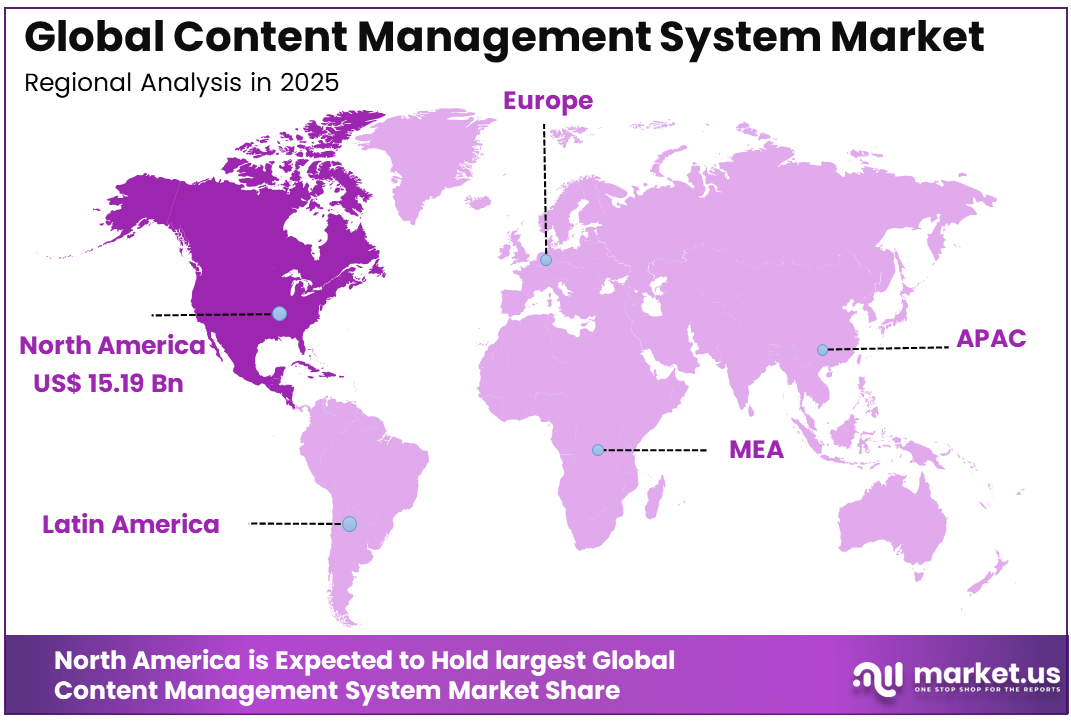
The Global Content Management System Market size is expected to be worth around USD 108.05 billion by 2035, from USD 36.71 billion in 2025, growing at a CAGR of 11.4% during the forecast period from 2025 to 2035. North America held a dominant market position, capturing more than a 41.4% share, holding USD 15.19 billion in revenue.
A content management system refers to software that helps users create, edit, organize, and publish digital content without advanced coding skills. It allows teams to manage website pages, blogs, images, videos, and documents from one platform, making content updates faster, more consistent, and easier to control across different digital channels.
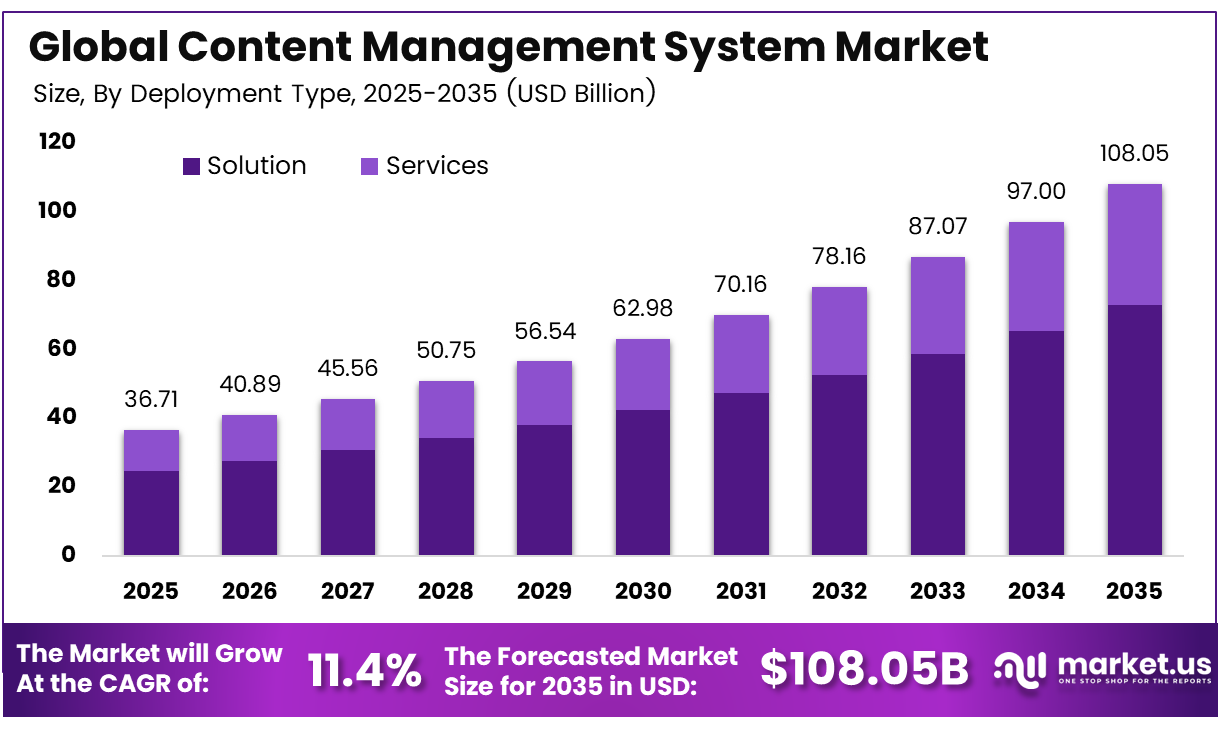
Top driving factors include the need for faster publishing, stronger collaboration, and lower dependency on developers for daily content updates. These improvements can cut content cycle time by nearly 50% in many teams. As remote and hybrid work expands, centralized and cloud-based CMS tools help teams working from 10 or more locations manage the same site efficiently.
The market for Content Management Systems is driven by the rising need for faster content publishing, centralized workflow control, and consistent digital experiences across websites, mobile apps, and online platforms. Businesses are adopting CMS tools to reduce dependency on developers, manage large content libraries, improve collaboration, and support personalized customer communication across multiple digital channels.
Demand is also influenced by customer expectations for consistent and personalized digital experiences across different channels. Personalization can lift conversion rates by 10 to 30% according to multiple industry benchmarks. Organizations are therefore using CMS platforms to reuse the same content across web, mobile, email, and connected devices without rewriting it separately for every channel.
For instance, in May 2025, Oracle rolled out fresh Oracle Cloud updates that extend automation, analytics, and integration around its content services. These enhancements make it easier for enterprises to centralize web assets, streamline approvals, and connect CMS content with marketing and ERP systems, supporting more data‑driven digital experience programs on Oracle Cloud.
Key Takeaway
- In 2025, the Solution segment held a dominant market position, capturing a 67.4% share of the Global Content Management System Market.
- In 2025, the Cloud-based segment held a dominant market position, capturing a 74.8% share of the Global Content Management System Market.
- In 2025, the Small & Medium Enterprises segment held a dominant market position, capturing a 54.9% share of the Global Content Management System Market.
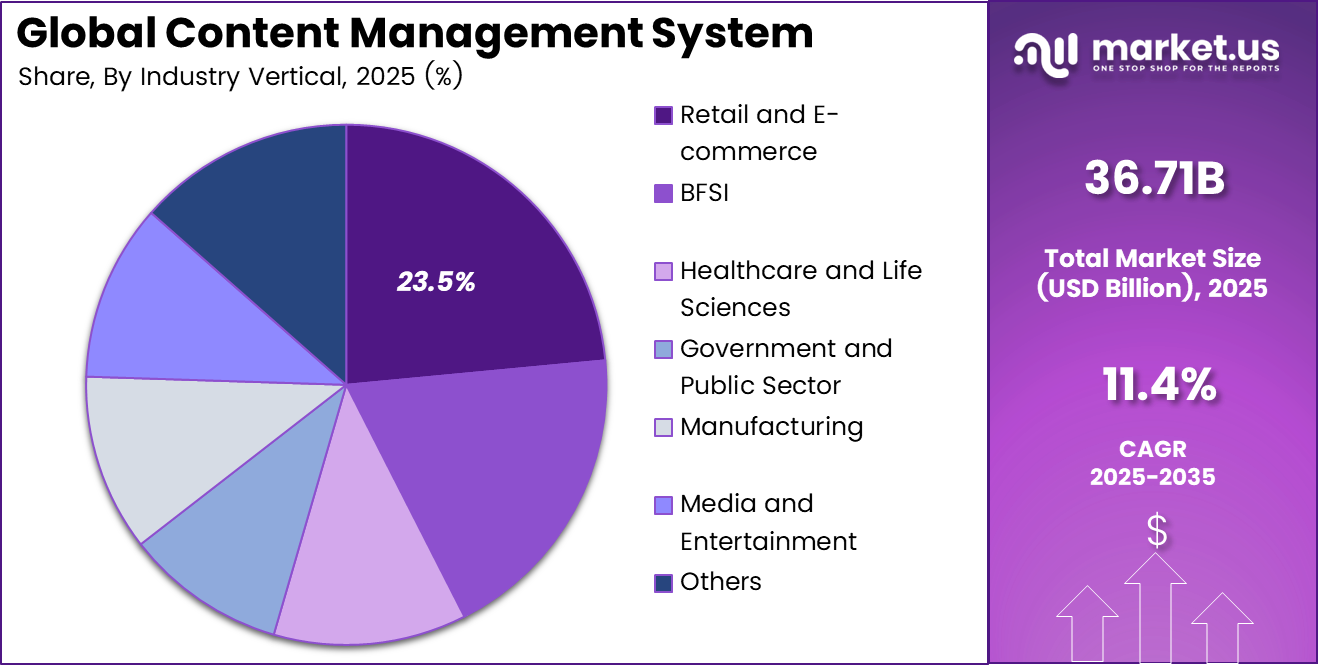
- In 2025, the Retail and E-commerce segment held a dominant market position, capturing a 23.5% share of the Global Content Management System Market.
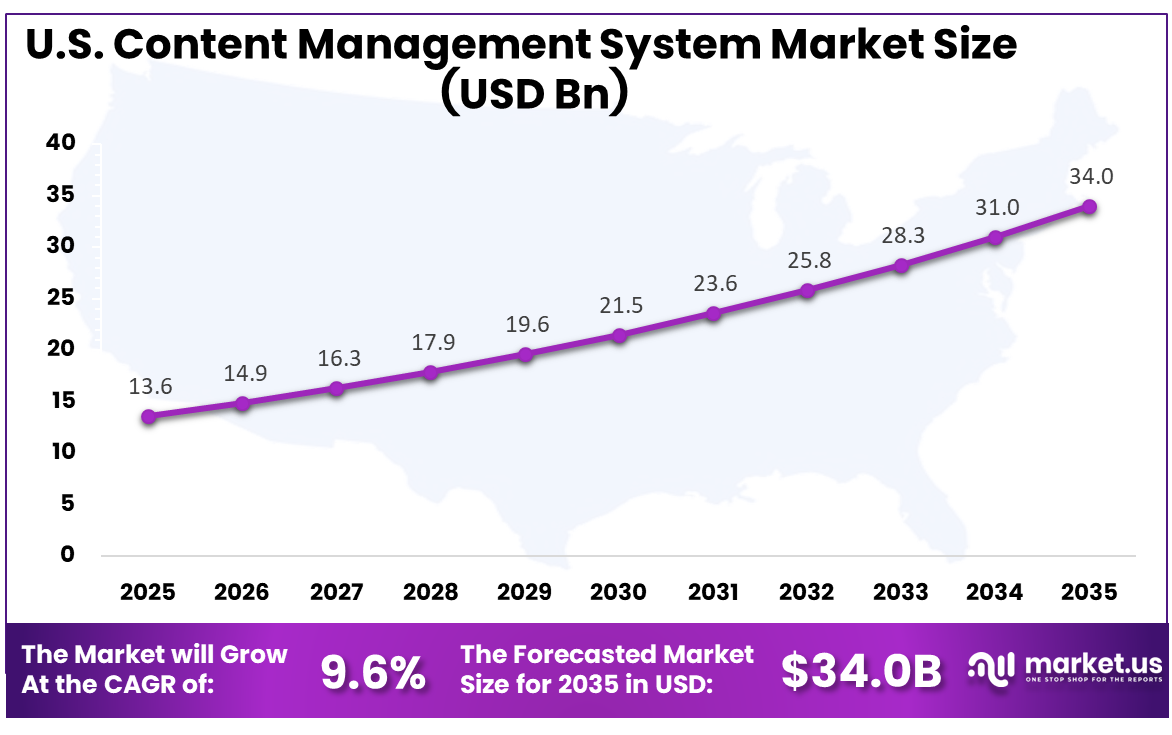
- The U.S. Content Management System Market was valued at USD 13.6 billion in 2025, with a robust CAGR of 9.6%.
- In 2025, North America held a dominant market position in the Global Content Management System Market, capturing more than a 41.4% share.
Role of Generative AI
Generative AI is becoming a regular part of CMS workflows, especially for website copy, product pages, and support content. It often prepares the first draft before human review. In many digital teams, AI supports roughly 60% of low-value work such as summarising, rephrasing, and repurposing content.
AI connected with CMS platforms can auto-tag assets, suggest internal links, and recommend layout changes based on engagement data. This reduces manual work for site teams and improves content findability. Over time, the CMS moves from a static content store to a smarter system that learns from every published asset.
Investment and Business Benefits
Investment opportunities are emerging in specialized CMS solutions for regulated industries, multilingual platforms, and composable architectures. These systems can connect 10 or more third-party tools, including CRM, analytics, and commerce engines. Vendors offering strong integration, security, and AI-assisted governance are expected to benefit from future upgrade and migration demand.
Businesses see clear benefits through lower operational effort, higher content reuse, and more targeted customer experiences. Centralized processes can improve campaign launch times by 30% or more. Better control over templates, permissions, and content workflows also reduces IT support tickets while keeping digital touchpoints consistent, professional, and easier to manage across departments.
Regional Analysis
In 2025, North America held a dominant market position in the Global Content Management System Market, capturing more than a 41.4% share, holding USD 15.19 billion in revenue. This dominance is due to North America’s advanced digital infrastructure, high cloud adoption, and strong use of CMS platforms across retail, media, healthcare, education, and financial services. Businesses in the region are investing in faster content publishing, personalized customer experiences, and secure digital workflows. The presence of mature technology ecosystems, skilled digital teams, and early adoption of AI-enabled content tools further supports regional leadership.
For instance, in November 2025, at OpenText World 2025, OpenText highlighted new AI‑ready capabilities in Content Cloud, including Content Aviator for generative‑AI search and advanced private‑cloud migration tools that cut upgrade effort dramatically. These updates solidify OpenText’s position as a leading North American provider of enterprise content services and governance platforms.
U.S. Content Management System Market Size
The market for Content Management Systems within the U.S. is growing tremendously and is currently valued at USD 13.6 billion; the market has a projected CAGR of 9.6%. The market is growing due to the strong shift toward digital business operations, online commerce, and personalized customer engagement across the U.S. Companies are using content management systems to publish faster, manage large content libraries, and maintain brand consistency across websites, mobile apps, and digital campaigns. Growth is also supported by cloud adoption, remote work, AI-assisted content tools, and rising demand for secure, scalable content platforms.
For instance, in May 2025, Broadcom’s Private Cloud Outlook 2025 report showed enterprises increasingly prioritizing private cloud for modern workloads, including content‑heavy and GenAI applications that rely on robust content platforms. This strengthens Broadcom’s VMware‑based content and experience infrastructure footprint across North American data centers.
Key Regions and Countries
North America
- US
- Canada
Europe
- Germany
- France
- The UK
- Spain
- Italy
- Russia
- Netherlands
- Rest of Europe
Asia Pacific
- China
- Japan
- South Korea
- India
- Australia
- Singapore
- Thailand
- Vietnam
- Rest of APAC
Latin America
- Brazil
- Mexico
- Rest of Latin America
Middle East & Africa
- South Africa
- Saudi Arabia
- UAE
- Rest of MEA
Component Analysis
In 2025, the Solution segment held a dominant market position, capturing a 67.4% share of the Global Content Management System Market. This dominance is due to the strong use of complete CMS solutions that help teams create, edit, approve, and publish content from one platform. Businesses prefer solutions that reduce manual work, improve workflow control, and support consistent digital content across websites, mobile apps, and customer touchpoints.
The solution segment is also supported by rising demand for better content governance, template control, and digital asset management. Companies are choosing CMS solutions to improve collaboration between marketing, design, and technical teams while reducing delays caused by scattered tools and manual publishing processes.
For Instance, in February 2025, OpenText released an update to its Content Management platform, adding deeper workflow automation, better integrations with core business apps, and enhanced security controls. These improvements show how solution providers are expanding beyond basic document storage to cover more of the content lifecycle.
Deployment Analysis
In 2025, the Cloud-Based segment held a dominant market position, capturing a 74.8% share of the Global Content Management System Market. This dominance is due to the growing preference for cloud-based CMS platforms that offer easier access, faster setup, and flexible content management. Cloud deployment allows teams to work from different locations while maintaining centralized control over content, users, approvals, and publishing schedules.
The segment is further supported by lower infrastructure needs and easier system updates. Businesses prefer cloud-based CMS platforms because they reduce the burden on internal IT teams and help organizations manage digital content securely across multiple channels, campaigns, and customer-facing platforms.
For instance, in May 2025, Broadcom published its Private Cloud Outlook report, describing how organizations are rebalancing between public and private cloud for key workloads. The findings reflect growing interest in flexible cloud strategies, which also influences how enterprises choose and deploy CMS platforms.
Enterprise Size Analysis
In 2025, the Small & Medium Enterprises segment held a dominant market position, capturing a 54.7% share of the Global Content Management System Market. This dominance is due to the rising use of CMS platforms among small and medium enterprises that need simple and affordable content tools. These businesses often prefer systems that allow non-technical users to update websites, blogs, product pages, and landing pages without depending heavily on developers.
The segment also benefits from the need for faster marketing execution and better online visibility. Small and medium enterprises use CMS platforms to manage regular content updates, improve brand consistency, and support digital growth while keeping operations lean and easier to manage.
For Instance, in June 2025, Microsoft detailed new SharePoint enhancements that simplify approvals, improve metadata automation, and strengthen integration with Microsoft 365. The focus on ease of use and automation supports smaller organizations that need structured content management without heavy customization.
Industry Vertical Analysis
In 2025, the Retail and E-commerce segment held a dominant market position, capturing a 23.5% share of the Global Content Management System Market. This dominance is due to the strong content needs of retail and e-commerce businesses. These companies depend on CMS platforms to manage product pages, promotional content, banners, blogs, and customer communication across digital storefronts, mobile channels, and campaign pages.
The segment is also supported by the need for consistent product information and faster campaign updates. Retail and e-commerce teams use CMS tools to align content with seasonal offers, customer behavior, and merchandising plans while improving the overall shopping experience across online touchpoints.
For Instance, in June 2025, Adobe shared upcoming Adobe Commerce innovations, including AI-supported content tools and tighter links between product content and digital storefronts. These enhancements help retailers update catalogs, campaigns, and experiences more quickly across their online channels.
Key Market Segments
By Offering
- Solution
- Document Management
- Web Content Management
- Collaboration Software
- Digital Rights Management
- Content Analytics
- Others
- Services
- Consulting
- Implementation and Integration
- Support and Maintenance
By Deployment
- Cloud-Based
- On-Premise
By Enterprise Size
- Small and Medium Enterprises (SMEs)
- Large Enterprises
By Industry Vertical
- Retail and E-commerce
- BFSI
- Healthcare and Life Sciences
- Government and Public Sector
- Manufacturing
- Media and Entertainment
- Others
Emerging trends
A key trend is AI-assisted personalization, where CMS platforms create and test different versions of copy and layouts. These versions are then adjusted using engagement data. API first and composable architectures are also gaining attention, as they allow AI services to work with CMS, commerce, and analytics tools.
Generative AI is also expanding beyond marketing into wider business functions. Technology, media, telecom, and professional services report adoption rates at or above 80% across internal functions. This is pushing CMS platforms to support websites, knowledge bases, search, summarization, and content rewriting under one governance framework.
Growth Factors
One major growth factor is cost efficiency. AI helps teams manage more content with the same or smaller headcount. Organizations using generative AI have reported average improvements in customer engagement of around 6.7% in early pilots, strengthening the case for CMS upgrades and AI-enabled content operations.
Another growth factor is the wider use of AI in daily work. Surveys show that close to 40% of working-age adults in some markets already use generative AI at home or work. As familiarity increases, content teams expect CMS tools to include chat-style assistance, auto tagging, and smart search as standard features.
Market Dynamics
Drivers - Faster Digital Content Operations
Faster digital content operations are driving the Content Management System market as businesses need to publish, update, and manage content across websites, apps, and digital channels quickly. CMS platforms help marketing and content teams reduce delays, manage approvals, and keep communication consistent without relying on developers for every routine update.
This demand is stronger as companies manage larger content libraries, multiple campaigns, and frequent website changes. A CMS supports structured workflows, reusable templates, and centralized content control, allowing teams to launch pages, refresh product information, and maintain brand consistency across customer touchpoints with less manual effort.
For instance, in April 2026, at its 2026 Summit, Adobe introduced CX Enterprise Coworker, an AI‑driven layer that orchestrates workflows across its content and experience tools, helping marketing and digital teams move from manual campaign steps to continuous, automated content delivery across channels, which directly supports faster digital content operations.
Restraint - High Implementation Costs
High implementation costs can limit CMS adoption, especially for smaller businesses with restricted budgets. Expenses may include software licensing, customization, migration, integration, staff training, and ongoing support. These costs can increase when companies need advanced workflows, multilingual content, security features, and connections with other business systems.
The cost burden is also linked to the time needed for planning and deployment. Moving from older systems to a modern CMS may require content restructuring, user role mapping, and technical configuration. This can delay expected benefits and make decision makers cautious about large platform investments.
For instance, in June 2025, OpenText’s Documentum updates focus on advanced security, governance, and integrations with tools such as Microsoft Purview and HashiCorp Vault, but these capabilities typically require containerized deployments and specialized skills, which can raise project complexity and total implementation cost for enterprises moving from older content systems.
Opportunities - Next-Generation and Headless CMS Adoption
Next-generation and headless CMS adoption is creating strong opportunities as businesses look for more flexible ways to deliver content across websites, mobile apps, smart devices, and commerce platforms. Headless CMS systems separate content management from the front-end design, making content reuse easier across multiple digital channels.
This opportunity is also supported by the growing demand for faster digital experience development. Companies can connect headless CMS platforms with analytics, personalization, search, and commerce tools. This helps teams build modern customer experiences while keeping content centralized, structured, and easier to update across different touchpoints.
For instance, in March 2026, Microsoft’s SharePoint and SPFx roadmap updates show a push toward SharePoint as a core content platform for AI‑enabled work, with extensibility across Microsoft 365, which supports more decoupled, API‑driven experiences that resemble headless patterns for intranets, portals, and business applications.
Challenges - Data Security Concerns
Data security concerns remain a major challenge for the Content Management System market because CMS platforms often manage sensitive business content, user accounts, customer data, and website assets. Weak access controls, outdated plugins, poor patching, or unsecured integrations can expose organizations to cyber risks and operational disruption.
The challenge becomes larger when multiple teams, agencies, and external users access the same CMS environment. Businesses must manage permissions carefully, monitor content changes, apply security updates, and protect stored data. Without strong governance, CMS platforms can become vulnerable points within the wider digital infrastructure.
For instance, in April 2026, WorkDrive 6.0 adds new ways to scan and safeguard confidential information, as well as secure integrations with AI agents, demonstrating how content platforms are hardening security controls while still enabling automation, amid persistent concerns about data leakage and unauthorized access.
Key Players Analysis
One of the leading players in October 2025, OpenText expanded its content and experience suite with new AI capabilities under the Aviator banner, bringing intelligent classification, search, and governance into its web and enterprise content tools. This keeps OpenText highly relevant for enterprises standardizing on one platform for compliant, AI‑ready content operations across web, documents, and records.
Top Key Players in the Market
- Adobe Inc.
- Broadcom
- Oracle Corporation
- OpenText Corporation
- Cisco Systems Inc.
- IBM Corporation
- EMC Corporation
- Microsoft Corporation
- Hyland Software
- Xerox Corporation
- Lexmark International
- Zoho Corporation
- WordPress
- Others
Recent Developments
- In July 2025, Adobe continued to solidify its position in enterprise CMS with ongoing enhancements to Adobe Experience Manager within Adobe Experience Cloud, deepening AI‑driven personalization, asset automation, and omnichannel publishing. These upgrades keep Adobe central to large‑scale digital‑experience programs where brands are standardizing on a single content layer for web and apps.
- In April 2026, Cisco continued to enhance Webex and related digital‑experience services with richer content‑sharing, templates, and embedded knowledge spaces rather than a standalone CMS launch. For content‑heavy collaboration and customer‑engagement scenarios, Cisco is effectively turning communication endpoints into lightweight content experiences, especially in regulated collaboration environments.
Report Scope
| Report Features | Description |
|---|---|
| Market Value (2025) | USD 36.71 Billion |
| Forecast Revenue (2035) | USD 108.05 Billion |
| CAGR (2026-2035) | 11.4% |
| Base Year for Estimation | 2025 |
| Historic Period | 2020-2024 |
| Forecast Period | 2026-2035 |
| Report Coverage | Revenue Forecast, Market Dynamics, Competitive Landscape, Recent Developments |
| Segments Covered | By Offering (Solution, Services), By Deployment (Cloud-Based, On-Premise), By Enterprise Size (Small and Medium Enterprises (SMEs), Large Enterprises), By Industry Vertical (BFSI, Retail and E-commerce, Healthcare and Life Sciences, Government and Public Sector, Manufacturing, Media and Entertainment, Others) |
| Regional Analysis | North America (US and Canada), Europe (Germany, France, The UK, Spain, Italy, and Rest of Europe), Asia Pacific (China, Japan, South Korea, India, Australia, and Rest of APAC), Latin America (Brazil, Mexico, and Rest of Latin America), Middle East & Africa (GCC, South Africa, and Rest of MEA) |
| Competitive Landscape | Adobe Inc., Broadcom, Oracle Corporation, OpenText Corporation, Cisco Systems Inc, IBM Corporation, EMC Corporation, Microsoft Corporation, Hyland Software, Xerox Corporation, Lexmark International, Zoho Corporation, WordPress, Others |
| Customization Scope | Customization for segments and region/country levels will be provided. Moreover, customization can be tailored to the requirements. |
| Purchase Options | We have three licenses to opt for: Single User License, Multi-User License (Up to 5 Users), Corporate Use License (Unlimited Users and Printable PDF) |