Market Overview
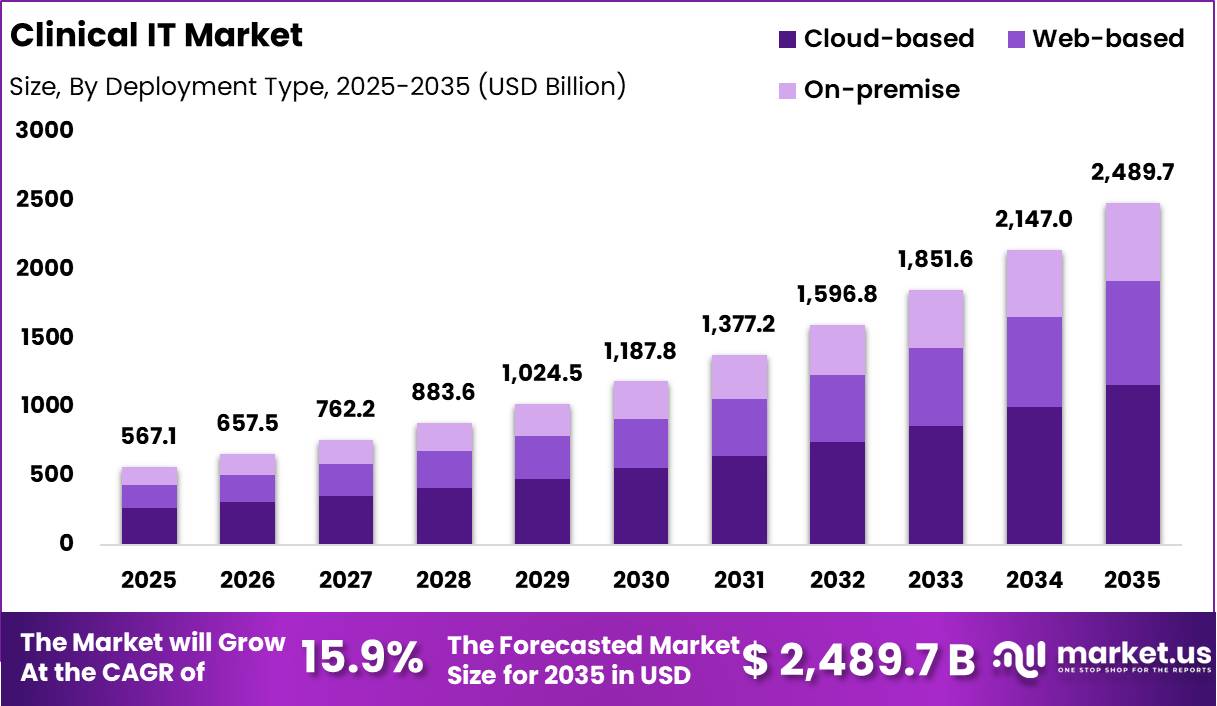
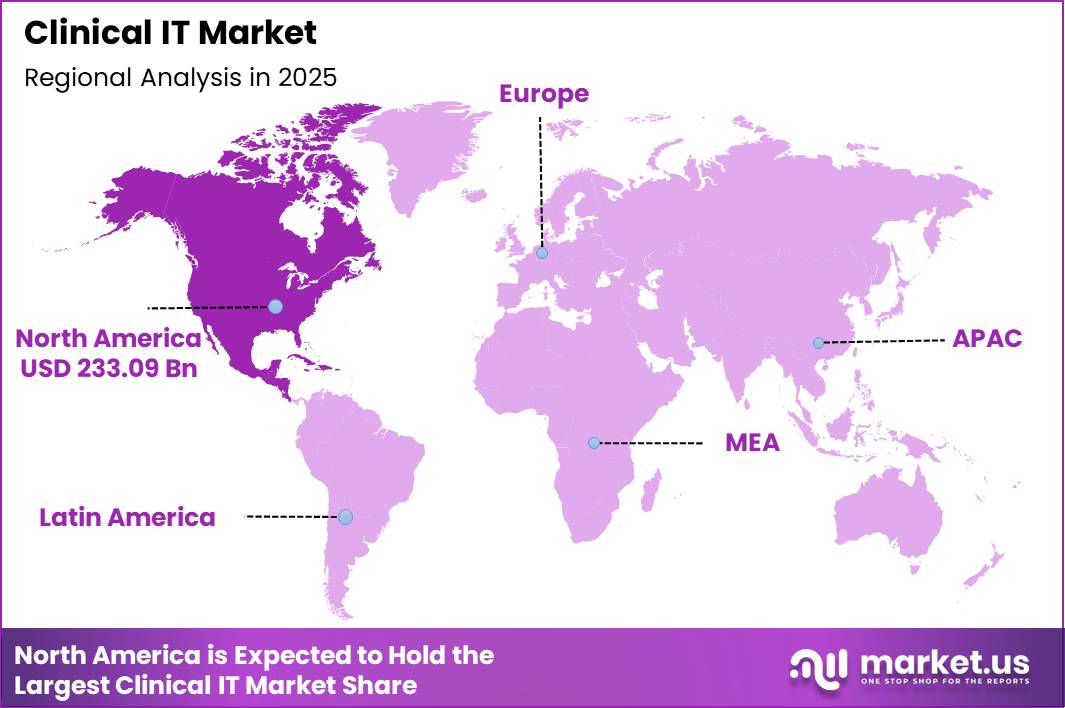
Global Clinical IT Market size is expected to be worth around US$ 2,489.7 Billion by 2035 from US$ 567.1 Billion in 2025, growing at a CAGR of 15.9% during the forecast period from 2026 to 2035. In 2025, North America led the market, achieving over 41.1% share with a revenue of US$ 233.09 Billion.
Global Clinical IT systems are rapidly reshaping healthcare delivery by improving clinical workflows, enabling real-time patient data access, and strengthening population health management across hospitals, clinics, and diagnostic networks.
Governments and public health bodies are increasingly prioritizing digital health infrastructure to improve care quality, reduce administrative burden, and enhance patient safety outcomes. The World Health Organization (WHO) has emphasized that over 70% of countries have now adopted national digital health strategies, reflecting a global shift toward interoperable electronic health ecosystems.
In the United States, the Centers for Medicare & Medicaid Services (CMS) continues to expand value-based care programs, with more than 80% of eligible providers now participating in digital reporting and electronic health record integration initiatives.
The U.S. Centers for Disease Control and Prevention (CDC) also reports that electronic case reporting adoption has improved outbreak detection timelines by nearly 30% in participating jurisdiction. Similar modernization efforts are underway in Europe through national eHealth programs coordinated under the European Commission, focusing on cross-border health data exchange and standardized clinical terminology systems.
Clinical IT adoption is further supported by rising investments in cloud computing, AI-assisted diagnostics, and cybersecurity frameworks designed to protect sensitive patient records. Many national health systems are targeting full digitization of hospital workflows and lab reporting systems by the end of the decade, with interoperability standards such as HL7 FHIR becoming widely implemented.
These developments are collectively accelerating digital transformation in healthcare, improving decision-making speed, reducing medical errors, and enabling more coordinated and efficient care delivery across global health systems.
Key Takeaways
- The Global Clinical IT Market was valued at US$ 567.1 Billion in 2025.
- The Global Clinical IT Market is projected to grow at a CAGR of 15.9% and is estimated to reach US$ 2,489.7 Billion by 2035.
- By Solution Type, Electronic health records and clinical information systems dominated the market, accounting for 35.1% of the total market share in 2025.
- By Deployment,Cloud‑based dominated the market, constituting 46.8% of the total market share.
- By End-user, Hospitals and health systems dominated the market, constituting 48.9% of the total market share
- Among regions, North America emerged as the leading regional market, contributing 45.0% of the global Global Clinical IT Market revenue in 2025.
By Solution Type
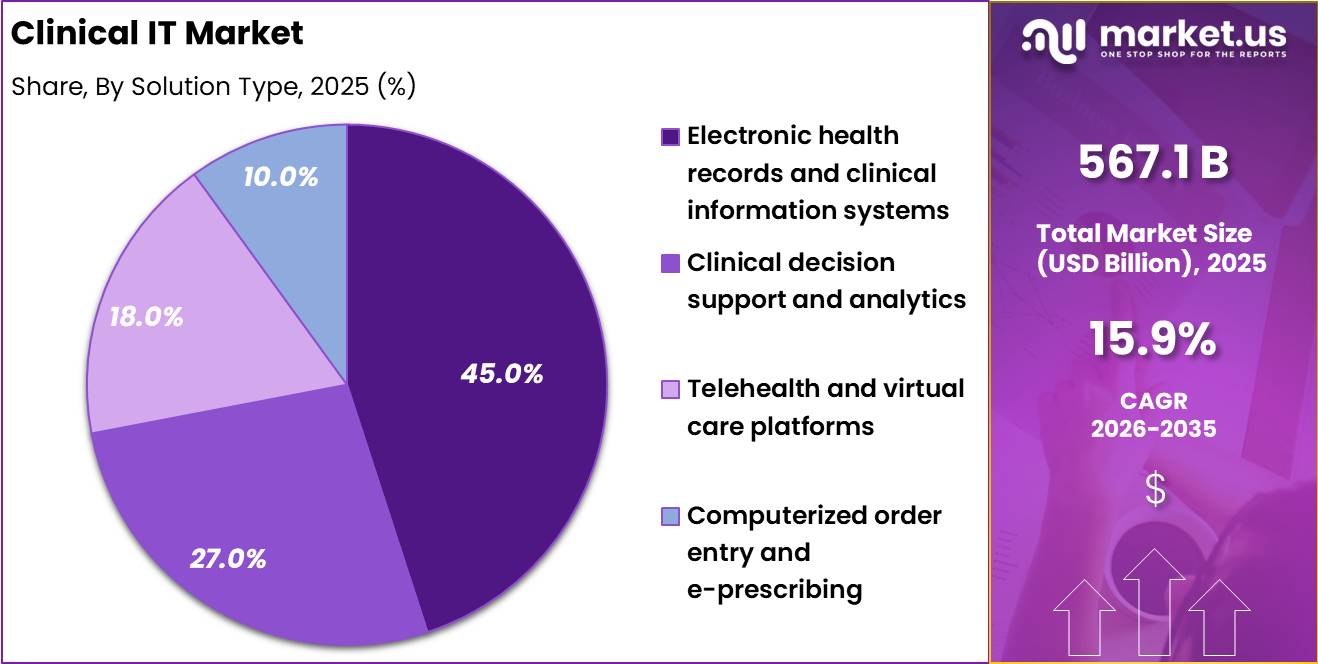
The Clinical IT Market by solution type is primarily led by Electronic Health Records (EHR) and Clinical Information Systems, which together account for the dominant 35.1% market share in 2025. This leadership is driven by widespread digitization of patient records, regulatory mandates for interoperability, and the growing need for centralized, real-time clinical data access across healthcare ecosystems. These systems form the backbone of digital healthcare infrastructure, enabling efficient documentation, care coordination, and compliance reporting.
Clinical Decision Support and Analytics solutions represent the second-largest segment with a 25.6% share, supported by rising adoption of AI-driven diagnostics, predictive analytics, and value-based care models. Telehealth and Virtual Care Platforms hold a 20.4% share, expanding rapidly due to demand for remote patient monitoring, post-pandemic care delivery transformation, and chronic disease management.
Computerized Physician Order Entry (CPOE) and e-Prescribing systems account for 18.90% of the market, driven by medication safety initiatives, reduced prescription errors, and integration with pharmacy networks. Overall, the solution landscape reflects a shift toward connected, data-driven, and patient-centric clinical workflows, with increasing convergence between documentation, analytics, and virtual care capabilities.
By Deployment
In the Clinical IT Market by deployment mode, cloud-based solutions dominate with a 46.8% market share in 2025, reflecting the accelerating shift toward scalable, flexible, and cost-efficient healthcare IT infrastructure.
Cloud adoption is being driven by healthcare providers seeking improved data accessibility, reduced capital expenditure, and enhanced interoperability across multi-site hospital networks. Additionally, cloud platforms support advanced analytics, AI integration, and real-time data sharing, making them increasingly central to modern clinical ecosystems.
Web-based solutions hold a 30.3% share, serving as a transitional model for organizations that require browser-accessible systems without fully migrating to cloud-native architectures. These platforms remain popular in mid-sized healthcare facilities due to ease of deployment and lower IT complexity.
On-premise systems account for 22.9% of the market, primarily sustained by large hospitals and institutions with strict data governance, regulatory compliance requirements, and concerns around data sovereignty. Despite slower growth, on-premise deployments continue to be relevant in regions with limited digital infrastructure maturity.
Overall, deployment trends indicate a clear long-term migration toward cloud-first clinical IT environments, supported by cybersecurity advancements, hybrid interoperability frameworks, and growing reliance on remote healthcare delivery models.
By End User
In the Clinical IT Market by end-user segmentation, hospitals and health systems dominate the landscape with a 48.9% market share in 2025. This dominance is attributed to their large-scale operational complexity, high patient volumes, and strong need for integrated clinical workflows across departments.
Hospitals are the primary adopters of comprehensive clinical IT ecosystems, including EHRs, decision support tools, CPOE systems, and telehealth platforms, all aimed at improving care coordination, reducing errors, and enhancing patient outcomes.
The segment is further supported by increasing investments in digital transformation initiatives, especially in tertiary and quaternary care centers that require advanced analytics, interoperability, and population health management capabilities. Health systems are also leveraging clinical IT to support value-based care models and regulatory compliance.
While hospitals lead the market, outpatient clinics, ambulatory surgical centers, and specialty care facilities are increasingly adopting modular clinical IT solutions, particularly cloud-based and web-enabled platforms. However, their contribution remains smaller compared to large hospital networks.
Overall, the end-user landscape reflects a hospital-centric adoption pattern, with gradual expansion into decentralized care settings driven by telehealth growth, outpatient care shift, and demand for continuous patient monitoring solutions.
Market Segmentations
By Solution Type
- Electronic health records and clinical information systems
- Clinical decision support and analytics
- Telehealth and virtual care platforms
- Computerized order entry and e‑prescribing
By Deployment
- Cloud‑based
- Web‑based
- On‑premise
By End-user
- Hospitals and health systems
- Clinics and ambulatory centers
- Diagnostic and laboratory centers
- Payers and other organizations
Driver
Interoperability mandates accelerating core platform refresh
The strongest near-term growth driver remains the conversion of interoperability from a discretionary feature into a compliance-led procurement requirement.
In the U.S., the ONC HTI-1 final rule pushed certified health IT toward USCDI v3 and new interoperability reporting obligations, with core implementation dates reaching into 2026 and reporting cycles extending into 2027, which materially raises upgrade pressure for EHR vendors, interface engines, terminology layers, consent tools, and API management stacks.
At the network level, TEFCA has moved from policy design to operating infrastructure, with nationwide exchange positioned as a “universal floor” for data sharing and thousands of organizations already live; industry reporting noted 2,816 organizations live on TEFCA and more than 14 million documents shared after go-live, while Epic indicated over 1,000 hospital customers and 22,000 clinics were live by early 2025.
Commercially, this shifts Clinical IT spending away from isolated module purchases toward enterprise integration roadmaps, because providers now need FHIR-ready records, patient access layers, identity management, referral exchange, and public health connectivity to work as a coordinated stack rather than as standalone deployments.
The revenue effect is not just fresh license demand; it also expands recurring service lines in implementation, managed interoperability, interface remediation, data normalization, and compliance analytics, especially in the U.S. and EU where cross-network exchange rules are increasingly explicit.
| Driver | (~) % Impact on CAGR Forecast | Geographic Relevance | Impact Timeline |
|---|---|---|---|
| Interoperability mandates accelerating core platform refresh | +2.3% | North America core, EU core, GCC and APAC spill-over | Short term (≤ 2 years) |
| Ambient AI documentation reshaping clinician productivity economics | +1.9% | North America core, Western Europe, Australia, advanced APAC | Short term (≤ 2 years) |
| Regulatory AI governance increasing spend on explainable clinical workflows | +1.4% | U.S., EU core, UK, Japan selective | Medium term (2-4 years) |
| Cybersecurity and resilience budgets moving Clinical IT into mission-critical spend | +1.6% | U.S. core, EU, UK, Middle East, tertiary hospitals in APAC | Short term (≤ 2 years) |
| Cross-border patient data frameworks expanding longitudinal record demand | +1.2% | EU core, Nordics, North America adjacency, developed APAC | Medium term (2-4 years) |
| Cloud-native EHR and modular modernization improving replacement ROI | +1.7% | U.S. core, Canada, Western Europe, Australia, urban APAC | Medium term (2-4 years) |
Challenge
Fragmented data interoperability
Fragmented data interoperability remains a structural drag on the global clinical IT market because even in 2026, fewer than 40–45% of multi-site health systems report consistently using FHIR-native APIs across all major EHR, imaging, and ancillary clinical systems, forcing providers to maintain 10–25 parallel point-to-point interfaces per hospital and adding 9–14 months to multi-country rollouts of population health, clinical decision support, or AI-based care management platforms.
This fragmentation converts directly into friction: integration, mapping, and interface engine work can account for 18–25% of total project capex on large clinical IT programs and add 15–20% to lifetime TCO due to continuous interface break-fix and standards upgrades, while cross-border data localization rules (e.g., GDPR health data provisions and country-level residency requirements) can raise cloud storage and routing costs by 8–12% per terabyte compared with single-jurisdiction deployments.
The operational consequence is that a global platform that could theoretically scale to 200–300 hospitals in 24–30 months often only achieves 120–180 hospitals in the same period, effectively trimming 1.0–1.5 percentage points from achievable CAGR as vendors and providers divert engineers into bespoke mappings, duplicate data warehouses, and manual reconciliation workflows instead of accelerating new module adoption.
To navigate this, leading vendors are building interoperability roadmaps that mandate FHIR-first architectures, real-time terminology services, and unified patient identity resolution (aiming for duplicate record rates below 1% versus current 3–5%).
While large provider groups are setting enterprise integration standards with centralized API gateways, cross-vendor interoperability councils, and contractual requirements that new clinical IT contracts expose minimum API coverage thresholds (for example, 90% of workflow-critical resources accessible via standards-based APIs at go-live) to gradually compress this friction over a 4–7 year horizon.
| Challenge | (~) % CAGR Friction Drag | Geographic Relevance | Mitigation Horizon |
|---|---|---|---|
| Fragmented data interoperability | -1.3% | North America, EU, APAC | Long term (≥ 4 years) |
| Cybersecurity and ransomware load | -1.1% | North America core, EU regulatory hubs | Medium term (2-4 years) |
| Talent and skills shortfall | -0.9% | North America, EU, APAC tier-1 | Long term (≥ 4 years) |
| Legacy infrastructure technical debt | -0.8% | North America, EU, Japan | Long term (≥ 4 years) |
| Budget volatility and ROI scrutiny | -0.7% | North America, EU, Emerging APAC | Medium term (2-4 years) |
| Vendor lock-in and ecosystem complexity | -0.6% | Global tier-1 health systems | Long term (≥ 4 years) |
Restraints
Escalating EHR / clinical IT TCO
The single largest structural restraint on clinical IT adoption through 2030 is the step-up in total cost of ownership for enterprise EHR and broader clinical IT stacks, with small practices facing first-year outlays of roughly 20,000–65,000 USD and mid-sized clinics absorbing 65,000–200,000 USD per site once hardware, data migration, and training are included, while full-scale hospital upgrades can easily cross 2–4 million USD per facility when replacing legacy systems, materially depressing ROI on digital initiatives.
At the operating level, recurring cloud EHR subscriptions in the 3,000–10,000 USD per provider per year range, layered with security and compliance tooling that often adds another 5,000–20,000 USD annually per site, mean that IT opex is trending towards 4–6 percent of revenue for mid-sized hospitals versus historic norms closer to 2–3 percent, particularly in North America and Western Europe.
This cost inflation is amplified by vendor lock-in and multi-year contracts: large systems are increasingly tied into 5–7-year agreements with single-digit annual price escalators but limited flexibility, effectively turning 15–20 percent of total IT budget into “fixed” spend and crowding out new clinical decision support, interoperability, and analytics deployments.
The result is a structurally higher payback threshold for new clinical IT, forcing CFOs to push hurdle rates from 10–12 percent IRR to 15 percent or higher, lengthening evaluation cycles by 6–12 months, and delaying or downsizing rollouts (for example, phasing deployments from system-wide go-lives to 3–5 hospital clusters) to manage CapEx and cash burn, which cumulatively dampens global clinical IT volume growth by an estimated 2 percentage points on the CAGR over a 2–4-year horizon.
| Restraint | (~) % Impact on CAGR Forecast | Geographic Relevance | Impact Timeline |
|---|---|---|---|
| Escalating EHR / clinical IT TCO | -2.0% | North America, EU, GCC, urban APAC | Medium term (2–4 years) |
| Cybersecurity and data breach risk | -1.5% | North America core, EU, APAC corridors | Medium term (2–4 years) |
| Clinical IT talent and workflow bottlenecks | -1.2% | North America, EU, India, ASEAN | Long term (≥ 4 years) |
| Interoperability and legacy integration drag | -0.9% | US, EU, Japan, Middle East | Long term (≥ 4 years) |
| Regulatory and compliance overhead | -0.8% | US, EU, UK, GCC | Short–Medium term (≤ 4 years) |
| Capital expenditure rationing by providers | -0.7% | Emerging APAC, LatAm, Africa | Short term (≤ 2 years) |
Opportunity
FHIR data utility layer
This is an opportunity rather than a current driver because baseline clinical IT growth already reflects core EHR, PACS, LIS and telehealth adoption, whereas the next upside sits in monetizing the data liquidity layer that emerges once FHIR based exchange becomes commercially usable across networks instead of remaining a compliance cost center.
The market signal is now clearer: the U.S. certification regime has moved to USCDI v3 as a new baseline from January 1, 2026, TEFCA on FHIR is positioning direct transaction exchange without prior bilateral connections, and OECD data still shows fragmentation with only 15 of 27 surveyed countries operating nationally unified records, which means the installed base is large but under-monetized.
Vendors that build middleware for prior authorization orchestration, clinical data normalization, longitudinal patient graphing, and app based encounter level extraction can expand wallet share by 15% to 25% per enterprise account, push gross margins 500 to 800 basis points above legacy license modules, and reduce integration deployment time from 9 to 12 months toward 3 to 5 months through reusable API connectors; that converts interoperability from a defensive feature into a revenue layer with an estimated adjacent TAM of 8% to 12% of existing enterprise clinical software spend by 2030, justifying roughly +2.4 percentage points of CAGR upside if scaled across provider and payer ecosystems.
| Opportunity | (~) % Potential CAGR Upside | Geographic Relevance | Execution Window |
|---|---|---|---|
| FHIR data utility layer | +2.4% | North America core, EU, APAC tier-1 | Short term (≤ 2 years) |
| Elder-care workflow suites | +1.9% | Japan, Western Europe, U.S., South Korea, urban China | Medium term (2-4 years) |
| RPM-to-clinical IT bundling | +1.7% | U.S. core, UK, GCC, Australia | Short term (≤ 2 years) |
| ABDM/NHCX claims stack | +2.1% | India core, South Asia follow-on | Short term (≤ 2 years) |
| AI auditability platforms | +1.5% | U.S., EU, Canada, ANZ | Medium term (2-4 years) |
| Provider roll-up platforms | +1.3% | Southeast Asia, LATAM, CEE, Africa private markets | Long term (≥ 4 years) |
Regional Analysis
In 2025, North America led the market, achieving over 41.1% share with a revenue of US$ 233.09% Billion.
In 2025, the global Clinical IT market demonstrates strong regional concentration, with North America maintaining leadership due to advanced healthcare infrastructure, high EHR penetration, and accelerated adoption of AI-enabled clinical systems.
Europe remains a highly regulated but steadily expanding market, driven by interoperability mandates, national digital health programs, and increasing investment in clinical decision support tools across public healthcare systems.
Asia Pacific is emerging as the fastest-growing region, fueled by large-scale hospital digitization in China and India, expanding telehealth adoption, and government-backed health IT modernization initiatives.
Latin America, the Middle East, and Africa collectively represent an emerging opportunity space, characterized by gradual EHR adoption, infrastructure constraints, and increasing public-private partnerships in healthcare IT deployment.
Overall, regional disparities in reimbursement frameworks, digital maturity, and regulatory alignment continue to shape investment priorities for vendors and healthcare providers. North America and Europe dominate innovation, while Asia Pacific drives volume-led expansion, and emerging regions gradually close infrastructure gaps through cloud-based clinical IT solutions. This multi-regional evolution reinforces sustained long-term market growth across both developed and developing healthcare economies worldwide adoption trends.
Key Regions and Countries
North America
- The US
- Canada
Europe
- Germany
- France
- The U.K.
- Italy
- Spain
- Russia & CIS
- Rest of Europe
Asia Pacific
- China
- India
- Japan
- South Korea
- ASEAN
- Australia & New Zealand
- Rest of Asia Pacific
Middle East & Africa
- GCC
- South Africa
- Rest of Middle East & Africa
Latin America
- Brazil
- Mexico
- Rest of Latin America
Key Player Analysis
Clinical IT Market is moderately consolidated, led by global EHR and health IT platform vendors alongside diversified technology and services providers. Competition is shaped by digital transformation in healthcare, rising adoption of cloud-based clinical systems, and increasing focus on interoperability, analytics, and precision-driven care delivery.
Market structure is moderately consolidated across three tiers. Tier 1 platform leaders include Oracle Health (Cerner), Epic Systems Corporation, McKesson Corporation, Philips Healthcare (Koninklijke Philips N.V.), GE HealthCare, Siemens Healthineers, and Optum (UnitedHealth Group), anchoring hospital EHR and imaging ecosystems.
Tier 2 includes IBM (incl. Watson Health / Merative), Microsoft Corporation, SAS Institute Inc., Dell Technologies (Dell / EMC), Athenahealth, and Allscripts / Veradigm Inc., focusing on analytics and workflow. Tier 3 includes Wipro Limited and Cognizant Technology Solutions as implementation partners.
Competition emphasizes interoperability standards, AI-enabled clinical decision support, and cloud-native EHR modernization. Companies invest in R&D-driven analytics, integrate diagnostics and imaging workflows, and pursue partnerships across device, software, and cloud ecosystems to strengthen data continuity and platform lock-in across care settings.
Platform vendors: Oracle Health (Cerner), Epic Systems Corporation, McKesson Corporation, Optum (UnitedHealth Group); imaging/device: Philips Healthcare (Koninklijke Philips N.V.), GE HealthCare, Siemens Healthineers; analytics/software: IBM (incl. Watson Health / Merative), Microsoft Corporation, SAS Institute Inc., Athenahealth, Allscripts / Veradigm Inc., Dell Technologies (Dell / EMC); services: Wipro Limited, Cognizant Technology Solutions.
Top Key Players
- Oracle Health (Cerner)
- Epic Systems Corporation
- McKesson Corporation
- Philips Healthcare (Koninklijke Philips N.V.)
- GE HealthCare
- Optum (UnitedHealth Group)
- Allscripts / Veradigm Inc.
- Siemens Healthineers
- IBM (incl. Watson Health / Merative)
- Microsoft Corporation
- SAS Institute Inc.
- Dell Technologies (Dell / EMC)
- Wipro Limited
- Cognizant Technology Solutions
- Athenahealth
Recent Developments
- In 2025, GE HealthCare announced acquisition of Intelerad Medical Systems ($2.3B) to strengthen enterprise imaging IT capabilities.
- In March 2025 – AI imaging collaboration with NVIDIA -GE HealthCare expanded collaboration with NVIDIA to develop autonomous imaging (X-ray and ultrasound AI systems) for diagnostic automation.
- In August 2025, Oracle Launch of AI-Powered Next-Generation EHR released a new AI-native EHR built on Oracle Cloud Infrastructure with embedded generative AI across clinical workflows, enabling voice-driven access to labs, medications, and patient summaries.
Report Scope
| Report Features | Description |
|---|---|
| Market Value (2025) | US$ 567.1 Bn |
| Forecast Revenue (2035) | US$ 2489.7 Bn |
| CAGR (2026-2035) | 15.9% |
| Base Year for Estimation | 2025 |
| Historic Period | 2020-2024 |
| Forecast Period | 2026-2035 |
| Report Coverage | Revenue Forecast, Market Dynamics, Competitive Landscape, Recent Developments |
| Segments Covered | By Solution Type (Electronic health records and clinical information systems ,Clinical decision support and analytics ,Telehealth and virtual care platforms ,Computerized order entry and e‑prescribing) By Deployment (Cloud‑based ,Web‑based ,On‑premise) By End-user (Hospitals and health systems ,Clinics and ambulatory centers ,Diagnostic and laboratory centers ,Payers and other organizations) |
| Regional Analysis | North America – The US, Canada; Europe – Germany, France, U.K., Italy, Spain, Russia & CIS, Rest of Europe; Asia Pacific – China, India, Japan, South Korea, ASEAN, Australia & New Zealand, Rest of Asia Pacific; Middle East & Africa – GCC, South Africa, Rest of Middle East & Africa; Latin America – Brazil, Mexico, Rest of Latin America |
| Competitive Landscape | Oracle Health (Cerner) ,Epic Systems Corporation ,McKesson Corporation ,Philips Healthcare (Koninklijke Philips N.V.) ,GE HealthCare ,Optum (UnitedHealth Group) ,Allscripts / Veradigm Inc. ,Siemens Healthineers, IBM (incl. Watson Health / Merative) ,Microsoft Corporation ,SAS Institute Inc. ,Dell Technologies (Dell / EMC), Wipro Limited ,Cognizant Technology Solutions ,Athenahealth , |
| Customization Scope | Customization for segments, region/country-level will be provided. Moreover, additional customization can be done based on the requirements. |
| Purchase Options | We have three licenses to opt for: Single User License, Multi-User License (Up to 5 Users), Corporate Use License (Unlimited User and Printable PDF) |