


Report Overview
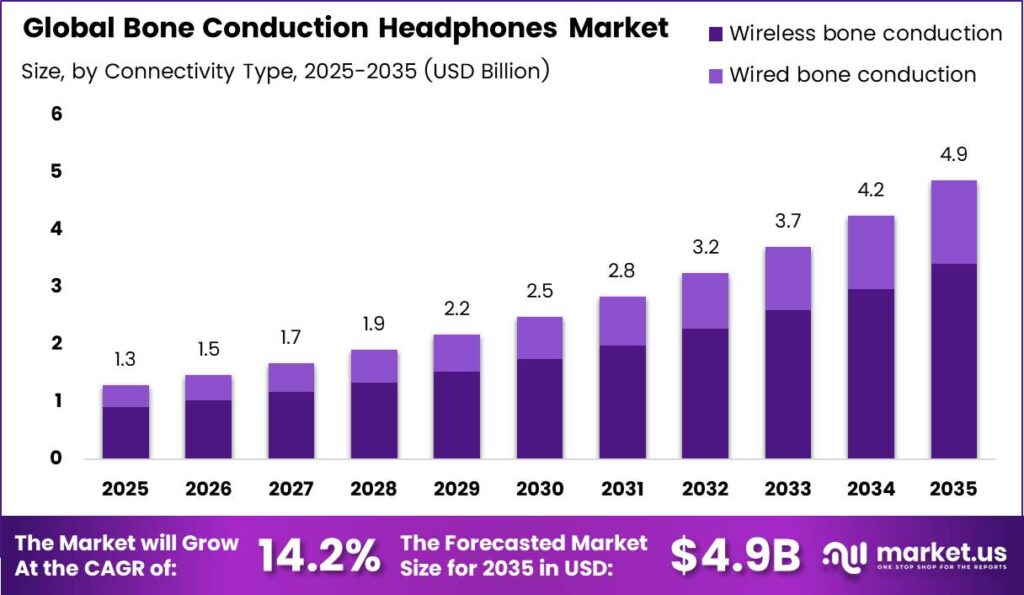
Global Bone Conduction Headphones Market size is expected to be worth around USD 4.9 Billion by 2035 from USD 1.3 Billion in 2025, growing at a CAGR of 14.2% during the forecast period 2026 to 2035. This growth reflects a shift in how active users buy audio. Buyers now weigh safety and comfort against sound quality, opening a distinct product tier that traditional earbud makers cannot easily serve.
Bone conduction headphones transmit sound through the cheekbones and skull directly to the inner ear, leaving the ear canal open. This design serves runners, cyclists, workers, and hearing-assistance users who need situational awareness. The market splits by connectivity, application, price, and channel, with wireless models and sports use anchoring most volume. This structure lets vendors target narrow, high-intent buyer groups instead of the broad music market.
Government and regulatory action now shapes demand directly. The U.S. FDA’s October 2022 OTC hearing aid rule created a self-fitting device category for adults with mild-to-moderate hearing loss. This opens a legal path for repositioning open-ear devices as accessible amplification tools. Vendors that align product claims with this framework can enter clinical channels that carry higher prices and thicker margins than sports retail.
Key Takeaways
- Global market reaches USD 4.9 Billion by 2035 from USD 1.3 Billion in 2025 at a CAGR of 14.2%.
- Wireless bone conduction leads the connectivity segment with a 70.1% share.
- Sports and fitness dominates applications with a 40.1% share.
- Mid-range pricing captures the largest price tier at 45.7%.
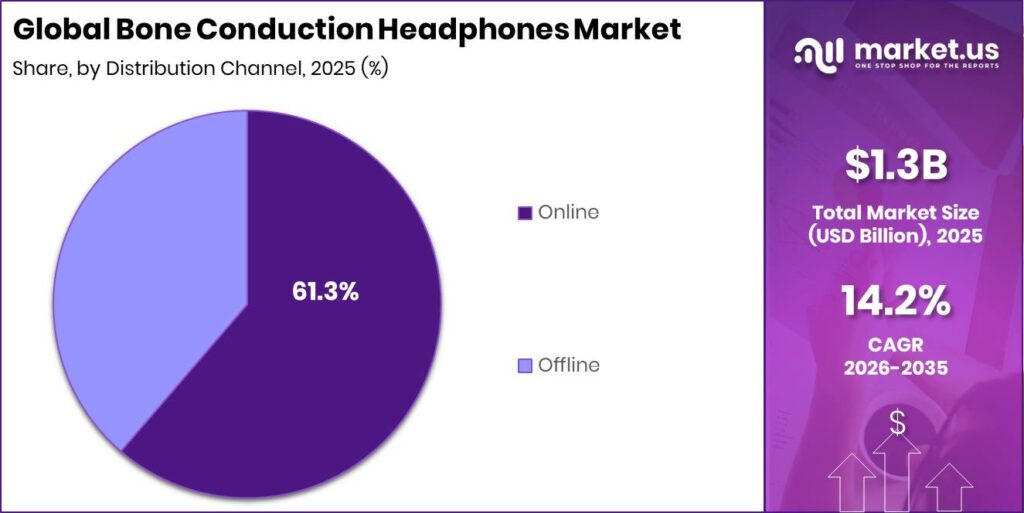
- Online distribution controls 61.3% of sales channels.
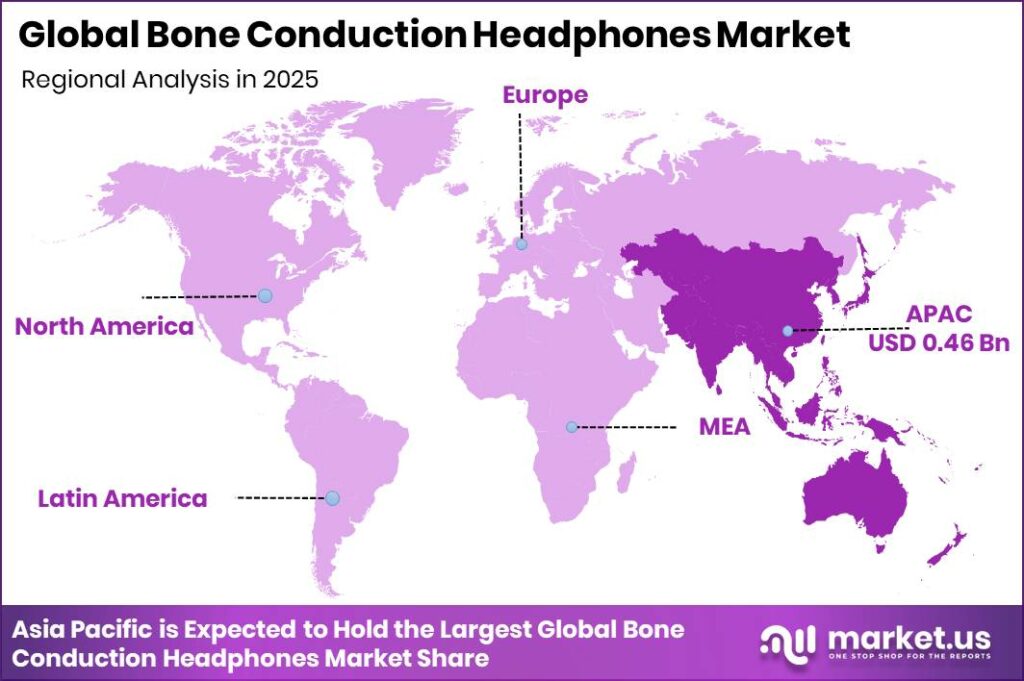
- Asia Pacific leads all regions with a 35.6% share, valued at USD 0.46 Billion.
Clinical evidence reinforces the health case behind demand. Based on research published in PMC, 84% of surveyed students reported regular headphone use, while 3.6% of regular users showed sensorineural hearing loss. This signals a large, exposed user base seeking safer audio. Vendors that market ear-canal health and open-ear design can convert risk-aware young buyers before rivals reach them.
Hearing outcome data further validates the underlying technology. A large Bonebridge cohort study found statistically significant word recognition improvement at p < 0.001, with disability scores improving across all subscales. This proves bone conduction delivers measurable clinical benefit, not just convenience. As a result, brands can credibly extend from lifestyle sales into audiology channels with clinical backing.
Connectivity Type Analysis
Wireless bone conduction dominates with 70.1% due to cable-free freedom during intense movement.
In 2025, Wireless bone conduction held a dominant market position in the By Connectivity Type segment of Bone Conduction Headphones Market, with a 70.1% share. Global headphone shipments reached 586 million units in 2024, up from 309.5 million earlier in the tracked period. This surge shows buyers now expect wireless as standard. Vendors that ship wired-only models risk shelf rejection in premium sports retail.
Wired bone conduction serves narrow professional and budget roles where signal reliability outweighs convenience. Tactical and industrial buyers value fixed connections that resist wireless interference in field conditions. Global trade flows tracked by UN Comtrade under HS code 8518 show headphone and earphone units moving in the billions annually across borders. This confirms steady component demand. Vendors serving defense and industrial fleets can defend margins here despite low consumer interest.
Wireless models also benefit from expanding platform integration. In January 2026, Linkage Global signed licensing agreements with ClickClack and VIBELENS to commercialize bone-conduction and wearable technology under a per-unit royalty model. This licensing route lowers entry cost for new wireless brands. As a result, more competitors can enter the wireless tier without heavy in-house transducer development.
Application Analysis
Sports and fitness dominates with 40.1% due to open-ear situational awareness during outdoor activity.
In 2025, Sports and fitness held a dominant market position in the By Application segment of Bone Conduction Headphones Market, with a 40.1% share. The Sports and Fitness Industry Association reported 247.1 million active Americans in 2024, up by 25.4 million year over year. This expanding active base feeds direct demand. Vendors that anchor products in running and cycling capture the highest-intent buyer pool first.
Military, firefighter, and police users adopt tactical models for hands-free communication in hazardous zones. These buyers need open ears to hear commands and threats while receiving radio audio. Procurement runs through structured government contracts rather than retail. This creates predictable, repeat-order volume that shields vendors from consumer price swings and seasonal demand shifts.
General consumer and entertainment users adopt bone conduction for comfort during long wear and commuting. This group prioritizes convenience over studio-grade sound. Hearing-aid and hearing-assistance buyers form a smaller but higher-value tier, drawn by open-ear amplification without ear canal blockage. Together these two groups hold the remaining share collectively, giving vendors a ladder from mass comfort sales toward premium clinical positioning.
Price Range Analysis
Mid-range dominates with 45.7% due to balanced feature sets at accessible price points.
In 2025, Mid-range held a dominant market position in the By Price Range segment of Bone Conduction Headphones Market, with a 45.7% share. World Bank income data shows rising middle-class spending power across North America, Europe, and East Asia. This buyer group accepts prices near USD 130 to USD 200 for durable sport models. Vendors that concentrate here capture the widest willing-to-pay audience.
Entry-level and budget models attract first-time buyers and emerging market entrants testing the category. These devices trade features for accessibility and drive trial-based adoption. Premium and high-end models target audiology-adjacent and enthusiast buyers seeking advanced waterproofing and fit. Together these two tiers hold the remaining share collectively, letting vendors run a good-better-best ladder that lifts buyers toward higher margins over time.
Distribution Channel Analysis
Online dominates with 61.3% due to broad reach and direct-to-consumer efficiency.
In 2025, Online held a dominant market position in the By Distribution Channel segment of Bone Conduction Headphones Market, with a 61.3% share. ITU data shows global internet penetration surpassed 67% of the world population by 2024. This connectivity base enables direct online purchasing at scale. Vendors that build strong e-commerce and marketplace presence reach buyers faster than physical-only rivals.
Offline retail retains value through hands-on trial and specialist staff guidance. Sport specialty stores let buyers test fit and vibration comfort before purchase, which lifts conversion for higher-priced models. National statistical office retail data confirms in-store sales remain a meaningful share of consumer electronics turnover. This means vendors that pair online scale with select physical demo points convert cautious first-time buyers most effectively.
Key Market Segments
By Connectivity Type
- Wireless bone conduction
- Wired bone conduction
By Application
- Sports and fitness
- Military / firefighter / police (tactical)
- General consumer / entertainment
- Hearing-aid / hearing-assistance field
By Price Range
- Mid-range
- Entry-level / budget
- Premium / high-end
By Distribution Channel
- Online
- Offline
Regional Analysis
Asia Pacific Dominates the Bone Conduction Headphones Market with a Market Share of 35.6%, Valued at USD 0.46 Billion
Asia Pacific leads the global market with a 35.6% share, valued at USD 0.46 Billion in 2025. The region combines large-scale transducer manufacturing in China and Japan with fast-rising active-lifestyle demand in China and South Korea. This dual role as both maker and buyer lowers landed cost. Vendors that source and sell within the region gain a structural price and speed advantage over import-dependent rivals.
North America ranks as a high-value growth region driven by outdoor sports and early clinical adoption. Regulatory shifts around open-ear hearing devices support premium positioning here. Europe follows with strong cycling participation and road-safety rules that steer buyers away from in-ear devices. This regulatory push converts safety-conscious cyclists into bone conduction buyers across major EU markets.
Latin America and the Middle East and Africa form the remaining regional demand. These markets show early-stage adoption limited by higher unit prices relative to conventional earphones. Affordable localized models and expanding online reach open entry paths here. Vendors that price for these regions early can build brand loyalty before larger competitors arrive.
Key Regions and Countries
North America
- US
- Canada
Europe
- Germany
- France
- The UK
- Spain
- Italy
- Rest of Europe
Asia Pacific
- China
- Japan
- South Korea
- India
- Australia
- Rest of APAC
Latin America
- Brazil
- Mexico
- Rest of Latin America
Middle East and Africa
- GCC
- South Africa
- Rest of MEA
Market Dynamics
Market Opportunity Analysis - Underserved clinical, enterprise, and emerging market tiers offer clear entry points for new players
The hearing-aid and hearing-assistance application remains the most underexploited segment. This group sits below sports at only a fraction of the 40.1% application share, yet clinical channels command far higher prices. New entrants that position devices for non-surgical amplification tap buyers underserved by both consumer brands and costly implants. This creates a defensible niche before larger rivals pivot toward it.
The tactical and enterprise application also stays underexploited relative to consumer volume. This buyer group runs on structured procurement rather than retail, giving stable repeat orders. New players that build push-to-talk and fleet-ready features enter a segment where consumer giants hold little advantage. As a result, specialist entrants can win long contracts that shield revenue from retail price wars.
Emerging regions inside Latin America and the Middle East and Africa remain underpenetrated against Asia Pacific’s 35.6% lead. High relative pricing has slowed adoption in these markets. New entrants that localize manufacturing and price for these buyers gain early share. This means first movers can build loyalty while incumbents still focus on saturated developed markets.
The offline channel stays underused against online’s 61.3% dominance. This gap matters because hands-on trial lifts conversion for higher-priced models. New players that secure sport specialty demo placement reach cautious first-time buyers that pure online sellers miss. Instead of competing only on price, these entrants convert on fit and comfort experience.
Technology and Innovation Landscape - AI speech enhancement and multimodal bone conduction sensing reshape the competitive edge
Multimodal bone conduction systems now boost audio quality measurably. The VibOmni system delivered a 21% gain in speech quality, a 26% rise in SNR, and roughly a 40% drop in word error rate. This proves bone conduction can overcome its noise weakness through sensor fusion. Manufacturers that adopt multimodal designs can enter voice-critical enterprise and tactical markets with credible performance claims.
User preference data confirms strong market pull for these systems. In real-world testing with 32 volunteers, 87% of users preferred the bone-conduction multimodal system over baseline audio. This signals clear buyer demand, not just lab novelty. As a result, brands that ship multimodal features early can differentiate on proven listener preference rather than price alone.
Signal-to-noise gains extend the technology into demanding environments. The same multimodal system achieved a 26% SNR improvement during field tests with real users. This means bone conduction can now serve loud industrial and outdoor settings where clarity once failed. Manufacturers targeting frontline and safety markets gain a concrete performance argument for procurement buyers.
Low latency processing makes real-time use practical. One system held inference latency to just 1.74 ms per streaming window, enabling near-instant speech enhancement. This near-zero delay supports live communication without lag. Therefore vendors can integrate bone conduction into push-to-talk radios and AR headsets where timing precision decides adoption.
Drivers
Rising participation in outdoor endurance sports converges with tightening road-safety rules to push open-ear audio adoption. In the United States, over 60 million people run or jog each year, and the EU-27 counted 80+ million regular cyclists by 2024. France fines in-ear device use while cycling at EUR 135. This regulatory pressure converts safety-conscious athletes into direct bone conduction buyers.
Bone conduction still holds only about 3% to 5% of the sports audio addressable market, against a global headphone base of roughly 320 million units where sports use covers 18% to 22% of volume. This gap shows a large unconverted, high-intent buyer pool. Vendors that lead specialist sport retail channels capture first-mover share, earning gross margins of 52% to 62% versus 38% to 48% in mass electronics retail.
| Driver | (~) % Impact on CAGR Forecast | Geographic Relevance | Impact Timeline |
|---|---|---|---|
| Outdoor & Active Lifestyle Sports Adoption Requiring Situational Awareness Audio Solutions | +4.20% | North America, Europe, Australia, Japan, South Korea | Short term (≤ 2 years) |
| Rising Sensorineural Hearing Loss Prevalence & Audiology-Recommended Open-Ear Alternatives | +3.10% | Global — North America, Europe, Japan most active clinical adoption markets | Short term (≤ 2 years) |
| Workplace Safety & Industrial Communication Compliance Mandating Open-Ear Wearable Solutions | +2.40% | United States, Germany, United Kingdom, Australia, Canada, Japan | Medium term (2–4 years) |
| Military & Law Enforcement Procurement Expanding Tactical Bone Conduction Device Volumes | +1.80% | United States, Israel, Germany, South Korea, Australia, France | Medium term (2–4 years) |
| Consumer Premiumisation & IP68 Waterproofing Driving Swim & Multi-Sport Use Case Expansion | +1.55% | North America, Europe, Japan, Australia, South Korea | Short term (≤ 2 years) |
| Growing Awareness of Ear Canal Health & Occlusion-Free Audio Among Younger Demographics | +0.85% | United States, United Kingdom, Germany, South Korea, China | Short term (≤ 2 years) |
Restraints
Bone conduction physics caps low-frequency sound because vibration transfers through the skull rather than the ear canal. Response rolls off below 200 Hz, and peak output reaches only 80 to 90 dB SPL versus 100 to 115 dB in premium headphones. Lab panels score bass 30% to 45% below equal-priced conventional models. This deficit blocks conversion among the 55% to 65% of buyers who rank music quality first.
The engineering trade-off resists cheap fixes. Better bass needs heavier transducers and higher skull pressure, which raise weight and discomfort beyond the 28 to 45 gram comfort budget. This limits everyday-listener conversion to about 8% to 15% of replacement occasions. Hybrid designs add USD 15 to USD 35 per unit, squeezing margins from 48% to 50% unless brands raise prices.
| Restraint | (~) % Impact on CAGR Forecast | Geographic Relevance | Impact Timeline |
|---|---|---|---|
| Audio Quality Perception Gap Versus Premium TWS & Over-Ear Headphones Limiting Mass-Market Conversion | -2.50% | Global — most acute among non-sports general music listening segments | Short term (≤ 2 years) |
| High Unit Price Relative to Conventional Earphones Restricting Emerging Market Penetration | -1.60% | India, Southeast Asia, Latin America, Sub-Saharan Africa | Short term (≤ 2 years) |
| Chinese OEM Low-Cost Clone Market Commoditising Entry Tier & Suppressing Branded ASPs | -1.10% | Global — Amazon marketplace, AliExpress, Southeast Asia, Latin America | Short term (≤ 2 years) |
| Bone Vibration Discomfort & Cheekbone Pressure Complaint Rate Suppressing Repeat Purchase | -0.65% | Global — user experience issue affecting all markets uniformly | Medium term (2–4 years) |
| Limited Battery Life (<8 Hours) in Compact Form Factor Constraining All-Day Professional Use | -0.42% | Global — most acute in workplace & industrial professional use segments | Short term (≤ 2 years) |
Challenges
Precision transducer supply sits dangerously concentrated in Japan and China. This component alone carries 25% to 40% of bill-of-materials cost on a device priced at USD 130 to 180 ex-factory. Fewer than 8 to 12 suppliers can meet premium acoustic specs. This means a single facility disruption can delay 14 to 22 weeks across multiple assemblers at once.
The 2021 to 2022 COVID period exposed the risk, with transducer shortfalls of 30% to 45% against forecast demand. Holding 16 to 24 weeks of safety stock ties up USD 9 million to USD 75 million in working capital. This drains cash from R&D and marketing. Vendors that qualify dual suppliers, a 12 to 18 month process, protect supply and free capital for growth.
| Challenge | (~) % CAGR Friction Drag | Geographic Relevance | Mitigation Horizon |
|---|---|---|---|
| Transducer Component Supply Chain Concentration | -1.40% | Global — piezoelectric & electromagnetic transducer supply concentrated in China & Japan | Long term (≥ 4 years) |
| Sound Leakage & Privacy Limitation in Shared Environments | -1.10% | Global — office, public transport, and shared workspace use cases | Long term (≥ 4 years) |
| Intellectual Property Litigation & Patent Landscape Complexity | -0.80% | United States, Europe, Japan, South Korea | Medium term (2–4 years) |
| Consumer Education & Trial Conversion Barrier | -0.65% | Global — most acute in markets with low prior bone conduction awareness | Medium term (2–4 years) |
| After-Sales Service & Warranty Infrastructure Gap in Emerging Markets | -0.38% | India, Southeast Asia, Latin America, Middle East, Africa | Long term (≥ 4 years) |
Opportunities
Medical and audiology channels form clear white space. As of 2025 to 2026, most revenue still flows through consumer and sports retail, with almost no clinical penetration. Surgical bone-anchored hearing aids cost USD 3,000 to USD 8,000 per device. An estimated 35 to 40 million people in the US and Europe are candidates who decline or await surgery. These buyers need a non-invasive alternative.
The FDA’s October 2022 OTC hearing aid rule opens this path, yet mainstream brands have not exploited it at scale. Audiology channel pricing of USD 250 to USD 450 lifts ASP by 40% to 65% over sports retail, at margins of 58% to 70%. This means early movers who fund clinical validation within a 2 to 4 year window can lock in a higher-margin revenue stream.
| Opportunity | (~) % Potential CAGR Upside | Geographic Relevance | Execution Window |
|---|---|---|---|
| Medical & Audiology Channel Expansion for Conductive Hearing Loss & Single-Sided Deafness Applications | +2.60% | United States, Germany, France, United Kingdom, Japan, Australia | Medium term (2–4 years) |
| Enterprise & Frontline Worker Deployment via B2B Fleet & Managed Service Contracts | +1.90% | United States, Germany, United Kingdom, Japan, Australia, GCC | Medium term (2–4 years) |
| AR & Spatial Computing Headset Integration as Bone Conduction Becomes Default Open-Ear Audio Layer | +1.35% | United States, South Korea, Japan, Germany, China | Long term (≥ 4 years) |
| Emerging Market Affordable Tier Penetration via Sub-USD 50 Localised Manufacturing | +0.85% | India, Indonesia, Brazil, Vietnam, Philippines | Short term (≤ 2 years) |
| Senior & Age-Related Hearing Decline Assistive Positioning via OTC Hearing Aid Regulatory Framework | +0.62% | United States, Europe, Japan, Australia, Canada | Long term (≥ 4 years) |
Key Company Insights
Shokz Ltd anchors its position in open-ear sports audio, where situational awareness matters more than deep bass. This focus matters because bone conduction intelligibility can drop to 50% under heavy noise, so Shokz targets outdoor use where ambient hearing is a feature, not a flaw. In April 2026, Shokz partnered with Zello to launch OpenComm2 PTT, a headset with push-to-talk hardware for frontline workers. This move extends Shokz into enterprise fleets and diversifies beyond retail sport sales.
Bose Corporation leverages premium audio engineering to attack the category’s core weakness, sound quality. This creates an advantage because AI speech enhancement now delivers up to 18.3 dB SI-SDR improvement at under 10 ms latency, letting premium brands narrow the fidelity gap. Bose can pair its acoustic reputation with these gains to court everyday listeners. However, higher price points risk limiting reach in cost-sensitive emerging markets where budget rivals dominate.
Key Players
- Shokz Ltd
- Bose Corporation
- Panasonic Corporation
- BoCo Inc.
- Damson Audio
- Audio Bone
- INVISIO Communications AB
- Motorola Solutions, Inc.
- Marsboy
- Shenzhen Vidonn Electronic Co., Ltd
- Shenzhen Tayogo Technology Co., Ltd
- H2O Audio
- Naenka
- Zulu Audio
- OAXIS
- Others
Recent Developments
- February 2026: H2O Audio launched TRI RUN, a USD 99 Bluetooth open-ear bone conduction headset for runners and cyclists, expanding its TRI Series with improved battery life and ergonomic fit.
- May 2026: Sychedelic raised USD 3.5 million in seed funding to develop closed-loop neurostimulation headphones combining audio playback, brain stimulation, and biofeedback.
Geopolitical Impact Analysis
According to the World Trade Organization, global merchandise trade growth stayed near 2.7% in 2024 while tariff tensions rose across electronics supply routes. Bone conduction transducers depend heavily on China and Japan, so new duties raise landed component costs. As reported by UNCTAD, container freight rates climbed over 150% on key Asia routes during Red Sea rerouting. This directly lifts per-unit logistics cost for assemblers shipping finished headsets westward.
Figures from the IEA show energy price volatility pushed manufacturing input costs sharply higher across Asian production hubs during recent supply shocks. This matters because transducer fabrication and plastic housing molding both consume significant energy. Consequently, vendors sourcing from single-region suppliers face compounding cost pressure from both tariffs and freight. This creates a clear case for dual-region sourcing to stabilize pricing and protect margins through ongoing trade uncertainty.
Report Scope
| Report Features | Description |
|---|---|
| Market Value (2025) | USD 1.3 Billion |
| Forecast Revenue (2035) | USD 4.9 Billion |
| CAGR (2026-2035) | 14.2% |
| Base Year for Estimation | 2025 |
| Historic Period | 2020-2024 |
| Forecast Period | 2026-2035 |
| Report Coverage | Revenue Forecast, Market Dynamics, Market Opportunity Analysis, Technology and Innovation Landscape, Competitive Landscape, Recent Developments |
| Segments Covered | By Connectivity Type (Wireless bone conduction, Wired bone conduction), By Application (Sports and fitness, Military / firefighter / police (tactical), General consumer / entertainment, Hearing-aid / hearing-assistance field), By Price Range (Mid-range, Entry-level / budget, Premium / high-end), By Distribution Channel (Online, Offline) |
| Regional Analysis | North America (US and Canada), Europe (Germany, France, The UK, Spain, Italy, and Rest of Europe), Asia Pacific (China, Japan, South Korea, India, Australia, and Rest of APAC), Latin America (Brazil, Mexico, and Rest of Latin America), Middle East and Africa (GCC, South Africa, and Rest of MEA) |
| Competitive Landscape | Shokz Ltd, Bose Corporation, Panasonic Corporation, BoCo Inc., Damson Audio, Audio Bone, INVISIO Communications AB, Motorola Solutions, Inc., Marsboy, Shenzhen Vidonn Electronic Co., Ltd, Shenzhen Tayogo Technology Co., Ltd, H2O Audio, Naenka, Zulu Audio, OAXIS, Others |
| Customization Scope | Customization for segments, region / country-level will be provided. Additional customization can be done based on requirements. |
| Purchase Options | We have three licenses to opt for: Single User License | Multi-User License (Up to 5 Users) | Corporate Use License (Unlimited User and Printable PDF) |





































