Report Overview
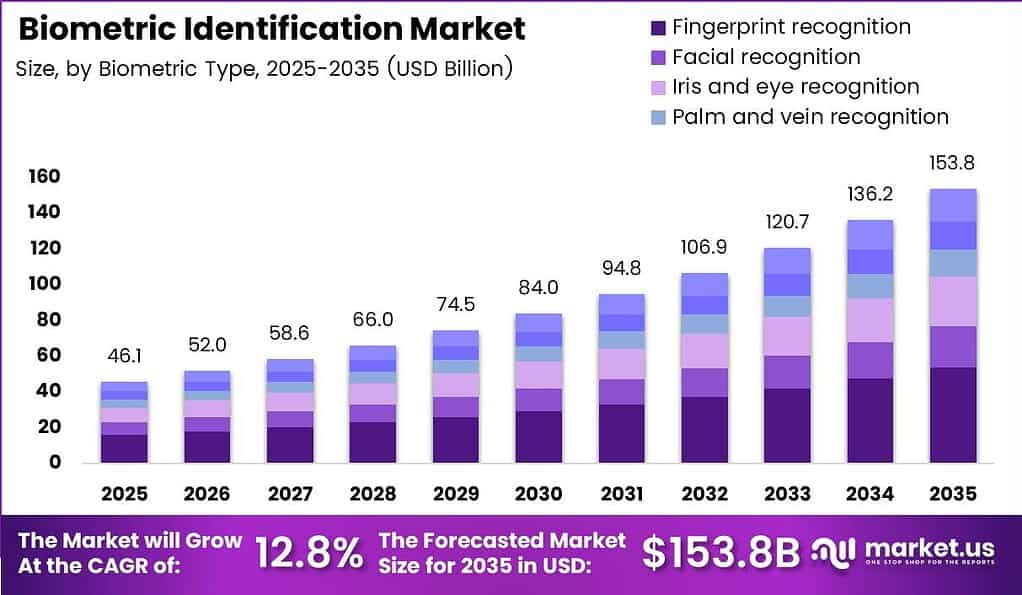
Global Biometric Identification Market size is expected to be worth around USD 153.8 Billion by 2035 from USD 46.1 Billion in 2025, growing at a CAGR of 12.8% during the forecast period 2026 to 2035.
The Biometric Identification Market covers technologies that verify or authenticate individuals using physiological or behavioral traits. This includes fingerprint recognition, facial recognition, iris and eye recognition, palm and vein recognition, voice recognition, and behavioral biometrics. Solutions span hardware, software, and services deployed across government, financial services, healthcare, defense, and consumer electronics.
Key Takeaways
- The global Biometric Identification Market was valued at USD 46.1 Billion in 2025 and is forecast to reach USD 153.8 Billion by 2035.
- The market is growing at a CAGR of 12.8% during the forecast period 2026 to 2035.
- By Biometric Type, Fingerprint Recognition dominates with a 35.00% share.
- By Component, Hardware dominates with an 84.00% share.
- By Contact, Contact-based dominates with a 54.20% share.
- By Device Type, Fixed Systems dominates with a 45.00% share.
- By Application, Physical and Logical Access Control dominates with a 38.00% share.
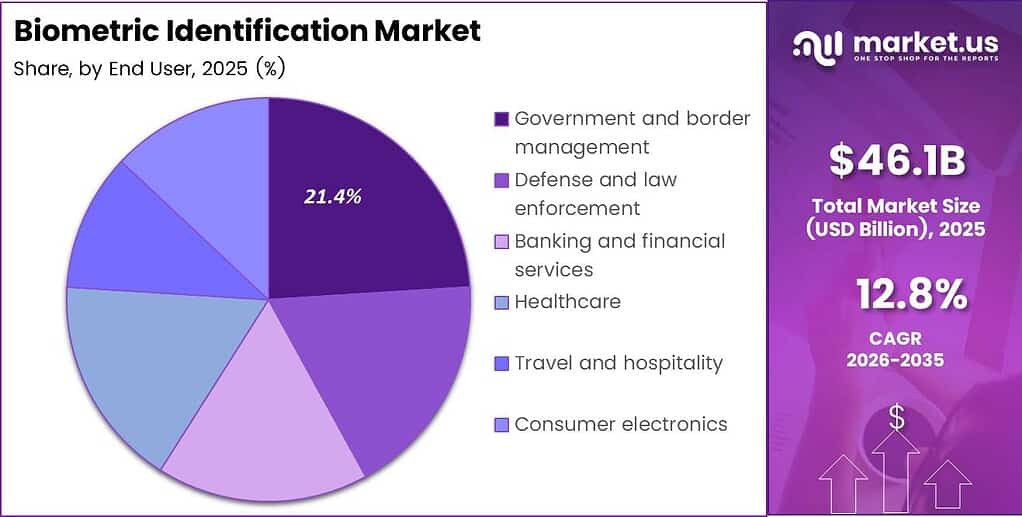
- By End User, Government and Border Management dominates with a 21.40% share.
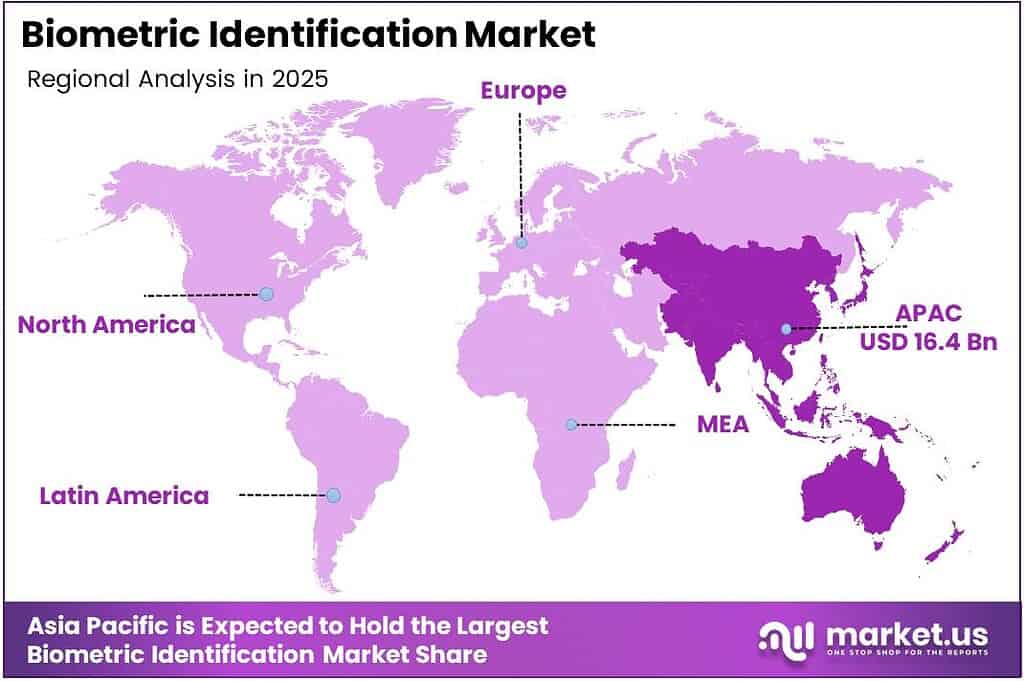
- Asia Pacific is the dominant region with a 35.60% share, valued at USD 16.4 Billion.
As per our research, at least 152 foundational ID systems worldwide now collect biometric data. This scale of deployment confirms that biometric infrastructure has crossed from pilot adoption into institutional standard. Buyers entering this market today are not investing in experimental technology; they are integrating into established sovereign and commercial identity frameworks.
Data from the World Bank ID4D Global Dataset shows approximately 800 million people worldwide still lack an official ID. This unserved population represents a structural demand ceiling for biometric enrollment programs. Governments and development agencies targeting this gap will drive new procurement cycles across Africa, South Asia, and Latin America over the forecast period.
As reported by the World Bank ID4D Global Dataset, at least 2.8 billion people lack access to a government-recognized digital identity for secure online transactions. This gap creates a commercial opportunity for biometric identity platforms that can bridge physical and digital enrollment. The World Bank ID4D Global Dataset also indicates that in October 2024, IDEMIA Secure Transactions partnered with GlobalFoundries to target a 100% European value chain for advanced smart cards by 2026, signaling that supply-chain localization is now a strategic priority alongside enrollment scale.
Biometric Type Analysis
Fingerprint Recognition dominates with 35.00% due to mature infrastructure, low sensor cost, and wide government adoption.
In 2025, Fingerprint Recognition held a dominant market position in the By Biometric Type segment of the Biometric Identification Market, with a 35.00% share. World Bank ID4D Global Dataset data shows that of 134 countries known to collect fingerprint data, 54 use it for verification and authentication. This active deployment base locks in recurring maintenance, hardware refresh, and software licensing revenue for fingerprint solution vendors.
Facial Recognition follows as the second most-deployed modality, driven by contactless processing needs at border checkpoints, airports, and urban access points. Its integration into existing camera infrastructure lowers total deployment cost relative to purpose-built sensor alternatives. Vendors offering cloud-based facial match engines benefit from recurring API revenue as transaction volumes scale.
Iris and Eye Recognition commands a premium position in high-security environments including border control, corrections facilities, and financial vaults where false accept rates must be near zero. Its resistance to spoofing through standard photograph or video replay strengthens its case in regulated environments. Palm and Vein Recognition, Voice Recognition, Behavioral Biometrics, and Others collectively hold the remaining share, each serving specialized verticals where primary modalities face environmental or accuracy constraints.
Component Analysis
Hardware dominates with 84.00% due to the capital-intensive nature of sensor and device deployment.
In 2025, Hardware held a dominant market position in the By Component segment of the Biometric Identification Market, with an 84.00% share. According to the World Bank ID4D Global Dataset, at least 134 of 175 countries issue a permanent ID number, and a large share of these programs require purpose-built enrollment terminals, scanners, and readers. This sovereign demand base sustains high hardware volumes across national ID rollouts and border modernization programs.
Software accounts for a structurally smaller but faster-growing share as vendors shift toward algorithm licensing, cloud inference platforms, and biometric middleware. The transition from hardware-led to software-augmented deployment models improves vendor margins by converting one-time device sales into recurring subscription revenue. This transition rewards vendors who can demonstrate accuracy compliance under NIST testing frameworks.
Services round out the component landscape, covering system integration, managed operations, training, and post-deployment support. As biometric systems expand into complex multi-agency and cross-border environments, integration services become a critical revenue layer. Vendors with deep government delivery track records hold a structural bid advantage in large-scale program tenders.
Contact Analysis
Contact-based dominates with 54.20% due to established fingerprint infrastructure across government and enterprise deployments.
In 2025, Contact-based systems held a dominant market position in the By Contact segment of the Biometric Identification Market, with a 54.20% share. The installed base of fingerprint readers in border control, law enforcement, and workforce management creates a durable revenue floor that contactless entrants must displace rather than simply compete against. Hardware refresh cycles within this installed base generate predictable procurement volume.
Contactless biometric systems are gaining structured adoption as hygiene awareness, throughput speed, and user experience requirements push buyers toward non-touch modalities. According to the UK Government Digital Identity Sectoral Analysis 2025, 79% of surveyed users identified privacy as an important factor and 79% identified security as equally important in adopting digital identity services. These twin priorities favor contactless systems that eliminate physical interaction points and reduce cross-contamination concerns in high-volume environments such as airports and hospitals.
Device Type Analysis
Fixed Systems dominates with 45.00% due to entrenched deployment in border control, government facilities, and enterprise access points.
In 2025, Fixed Systems held a dominant market position in the By Device Type segment of the Biometric Identification Market, with a 45.00% share. These systems anchor national infrastructure programs because they deliver consistent throughput, network connectivity, and tamper resistance that mobile alternatives cannot replicate at scale. Long-term government contracts built around fixed system architectures sustain multi-year hardware and software revenue streams.
Mobile Devices and Tablets represent the fastest-shifting device category as field agents, bank branches, and healthcare workers require portable enrollment and verification capabilities. As per our research, 75% of surveyed users reported faster transactions with digital identity than physical ID for popular use cases, validating the commercial case for mobile-first biometric deployment in service-facing roles. This speed advantage drives adoption in financial onboarding and telecom subscriber registration across emerging markets.
Personal Computers support biometric authentication in enterprise logical access and remote workforce identity verification, particularly as passwordless login mandates expand across regulated sectors. Wearables occupy an early-stage position in the device mix, with commercial traction limited to niche industrial, healthcare, and payments applications. As sensor miniaturization lowers cost and power consumption, wearable biometrics will expand their addressable use cases over the forecast horizon.
Application / Function Analysis
Physical and Logical Access Control dominates with 38.00% due to broad enterprise and government deployment of entry management systems.
In 2025, Physical and Logical Access Control held a dominant market position in the By Application segment of the Biometric Identification Market, with a 38.00% share. This application layer spans facility entry gates, server room authentication, and network login systems across corporate campuses, government buildings, and critical infrastructure sites. The dual physical-logical requirement creates bundled hardware and software contract opportunities that raise average deal value above single-mode deployments.
Payment Authentication is expanding as financial institutions replace PIN and card-present transactions with biometric confirmation at point-of-sale and within mobile banking apps. UK Government Digital Identity Sectoral Analysis 2025 data shows 69% of UK digital identity providers offered identity or attribute-verification services and 54% offered document-based verification, indicating a mature supplier ecosystem already structured to serve financial authentication workflows. This density of capable providers accelerates competitive pricing but also drives faster buyer adoption.
Identity Verification serves digital onboarding workflows across banking, telecommunications, insurance, and e-commerce, where remote customer acquisition creates document fraud exposure without biometric confirmation. As per our research, 50% of UK digital identity providers offered identity-management services and 45% offered biometrics and liveness solutions, reflecting the operational complexity buyers face when sourcing full-stack identity programs. Time and Attendance Tracking holds the remaining application share, serving workforce management programs across manufacturing, logistics, and public-sector payroll environments where buddy-punching fraud drives biometric investment.
End User Analysis
Government and Border Management dominates with 21.40% due to sovereign mandate programs and national security investment priorities.
In 2025, Government and Border Management held a dominant market position in the By End User segment of the Biometric Identification Market, with a 21.40% share. World Bank ID4D Global Dataset research indicates women in low-income countries are 5.1 percentage points less likely than men to have an ID, highlighting an inclusion gap that expands the procurement case for accessible biometric enrollment infrastructure. Governments addressing this disparity require additional fixed enrollment stations, mobile enrollment units, and agent-network support contracts.
Defense and Law Enforcement represent the second-largest end-user cluster, deploying biometric systems for criminal identification, field identity checks, and secure facility access across military and intelligence installations. As per our research, 39% of adults in low-income countries without ID cite high cost as the primary barrier, which reinforces the argument that government-subsidized or donor-funded enrollment programs will anchor procurement budgets in these geographies rather than private-sector channels.
Banking and Financial Services is a high-growth end-user segment as fraud losses from synthetic identity attacks accelerate investment in biometric onboarding and transaction confirmation. According to the UK Government Digital Identity Sectoral Analysis 2025, 85% of UK digital identity providers served financial-services customers, confirming that financial institutions are the dominant commercial buyer in mature identity markets. Healthcare, Travel and Hospitality, Consumer Electronics, and Others hold the remaining share. As per our research, 44% of surveyed respondents had used a digital identity service and 71% reported at least some understanding of digital identity, signaling growing consumer familiarity that will support biometric adoption in consumer-facing verticals over the forecast period.
Key Market Segments
By Biometric Type
- Fingerprint Recognition
- Facial Recognition
- Iris and Eye Recognition
- Palm and Vein Recognition
- Voice Recognition
- Behavioral Biometrics
- Others
By Component
- Hardware
- Software
- Services
By Contact
- Contact-based
- Contactless
By Device Type
- Fixed Systems
- Mobile Devices and Tablets
- Personal Computers
- Wearables
By Application / Function
- Physical and Logical Access Control
- Payment Authentication
- Identity Verification
- Time and Attendance Tracking
By End User
- Government and Border Management
- Defense and Law Enforcement
- Banking and Financial Services
- Healthcare
- Travel and Hospitality
- Consumer Electronics
- Others
Regional Analysis
Asia Pacific Dominates the Biometric Identification Market with a Market Share of 35.60%, Valued at USD 16.4 Billion
Asia Pacific commands the largest regional share in the Biometric Identification Market at 35.60%, valued at USD 16.4 Billion in 2025. Government-led national ID programs across India, China, and Southeast Asia create recurring procurement cycles for enrollment hardware, biometric middleware, and managed identity services. The scale and frequency of these sovereign programs position Asia Pacific as the anchor revenue region for global biometric vendors throughout the forecast period.
North America represents the fastest-growing regional market outside Asia Pacific, driven by federal investment in border modernization and enterprise adoption of passwordless authentication across financial services and healthcare. According to the U.S. Department of Homeland Security, the IDENT system holds more than 320 million unique identities and processes more than 400,000 biometric transactions per day. This volume confirms North America’s position as the world’s largest single operational biometric infrastructure deployment, creating a durable hardware refresh and software upgrade pipeline for incumbent vendors.
Europe presents a structurally bifurcated opportunity shaped by the European AI Act. The Act entered into force on 1 August 2024, with prohibited-practice provisions effective from 2 February 2025, narrowing the addressable perimeter for public-space surveillance deployments. This creates constraint in centralized law-enforcement programs but leaves enterprise, border, and identity-verification applications largely intact. According to the UK Government Digital Identity Sectoral Analysis 2025, 266 firms operated in the UK digital identity market as of March 2025, with 227 dedicated providers and 39 diversified firms. UK digital identity firms generated £2.113 Billion in revenue and £888 Million in gross value added in 2023/2024, employing 10,246 full-time-equivalent workers, with sector employment growing at an average of 11.7% annually between 2020 and 2024.
Key Regions and Countries
North America
- US
- Canada
Europe
- Germany
- France
- The UK
- Spain
- Italy
- Rest of Europe
Asia Pacific
- China
- Japan
- South Korea
- India
- Australia
- Rest of APAC
Latin America
- Brazil
- Mexico
- Rest of Latin America
Middle East and Africa
- GCC
- South Africa
- Rest of MEA
Market Dynamics
Market Opportunity Analysis - Underserved end users, contactless adoption gaps, and mobile-first emerging markets offer high-return entry points for focused biometric vendors
The Consumer Electronics end-user segment presents a structurally underexploited opportunity despite growing user familiarity with digital identity services. The segment trails Government, Defense, and Financial Services in biometric adoption intensity relative to the scale of its addressable user base. Vendors who build lightweight, privacy-compliant biometric SDKs optimized for consumer device integration can capture recurring software licensing revenue without competing directly against sovereign program incumbents.
The Contactless sub-segment within the By Contact category holds meaningful expansion headroom relative to its current position below Contact-based systems. Enterprise buyers in healthcare, retail, and hospitality have a clear hygiene and throughput justification for contactless migration, but integration complexity and legacy reader infrastructure slow transition timelines. Vendors offering managed migration paths from contact to contactless architectures reduce switching friction and position themselves for multi-year upgrade contracts.
The Travel and Hospitality end-user vertical sits at an early-stage adoption phase relative to the scale of cross-border traveler volumes documented in the data. Hotel chains, airlines, and cruise operators face growing passenger throughput requirements without the sovereign procurement budgets of border agencies. This creates an opening for modular, subscription-priced biometric identity platforms sized for hospitality infrastructure rather than government-grade deployments.
Wearable devices remain the most underpenetrated device category in the current market structure. Industrial and healthcare settings require hands-free identity confirmation that fixed terminals and mobile devices cannot efficiently serve. Vendors investing in ruggedized wearable biometric readers for manufacturing and logistics corridors access a buyer segment with a documented compliance need, limited incumbent competition, and willingness to pay for operational efficiency gains.
Technology and Innovation Landscape - Liveness detection, edge inference, multimodal fusion, and post-quantum security define the next competitive frontier in biometric identification
Presentation-attack detection is the most commercially urgent technology frontier in the Biometric Identification Market. Generative AI tools have reduced the cost and technical skill required to produce synthetic face, voice, and document spoofs that defeat single-layer biometric checks. Vendors who deploy passive liveness combined with active challenge-response and behavioral signal fusion reduce false-accept rates without adding session latency that degrades conversion in high-volume digital onboarding flows.
Edge-compute biometric inference is emerging as a critical capability for deployments in emerging markets, remote border posts, and industrial environments with unreliable connectivity. Processing biometric match operations on-device or at local edge nodes eliminates round-trip latency to cloud inference engines and removes data-transmission exposure in jurisdictions with strict biometric data-localization requirements. Vendors with optimized on-device model architectures hold a structural advantage in these constrained-connectivity segments.
Multimodal biometric fusion combines two or more modalities, such as face plus iris or fingerprint plus behavioral signals, to raise match confidence above what any single modality achieves alone. This approach directly addresses demographic performance validation requirements by compensating for single-modality accuracy gaps across age groups, skin tones, and environmental conditions. Regulated government and financial-services buyers who require documented equal-error-rate parity across demographic cohorts will increasingly specify multimodal architectures as a procurement requirement rather than an optional enhancement.
Post-quantum cryptographic protection for biometric templates is transitioning from research priority to near-term commercial requirement as national standards bodies finalize algorithm recommendations. IDEMIA Secure Transactions announced in February 2025 the first offline CBDC payment transaction designed to resist quantum-computing threats, confirming that leading vendors are already embedding quantum-resistant security into production financial identity products. Vendors who achieve post-quantum template protection certification first will hold a defensible compliance advantage in critical-infrastructure and central-bank digital currency programs over the long-term horizon.
Drivers
Governments worldwide are converting airport, land-border, visa, and port-of-entry workflows from document-centric inspection to biometric verification. Rising cross-border traveler volumes, identity fraud exposure, and screening throughput constraints make manual processing increasingly uneconomic. A facial-comparison transaction completes in seconds, while reusable biometric galleries lower repeat-enrollment cost and enable recurring software, maintenance, and hardware-refresh revenue. This driver contributes an estimated +2.1% incremental CAGR through higher deployment density and contract renewal visibility.
Digital identity rollout programs across India, Southeast Asia, Africa, and Latin America are accelerating biometric infrastructure procurement as governments expand financial inclusion and e-government access. Fraud-resistant financial onboarding is driving adoption across emerging-market banks and telecom operators, contributing a combined estimated +3.4% to the CAGR through hardware deployment cycles and recurring per-transaction verification revenue. Workforce access modernization and mobile multimodal authentication add a further estimated +2.1%, as enterprises replace legacy access cards with biometric alternatives and consumer devices embed multiple authentication modalities.
| Driver | (~) % Impact on CAGR Forecast | Geographic Relevance | Impact Timeline |
|---|---|---|---|
| Border-control biometric expansion | +2.1% | North America, Europe, Gulf states, Asia-Pacific | Short term (≤ 2 years) |
| Digital identity rollout acceleration | +1.8% | India, Southeast Asia, Africa, Latin America | Short term (≤ 2 years) |
| Fraud-resistant financial onboarding | +1.6% | Global, strongest in emerging markets | Short term (≤ 2 years) |
| Workforce access modernization | +1.1% | North America, Europe, East Asia | Medium term (2–4 years) |
| Mobile multimodal authentication | +1.0% | Global consumer and enterprise markets | Medium term (2–4 years) |
| NIST-tested accuracy improvements | +0.8% | Global, especially regulated deployments | Medium term (2–4 years) |
Restraints
The most immediate sales constraint in the Biometric Identification Market is the narrowing legal perimeter for remote biometric identification in public spaces. The European AI Act entered into force on 1 August 2024, with prohibited-practice provisions effective from 2 February 2025. These restrictions include broad limits on real-time remote biometric identification for law enforcement in publicly accessible spaces, reducing hardware volumes and elongating revenue-recognition cycles by roughly 6 to 18 months for affected public procurements.
Privacy litigation exposure and public-sector procurement freezes compound this regulatory headwind across North America and fiscal-constrained emerging markets. Consent-management deployment costs and cross-border data localization requirements add further drag in Europe, India, and Southeast Asia. Legacy identity-system lock-in in global public-sector deployments slows migration timelines and delays contract awards. The estimated combined CAGR deduction from these restraints reaches -6.9%, reflecting lost or deferred high-value deployments and margin compression as vendors fund compliance configurations without equivalent pricing power.
| Restraint | (~) % Impact on CAGR Forecast | Geographic Relevance | Impact Timeline |
|---|---|---|---|
| Restricted remote biometric surveillance | -2.0% | European Union and aligned jurisdictions | Short term (≤ 2 years) |
| Privacy litigation exposure | -1.5% | North America, Europe, selected Asia-Pacific markets | Short term (≤ 2 years) |
| Public-sector procurement freezes | -1.1% | Fiscal-constrained emerging and developed markets | Short term (≤ 2 years) |
| Consent-management deployment costs | -0.9% | Europe, India, North America | Medium term (2–4 years) |
| Cross-border data localization | -0.8% | India, China, Middle East, Southeast Asia | Medium term (2–4 years) |
| Legacy identity-system lock-in | -0.6% | Global public-sector deployments | Medium term (2–4 years) |
Challenges
Generative artificial intelligence is increasing the sophistication and availability of spoofing attempts using synthetic faces, injected video streams, face swaps, and voice-cloning-assisted account takeover. Biometric providers must continuously retrain models, add liveness layers, and operate fraud-review escalation paths to maintain security standards. A solution that adds even 1 to 3 seconds to a digital identity session or raises manual-review rates by 2 to 5 percentage points weakens conversion economics for high-volume lenders and digital wallets.
Demographic performance validation and fragmented interoperability standards create further systemic drag. Regulated buyers require documented accuracy parity across demographic cohorts before approving production deployment, extending sales cycles. Edge-compute power constraints limit biometric performance in distributed emerging-market installations, while specialist talent scarcity and biometric template lifecycle management add long-term operational cost. The estimated combined CAGR friction from these challenges reaches -6.5%, capturing higher research-and-development expenditure, model release frequency, and customer-specific threshold tuning costs.
| Challenge | (~) % CAGR Friction Drag | Geographic Relevance | Mitigation Horizon |
|---|---|---|---|
| Deepfake presentation-attack resilience | -1.7% | Global digital onboarding markets | Medium term (2–4 years) |
| Demographic performance validation | -1.3% | Global regulated and public-sector markets | Medium term (2–4 years) |
| Fragmented interoperability standards | -1.1% | Global, strongest across government systems | Long term (≥ 4 years) |
| Edge-compute power constraints | -0.9% | Emerging markets and distributed deployments | Medium term (2–4 years) |
| Specialist talent scarcity | -0.8% | North America, Europe, India, East Asia | Long term (≥ 4 years) |
| Biometric template lifecycle management | -0.7% | Global enterprise and government markets | Long term (≥ 4 years) |
Opportunities
Reusable verified-identity networks remain largely untapped because biometric onboarding is still purchased as a separate verification event by each bank, telecom operator, marketplace, or public-service portal. A consent-based network where a user-held credential can be reused across eligible relying parties changes unit economics from low-margin one-off checks to recurring platform revenue. A provider able to reduce repeated full onboarding events by 40 to 70% can improve gross-margin potential by an estimated 5 to 12 percentage points at scale.
Privacy-preserving biometric credentials and healthcare patient identity orchestration offer structured expansion paths in Europe, North America, and the Gulf states. Age-assurance identity services represent a near-term revenue stream as legislation in Europe, the United Kingdom, and Australia mandates age verification for digital platforms, creating a short-term execution window estimated at +1.3% CAGR upside. Industrial frontline identity platforms and post-quantum template security round out the opportunity set, with post-quantum adding an estimated +0.8% CAGR potential for vendors targeting critical-infrastructure markets over a long-term horizon.
| Opportunity | (~) % Potential CAGR Upside | Geographic Relevance | Execution Window |
|---|---|---|---|
| Reusable verified-identity networks | +2.3% | India, Southeast Asia, Africa, Latin America, Europe | Medium term (2–4 years) |
| Privacy-preserving biometric credentials | +1.8% | Europe, North America, advanced Asia-Pacific markets | Medium term (2–4 years) |
| Healthcare patient identity orchestration | +1.5% | North America, Europe, Gulf states, India | Medium term (2–4 years) |
| Age-assurance identity services | +1.3% | Europe, United Kingdom, Australia, North America | Short term (≤ 2 years) |
| Industrial frontline identity platforms | +1.1% | Manufacturing hubs and logistics corridors | Medium term (2–4 years) |
| Post-quantum template security | +0.8% | Global critical-infrastructure markets | Long term (≥ 4 years) |
Key Company Insights
IDEMIA reported more than €2.8 Billion in revenue in 2024, backed by 12,500 employees including 3,000 R&D engineers, €1 Billion in R&D investment over five years, and more than 1,500 active patent families across 6 continents. In January 2024, IDEMIA reorganized into three divisions: IDEMIA Secure Transactions, IDEMIA Public Security, and IDEMIA Smart Identity. This restructuring sharpens commercial focus and creates division-level accountability for revenue and margin performance.
IDEMIA Public Security employs more than 3,800 people and has issued more than 60 Million smart credentials in the Americas. IDEMIA Smart Identity has issued 3.5 Billion identity documents across 79 countries, employing 1,880 people in 40 countries. In October 2024, IDEMIA Secure Transactions invested more than €20 Million in a new Vitré, France infrastructure site employing 500 people, reinforcing its European manufacturing capability ahead of sovereign supply-chain mandates.
NEC Corporation positions itself as a tier-one competitor in government biometric programs through deep integration with national civil registration, law enforcement, and border management systems across Asia Pacific, Europe, and the Americas. NEC’s biometric algorithm performance under independent NIST testing provides a verifiable accuracy credential that government procurement officers require before awarding large-scale identity contracts. This independently validated accuracy record creates a repeatable bid advantage in regulated markets where self-certification carries no procurement weight.
Key Players
- IDEMIA
- NEC Corporation
- Thales Group
- HID Global Corporation
- Fujitsu Limited
- Entrust Corporation
- Aware, Inc.
- Suprema Inc.
- Cognitec Systems GmbH
- DERMALOG Identification Systems GmbH
- Innovatrics, s.r.o.
- Daon, Inc.
- BIO-key International, Inc.
- Fingerprint Cards AB
- M2SYS Technology
Recent Developments
- February 2025 – IDEMIA Secure Transactions announced the first offline CBDC payment transaction designed to resist quantum-computing threats, signaling a pivot toward post-quantum financial infrastructure that positions the division ahead of central bank digital currency deployment timelines.
- February 2025 – IDEMIA Secure Transactions partnered with Telefónica to develop quantum-computer-resilient IoT solutions, extending biometric and secure-transaction capabilities into connected device ecosystems across Telefónica’s global network footprint.
- February 2025 – IDEMIA Secure Transactions and Vantiva collaborated on advanced eSIM technology for 5G fixed-wireless-access services, combining secure identity provisioning with next-generation connectivity infrastructure for enterprise and consumer endpoints.
Report Scope
| Report Features | Description |
|---|---|
| Market Value (2025) | USD 46.1 Billion |
| Forecast Revenue (2035) | USD 153.8 Billion |
| CAGR (2026-2035) | 12.8% |
| Base Year for Estimation | 2025 |
| Historic Period | 2020-2024 |
| Forecast Period | 2026-2035 |
| Report Coverage | Revenue Forecast, Market Dynamics, Market Opportunity Analysis, Technology and Innovation Landscape, Competitive Landscape, Recent Developments |
| Segments Covered | By Biometric Type (Fingerprint Recognition, Facial Recognition, Iris and Eye Recognition, Palm and Vein Recognition, Voice Recognition, Behavioral Biometrics, Others), By Component (Hardware, Software, Services), By Contact (Contact-based, Contactless), By Device Type (Fixed Systems, Mobile Devices and Tablets, Personal Computers, Wearables), By Application / Function (Physical and Logical Access Control, Payment Authentication, Identity Verification, Time and Attendance Tracking), By End User (Government and Border Management, Defense and Law Enforcement, Banking and Financial Services, Healthcare, Travel and Hospitality, Consumer Electronics, Others) |
| Regional Analysis | North America (US and Canada), Europe (Germany, France, The UK, Spain, Italy, and Rest of Europe), Asia Pacific (China, Japan, South Korea, India, Australia, and Rest of APAC), Latin America (Brazil, Mexico, and Rest of Latin America), Middle East and Africa (GCC, South Africa, and Rest of MEA) |
| Competitive Landscape | IDEMIA, NEC Corporation, Thales Group, HID Global Corporation, Fujitsu Limited, Entrust Corporation, Aware, Inc., Suprema Inc., Cognitec Systems GmbH, DERMALOG Identification Systems GmbH, Innovatrics, s.r.o., Daon, Inc., BIO-key International, Inc., Fingerprint Cards AB, M2SYS Technology |
| Customization Scope | Customization for segments, region/country-level will be provided. Additional customization can be done based on requirements. |
| Purchase Options | We have three licenses to opt for: Single User License, Multi-User License (Up to 5 Users), Corporate Use License (Unlimited User and Printable PDF) |