Report Overview
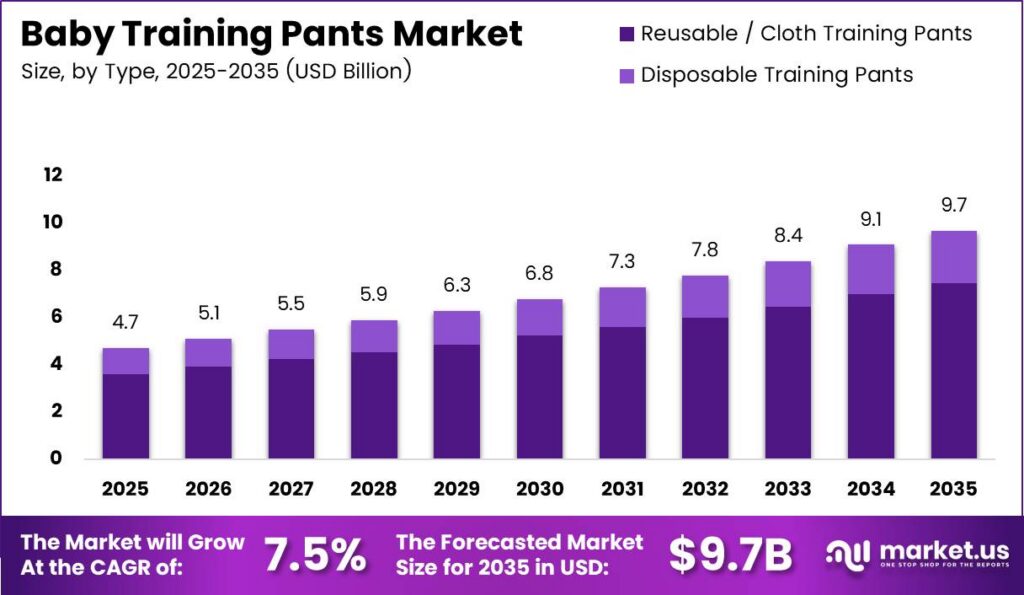
Global Baby Training Pants Market size is expected to be worth around USD 9.7 Billion by 2035 from USD 4.7 Billion in 2025, growing at a CAGR of 7.5% during the forecast period 2026 to 2035. Baby training pants are pull-on absorbent garments that help toddlers transition from infant diapers to regular underwear during potty training. These products use elastic waistbands and moisture liners to let children dress independently while preventing accidental leaks.
The market structure divides into high-volume disposable lines and washable cloth formats serving household retail, commercial daycares, and pediatric institutions. According to CDC National Center for Health Statistics (NCHS), the United States recorded 3,612,012 live births in 2025, while the general fertility rate dropped 1% to 53.2 births per 1,000 women ages 15 to 44. Consequently, smaller annual birth cohorts force hygiene producers to extract higher revenue per child through premium training pants.
Key Takeaways
- The global Baby Training Pants Market was valued at USD 4.7 Billion in 2025.
- Global market revenue will reach USD 9.7 Billion by 2035.
- The market will expand at a CAGR of 7.5% during the forecast period from 2026 to 2035.
- In the Size segment, the Medium sub-segment held a dominant 53.23% market share in 2025, while Extra Large is the fastest-growing category.
- In the Type segment, Reusable / Cloth Training Pants captured a leading 76.78% share in 2025 and represent the fastest-growing product type.
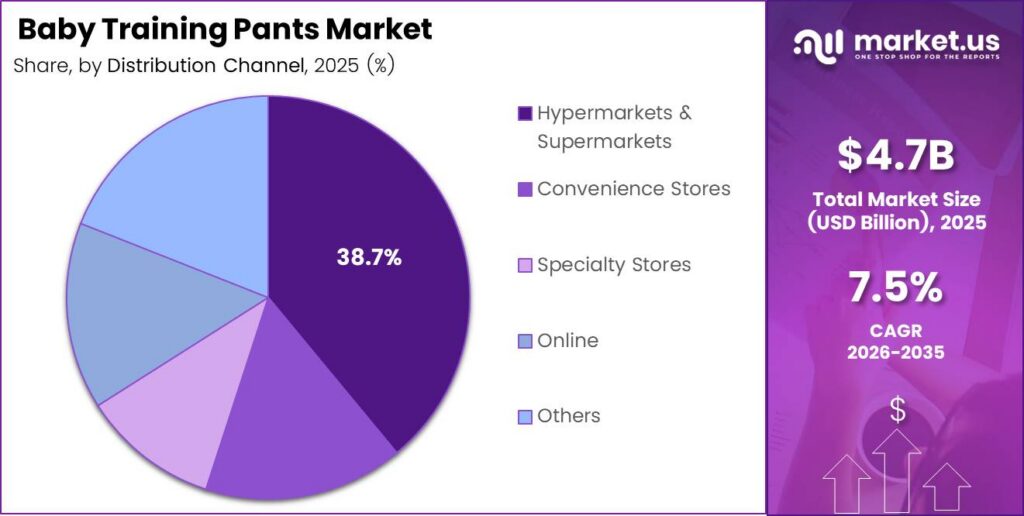
- In the Distribution Channel segment, Hypermarkets & Supermarkets accounted for a 38.78% share in 2025, while Online serves as the fastest-growing channel.
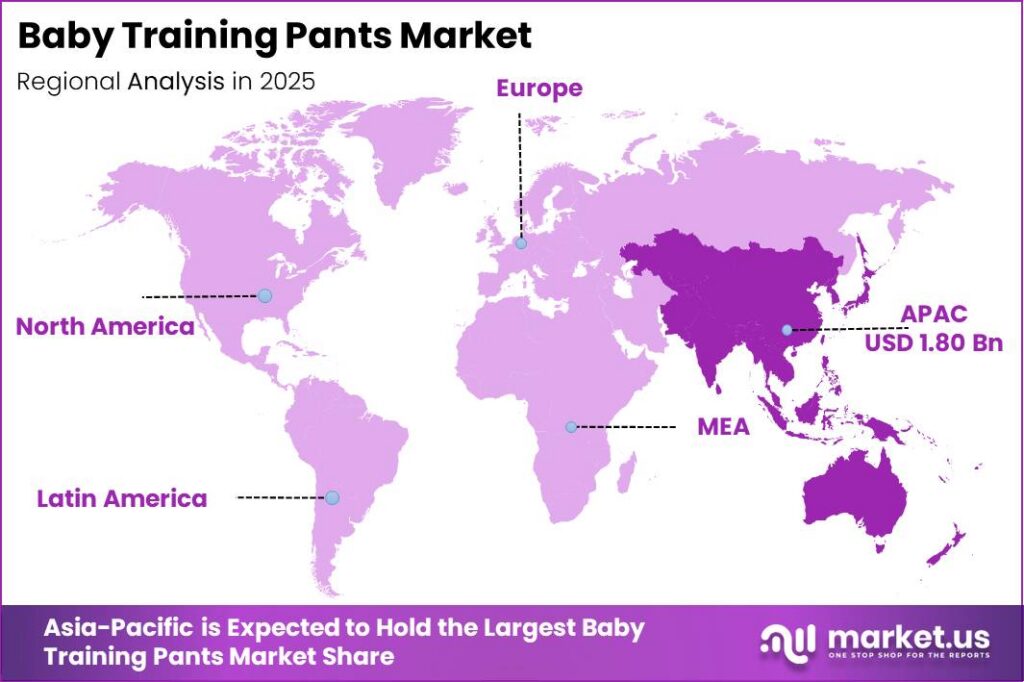
- Asia-Pacific led the global market in 2025 with a 38.56% share valued at USD 1.80 Billion, whereas Middle East & Africa is the fastest-growing region.
Public family policies, municipal waste rules, and childcare subsidies directly shape product adoption across developed economies. As reported by Eurostat, births in the European Union fell by 3.3% from 3.67 million in 2023 to 3.55 million in 2024, putting the total fertility rate at 1.34 live births per woman . Therefore, European governments are expanding subsidized public daycare spots, which requires parents to buy pull-on training pants that meet institutional independence rules.
Corporate consolidation is reshaping how personal care leaders bundle toddler hygiene and skin health products across global retail pharmacies. In November 2026, a major personal care group completed a USD 48.7 billion acquisition of a global consumer health company, uniting 10 billion-dollar brands and targeting USD 2.1 billion in annual run-rate synergies within 3 years. This signals that hygiene conglomerates are combining baby skin lotions with training pants to defend shelf space against private-label rivals.
Asia-Pacific leads global consumption and holds a 38.56% market share in 2025, supported by massive toddler populations and expanding urban retail networks. Data from UNICEF shows that over 500 million children under age 5 globally had their births registered over the past 5 years, while 150 million children remain unregistered . Consequently, improving civil registration and maternal healthcare access across developing Asian nations brings millions of toddlers into formal retail channels for hygiene products.
Private equity firms and consumer brand aggregators are also targeting digitally native diaper startups that capture high-income urban households. In October 2025, a consumer goods parent company acquired a premium baby care brand in a deal valued at over USD 1 billion after the brand passed USD 200 million in annual net sales with 60% yearly growth. This creates pressure on legacy producers to launch ultra-soft, hypoallergenic training pants before challenger brands lock in subscription buyers.
Size Analysis
Medium dominates with 53.23% share in 2025 due to standard toddler potty-training onset weights.
In 2025, Medium held a 53.23% share in the Size segment of the Baby Training Pants Market. World Health Organization (WHO) found that 24-month-old toddler boys have a median weight of 12.2 kg, with the 3rd to 97th percentiles spanning 9.8 kg to 15.1 kg . Most children begin active bladder control at age 2, which requires elastic side panels calibrated to this exact torso weight range. Therefore, retailers must allocate over half of their shelf space to medium packs to prevent stockouts.
The Small sub-segment serves infants and early walkers who begin daytime toilet familiarization around their first birthday. Based on World Health Organization (WHO) data, 12-month-old infants record a median weight of 9.6 kg for boys, ranging from 7.7 kg to 12.0 kg, and 8.9 kg for girls . Early mobility requires narrower leg cuffs and lower waist rises so garments do not slip during crawling or early walking. Consequently, brands use small sizes as customer acquisition tools to lock parents into brand ecosystems early.
The Large sub-segment accommodates older toddlers between ages 3 and 4 who need higher fluid retention during nighttime sleep. World Health Organization (WHO) indicates that 36-month-old boys reach a median weight of 14.3 kg, with the 15th to 85th percentiles ranging from 12.7 kg to 16.3 kg . Heavier body mass produces larger bladder void volumes, which requires thicker superabsorbent polymer cores and reinforced tear-away side seams. This means manufacturers can charge higher unit prices per pant to offset increased raw material usage.
Type Analysis
Reusable / Cloth Training Pants dominates with 76.78% share in 2025 due to repeat washability and household cost savings.
In 2025, Reusable / Cloth Training Pants held a 76.78% share in the Type segment of the Baby Training Pants Market. Figures from Office of Textiles and Apparel (OTEXA) and International Trade Centre (ITC) show that cotton apparel reached 39.9% of U.S. apparel import volume in 2025 at USD 3.59 per square meter equivalent . In September 2025, Splash About acquired 25-year-old reusable brand Bambino Mio after an 8-month profit turnaround . Brushed cotton layers retain slight wetness against skin to accelerate potty learning, letting brands capture high upfront margins.
The Disposable Training Pants sub-segment provides single-use convenience for travel, commercial daycares, and overnight containment. According to UN Comtrade, global trade in HS Code 9619 diapers and sanitary articles reached USD 14.77 billion and 3,399.74 kilotons in 2024, reflecting a 2.3% volume increase . In December 2025, Ontex Group NV tripled its North American baby pants production capacity across 2 plants to meet 8% annual demand growth . High-speed ultrasonic side-seam bonding lowers unit conversion costs, enabling private-label manufacturers to win mass-merchandise contracts.
Disposable and cloth product lines increasingly overlap as parents combine daytime washable underwear with nighttime single-use pull-ups. While cloth garments rely on multi-layer terry fabrics and thermoplastic polyurethane waterproofing, disposable formats depend on wood fluff pulp and nonwoven polypropylene webs. This dual-usage pattern protects category revenue across income brackets because budget-conscious families buy cloth packs for home use while purchasing smaller disposable packs for outings. Therefore, suppliers that offer both textile and nonwoven formats capture a higher share of toddler hygiene spending.
Distribution Channel Analysis
Hypermarkets & Supermarkets dominates with 38.78% share in 2025 due to one-stop household grocery shopping habits.
In 2025, Hypermarkets & Supermarkets held a 38.78% share in the Distribution Channel segment of the Baby Training Pants Market. As reported by US Census Bureau, U.S. grocery and supermarket sales reached USD 77.15 billion in September 2026 and USD 683.44 billion over the first 9 months of 2026, rising 1.0% year-over-year . Parents buy bulky training pant boxes during weekly food trips to inspect sizing and redeem instant shelf coupons. Therefore, manufacturers must fund end-cap promotions and multi-count club boxes to defend supermarket shelf space.
The Convenience Stores sub-segment serves emergency, single-pack purchases for families traveling or running out of supplies between grocery trips. Data from US Census Bureau shows that U.S. gasoline station and convenience store sales jumped 21.0% year-over-year to USD 62.3 billion in August 2026 and rose 6.4% month-over-month in September 2026, capturing 8.1% of retail sales . Limited shelf depth in neighborhood stores requires compact, flexible polybags containing 3 to 5 pants. Consequently, suppliers earn higher per-unit gross margins on travel packs sold through convenience chains.
The Specialty Stores sub-segment includes baby boutiques, children’s apparel chains, and pharmacies that curate organic cloth and dermatologist-tested training pants. US Census Bureau found that U.S. clothing specialty store sales grew 5.0% year-over-year in September 2026, whereas health and personal care store sales dipped 1.2% . First-time parents visit specialty baby retailers for tactile fabric comparisons and expert fitting advice on reusable training underwear. This means premium cloth brands should prioritize baby apparel chains over traditional drugstores to maximize full-price sell-through.
Key Market Segments
By Size
- Medium
- Small
- Large
- Extra Large
By Type
- Reusable / Cloth Training Pants
- Disposable Training Pants
By Distribution Channel
- Hypermarkets & Supermarkets
- Convenience Stores
- Specialty Stores
- Online
- Others
Regional Analysis
Asia-Pacific Dominates the Baby Training Pants Market with a Market Share of 38.56% in 2025, Valued at USD 1.80 Billion
Asia-Pacific leads global revenue with a 38.56% market share valued at USD 1.80 Billion in 2025. Based on UNICEF data, the East Asia and Pacific region is home to nearly 490 million children under age 18 in 2025, representing the world’s largest youth base . Rapid urbanization and rising dual-income female employment across China, India, and Southeast Asia are replacing split-pants habits with modern pull-on training pants. Consequently, global hygiene manufacturers must localize nonwoven converting plants in Asia to reduce regional distribution costs.
Middle East & Africa is the fastest-growing region during the forecast period due to expanding birth cohorts and modernizing retail infrastructure. World Bank indicates that the population across the Middle East, North Africa, Afghanistan, and Pakistan reached 828,025,185 in 2025 with 1.8% annual growth, while Sub-Saharan Africa recorded 33 live births per 1,000 people . Expanding supermarket chains and rising urban incomes in Gulf and African cities are shifting parents toward packaged hygiene goods. Therefore, early entrants offering affordable mid-tier packs will capture long-term regional market share.
Key Regions and Countries
North America
- US
- Canada
Europe
- Germany
- France
- The UK
- Spain
- Italy
- Rest of Europe
Asia Pacific
- China
- Japan
- South Korea
- India
- Australia
- Rest of APAC
Latin America
- Brazil
- Mexico
- Rest of Latin America
Middle East and Africa
- GCC
- South Africa
- Rest of MEA
Market Dynamics
Environmental waste rules, raw material costs, and household purchasing power govern the competitive balance between disposable and cloth training pants. Figures from US Environmental Protection Agency (US EPA) show that disposable diapers generated 4.1 million tons of U.S. municipal solid waste, representing 1.4% of all 292.4 million tons of waste with 0% recycling . Because landfill fees and plastic taxes are rising, manufacturers must invest in washable textiles and plant-based absorbent cores to protect retail listings.
Drivers
Parents are increasingly choosing training pants based on skin comfort rather than simple liquid containment. In January 2026, Kimberly-Clark reviewed its 2025 rollout of dermatologist-approved Pull-Ups Skin Essentials with a 100% breathable cover, while linking South Korean skin-health premiumization to a 60-basis-point annual share gain. Shifting 3 percentage points of annual sales toward products with a 20% price premium adds 0.60 percentage points to revenue growth. Consequently, brands that validate hypoallergenic claims can expand revenue even when birth rates flatten.
Scenario estimates bounded at November 2026 treat table impacts as embedded components within the 7.5% baseline CAGR rather than separate additions. Drivers total +1.80 percentage points, restraints total -1.20 percentage points, and challenges represent -0.80 percentage points of friction drag. Only the +1.00 percentage point opportunity envelope is incremental, which creates a conditional upper growth case of 8.5%. Therefore, investors should back manufacturers that pair breathable materials with tiered retail shelf architecture to capture premium trade-up spending.
| Driver | (~) % Impact on CAGR Forecast | Geographic Relevance | Impact Timeline |
|---|---|---|---|
| Skin-health premiumization | +0.60% | North America; East Asia; Western Europe | Short term (≤ 2 years) |
| Underwear-like independent changing | +0.45% | Global urban toddler households | Short term (≤ 2 years) |
| Existing retail assortment expansion | +0.30% | Asia-Pacific; Latin America | Medium term (2–4 years) |
| Toddler-engagement character designs | +0.25% | North America; Europe; urban Asia | Short term (≤ 2 years) |
| Established digital replenishment adoption | +0.20% | Connected metropolitan markets | Short term (≤ 2 years) |
Restraints
Limited discretionary income in developing regions prevents many families from making repeat disposable training pant purchases. In September 2026, the World Bank estimated that over 824 million people lived in extreme poverty in 2024, equal to 10.1% of the world population, with projections dipping slightly to 9.8% in 2026. A 15% market exposure to budget-constrained households facing a 3% annual volume shortfall creates a -0.45 percentage point drag on growth. Consequently, high retail unit prices push low-income parents toward unbranded cloth alternatives.
Producers often introduce smaller pack counts to lower the cash outlay per shopping trip, but smaller packs alter plant economics. When packaging and handling represent 8% of production expenses, a 25% jump in packaging intensity raises total manufacturing cost by roughly 2%. Blanket price discounting erodes contribution margins without solving underlying household income limits. Instead, manufacturers must use disciplined entry-price pack architecture and focus capital on higher-income urban corridors.
| Restraint | (~) % Impact on CAGR Forecast | Geographic Relevance | Impact Timeline |
|---|---|---|---|
| Household affordability exclusion | −0.45% | Sub-Saharan Africa; South Asia; fragile economies | Short term (≤ 2 years) |
| Shrinking toddler cohorts | −0.30% | East Asia; Southern Europe | Long term (≥ 4 years) |
| Early toilet-training substitution | −0.20% | Early-training household segments globally | Short term (≤ 2 years) |
| Import-duty retail price barriers | −0.15% | Selected import-dependent markets | Short term (≤ 2 years) |
| Retail listing access barriers | −0.10% | Concentrated grocery and pharmacy channels | Medium term (2–4 years) |
Challenges
Cross-border shipments of wood pulp, superabsorbent polymers, and finished training pants expose producers to maritime chokepoints. UNCTAD reported that by mid-2024, Suez Canal transit tonnage dropped 70%, Cape of Good Hope vessel arrivals rose 89%, and the Shanghai Containerized Freight Index more than doubled from late 2023. When ocean freight equals 4% of delivered cost, a 50% freight spike raises delivered cost by 2%. This means import-dependent distributors face sudden margin compression during shipping crises.
Longer sea voyages also disrupt retail shelf availability and working capital cycles. An extra 14 days at sea requires 2 weeks of additional buffer inventory to prevent retail stockouts. Under a model where 10% of sales face a 3% annual fulfillment shortfall, shipping volatility creates a -0.30 percentage point growth drag. Therefore, hygiene suppliers must qualify backup ports and regionalize converting lines, even though holding extra safety stock ties up operating cash.
| Challenge | (~) % CAGR Friction Drag | Geographic Relevance | Mitigation Horizon |
|---|---|---|---|
| Maritime Supply Route Volatility | −0.30% | Asia–Europe corridors; import-dependent Africa | Short term (≤ 2 years) |
| Elastic Lamination Yield Losses | −0.18% | Global converting operations | Medium term (2–4 years) |
| Size Mix Forecasting Errors | −0.14% | Multichannel retail markets globally | Short term (≤ 2 years) |
| Absorbent Material Qualification Delays | −0.10% | Global procurement and manufacturing networks | Medium term (2–4 years) |
| Environmental Claim Verification Complexity | −0.08% | Europe; North America; export-oriented suppliers | Medium term (2–4 years) |
Opportunities
Toddlers with physical or developmental disabilities often struggle with standard pull-on waistbands during toilet learning. UNICEF notes that unadapted sanitation and hygiene products create daily barriers for children with disabilities, pointing to a clear product gap for easy-open waistbands and adjustable closures. In a commercial model with a 35% starting gross margin, a 15% price premium paired with an 8% manufacturing cost increase lifts gross margin to 39%, adding 4 percentage points before marketing expenses.
Capturing this niche requires clinical co-design with pediatric therapists and targeted pharmacy distribution rather than mass-market advertising. When adaptive toddler training systems reach 2% of category revenue and generate 15% incremental annual growth, they unlock +0.30 percentage points of market upside. Early movers that validate fit and secure medical supply referrals will build high-margin customer loyalty in an underserved segment.
| Opportunity | (~) % Potential CAGR Upside | Geographic Relevance | Execution Window |
|---|---|---|---|
| Adaptive toddler training systems | +0.30% | North America; Europe; selected Asian markets | Medium term (2–4 years) |
| Childcare institutional supply contracts | +0.25% | Urban formal-childcare markets | Medium term (2–4 years) |
| Reusable hybrid training platforms | +0.20% | Western Europe; Oceania; North America | Long term (≥ 4 years) |
| Toddler swim-training adjacency | +0.15% | Organized aquatic-learning markets | Medium term (2–4 years) |
| Fragmented regional converter acquisitions | +0.10% | Latin America; Southeast Asia | Medium term (2–4 years) |
Key Company Insights
KCWW
KCWW (Kimberly-Clark Corporation) leads the global toddler hygiene sector through its flagship Pull-Ups, Huggies, and GoodNites brands sold across more than 175 countries . According to Kimberly-Clark Form 10-K filings, the company generated USD 16,447 million in 2025 consolidated net sales, including USD 10,753 million in North America and USD 5,694 million in International Personal Care, driven by 1.7% organic growth and 2.5% volume gains . This scale lets KCWW spread elastic nonwoven research costs across massive global volumes.
The company is aggressively modernizing its domestic supply chain to lower unit conversion and logistics costs. As reported by Kimberly-Clark in May 2025, the manufacturer announced a USD 2 billion, 5-year North American expansion featuring an USD 800 million advanced personal care plant in Warren, Ohio, and a USD 200 million automated distribution center in Beech Island, South Carolina, creating over 900 jobs . Consequently, automated domestic production shields KCWW from import tariff volatility and speeds up retail replenishment.
Procter & Gamble
Procter & Gamble commands a major share of the global baby care aisle through its Pampers Easy Ups, Cruisers 360, and Ninjamas training pant lines . Data from Procter & Gamble Form 10-K filings shows that total company net sales reached USD 87.0 billion in fiscal year 2026, while Baby, Feminine & Family Care segment net sales rose 1% to USD 20,401 million . High brand equity allows Procter & Gamble to pass polymer and pulp cost increases on to retail buyers.
To offset mature demographics in Western markets, the company is building localized converting plants across high-birth-rate Central Asian corridors. In November 2025, Procter & Gamble announced a USD 20 million investment inside the USD 1.2 billion Tashkent Pharma Park in Uzbekistan to manufacture Pampers diapers, training pants, and wet wipes, creating 350 local jobs . This local footprint eliminates cross-border customs duties and positions the company to capture young families across emerging Eurasian markets.
Key Players
- KCWW
- Procter & Gamble
- Essity Aktiebolag
- MooMoo Baby Training Solutions
- Bambino Mio
- Charlie Banana
- Thirsties Inc.
- The Honest Company, Inc.
- Kanga Care, LLC
- Green Mountain Diapers
- Other Key Players
Recent Developments
2026
- October 2026: KCWW product launch introduced Big Dreams baby diapers starting at USD 8.99 and wipes starting at USD 7.99 exclusively across Amazon U.S. online stores according to Kimberly-Clark official releases .
- September 2026: Drylock Technologies NV capacity expansion inaugurated an expanded 450,000 square foot baby diaper and training pants plant in Reidsville, North Carolina, surpassing targets in 2 years with over USD 31 million invested and 212 workers according to Drylock Technologies .
- August 2026: Essity Aktiebolag acquisition signed an agreement to acquire Kenvue’s Brazilian hygiene business for USD 284 million, or SEK 2.7 billion, adding BRL 800 million in annual net sales according to Essity official press releases .
- July 2026: KCWW and Suzano S.A. partnership launched the USD 3.4 billion Arbex tissue joint venture across 22 plants and 70 markets, with Suzano paying USD 1.3 billion at closing for a 51% stake so KCWW can focus on core baby and personal care according to Suzano SEC filings .
- June 2026: KCWW product launch debuted Pull-Ups training pants with Learning Layer moisture technology across Canadian retailers to help toddlers feel wetness across 3 potty-training steps according to Kimberly-Clark official releases .
- June 2026: Procter & Gamble capacity expansion completed a USD 501 million, 250,000 square foot manufacturing and logistics expansion in Lima, Ohio, adding 120 jobs and increasing site shipping capacity by 40% according to Procter & Gamble reports.
- March 2026: Millie Moon product launch rolled out exclusive Ms. Rachel Training Pants and Luxury Diapers across Walmart Canada stores and online, expanding the brand past 8,000 global retail locations according to Millie Moon press releases .
- February 2026: Essity Aktiebolag acquisition and product launch completed the USD 339 million, or SEK 2,994 million, purchase of Edgewell’s North American hygiene unit adding 500 employees and launched a new ultra-soft Libero baby diaper range as Q1 2026 net sales hit SEK 33,177 million according to Essity interim reports .
2025
- June 2025: First Quality Enterprises, Inc. capacity expansion completed a multi-phase manufacturing investment that boosted North American baby diaper and training pant production capacity by 50% and protective underwear capacity by over 25% according to First Quality press releases .
- February 2025: Unicharm Corporation investment opened its 3rd Indian disposable diaper factory in Ahmedabad, Gujarat, backed by a USD 131 million investment that raises regional capacity by 30%, creates 1,000 jobs, and dedicates 35,000 square meters to solar power according to Unicharm announcements .
- February 2025: Kudos funding round raised USD 3 million in seed extension capital to reach over USD 6.2 million in total funding while expanding its cotton-lined diapers across 375 Target stores according to Kudos announcements .
Geopolitical Impact Analysis
Trade tariff realignments and Red Sea maritime disruptions directly alter the landed cost of raw materials used in baby training pants. World Trade Organization (WTO) found that global merchandise trade volume grew 4.6% in 2025 to reach USD 26.26 trillion, with volume growth projected at 3.9% in 2026 and 4.1% in 2027 . However, Based on UNCTAD data, global seaborne trade grew 2.2% to 12,720 million tons in 2024 while vessel rerouting around the Cape of Good Hope pushed ton-miles up 5.9% and drove the Shanghai Containerized Freight Index up 149% to 2,496 points . Because disposable and cloth training pants rely on cross-border shipments of southern bleached softwood kraft fluff pulp, propylene-derived superabsorbent polymers, elastane waist threads, and combed cotton yarns, container rate spikes inflate factory gate costs. Consequently, hygiene converters are shifting from single-country Asian sourcing to dual-shore pulp and nonwoven procurement to protect distributor margins.
Divergent regional economic trajectories and tariff barriers also dictate where manufacturers allocate capital for new converting lines. International Monetary Fund (IMF) indicates that global real GDP growth will reach 3.0% in 2026 and 3.4% in 2027, while total world trade volume growth moderates from 5.0% in 2025 to 3.5% in 2026 under tariff drag . By contrast, Figures from World Bank show that Middle East and North Africa GDP will grow 2.6% in 2025 while Sub-Saharan Africa GDP growth accelerates from 4.1% in 2025 to 4.3% in 2026 . Because importing finished bulky training pants into emerging African and Middle Eastern markets incurs high freight-to-value ratios and customs duties on polypropylene nonwovens, multinational brands face severe retail price penalties. Therefore, producers are establishing regional converting hubs inside customs unions to import compressed roll goods and assemble finished training pants locally.
Report Scope
| Report Features | Description |
|---|---|
| Market Value (2025) | USD 4.7 Billion |
| Forecast Revenue (2035) | USD 9.7 Billion |
| CAGR (2026-2035) | 7.5% |
| Base Year for Estimation | 2025 |
| Historic Period | 2021-2025 |
| Forecast Period | 2026-2035 |
| Report Coverage | Revenue Forecast, Market Dynamics, Market Opportunity Analysis, Technology and Innovation Landscape, Competitive Landscape, Recent Developments |
| Segments Covered | By Size (Medium, Small, Large, Extra Large), By Type (Reusable / Cloth Training Pants, Disposable Training Pants), By Distribution Channel (Hypermarkets & Supermarkets, Convenience Stores, Specialty Stores, Online, Others) |
| Regional Analysis | North America (US and Canada), Europe (Germany, France, The UK, Spain, Italy, and Rest of Europe), Asia Pacific (China, Japan, South Korea, India, Australia, and Rest of APAC), Latin America (Brazil, Mexico, and Rest of Latin America), Middle East and Africa (GCC, South Africa, and Rest of MEA) |
| Competitive Landscape | KCWW, Procter & Gamble, Essity Aktiebolag, MooMoo Baby Training Solutions, Bambino Mio, Charlie Banana, Thirsties Inc., The Honest Company, Inc., Kanga Care, LLC, Green Mountain Diapers, Other Key Players |
| Customization Scope | Customization for segments, region / country-level will be provided. Additional customization can be done based on requirements. |
| Purchase Options | We have three licenses to opt for: Single User License | Multi-User License (Up to 5 Users) | Corporate Use License (Unlimited User and Printable PDF) |