


Report Overview
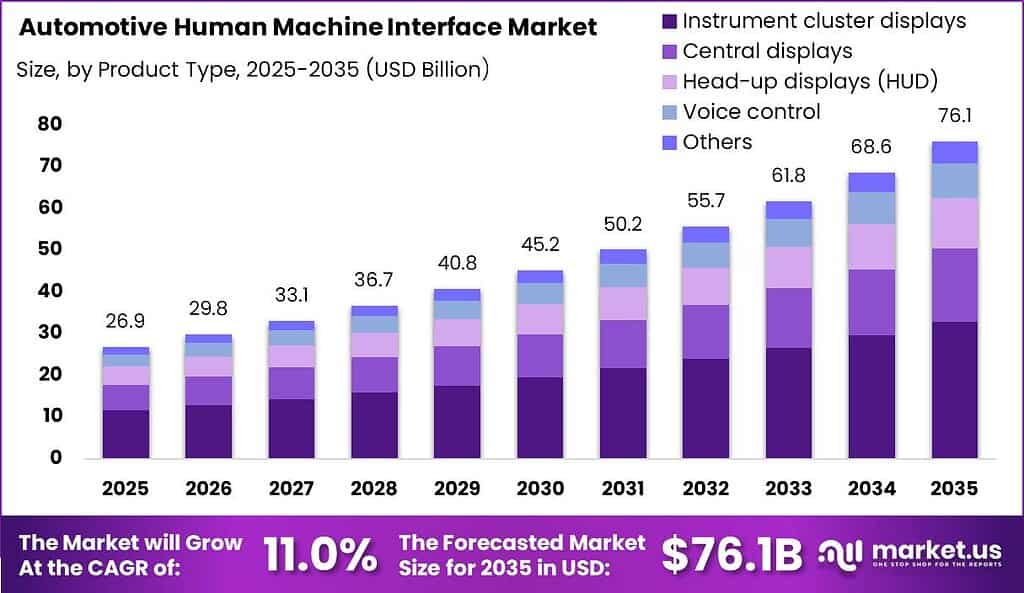
Global Automotive Human Machine Interface Market size is expected to be worth around USD 76.10 Billion by 2035 from USD 26.90 Billion in 2025, growing at a CAGR of 11.0% during the forecast period 2026 to 2035. Cockpit electronics programs now treat HMI as a profit layer rather than a fixed trim cost. Investors who track per-vehicle interface content will see clearer margin expansion than pure unit volume growth.
Therefore, the Automotive Human Machine Interface Market covers the hardware and software that let drivers and passengers control vehicle functions. Product types include instrument cluster displays, central displays, head-up displays, and voice control units. Technology splits across visual, acoustic, and mechanical haptic interfaces. Access type separates standard and multimodal systems, while display size bands define cabin packaging choices for OEMs and suppliers.
Key Takeaways
- The market is valued at USD 26.90 Billion in 2025 and is projected to reach USD 76.10 Billion by 2035.
- The market expands at a CAGR of 11.0% during 2026 to 2035.
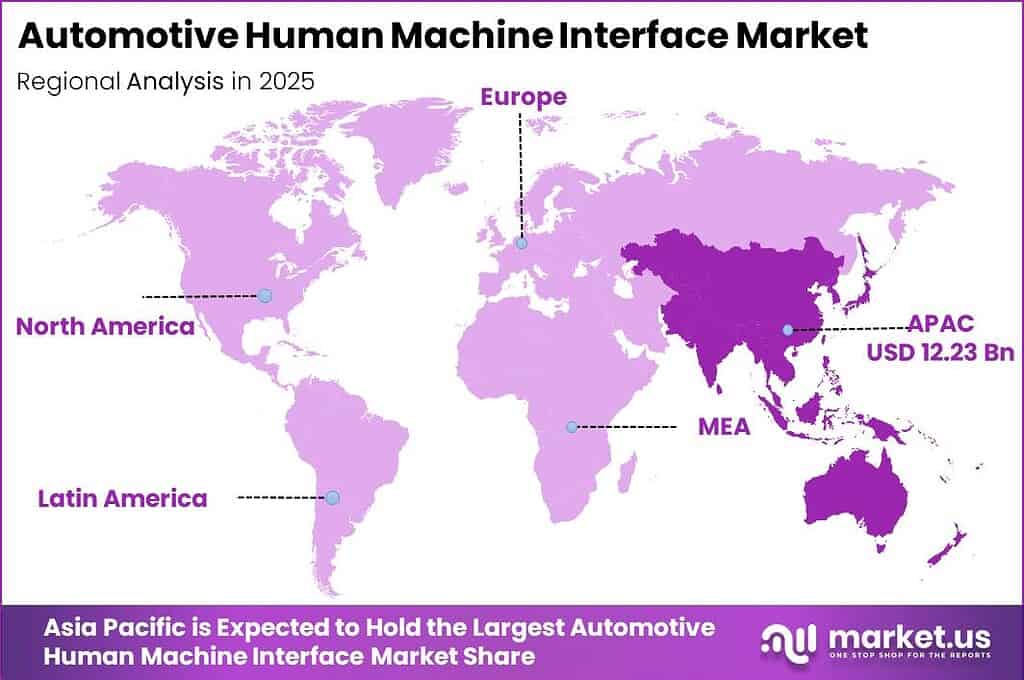
- Asia Pacific leads with a 45.5% share, valued at USD 12.23 Billion in 2025.
- Instrument cluster displays lead product type with a 43.2% share.
- Visual interface leads technology with a 62.3% share.
- Standard HMI systems lead access type with a 72.2% share.
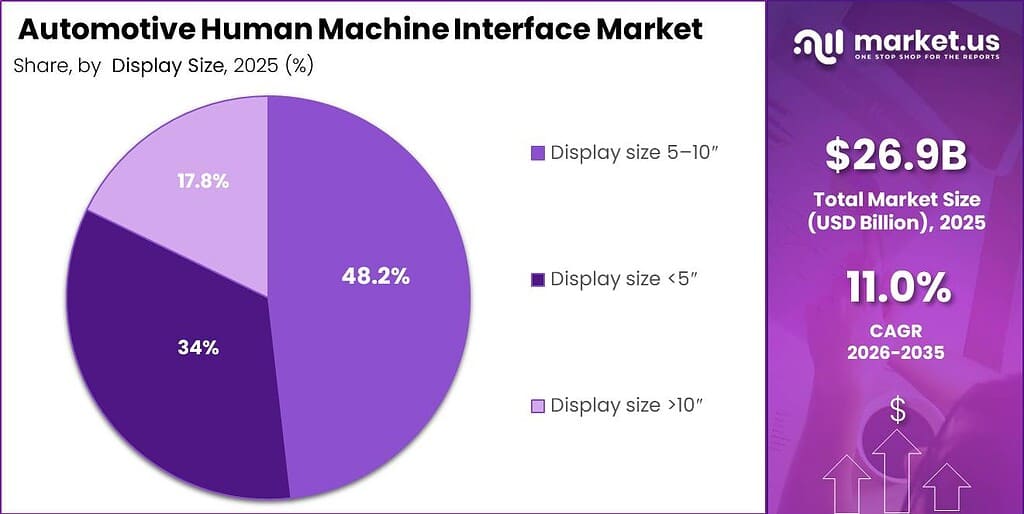
- Display size 5 to 10 inch leads display size with a 48.2% share.
- Head-up displays, multimodal HMI systems, and display size above 10 inch are the fastest-growing lines in their groups.
Safety regulators now force cockpit systems to watch the driver as closely as the road ahead. Europe requires advanced driver distraction warning on new vehicles from 2026. That rule pulls camera-based HMI into mass-market trims at scale. Suppliers that already ship certified monitoring stacks win volume programs first. OEMs that delay integration face delayed type approval and lost model-year launch slots across regions.
According to Mobility Global, 48% of 8,023 vehicle owners across eight countries preferred an HMI combining touchscreens with physical buttons or knobs in 2025. Hybrid control layouts cut learning time for mixed-age buyers in daily use. Vendors who keep redundant tactile controls will defend share against pure glass cockpits. Daily drivers reject interfaces that slow simple climate and audio tasks during ordinary trips.
As reported by Qualcomm, Snapdragon Cockpit platforms with integrated AI operated in more than 75 million vehicles worldwide as of June 2025. Scale like this turns cockpit silicon into a software distribution channel after sale. Consequently, Tier-1s aligned with high-volume AI platforms capture recurring feature revenue over the vehicle life. End-use EV growth multiplies demand for updatable cabin interfaces per shipped vehicle.
Product Type Analysis
Instrument cluster displays dominates with 43.2% due to mandatory driver information in every vehicle.
In 2025, Instrument cluster displays held a dominant market position in the By Product Type segment of Automotive Human Machine Interface Market, with a 43.2% share. OICA data show world motor vehicle production reached about 96.4 million units in 2025. Nearly every unit still needs a primary driver information surface. Suppliers that pair digital clusters with over-the-air gauge themes lock long platform life cycles.
Central displays organize navigation, media, climate, and vehicle settings into one interaction hub for occupants. ACEA reported global car manufacturing near 75.5 million units in 2024 across major producing regions. That volume anchors sustained demand for center-stack screens as standard equipment spreads below premium trims. Firms that simplify menu depth reduce dealer complaint rates and protect brand quality scores over model years.
Head-up displays project speed, navigation cues, and ADAS alerts onto the windshield or a combiner surface. Drivers keep their eyes closer to the road while reading critical cues. Passenger cars still dominate global builds, representing roughly 73% of motor vehicle production in recent world tallies. That mix favors HUD attach on high-volume car platforms first. HUD specialists who cut combiner cost open segments beyond luxury nameplates.
Voice control reduces hand travel to screens during navigation and climate tasks in daily driving. Other product formats fill niche cabin roles beside the core display stack. NHTSA guidance discourages reading more than 30 characters of text during a single secondary task while driving. Voice menus that replace long on-screen strings lower that risk. Suppliers who certify low-latency offline speech win multimodal packages. Voice control and other residual formats hold the remaining product share collectively.
Technology Analysis
Visual interface dominates with 62.3% due to primary channel for cockpit information delivery.
In 2025, Visual interface held a dominant market position in the By Technology segment of Automotive Human Machine Interface Market, with a 62.3% share. OICA figures place Asia-Pacific production near 59.2 million vehicles in 2025. That equals more than 61% of world output and concentrates display-heavy cockpits in one region. Display vendors who raise brightness and cut power win EV thermal budgets on packed platforms.
Acoustic interface technology delivers chimes, voice prompts, and audio feedback that confirm commands without a glance. NHTSA distraction guidelines treat long visual-manual tasks as high risk and push designers toward non-visual confirmations. The same guidelines flag manual text entry beyond 6 button or key presses during a single task as problematic. Audio HMI suppliers who tune alerts by speed reduce nuisance warnings drivers ignore and improve compliance outcomes.
Mechanical and haptic interfaces restore physical confirmation through knobs, buttons, and pulsing touch surfaces in the cabin. Japan produced about 8.41 million vehicles in 2025 per OICA-linked tallies, sustaining a large base of quality-focused OEM programs. Those programs often retain physical controls beside digital glass. Component makers who embed reliable haptics in thin surfaces capture redesign cycles now underway on hybrid cockpits.
Other interface technologies cover emerging biometric readers and experimental cabin sensors outside classic visual groups. Euro NCAP 2026 protocols expand scoring for driver monitoring, distraction, and child presence detection on rated models. Global sales climbed to about 99.8 million vehicles in 2025 per OICA reporting, widening the addressable base for optional cabin sensing packages. Investors should treat these formats as option-value bets before standards harden into commodity purchases.
Access Type Analysis
Standard HMI systems dominates with 72.2% due to lower cost and simpler vehicle integration.
In 2025, Standard HMI systems held a dominant market position in the By Access Type segment of Automotive Human Machine Interface Market, with a 72.2% share. Standard layouts still map cleanly onto high-volume platforms that prioritize predictable validation paths. EU General Safety Regulation phase two extends advanced monitoring obligations from July 2026 across an annual European pool near 18 million cars. Incumbents who modularize standard stacks defend that base while multimodal options attach above it.
Multimodal HMI systems combine touch, voice, gesture, and camera inputs in one intent model. The vehicle interprets driver goals across channels instead of a single input path. EU rules require advanced driver distraction warning on all new vehicles from July 2026. UNECE Regulation No. 171 on driver control assistance systems reinforces attention-management expectations for assisted driving. Software firms that certify fused input stacks early capture this fastest-growing access tier.
Display Size Analysis
Display size 5 to 10 inch dominates with 48.2% due to balance of visibility and cabin packaging.
In 2025, Display size 5 to 10 inch held a dominant market position in the By Display Size segment of Automotive Human Machine Interface Market, with a 48.2% share. This band fits instrument and center roles across mainstream passenger cars in global fleets. U.S. vehicle production held near 10.24 million units in 2025 on OICA-linked counts, anchoring steady mid-size screen demand. Panel makers who hold automotive-grade yield here secure the volume core of cockpit glass.
Display size under 5 inch serves compact secondary readouts and cost-sensitive clusters in entry vehicles worldwide. India production climbed to about 6.49 million vehicles in 2025 on OICA-linked counts. That expansion grows the pool of buyers who still accept smaller primary screens for price. Suppliers who pair small panels with strong sunlight readability retain emerging-market OEM contracts over multiple model years.
Display size above 10 inch is the fastest-growing band as widescreen center stacks define premium cabins. China produced about 34.53 million vehicles in 2025, and domestic EV brands use large glass as a showroom differentiator. Larger panels raise GPU load and cabin heat at the same time. System integrators who manage multi-display timing without lag win flagship electrical architecture awards.
Key Market Segments
By Product Type
- Instrument cluster displays
- Central displays
- Head-up displays (HUD)
- Voice control
- Others
By Technology
- Visual interface
- Acoustic interface
- Mechanical / haptic interface
- Other
By Access Type
- Standard HMI systems
- Multimodal HMI systems
By Display Size
- Display size under 5 inch
- Display size 5 to 10 inch
- Display size above 10 inch
Regional Analysis
Asia Pacific Dominates the Automotive Human Machine Interface Market with a Market Share of 45.5%, Valued at USD 12.23 Billion
Asia Pacific leads because China, Japan, India, and South Korea concentrate vehicle output and digital cockpit adoption in one corridor. As per our research, the region held a 45.5% share valued at USD 12.23 Billion in 2025. Local EV makers refresh HMI software faster than many global mass-market brands. Suppliers with regional engineering hubs protect design-win velocity and logistics cost.
Europe is accelerating under mandatory driver-monitoring rules that raise HMI content per car. In January 2025, BMW Group unveiled its production-oriented Panoramic iDrive HMI. The package includes Panoramic Vision, an optional 3D head-up display, a central touchscreen, haptic steering-wheel controls, and Operating System X. Rollout is planned across new BMW models from the end of 2025. Premium European launches set the interface benchmark rivals must match.
North America continues premium multi-display adoption in trucks and SUVs at a steady pace. Latin America and Middle East and Africa absorb mid-range digital clusters more slowly today. This reflects uneven dealership software capability and lower average selling prices outside core metros. Global suppliers that modularize HMI hardware for cost tiers still address these regions without separate full redesign programs.
Key Regions and Countries
North America
- US
- Canada
Europe
- Germany
- France
- The UK
- Spain
- Italy
- Rest of Europe
Asia Pacific
- China
- Japan
- South Korea
- India
- Australia
- Rest of APAC
Latin America
- Brazil
- Mexico
- Rest of Latin America
Middle East and Africa
- GCC
- South Africa
- Rest of MEA
Market Dynamics
Market Opportunity Analysis - HUD, multimodal stacks, large glass, and haptic layers still leave open entry points
Head-up displays remain underexploited outside premium nameplates in volume vehicle programs across major regions today. Distraction rules favor eyes-up cues for core driving information. Many platforms still omit HUD to protect bill-of-materials targets on mass trims. Suppliers that deliver lower-cost combiners can open mainstream trims in Asia Pacific first. Early cost leaders will set the default safety display package before late entrants arrive.
Multimodal HMI systems grow fastest from a smaller base while standard systems still hold most units. Fleet and mass-market buyers have not fully paid for fused voice, camera, and touch stacks. Therefore, middleware vendors who certify multimodal kits for July 2026 European compliance gain a forced upgrade wave. That window favors software-heavy entrants over pure panel makers defending old architectures.
Displays larger than 10 inch concentrate in showroom flagships and leave mid-price SUVs only partly covered. Regional buyers in Latin America and Middle East and Africa still accept smaller glass for price reasons. Modular large-display kits sized for hot climates create a second-wave opportunity for exporters. Investors should watch local assembly partners who cut import cost on oversized automotive panels.
Acoustic and mechanical haptic layers stay secondary in many digital cabin designs that over-index on glass. Owner preference for physical confirmation leaves a service gap on pure touch fleets already on the road. By contrast, suppliers who retrofit haptic controllers and better voice prompts address dissatisfaction directly. They avoid full cockpit replacement cost. Aftermarket and mid-cycle refresh channels become practical entry points for new specialists.
Technology and Innovation Landscape - On-device AI silicon and low-power tactile displays rewrite cockpit design rules
Qualcomm designed the Snapdragon Cockpit Elite platform to sample in 2025 with large performance gains. Internal targets included 3x higher CPU, 3x higher GPU, and 12x higher NPU performance versus the prior generation. Higher on-device AI capacity moves assistants off the cloud connection. Manufacturers who adopt this silicon class ship features without waiting for network coverage in weak zones.
The same cockpit platform was designed to drive as many as 16 high-resolution displays at once. It was also built to process inputs from more than 40 multimodal sensors in parallel. Multi-display timing becomes a core competency, not a niche engineering skill. Tier-1s that master sensor fusion reduce OEM integration risk on flagship EVs and raise switching costs after lock-in.
MediaTek presented its Dimensity Auto Cockpit platform in 2025 with 8K video and Dolby Vision HDR support. Its MT2739 connectivity platform added 5G dual-SIM dual-active three-transmit-path technology for connected vehicles. Cabin entertainment quality now rivals living-room consumer electronics for rear and front passengers. Automakers who match phone-grade video reduce the urge to phone-mirror every trip and keep interaction inside the native HMI.
Himax and AUO showed a CES 2025 automotive demonstrator built around a 16 inch AmLED panel. Resolution reached 3.2K × 2K with claimed power cuts up to 50% through local dimming control. BHTC’s HaptiFold unit used a 14.6 inch Micro LED surface with active haptic feedback. Lower power and tactile response solve two buyer complaints at once. Panel innovators who ship both traits threaten static LCD incumbents on future platforms.
Drivers
Software-defined vehicle architectures pull HMI off fixed hardware cycles and onto zonal computers in new platforms. Those computers accept over-the-air feature delivery across the full vehicle life. SAE International guidance and OEM migrations report a 10% to 15% cut in per-vehicle semiconductor count. Discrete HMI controllers consolidate onto fewer chips as a result. Investors should value suppliers that sell updatable interface stacks, not one-time screen kits.
Volkswagen’s Cariad reset and General Motors’ Ultifi rollout show OEMs chasing cockpit revenue after sale. CAAM-linked China EV output accelerated zonal designs through 2024 and 2025 model cycles. As a result, infotainment gross margins can lift by roughly 400 to 600 basis points. Features sell after delivery instead of only at the dealer. HMI shifts from a sunk cost into a lifecycle monetization layer for investors.
| Driver | (~) % Impact on CAGR Forecast | Geographic Relevance | Impact Timeline |
|---|---|---|---|
| Software-Defined Vehicle (SDV) Architecture Migration | +2.3% | Global | Medium term (2 to 4 years) |
| Driver-Monitoring and ADAS Safety Mandates | +2.0% | Europe, North America | Short term (2 years or less) |
| EV Cockpit Digitization and Analog-to-Digital Cluster Replacement | +1.8% | China, Europe | Short term (2 years or less) |
| Generative-AI Voice Assistant Adoption | +1.4% | Global, premium segment first | Medium term (2 to 4 years) |
| Premiumization of Touchscreen and Multi-Display Systems | +1.1% | North America, Asia-Pacific | Short term (2 years or less) |
| Vehicle Digitization in Emerging Markets | +0.7% | India, Southeast Asia, Brazil | Long term (4 years or more) |
Restraints
Automotive-grade chips for displays and touch control still lose foundry priority to AI accelerators. SEMI-tracked lead times for HMI-critical systems-on-chip stretch to 26 to 34 weeks. Cockpit microcontroller prices rose an estimated 8% to 12% year on year in supplier disclosures. This slows mid-market cockpit refreshes for volume brands. Buyers who dual-source display drivers protect launch calendars when allocation tightens suddenly.
High policy rates raise the cost of inventory builds and new electronics production lines. The U.S. federal funds rate held near 4.25% to 4.50% through much of 2025 to 2026. European policy stayed tight over the same window as well. Consequently, volume OEMs defer cockpit CapEx by an estimated 12 to 18 months. Premium programs still advance, widening the feature gap versus mass trims.
| Restraint | (~) % Impact on CAGR Forecast | Geographic Relevance | Impact Timeline |
|---|---|---|---|
| Automotive-Grade Semiconductor Allocation and Cost Inflation | -1.8% | Global, acute in Asia-Pacific foundries | Short term (2 years or less) |
| High-Interest-Rate Environment Delaying Cockpit-Electronics CapEx | -1.3% | North America, Europe | Short term (2 years or less) |
| Tariff-Driven Cost Escalation on Display and Sensor Imports | -1.1% | United States-China trade corridor | Short term (2 years or less) |
| Multi-Year Platform Lock-In Delaying HMI Redesign | -0.9% | Global, mass-market segment | Medium term (2 to 4 years) |
| Functional-Safety Certification Bottlenecks (ISO 26262) | -0.8% | Europe, global Tier-1 supply chain | Short term (2 years or less) |
Challenges
Automotive cockpit programs lack enough embedded software and human-factors engineers for multimodal work. Voice, gesture, and biometric features need skills older curricula did not produce at scale. Workforce tracking cited through SAE and NASSCOM points to a shortfall above 300,000 engineers. U.S. openings outpace graduates by roughly 20% to 25% in related projections. Feature time-to-market stretches by 4 to 6 months per cycle.
Competition for ISO 26262 certified staff pushes OEMs toward offshore hubs and third-party platforms. Extra cost of about 3% to 5% per vehicle program appears when retention packages stack with licenses. This creates a revenue stream for specialized UX houses and certified software vendors. Early movers who productize compliant HMI toolkits sell into many OEMs at once and scale faster.
| Challenge | (~) % CAGR Friction Drag | Geographic Relevance | Mitigation Horizon |
|---|---|---|---|
| Embedded Software and UX Talent Shortage | -1.4% | Global, acute in North America and Europe | Medium term (2 to 4 years) |
| Cybersecurity and OTA Update Vulnerability Management | -1.2% | Global | Long term (4 years or more) |
| Cross-OEM HMI Standardization Fragmentation | -1.0% | Global | Medium term (2 to 4 years) |
| Display-Panel Raw Material Supply Volatility | -0.9% | Asia-Pacific concentrated supply | Medium term (2 to 4 years) |
| Driver-Distraction Liability and UX Testing Burden | -0.8% | North America, Europe | Long term (4 years or more) |
| Legacy Fleet Retrofit Complexity | -0.6% | Global, acute in emerging markets | Long term (4 years or more) |
Opportunities
Most OEMs still bundle advanced display and voice features into trim price at the factory. They rarely sell unlocks later even when the hardware already sits in the car. BMW and Mercedes-Benz pilots in 2024 to 2025 still show single-digit attach rates. Software lines often carry 70% to 85% gross margins versus 25% to 35% for embedded hardware. Raising attach rates toward 8% to 10% would lift blended profit without new silicon.
Capturing that white space needs billing systems, clearer consumer rules, and dealer pricing redesign. European digital fairness reviews add another compliance layer to feature-unlock models. Early movers who package interface personalities and display themes as subscriptions own the customer after delivery. This signals a medium-term shift in cockpit economics for the sector. Suppliers who enable metered features become strategic partners, not catalog component vendors only.
| Opportunity | (~) % Potential CAGR Upside | Geographic Relevance | Execution Window |
|---|---|---|---|
| Feature-on-Demand Subscription Monetization | +2.0% | Global, led by premium OEMs | Medium term (2 to 4 years) |
| Aftermarket Retrofit Upgrade Monetization for Existing Fleet | +1.6% | Global, acute in India and Southeast Asia | Medium term (2 to 4 years) |
| In-Cabin Biometric and Health-Monitoring Interface Expansion | +1.3% | North America, Europe | Long term (4 years or more) |
| Two-Wheeler and Commercial-Fleet Adjacent-Vertical Expansion | +1.1% | Asia-Pacific, especially India | Long term (4 years or more) |
| M&A Roll-Up of Fragmented Regional HMI Software Suppliers | +0.9% | Global, consolidation-ready Europe and Asia-Pacific | Short term (2 years or less) |
| AI-Personalization Data Monetization | +0.8% | Global | Long term (4 years or more) |
Key Company Insights
Continental AG is using concept cockpits to sell a full cabin experience rather than isolated screens. In January 2025, Continental premiered its Emotional Cockpit concept for customizable information and interior personalization. The system featured a 1.30 meter E Ink Prism dashboard display across the cabin width. Low-power E Ink only draws energy when the image changes. That efficiency story strengthens Continental’s pitch to EV makers guarding every watt of range.
Robert Bosch GmbH sits among the primary Tier-1 names defining automotive HMI supply for global OEMs. Broad electronics depth lets Bosch bundle cluster, center display, and control software together. One validation path shortens OEM sourcing cycles versus multi-vendor cabin programs. However, fast AI cockpit cycles reward software speed above static hardware catalogs. Slow iteration would risk premium design wins against more agile cockpit software rivals.
Key Players
- Continental AG
- Robert Bosch GmbH
- DENSO Corporation
- Valeo SA
- Visteon Corporation
- Harman International Industries
- Synaptics Incorporated
- Luxoft
- Alpine Electronics, Inc.
- Yazaki Corporation
- Panasonic Corporation
- Aptiv PLC
- Magneti Marelli
- Nippon Seiki Co., Ltd.
- Clarion Co., Ltd.
Recent Developments
- April 2025: Cerence AI partnered with MediaTek and expanded its NVIDIA collaboration to introduce a multimodal version of CaLLM Edge, an embedded automotive language model integrated with the Cerence xUI in-vehicle interaction platform.
- April 2025: FORVIA partnered with Rightware to integrate its Smart Dimming and MyVue display software into the Kanzi One automotive HMI toolchain, allowing vehicle-interface developers to improve display quality and reduce power use.
- April 2025: Visteon introduced a high-performance intelligent cockpit system developed with Qualcomm, combining Visteon’s cognitoAI framework with the Snapdragon Cockpit Elite platform for multimodal interaction, on-device AI, and 3D graphics.
Geopolitical Impact Analysis
Data from UNCTAD shows maritime trade growth slowing to about 0.5% in 2025. Growth was 2.2% in 2024 before the step-down. The Shanghai Containerized Freight Index averaged 2,496 points in 2024 amid volatile container pricing. Display panels and cockpit controllers move on these lanes from Asia to assembly plants. Higher freight volatility inflates landed cost for multi-screen HMI kits and rewards nearer sourcing.
Figures from U.S. policy tracking show duties near 25% on many automobiles and auto parts under Section 232 style actions. Average U.S. tariffs on Chinese goods stood near 34% in early 2026 across traded categories. Cockpit displays, harnesses, and control modules sit inside those part flows. As a result, HMI bill-of-materials inflation hits cross-Pacific programs first. Regionalizing Tier-1 production becomes a pricing strategy for margin defense.
Report Scope
| Report Features | Description |
|---|---|
| Market Value (2025) | USD 26.90 Billion |
| Forecast Revenue (2035) | USD 76.10 Billion |
| CAGR (2026-2035) | 11.0% |
| Base Year for Estimation | 2025 |
| Historic Period | 2020-2024 |
| Forecast Period | 2026-2035 |
| Report Coverage | Revenue Forecast, Market Dynamics, Market Opportunity Analysis, Technology and Innovation Landscape, Competitive Landscape, Recent Developments |
| Segments Covered | By Product Type (Instrument cluster displays, Central displays, Head-up displays (HUD), Voice control, Others), By Technology (Visual interface, Acoustic interface, Mechanical / haptic interface, Other), By Access Type (Standard HMI systems, Multimodal HMI systems), By Display Size (Display size under 5 inch, Display size 5 to 10 inch, Display size above 10 inch) |
| Regional Analysis | North America (US and Canada), Europe (Germany, France, The UK, Spain, Italy, and Rest of Europe), Asia Pacific (China, Japan, South Korea, India, Australia, and Rest of APAC), Latin America (Brazil, Mexico, and Rest of Latin America), Middle East and Africa (GCC, South Africa, and Rest of MEA) |
| Competitive Landscape | Continental AG, Robert Bosch GmbH, DENSO Corporation, Valeo SA, Visteon Corporation, Harman International Industries, Synaptics Incorporated, Luxoft, Alpine Electronics, Inc., Yazaki Corporation, Panasonic Corporation, Aptiv PLC, Magneti Marelli, Nippon Seiki Co., Ltd., Clarion Co., Ltd. |
| Customization Scope | Customization for segments, region / country-level will be provided. Additional customization can be done based on requirements. |
| Purchase Options | We have three licenses to opt for: Single User License | Multi-User License (Up to 5 Users) | Corporate Use License (Unlimited User and Printable PDF) |





































