Report Overview
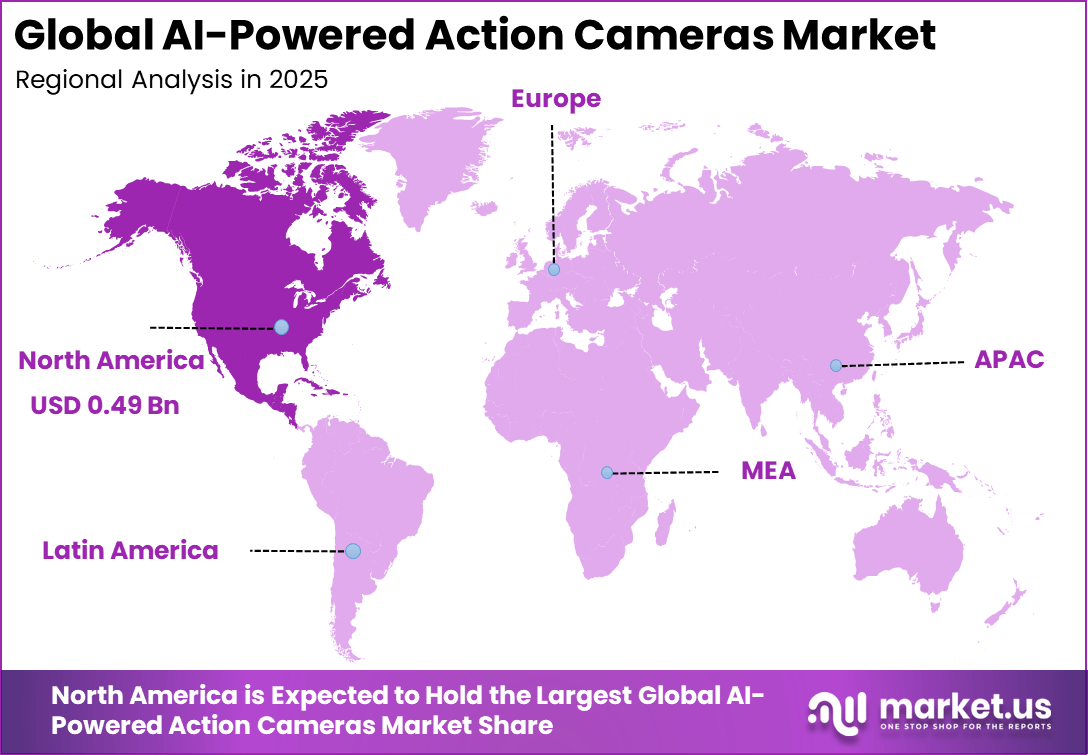
The Global AI-Powered Action Cameras Market size is expected to be worth around USD 6.49 billion by 2035, from USD 1.35 billion in 2025, growing at a CAGR of 17.0% during the forecast period from 2025 to 2035. North America held a dominant market position, capturing more than a 36.5% share, holding USD 0.49 billion in revenue.
AI-Powered Action Cameras Market refers to advanced wearable and mountable camera systems that integrate artificial intelligence to enhance video capture, processing, and user experience. These cameras use on-device intelligence to automate functions such as scene recognition, stabilization, subject tracking, and highlight generation.
The market has evolved from basic recording devices into intelligent imaging tools that adapt to movement, environment, and user intent. This evolution reflects broader adoption of AI at the edge, where processing happens directly on the device. The market is driven by demand for smarter content creation tools across sports, travel, outdoor recreation, and professional field use.
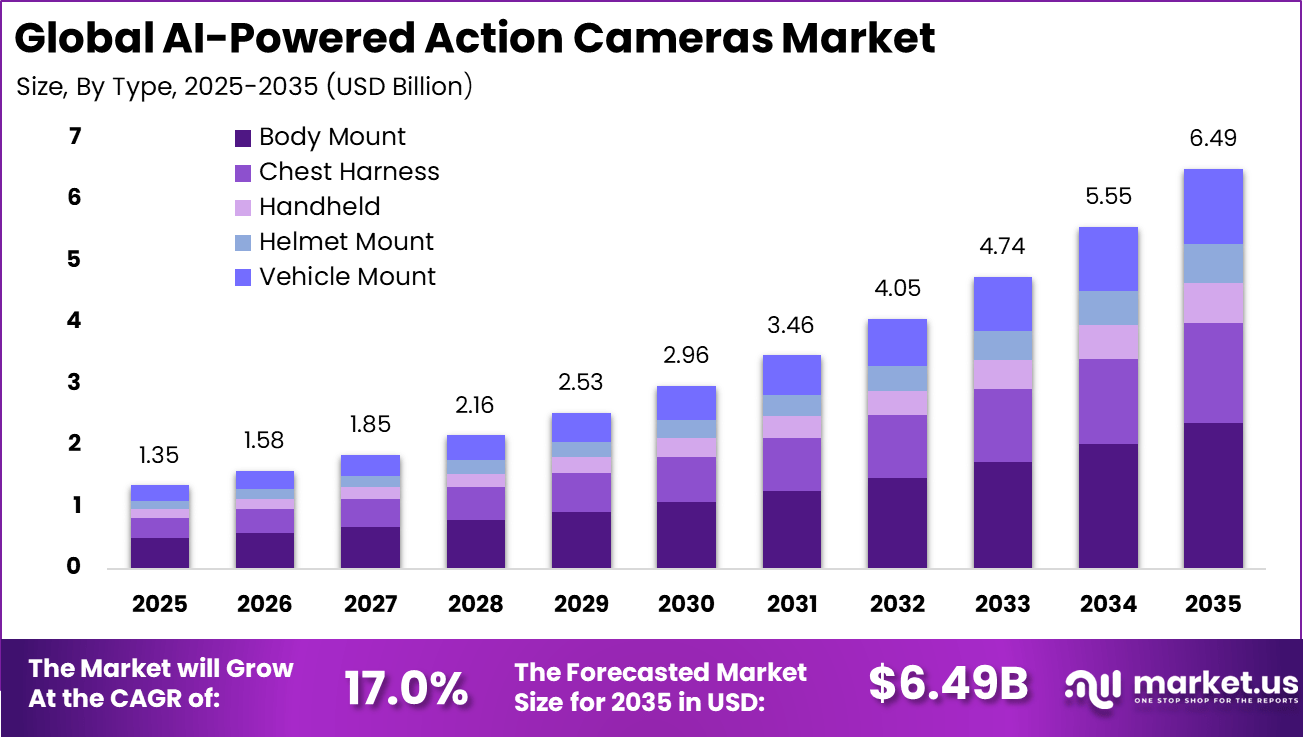
Top Driving Factors include the rapid growth of short-form video content and the expectation for high-quality footage captured in motion. Users increasingly demand cameras that can automatically adjust settings in fast-changing environments. AI enables real-time decisions related to exposure, framing, and stabilization, improving output consistency. This capability is especially valuable in high-speed or unpredictable scenarios.
For instance, in January 2026, Garmin unveiled Unified Cabin 2026 at CES, featuring an AI/LLM-based conversational assistant for automotive action capture with seat-aware video. While not pure action cams, this expands Garmin’s AI edge in multi-angle, intelligent recording for vehicles and adventures.
Demand Analysis shows strong interest from users who create frequent video content but lack time or technical expertise for editing. AI reduces the effort required to produce shareable footage by automatically selecting key moments. This lowers entry barriers for casual users while increasing efficiency for advanced creators. Demand is also supported by the growing creator economy and social media platforms that prioritize video.
Key Takeaway
- Body Mount segment led with a 36.4% share of the Global AI-Powered Action Cameras Market in 2025.
- CMOS segment dominated with a 98.3% share, reflecting its importance in image quality and camera performance.
- 4K & Above segment captured 85.6%, driven by increasing demand for high-definition video recording in action cameras.
- Premium segment held 66.8% of the market, highlighting strong demand for high-end, feature-rich action cameras.
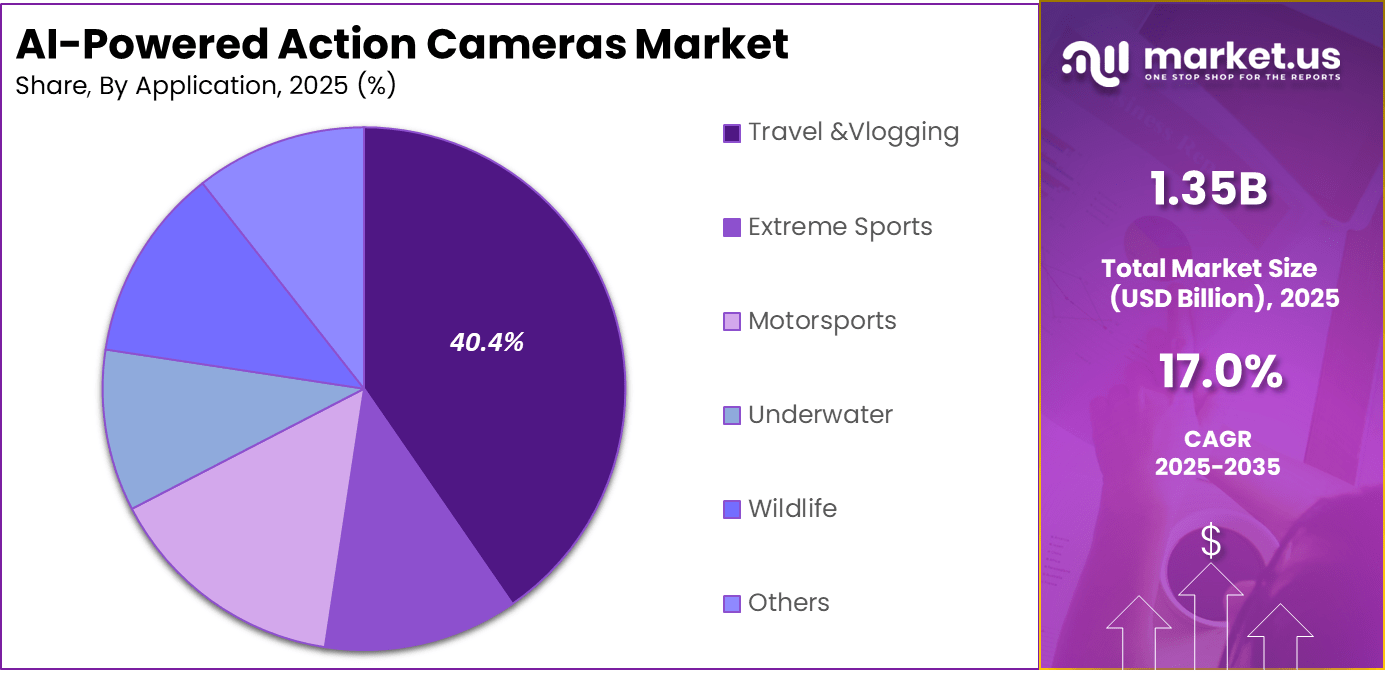
- Travel & Vlogging segment represented 40.4%, driven by the growing popularity of action cameras for content creation.
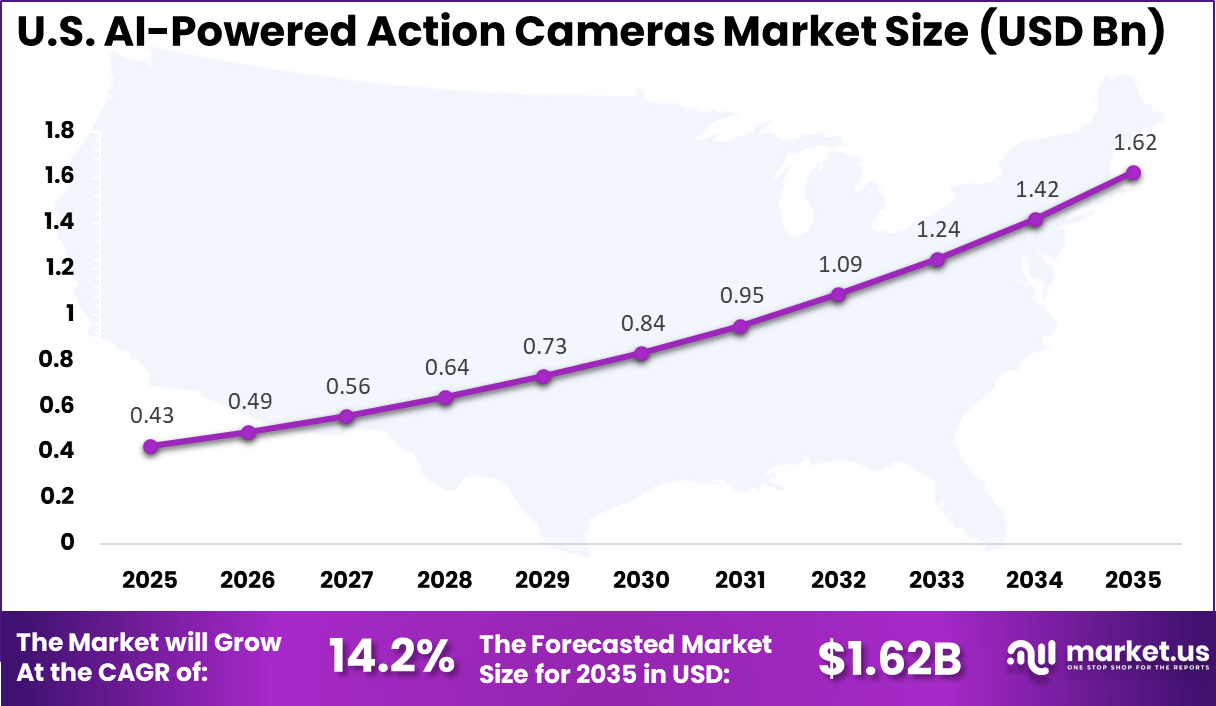
- U.S. market valued at USD 0.43 billion in 2025, with a CAGR of 14.2%.
- North America held a dominant 36.5% share, supported by high adoption and strong market presence.
Drivers Impact Analysis
| Driver Category | Key Driver Description | Estimated Impact on CAGR (%) | Geographic Relevance | Impact Timeline |
|---|---|---|---|---|
| Advancements in AI technology | AI features enhancing image quality and video stabilization | ~6.3% | Global | Short Term |
| Increasing adoption of wearable cameras | Integration of AI in wearable devices for better usability | ~5.4% | North America, Europe | Short Term |
| Growth in adventure sports and content creation | Rising demand for high quality action videos | ~4.9% | North America, Europe | Mid Term |
| Social media and influencer culture | Growing need for personal branding with action videos | ~4.1% | Global | Mid Term |
| Improvements in battery and processing power | AI enhanced performance without compromising battery life | ~3.6% | Global | Long Term |
Risk Impact Analysis
| Risk Category | Risk Description | Estimated Negative Impact on CAGR (%) | Geographic Exposure | Risk Timeline |
|---|---|---|---|---|
| High product cost | Expensive hardware and AI integration for consumers | ~4.7% | Emerging Markets | Short to Mid Term |
| Data privacy concerns | Security and privacy issues with video recordings | ~4.0% | Europe, North America | Short Term |
| Competition from traditional cameras | Established brands offering similar features without AI | ~3.2% | Global | Mid Term |
| Battery limitations | Constraints on usage time due to power intensive AI features | ~2.9% | Global | Mid Term |
| Consumer awareness and adoption barriers | Reluctance to adopt new technologies among non tech savvy users | ~2.1% | Emerging Markets | Long Term |
Restraint Impact Analysis
| Restraint Factor | Restraint Description | Impact on Market Expansion (%) | Most Affected Regions | Duration of Impact |
|---|---|---|---|---|
| High price point | Expensive for average consumers due to AI features | ~6.3% | Emerging Markets | Short to Mid Term |
| Lack of technical expertise | Need for knowledge in using AI features | ~5.1% | Global | Mid Term |
| Limited availability of AI driven cameras | Limited product offerings from existing camera manufacturers | ~4.4% | Global | Mid Term |
| Privacy concerns | Consumer hesitation due to concerns about AI data processing | ~3.6% | Europe, North America | Long Term |
| Reliance on internet connectivity for AI features | AI driven features requiring stable connectivity | ~2.9% | Global | Long Term |
Type Analysis
Body-mounted action cameras account for 36.4% of the market, reflecting strong demand for hands-free recording. These cameras are widely used for capturing first-person perspectives during travel, sports, and outdoor activities. Body mounting improves stability and enables continuous recording without manual handling.
Users prefer body-mounted designs for immersive content creation. AI features enhance footage by stabilizing motion and adjusting framing automatically. This improves video quality in dynamic environments. As experiential content gains popularity, body-mounted cameras remain in demand. Their practicality and immersive output support adoption. This segment continues to hold a significant market share.
For Instance, in October 2025, GoPro, Inc. updated Hero13 Black with new body mount accessories for extreme adhesion in wet conditions. Users strap it for skiing or biking, getting steady shots via AI stabilization. The design cuts weight while holding firm through jumps, drawing adventurers tired of loose gear.
Sensor Analysis
CMOS sensors dominate the market with a 98.3% share, highlighting their efficiency and performance advantages. CMOS technology supports high-speed image processing and low power consumption. These characteristics are critical for compact action cameras. AI-powered features rely on rapid sensor data processing.
CMOS sensors enable real-time enhancements such as noise reduction and object tracking. This supports consistent image quality. As camera performance requirements increase, CMOS remains the standard sensor choice. Its reliability and scalability reinforce dominance. This sensor segment continues to lead the market.
For instance, in September 2025, SZ DJI Technology Co., Ltd. released Osmo Action 6, featuring a large 1/1.1-inch CMOS sensor for superior low-light performance. This powers AI tracking in dim trails or underwater, delivering noise-free video that rivals bigger cams. Hikers and divers praise the clarity boost for night adventures.
Resolution Analysis
Resolution of 4K and above accounts for 85.6% of market demand, reflecting consumer preference for high-definition content. High resolution improves clarity and detail, which is essential for professional-quality footage. AI processing further enhances sharpness and color accuracy. Content creators rely on high-resolution output for editing flexibility.
Cropping and stabilization can be applied without significant quality loss. This supports professional and semi-professional use cases. As viewing platforms support higher resolutions, demand continues to rise. High-resolution capability remains a key purchasing factor. This segment dominates resolution adoption.
For Instance, in December 2025, Insta360 rolled out Ace Pro 2 with 8K resolution support for ultra-detailed 4K+ clips. AI refines slow-motion from high-res files, ideal for vloggers cropping epic moments. Sports fans love the sharpness on big screens after edits.
Price Range Analysis
Premium-priced action cameras represent 66.8% of the market, driven by demand for advanced features and durability. Premium models integrate AI-powered stabilization, voice control, and intelligent scene recognition. These features enhance usability and content quality. Consumers in this segment prioritize performance over cost.
Premium devices offer superior build quality and extended functionality. This appeals to professional users and enthusiasts. As content standards rise, premium adoption increases. Users seek reliable and feature-rich devices. This price range remains dominant.
For Instance, in June 2025, Garmin Ltd. launched the premium Virb Ultra with advanced GPS-AI fusion for tracking in extreme sports. Priced high for durability and analytics, it appeals to athletes analyzing rides or runs via detailed 4K logs.
Application Analysis
Travel and vlogging applications account for 40.4% of market usage, making them the leading application segment. Action cameras are widely used to document travel experiences and daily activities. AI features simplify content creation by automating adjustments. Vloggers benefit from stabilization, face tracking, and lighting correction.
These tools reduce post-production effort. This improves content consistency. As digital storytelling grows, demand from this segment increases. Travel and vlogging continue to drive adoption. This application remains a key contributor to market demand.
For Instance, in July 2025, Xiaomi Corporation unveiled AI Glasses with a 2K camera for discreet travel vlogging. Lightweight at 40g, it records hands-free with scene AI for auto-highlights. Travelers capture streets or hikes naturally, sharing edited stories quickly.
Regional Analysis
North America holds a 36.5% share of the AI-powered action cameras market, supported by strong consumer interest in content creation. High adoption of social media and video platforms supports demand. Technology awareness drives early adoption.
| Region | Primary Growth Driver | Regional Share (%) | Regional Value (USD Bn) | Adoption Maturity |
|---|---|---|---|---|
| North America | Popularity of action sports and content creation | 36.5% | USD 0.49 Bn | Advanced |
| Europe | Rising adventure tourism and wearable tech adoption | 30.2% | USD 0.41 Bn | Advanced |
| Asia Pacific | Increasing adoption of action cameras in emerging markets | 18.5% | USD 0.25 Bn | Developing to Advanced |
| Latin America | Growing interest in sports and video content creation | 8.4% | USD 0.11 Bn | Developing |
| Middle East and Africa | Early stage market with potential for growth in sports | 6.4% | USD 0.09 Bn | Early |
For instance, in January 2026, Garmin Ltd. unveiled Unified Cabin 2026 at CES, featuring an AI/LLM-based conversational virtual assistant for automotive applications, highlighting advanced AI integration. While focused on in-cabin tech, this innovation reinforces Garmin’s AI expertise and North American market leadership in smart, AI-enhanced devices, including action cameras.
The United States contributes USD 0.43 billion in market value, driven by professional creators and travel enthusiasts. Users seek high-performance cameras for outdoor and lifestyle content. AI-powered features align with these needs. A CAGR of 14.2% reflects steady growth across the region. Continued expansion of digital content creation supports market development.
For instance, in November 2025, GoPro, Inc. announced plans for 2026 as “the year of GP3,” introducing a new flagship processor with enhanced computational photography and on-device AI features across multiple action cameras. This strategic move aims to diversify their product line and maintain leadership in the AI-powered action camera market. The development underscores U.S. dominance by driving innovation in performance and AI capabilities for content creators.
Investor Type Impact Matrix
| Investor Type | Adoption Level | Contribution to Market Growth (%) | Key Motivation | Investment Behavior |
|---|---|---|---|---|
| Action camera manufacturers | Very High | ~63.9% | Expanding product portfolio with AI features | Long term strategic development |
| AI and software solution providers | High | ~22.5% | Enhancing camera functionality and user experience | R and D focused |
| Sports and adventure companies | High | ~15.1% | Improving product offerings for content creators | Strategic product integration |
| Retail investors | Moderate | ~5.6% | Supporting emerging tech for personal use | Early stage funding |
| Tech and electronics firms | Moderate | ~3.7% | Exploring AI for competitive advantage in cameras | Innovation driven investments |
Technology Enablement Analysis
| Technology Layer | Enablement Role | Impact on Market Growth (%) | Adoption Status |
|---|---|---|---|
| AI driven image stabilization | Smoothing video and improving recording quality | ~7.2% | Growing |
| Deep learning algorithms | Enhancing video quality and content recognition | ~6.1% | Growing |
| Wearable technology integration | Embedding AI into action cameras for portability | ~5.5% | Mature |
| 4K video recording | High quality video capture for content creators | ~4.2% | Mature |
| Edge computing for real time processing | Efficient on device AI processing for instant results | ~3.8% | Developing |
Driver Analysis
The AI-powered action cameras market is expanding due to the increasing demand for smarter video capture solutions that enhance content creation and simplify use during dynamic activities. Users in sports, travel, adventure, and livestreaming rely on action cameras that can handle rapid movement, changing lighting, and unpredictable environments.
AI-powered cameras offer features like real-time image enhancement, automatic subject tracking, scene recognition, and adaptive exposure control. These capabilities improve video quality without the need for manual adjustments, making them attractive to both consumers and professionals.
Restraint Analysis
A key restraint in the AI-powered action camera market is the higher cost compared to standard action cameras. The integration of AI technologies, such as on-device neural processing and advanced sensors, increases the price point of these cameras. For casual users, the premium cost may not justify the added benefits, especially when other devices like smartphones can offer satisfactory performance for less money. Additionally, compatibility with various accessories and mounts can create complexity for users.
Opportunity Analysis
The AI-powered action camera market holds several opportunities, particularly in expanding use cases beyond traditional action sports into areas like professional content creation, remote monitoring, security, and immersive experiences. AI features like intelligent editing, automatic highlight extraction, and object recognition can enhance productivity for content creators.
Integration with mobile apps and cloud platforms for easy sharing and editing also increases the appeal. There is potential for specialised solutions in niche markets, such as wildlife observation, scientific research, and extreme sports.
Challenge Analysis
A major challenge for this market is balancing the power consumption and processing power of AI technologies with battery life and device heat management. Running complex AI tasks in real time requires significant processing power, which can drain batteries quickly and produce excess heat.
Ensuring that AI-enhanced features run efficiently without negatively affecting performance or longevity is a critical challenge. Additionally, user trust in AI’s automated decisions, such as selecting subjects or interpreting scenes, must be carefully managed to avoid user frustration.
Emerging Trends
One trend in the AI-powered action camera market is the development of advanced subject tracking that allows the camera to follow athletes or moving objects automatically. This reduces the need for manual adjustments while capturing footage.
Another trend is AI-assisted editing tools that create highlight reels or summarised clips directly from the footage, making post-production quicker. Additionally, cameras are incorporating multiple input modes, such as audio and motion data, to improve scene interpretation and automatic capture adjustments. Improved connectivity for live streaming with real-time AI adjustments is also gaining popularity.
Growth Factors
The AI-powered action camera market is growing as digital video content becomes more popular. Users want tools that simplify production and elevate the quality of their footage. Advancements in AI, sensor technology, and real-time processing allow action cameras to perform at a high level in challenging conditions.
The increased demand for interactive, social media-friendly video content further drives growth in this market, with AI-powered cameras becoming a preferred choice for capturing dynamic moments in high quality.
Key Market Segments
By Type
- Body Mount
- Chest Harness
- Handheld
- Helmet Mount
- Vehicle Mount
By Sensor
- CCD
- CMOS
By Resolution
- 4K & Above
- Up to 1080P
By Price Range
- Economy
- Mid Range
- Premium
By Application
- Travel &Vlogging
- Extreme Sports
- Motorsports
- Underwater
- Wildlife
- Others
Key Regions and Countries
North America
- US
- Canada
Europe
- Germany
- France
- The UK
- Spain
- Italy
- Russia
- Netherlands
- Rest of Europe
Asia Pacific
- China
- Japan
- South Korea
- India
- Australia
- Singapore
- Thailand
- Vietnam
- Rest of APAC
Latin America
- Brazil
- Mexico
- Rest of Latin America
Middle East & Africa
- South Africa
- Saudi Arabia
- UAE
- Rest of MEA
Key Players Analysis
One of the leading players in January 2026, GoPro CEO Nick Woodman announced the GP3 processor debut across new flagship action cameras, promising breakthrough AI features like advanced computational photography and real-world video content licensing. After a quiet 2025, this positions GoPro in a strong position for a strong comeback with smarter stabilization and editing tools that creators have been waiting for.
Top Key Players in the Market
- GoPro, Inc.
- SZ DJI Technology Co., Ltd.
- Shenzhen Arashi Vision Technology Co., Ltd.
- Sony Group Corporation
- Garmin Ltd.
- Hangzhou YI Technology Co., Ltd.
- Xiaomi Corporation
- Canon Inc.
- Shenzhen Aurora Innovation Technology Co., Ltd.
- Ricoh Imaging Company, Ltd.
- Others
Recent Developments
- In October 2024, Insta360 launched the Ace Pro 2, co-engineered with Leica for 8K/30fps video, dual AI chip for gesture control and auto-editing, plus PureVideo low-light mode. The tougher design and smarter features make it a game-changer for adventurers wanting pro-level AI without the hassle.
- In September 2025, Sony showcased AI-integrated camcorders like the PXW-Z300 at IBC with dedicated AI units for human recognition and auto-framing. These developments highlight Sony’s focus on seamless AI for action and live production, bridging professional video workflows.
Report Scope
| Report Features | Description |
|---|---|
| Market Value (2025) | USD 1.3 Bn |
| Forecast Revenue (2035) | USD 6.4 Bn |
| CAGR (2025-2035) | 17% |
| Base Year for Estimation | 2025 |
| Historic Period | 2020-2024 |
| Forecast Period | 2026-2035 |
| Report Coverage | Revenue forecast, AI impact on Market trends, Share Insights, Company ranking, competitive landscape, Recent Developments, Market Dynamics and Emerging Trends |
| Segments Covered | By Type (Body Mount, Chest Harness, Handheld, Helmet Mount, Vehicle Mount), By Sensor (CCD, CMOS), By Resolution (4K & Above, Up to 1080P), By Price Range (Economy, Mid Range, Premium), By Application (Extreme Sports, Motorsports, Travel, Underwater, Wildlife, Others) |
| Regional Analysis | North America – US, Canada; Europe – Germany, France, The UK, Spain, Italy, Russia, Netherlands, Rest of Europe; Asia Pacific – China, Japan, South Korea, India, New Zealand, Singapore, Thailand, Vietnam, Rest of Latin America; Latin America – Brazil, Mexico, Rest of Latin America; Middle East & Africa – South Africa, Saudi Arabia, UAE, Rest of MEA |
| Competitive Landscape | GoPro, Inc., SZ DJI Technology Co., Ltd., Shenzhen Arashi Vision Technology Co., Ltd., Sony Group Corporation, Garmin Ltd., Hangzhou YI Technology Co., Ltd., Xiaomi Corporation, Canon Inc., Shenzhen Aurora Innovation Technology Co., Ltd., Ricoh Imaging Company, Ltd., Others |
| Customization Scope | Customization for segments, region/country-level will be provided. Moreover, additional customization can be done based on the requirements. |
| Purchase Options | We have three license to opt for: Single User License, Multi-User License (Up to 5 Users), Corporate Use License (Unlimited User and Printable PDF) |