Report Overview
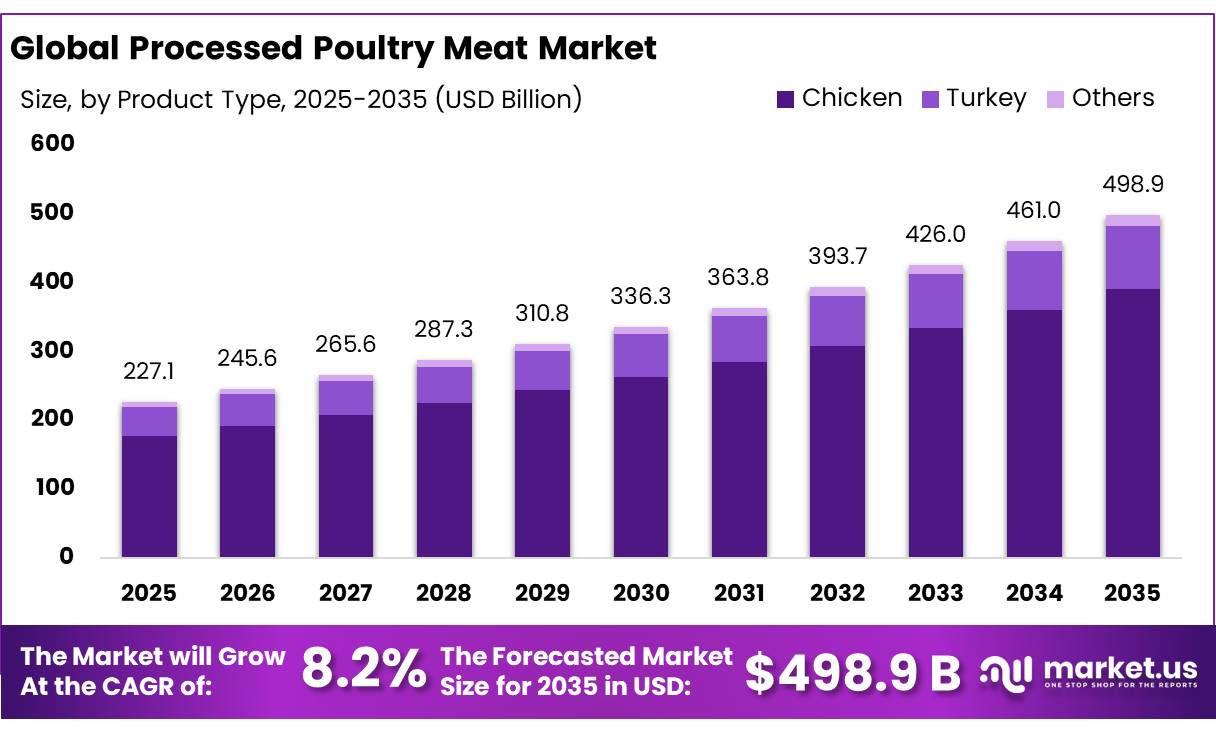
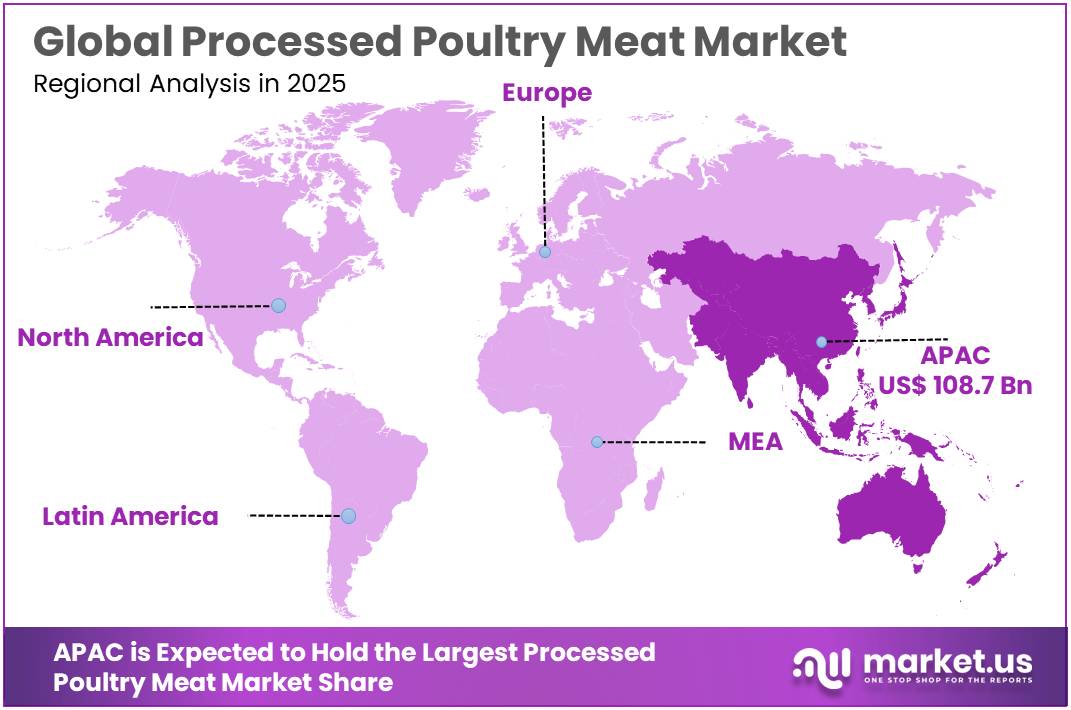
The Global Processed Poultry Meat Market size is expected to be worth around USD 498.9 Billion by 2035, from USD 227.1 Billion in 2025, growing at a CAGR of 8.2% during the forecast period from 2026 to 2035. In 2025, Asia-Pacific held a dominant market position, capturing more than a 47.90% share, holding USD 108.7 Billion revenue.
The processed poultry meat industry is an important part of the global food processing and meat production sector. It includes the processing, preservation, packaging, and distribution of chicken, turkey, and other poultry products into convenient food formats. Major products include chicken nuggets, sausages, meatballs, burgers, fillets, frozen chicken portions, deli meats, and ready-to-eat poultry meals.
- The industry is supported by rising demand for affordable animal protein, changing food consumption patterns, urbanization, and the growing preference for convenient food products. Poultry meat is gaining consumer attention because it offers a relatively affordable source of protein and has a favourable protein-to-fat ratio compared with several other meat products. According to the Food and Agriculture Organization (FAO), global meat production reached 374 million tonnes in 2024, increasing by 7 million tonnes compared with 2023.
The industrial scenario reflects increasing investment in automated slaughtering, deboning, cutting, marination, cooking, freezing, and packaging technologies. Manufacturers are focusing on improving production efficiency, maintaining product consistency, and reducing food contamination risks. Advanced processing equipment, including high-speed portioning machines, automated inspection systems, vacuum packaging, and individual quick freezing technology, is becoming important for large-scale production.
According to the USDA Economic Research Service, US broiler production reached approximately 48.0 billion pounds in 2025, representing a 2.1% increase compared with 2024. This production expansion demonstrates the importance of poultry processing facilities in meeting domestic consumption and export requirements.
Europe also maintains a strong position in processed poultry meat production through its established meat processing infrastructure and food manufacturing industry. According to Eurostat’s Key Figures on the European Food Chain 2025, European Union poultry meat production reached 14.1 million tonnes in 2024. The availability of established poultry farms, processing facilities, refrigerated transportation, and retail distribution channels supports the regional industry. Additionally, the European Commission reported that European Union poultry meat production increased by 4.6% during January–August 2026 compared with the corresponding period in 2025.
According to the OECD-FAO Agricultural Outlook 2025–2034, global poultry meat consumption is projected to reach approximately 173 million tonnes by 2034, accounting for 62% of additional meat consumption over the outlook period. Poultry meat is also projected to provide 45% of total protein consumed from meat sources by 2034. These projections highlight the long-term opportunity for processed poultry manufacturers to expand production, develop innovative food formats, and strengthen international distribution networks.
Key Takeaways
- Processed Poultry Meat Market size is expected to be worth around USD 498.9 Billion by 2035, from USD 227.1 Billion in 2025, growing at a CAGR of 8.2%.
- Chicken held a dominant market position, capturing more than a 78.33% share.
- Nuggets held a dominant market position, capturing more than a 45.78% share.
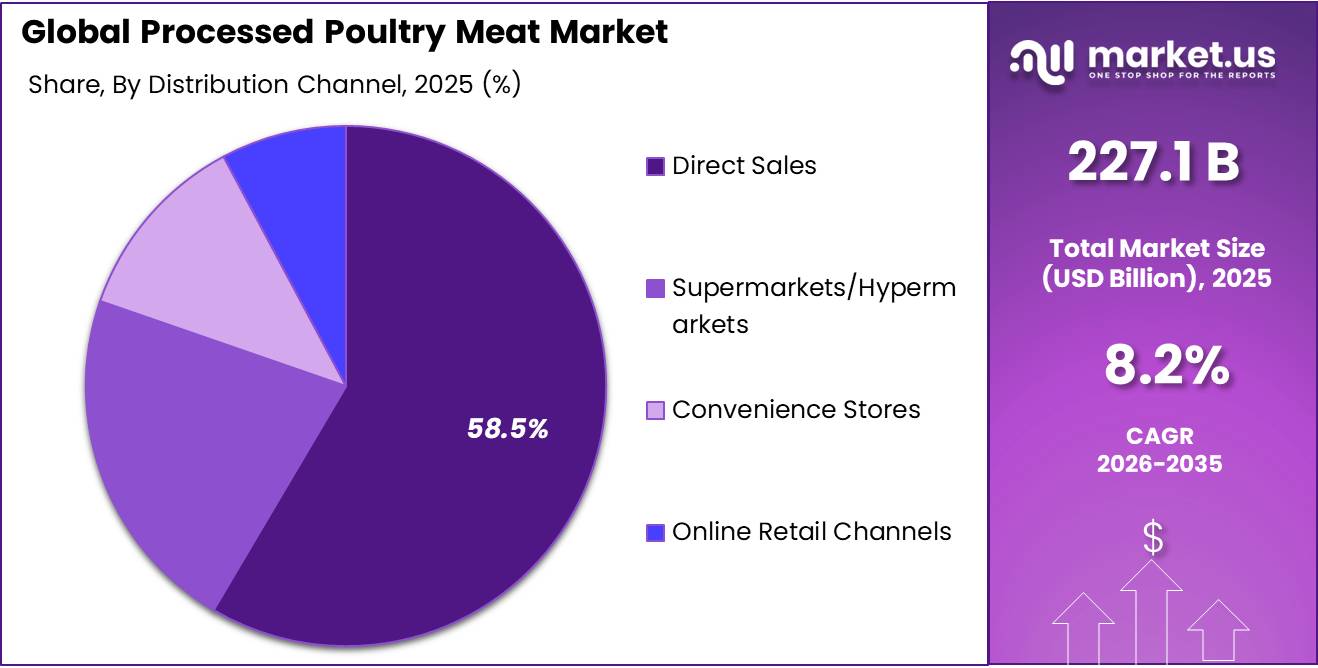
- Direct Sales held a dominant market position, capturing more than a 58.56% share.
- Asia-Pacific held a dominant position in the processed poultry meat market, accounting for 47.90% of the global market, with a reported market volume of 108.7 Bn.
By Product Type Analysis
Chicken – Dominates the market due to its affordability, widespread consumption, and suitability for value-added food products.
In 2025, “Chicken” held a dominant market position, capturing more than a 78.33% share of the processed poultry meat market. Chicken maintains its leading position because of its affordable pricing, widespread consumer acceptance, and availability across different processed food categories, including nuggets, sausages, burgers, fillets, and ready-to-cook meals. Its versatility allows manufacturers to supply retail, foodservice, and quick-service restaurant channels.
According to the USDA Foreign Agricultural Service, global chicken meat production reached approximately 108.37 million metric tonnes in 2025, with the United States contributing 21.77 million tonnes, China 16.50 million tonnes, and Brazil 15.45 million tonnes. This strong production base supports the availability of raw materials for processed chicken manufacturers.
Turkey remains an important product category in the processed poultry meat market, supported by demand for lean protein, sliced deli meat, sausages, burgers, smoked turkey, and ready-to-eat products. Its relatively low fat content and suitability for premium and health-focused food products encourage manufacturers to include turkey-based options in their product portfolios.
According to the USDA Economic Research Service, US turkey meat production reached 4.84 billion pounds in 2025, while the production value increased to USD 5.58 billion. In 2026, production is projected to reach 5.13 billion pounds, indicating continued availability of raw material for processing companies. The USDA also reported that 193.5 million turkeys were produced in the United States in 2025.
By Form Analysis
Nuggets – Dominates the market due to convenience, affordability, and strong demand for ready-to-cook poultry products.
In 2025, “Nuggets” held a dominant market position, capturing more than a 45.78% share of the processed poultry meat market. Nuggets remain a leading product form because of their convenience, easy preparation, consistent taste, and popularity among children and adult consumers. Their availability through supermarkets, quick-service restaurants, frozen food retailers, and foodservice outlets supports regular demand.
According to the USDA Economic Research Service, US per-capita broiler meat availability was projected to reach 102.7 pounds in 2025, reflecting the strong underlying demand for chicken-based products. The USDA Agricultural Marketing Service also maintains a dedicated commercial specification for fully cooked, individually frozen chicken nuggets, fingers, strips, fritters, and patties, supporting standardized procurement and product quality.
Deli meats represent an important segment of the processed poultry meat market, supported by demand for convenient, ready-to-eat food products. Chicken and turkey deli meats are widely used in sandwiches, wraps, salads, breakfast meals, and packaged lunch products. Their convenience and suitability for retail and foodservice applications encourage manufacturers to expand sliced, smoked, roasted, seasoned, and vacuum-packed product varieties.
In 2025, US turkey meat production reached 4.84 billion pounds, providing an important raw-material base for turkey-based processed products, including deli meats. The USDA Agricultural Marketing Service also maintained its Federal Purchase Program Specification for Deli-Style Turkey Breast, effective March 2025. Its procurement specification includes a purchase unit of 960 cases, equivalent to 38,400 pounds of fully cooked deli-style turkey breast.
By Distribution Channel Analysis
Direct Sales – Dominates the market through direct customer relationships, bulk purchasing, and better control over product distribution.
In 2025, “Direct Sales” held a dominant market position, capturing more than a 58.56% share of the processed poultry meat market. This channel maintains its strong position as poultry manufacturers and processors increasingly focus on supplying products directly to retailers, foodservice operators, restaurants, institutional buyers, and large-volume customers.
The channel also supports regular supply of frozen chicken nuggets, sausages, burgers, deli meats, and other value-added poultry products. According to the USDA Economic Research Service, total US food expenditure reached USD 2.51 trillion in 2025, reflecting the scale of the food distribution industry. The strong demand for food products across retail and foodservice channels provides opportunities for poultry processors to strengthen direct supply agreements and expand distribution networks.
Supermarkets/Hypermarkets represent an important distribution channel for processed poultry meat because they provide consumers with access to multiple product varieties under one roof. These stores offer frozen nuggets, chicken sausages, burgers, ready-to-cook poultry, and packaged deli meats through dedicated refrigerated and frozen food sections. Their established cold-storage facilities, promotional activities, private-label products, and broad retail networks support product visibility and repeat purchases.
According to the USDA Economic Research Service, grocery stores accounted for 56.2% of US food-at-home expenditure in 2025, making them the largest food-at-home retail outlet category. Warehouse clubs and supercenters contributed another 26.4%, reflecting the importance of large-format retail outlets in food distribution.
Key Market Segments
By Product Type
- Chicken
- Turkey
- Others
By Form
- Nuggets
- Deli Meats
- Sausages
- Tenders/Marinates
- Meatballs
- Others
By Distribution Channel
- Supermarkets/Hypermarkets
- Convenience Stores
- Online Retail Channels
- Drect Sales
Driver Analysis
Affordable Poultry Substitution
Poultry’s relative affordability supports substitution from more expensive meat proteins, expanding the customer base from which processors can sell marinated, formed, coated and cooked products. The July 2025 OECD–FAO Agricultural Outlook identifies poultry as the most affordable meat and projects global poultry consumption to grow approximately 21% to 173 million tonnes ready-to-cook equivalent by 2034, accounting for 62% of additional meat consumption and 45% of protein consumed from meat sources. These figures cover total poultry, not processed poultry, and therefore establish the upstream demand context rather than a processed-market forecast.
Current company results show the importance of keeping price and volume distinct: Tyson’s November 2026 release reported a 2.1% adjusted Chicken volume increase and a 0.8% average-price increase for fiscal 2026, while its Beef segment reported a 10.6% volume decline and 10.2% average-price increase; these diversified segment results are consistent with different affordability conditions but do not establish direct consumer switching or isolate further-processed chicken.
In an illustrative 100-g cooked protein portion, a USD 3.00/kg raw-material cost advantage combined with a common 75% cooking yield produces approximately USD 0.40 of ingredient savings per portion before processing differences. At ten million portions, the theoretical saving is USD 4 million, which can support lower customer prices, retained margin or both; the assumed cost gap and yield are not industry averages. The +0.9 pp contribution assumes 30% revenue exposure grows 3.0 percentage points faster through net substitution from non-poultry proteins into qualifying processed products, excluding growth that remains entirely in unprocessed poultry.
Drivers Impact Analysis
| Driver | (~) % Impact on CAGR Forecast | Geographic Relevance | Impact Timeline |
|---|---|---|---|
| Affordable poultry substitution | +0.9 pp | US, Mexico, Brazil, India, Southeast Asia | Short term (≤ 2 years) |
| Ready-to-heat household adoption | +0.8 pp | US, Canada, UK, Western Europe | Short term (≤ 2 years) |
| Standardized foodservice preparation | +0.8 pp | North America, EU, Gulf states | Short term (≤ 2 years) |
| Protein-led product renewal | +0.6 pp | US, Canada, UK, Western Europe | Short term (≤ 2 years) |
| Committed further-processing capacity | +0.6 pp | US; connected retail and foodservice channels | Medium term (2–4 years) |
Restraint Analysis
Processing-Premium Purchase Rejection
The UK Food Security Digest 2025 reported food prices 7% higher in real terms in October 2025 than in January 2020, food-price inflation of 4.9% year on year that October, and concern about food prices among 91% of respondents to the Food Standards Agency’s September 2025 tracker. These are affordability indicators, not processed-poultry elasticity estimates; the same publication records long-term growth in convenience-meat purchases, so pressure should not be interpreted as universal category contraction.
In an illustrative matched edible-weight comparison, a processed product at USD 6.00/kg versus a raw-poultry alternative at USD 4.00/kg carries a 50% acquisition-price premium, or USD 1.00 per 500-g purchase before cooking yield, preparation time and waste differences. If a manufacturer raises realization from USD 4.00/kg to USD 4.32/kg while volume falls from ten million to 9.3 million kg, nominal sales edge up from USD 40.0 million to USD 40.176 million, but constant-price revenue falls 7%.
At assumed variable costs increasing from USD 3.00/kg to USD 3.24/kg, contribution rises only from USD 10.0 million to USD 10.044 million before commercial expenditure, illustrating why cost recovery need not produce real demand growth. The −0.5 pp deduction assumes 25% revenue exposure grows 2.0 percentage points more slowly through rejected processing premiums and reduced purchase frequency, excluding equal-value switching between processed-poultry brands.
Restraint Impact Analysis
| Restraint | (~) % Impact on CAGR Forecast | Geographic Relevance | Impact Timeline |
|---|---|---|---|
| Processing-premium purchase rejection | −0.5 pp | US, Canada, UK, Western Europe | Short term (≤ 2 years) |
| Recall-driven product withdrawals | −0.4 pp | US retail, foodservice, institutions | Short term (≤ 2 years) |
| Disease-linked import exclusions | −0.3 pp | Brazil–Great Britain; restricted export corridors | Short term (≤ 2 years) |
| Preserved-meat purchase avoidance | −0.3 pp | UK, EU, US, Canada | Medium term (2–4 years) |
| HFSS advertising restrictions | −0.2 pp | UK advertising; England promotions | Short term (≤ 2 years) |
Opportunity Analysis
Specification-Led School Contracts
Domestic processed-poultry products engineered against school-meal specifications could capture additional menu occasions where existing recipes fail procurement, sodium or meal-crediting requirements, creating a qualification-led opportunity rather than ordinary institutional foodservice growth.
USDA’s implementation framework phases the permitted share of non-domestic school-food purchases from 10% in school year 2025–2026 to 8% in 2028–2029 and 5% in 2031–2032, subject to applicable exceptions and accommodations; these limits apply to total covered food purchases, not poultry alone. Its updated nutrition standards also require an approximately 15% sodium reduction at lunch from school year 2027–2028, assessed at meal-program level rather than as a universal reduction requirement for every chicken product.
Manufacturers can substantiate meal-pattern contributions through a product formulation statement, but documentation alone does not guarantee contract award. In an illustrative program covering 500 schools, 500 lunches daily, 180 school days and a 10% allocation to a newly qualified 75-g poultry component, annual demand reaches 337.5 tonnes, or USD 1.35 million at an assumed USD 4/kg realization. If 60% replaces existing processed-poultry purchases, net category expansion falls to USD 540,000.
A hypothetical USD 0.15/kg formulation-and-verification premium costs USD 50,625 across the contracted volume before tender support and development expenditure. The +0.35 pp contribution assumes 7% revenue exposure grows 5.0 percentage points faster through genuinely additional qualified menu placements, excluding import-source replacement and routine school sales already counted in the baseline.
Opportunity Impact Analysis
| Opportunity | (~) % Potential CAGR Upside | Geographic Relevance | Execution Window |
|---|---|---|---|
| Specification-led school contracts | +0.35 pp | US school procurement | Short term (≤ 2 years) |
| Texture-qualified care products | +0.30 pp | UK, Germany, US, Canada, Australia | Medium term (2–4 years) |
| Ambient poultry meal components | +0.30 pp | India, Indonesia, Philippines, South Africa | Medium term (2–4 years) |
| Shared-platform private labels | +0.25 pp | US, Canada, UK, Germany | Medium term (2–4 years) |
| Dual-qualified halal ranges | +0.20 pp | UK, EU, Canada; Gulf destinations | Medium term (2–4 years) |
Challenges Analysis
Continuous Pathogen-Control Workload
FSIS’s January 2025 inspection workbook identifies Listeria monocytogenes as a hazard that post-lethality-exposed ready-to-eat establishments must control through their HACCP plan or prevent through sanitation procedures or another prerequisite program; it distinguishes combinations of post-lethality treatments, growth-control measures and sanitation-based approaches rather than prescribing one universal operating model.
FSIS also announced additional sampling, inspector-training and oversight measures in its January 2025 review of the broader ready-to-eat sector, providing current context for the sustained verification burden without implying that a non-poultry outbreak measures poultry-plant risk.
In an illustrative facility operating 250 days annually, 30 environmental samples per operating day produce 7,500 samples; at an assumed USD 25 per sample, direct analytical expenditure is USD 187,500 before labor, consumables and investigations. An additional 20 minutes of sanitation verification daily consumes approximately 83.3 operating hours annually; at USD 1,000 contribution capacity per hour, exposure is USD 83,333 only if the time displaces otherwise saleable production. Those costs cannot simply be added to market-revenue losses.
Manufacturers need trend-based sampling, hygienic equipment design, root-cause investigation and documented release decisions. The −0.35 pp contribution assumes 17.5% revenue exposure grows 2.0 percentage points more slowly through incremental preventive-control expenditure and residual production holds, excluding recalled sales and cooking or cooling costs allocated separately.
Challenges Impact Analysis
| Challenge | (~) % CAGR Friction Drag | Geographic Relevance | Mitigation Horizon |
|---|---|---|---|
| Continuous pathogen-control workload | −0.35 pp | US, Canada, UK, EU processing hubs | Long term (≥ 4 years) |
| Labor retention and ergonomics | −0.35 pp | US, Canada, UK, Western Europe | Long term (≥ 4 years) |
| Raw-material functionality variability | −0.30 pp | US, Brazil, EU, Thailand | Long term (≥ 4 years) |
| Thermal yield and cooling | −0.30 pp | North America, EU, Brazilian export hubs | Medium term (2–4 years) |
| Portfolio changeover complexity | −0.20 pp | US, UK, EU multi-product plants | Medium term (2–4 years) |
Geopolitical Impact Analysis
Geopolitical Impact of Ongoing Wars on the Processed Poultry Meat Market
Ongoing geopolitical conflicts, particularly the Russia-Ukraine war and tensions in the Middle East, are creating cost and supply-chain pressures for the processed poultry meat industry. Disruptions to Black Sea trade routes, higher fuel costs, shipping delays, and uncertainty in international grain supplies can increase the cost of corn and soybean meal, which are essential ingredients in poultry feed. These pressures affect poultry farming, processing, cold storage, packaging, and transportation.
The Middle East conflict has also affected fuel and maritime transport costs, increasing expenses for refrigerated storage and long-distance delivery. The OECD reported that the disruption of vessel traffic through the Strait of Hormuz in March 2026 contributed to higher diesel and marine fuel prices. In addition, FAO reported that global fertilizer trade volumes declined by 20% to 25% between January and April 2026 compared with the same period in 2025. These developments may indirectly increase poultry production costs through feed and energy prices.
Regional Insights
Asia-Pacific – Dominates the market due to high poultry consumption, strong processing capacity, and expanding demand for convenient protein products.
In 2025, Asia-Pacific held a dominant position in the processed poultry meat market, accounting for 47.90% of the global market, with a reported market volume of 108.7 Bn. The region benefits from strong poultry production, increasing demand for affordable animal protein, expanding foodservice networks, and growing consumption of frozen and ready-to-cook products. China, Japan, Thailand, and other Southeast Asian markets support regional demand through established poultry farming and food processing industries.
According to the USDA Foreign Agricultural Service, China’s chicken meat production reached 16.50 million metric tonnes in 2025, compared with 15.35 million metric tonnes in 2024. Thailand also recorded production of 3.60 million metric tonnes in 2025. These production levels support the availability of raw materials for nuggets, sausages, burgers, and other processed poultry products.
Asia-Pacific is also positioned for strong future growth as manufacturers expand automated processing facilities, frozen food production, and retail distribution networks. China’s chicken meat production is projected to reach 18 million metric tonnes in 2026, compared with 16.50 million metric tonnes in 2025, according to USDA estimates.
The OECD-FAO Agricultural Outlook 2025–2034 also identifies Asia as an important contributor to future livestock production growth, supported by rising incomes, population growth, and increasing demand for animal-source foods. Growing supermarket penetration, quick-service restaurant expansion, and investments in cold-chain infrastructure are expected to create further opportunities for processed poultry manufacturers.
Key Regions and Countries Insights
- North America
- US
- Canada
- Europe
- Germany
- France
- The UK
- Spain
- Italy
- Rest of Europe
- Asia Pacific
- China
- Japan
- South Korea
- India
- Australia
- Rest of APAC
- Latin America
- Brazil
- Mexico
- Rest of Latin America
- Middle East & Africa
- GCC
- South Africa
- Rest of MEA
Key Players Analysis
Tyson Foods maintains a strong position in the processed poultry meat industry through its chicken processing operations and established food brands. In fiscal 2025, the company recorded total sales of USD 54.44 billion, while its Chicken segment generated USD 16.84 billion in sales, compared with USD 16.43 billion in 2024. The company operated 167 chicken facilities and reported weekly processing capacity of approximately 42 million birds. Its operations support fresh, frozen, and prepared chicken product supplies.
JBS S.A. strengthens its market presence through its global poultry operations, particularly under its Seara and Pilgrim’s Pride businesses. In 2025, JBS reported consolidated net revenue of USD 86.18 billion, while its Seara segment generated USD 9.17 billion in revenue, representing a 4.5% increase over 2024. Seara achieved an EBITDA margin of 16.9%, supported by export demand, domestic sales, and value-added poultry products. Its international distribution network supports processed chicken supplies across multiple markets.
BRF S.A., now part of MBRF, has an established presence in processed poultry products through its Sadia and Perdigão brands. In 2025, the BRF operation recorded net revenue of approximately BRL 65 billion, representing 5.8% growth compared with 2024. Its domestic processed product sales volume increased by 7%, supported by stronger retail demand and an 8% increase in its customer base. The company also expanded processing capacity and invested in automation and higher-value poultry products to strengthen its international presence.
Top Key Players Outlook
- Tyson Foods
- JBS S.A.
- BRF S.A.
- Cargill, Incorporated
- Pilgrim’s Pride Corporation
- Perdue Farms, Inc.
- Wayne-Sanderson Farms, Inc.
- Koch Foods, Inc.
- Foster Farms
- Hormel Foods Corporation
- Marfrig Global Foods S.A.
- Maple Leaf Foods Inc.
- Other Key Players
Recent Developments
- In September 2026, Cargill announced an investment of more than USD 130 million over two years to expand poultry operations in Thailand and the Philippines.
- In August 2026, Pilgrim’s Pride, through its UK subsidiary, agreed to acquire Walkers Deli & Sausage Company from Samworth Brothers for approximately USD 187.7 million, subject to regulatory approval.
Report Scope
| Report Features | Description |
|---|---|
| Market Value (2025) | USD 227.1 Bn |
| Forecast Revenue (2035) | USD 498.9 Bn |
| CAGR (2026-2035) | 8.2% |
| Base Year for Estimation | 2025 |
| Historic Period | 2020-2024 |
| Forecast Period | 2026-2035 |
| Report Coverage | Revenue Forecast, Market Dynamics, Competitive Landscape, Recent Developments |
| Segments Covered | By Product Type (Chicken, Turkey, Others), By Form (Nuggets, Deli Meats, Sausages, Tenders/Marinates, Meatballs, Others), By Distribution Channel ( Supermarkets/Hypermarkets, Convenience Stores, Online Retail Channels, Drect Sales) |
| Regional Analysis | North America – US, Canada; Europe – Germany, France, The UK, Spain, Italy, Rest of Europe; Asia Pacific – China, Japan, South Korea, India, Australia, Singapore, Rest of APAC; Latin America – Brazil, Mexico, Rest of Latin America; Middle East & Africa – GCC, South Africa, Rest of MEA |
| Competitive Landscape | Tyson Foods, JBS S.A., BRF S.A., Cargill, Incorporated, Pilgrim’s Pride Corporation, Perdue Farms, Inc., Wayne-Sanderson Farms, Inc., Koch Foods, Inc., Foster Farms, Hormel Foods Corporation, Marfrig Global Foods S.A., Maple Leaf Foods Inc., Other Key Players |
| Customization Scope | Customization for segments, region/country-level will be provided. Moreover, additional customization can be done based on the requirements. |
| Purchase Options | We have three licenses to opt for: Single User License, Multi-User License (Up to 5 Users), Corporate Use License (Unlimited User and Printable PDF) |