Report Overview
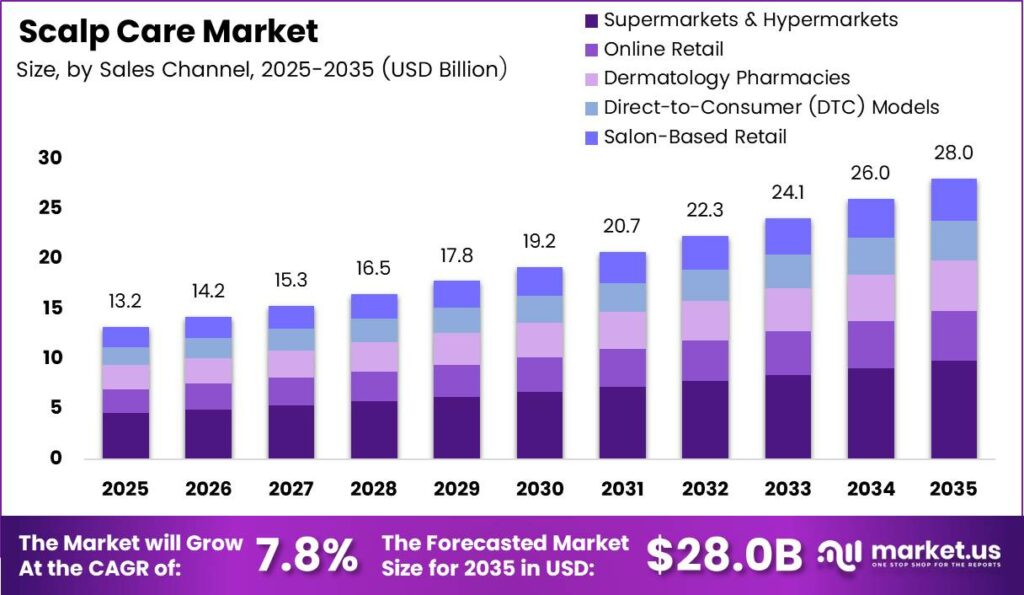
Global Scalp Care Market size is expected to be worth around USD 28.0 Billion by 2035 from USD 13.2 Billion in 2025, growing at a CAGR of 7.8% during the forecast period 2026 to 2035. Scalp care includes topical products that cleanse, hydrate, exfoliate, or manage specific scalp concerns. Manufacturers capture value by converting occasional symptom relief into repeat purchases, making product tolerability and sustained use central to commercial performance.
Scalp care connects consumer beauty, professional salon services, and pharmacy retail, with each channel supporting different price points and purchase triggers. According to Cosmetics Europe, European haircare retail sales reached EUR 18.1 billion in 2024, establishing a substantial adjacent spending pool. Concern-specific scalp products compete for that spending through targeted formulations rather than cleansing volume alone. Investors should assess repeat purchase rates because initial trial does not establish durable category participation.
Key Takeaways
- The global Scalp Care Market reached USD 13.2 Billion in 2025.
- The forecast market value reaches USD 28.0 Billion by 2035.
- The forecast CAGR is 7.8% during 2026 to 2035.
- Scalp Serums held a 31.67% product type share in 2025.
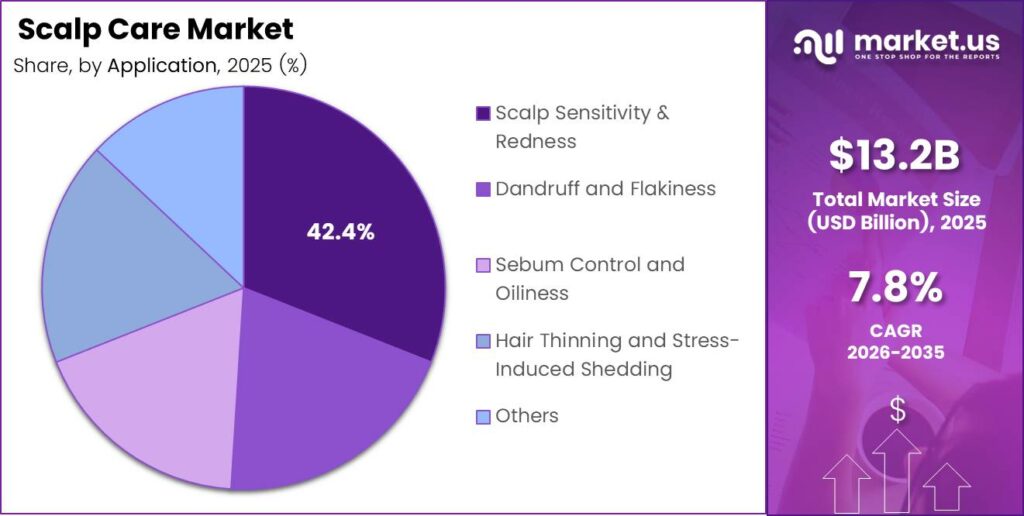
- Scalp Sensitivity & Redness held a 30.67% application share in 2025.
- Supermarkets & Hypermarkets held a 34.89% sales channel share in 2025.
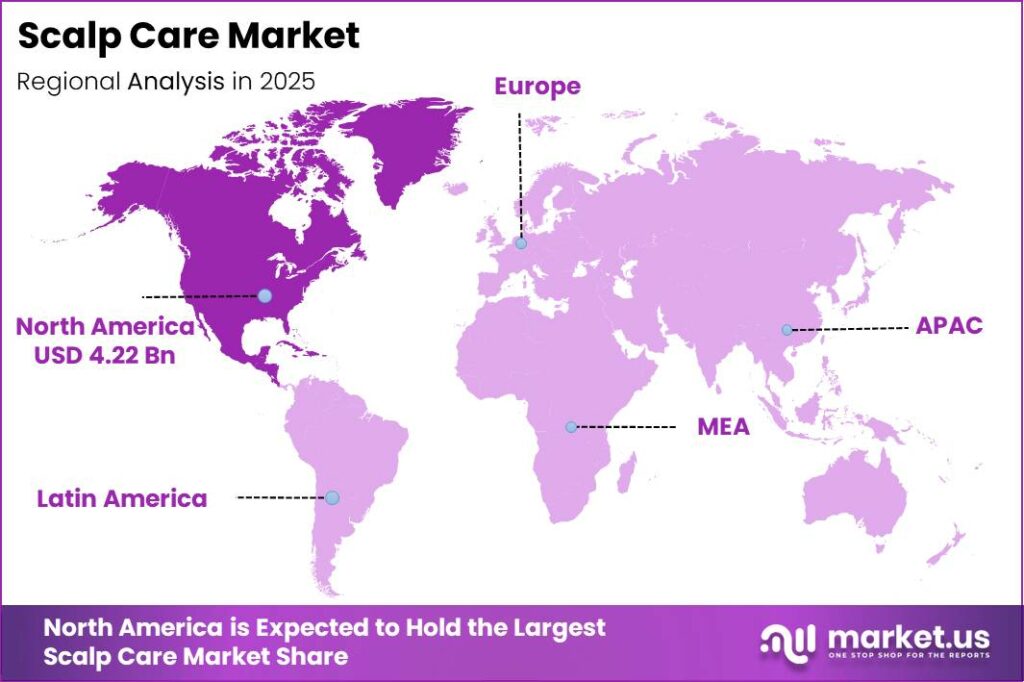
- North America held a 32.78% regional share in 2025, with a separately stated valuation of USD 4.22 Billion.
- Asia-Pacific represents the fastest-growing region across the 2026 to 2035 forecast period.
Government oversight makes claim discipline a commercial priority, particularly when products sit between cosmetic maintenance and therapeutic treatment. As reported by L’Oréal, its professional premium haircare segment grew 15% in 2025, demonstrating premium positioning rather than regulatory approval. Manufacturers should pair higher prices with clear substantiation because premium language alone cannot establish treatment performance. Buyers gain stronger differentiation when suppliers separate cosmetic benefits from claims requiring a different regulatory pathway.
Professional innovation infrastructure supports faster formulation testing and closer links between laboratory work and salon feedback. Data from Henkel shows that its Hamburg House of Hair consolidated activities across approximately 9,400 square meters in March 2025. The facility illustrates how integrated research, education, and testing can shorten commercial feedback loops. Suppliers gain an execution advantage when product development reflects actual application practices rather than laboratory performance without user validation.
North America leads the market with a 32.78% share in 2025, making regional distribution a priority for manufacturers seeking premium positioning. The commercial case rests on connecting concern-specific products with accessible retail advice and professional recommendation. Suppliers should treat shelf placement, replenishment, and customer education as linked investments rather than separate marketing tasks. Regional expansion creates durable value only when products earn repeat use without relying on repeated promotional discounts.
Product Type Analysis
Scalp Serums dominate with 31.67% share in 2025 due to targeted delivery and repeat treatment use.
In 2025, Scalp Serums held a 31.67% share in the Product Type segment of the Scalp Care Market. Aveda found that its overnight serum improved scalp hydration by 105% versus untreated control after one application among 32 women. Leave-on contact supports sustained ingredient delivery, making hydration a measurable purchase benefit. Suppliers should protect that premium through tolerable formulations, precise dispensing, and clear instructions that support repeated application without excessive residue.
Anti-Dandruff Product purchases center on controlling visible flakes while maintaining an acceptable cleansing experience for regular users. Based on FDA data, qualifying rinse-off dandruff products can contain pyrithione zinc at 0.3% to 2%. The permitted concentration range shapes formulation choices because active delivery must work alongside cleansing agents and scalp tolerance. Manufacturers therefore compete on compliant efficacy and repeat use, while distributors need jurisdiction-specific checks before extending assortments across borders.
Microbiome-Modulating Formulas position scalp balance as a maintenance objective rather than treating visible flakes as the sole purchase trigger. L’Oréal indicates that its scalp research evaluated more than 200 participants across barrier, microbiome, and inflammatory measures. Microbial balance can interact with scalp conditions, making formulation assessment more complex than ingredient inclusion alone. Investors should prioritize reproducible endpoints because a research sample establishes investigative depth, not category-wide efficacy or a proven commercial advantage.
Application Analysis
Scalp Sensitivity & Redness dominates with 30.67% share in 2025 due to comfort-focused routines and frequent maintenance needs.
In 2025, Scalp Sensitivity & Redness held a 30.67% share in the Application segment of the Scalp Care Market. Figures from L’Oréal Professionnel show up to 83% greater soothing after its specified regimen, based on self-assessment by 32 subjects. Comfortable cleansing supports continued use because harsh formulas can discourage adherence despite targeted benefits. Suppliers should distinguish perceived soothing from clinical redness reduction when setting claims, pricing, and professional recommendations.
Dandruff and Flakiness creates a recurring purchase occasion because consumers judge products through visible scalp and hair appearance. According to FDA, the OTC dandruff monograph specifies salicylic acid concentrations of 1.8% to 3%. Salicylic acid supports scale removal, connecting formulation strength directly to the flaking concern rather than general hair conditioning. Manufacturers should balance that function with tolerability, while retailers benefit from clear product guidance that separates maintenance routines from inappropriate therapeutic promises.
Sebum Control and Oiliness targets consumers who experience greasy roots, scalp buildup, and shorter intervals between cleansing. As reported by Aveda, its exfoliating scalp treatment reduced scalp oil by 76% immediately after one application in company testing. Oil removal creates a direct functional link between cleansing performance and perceived freshness. Suppliers should pair immediate results with repeat-use tolerance because aggressive cleansing may weaken acceptance even when a product delivers a strong initial impression.
Sales Channel Analysis
Supermarkets & Hypermarkets dominate with 34.89% share in 2025 due to broad access and routine replenishment convenience.
In 2025, Supermarkets & Hypermarkets held a 34.89% share in the Sales Channel segment of the Scalp Care Market. Data from Walmart shows that its US business operated 4,611 stores in fiscal 2026, illustrating mass-retail reach rather than scalp-specific distribution. Routine shopping lowers replenishment effort, supporting familiar products with clear shelf communication. Manufacturers should prioritize stock availability and efficient pack architecture because broad placement delivers little value when shoppers cannot quickly identify the relevant benefit.
Online Retail expands access to specialized formulations that may not justify permanent shelf space in every physical store. US Census Bureau found that ecommerce represented 16.4% of total US retail sales in the second quarter of 2026. Digital assortment economics support narrower scalp concerns because sellers can aggregate geographically dispersed buyers. Brands should invest in useful product education and repeat ordering, while monitoring acquisition costs that can erode the apparent advantage of direct digital access.
Dermatology Pharmacies occupy an advice-oriented position where shoppers seek help choosing products for persistent or uncomfortable scalp concerns. Based on Walgreens Boots Alliance data, its US Retail Pharmacy segment generated USD 26.911 billion in retail sales during fiscal 2024. That broader pharmacy measure illustrates channel scale, not specialist dermatology sales. Suppliers should equip pharmacy teams with accurate benefit boundaries because credible recommendation can support conversion without turning cosmetic products into unsupported medical treatments.
Key Market Segments
By Product Type
- Scalp Serums
- Anti-Dandruff Product
- Microbiome-Modulating Formulas
- Exfoliating Scalp Tonics
- Clay-Based Detox Masks
- Others
By Application
- Scalp Sensitivity & Redness
- Dandruff and Flakiness
- Sebum Control and Oiliness
- Hair Thinning and Stress-Induced Shedding
- Others
By Sales Channel
- Supermarkets & Hypermarkets
- Online Retail
- Dermatology Pharmacies
- Direct-to-Consumer (DTC) Models
- Salon-Based Retail
Regional Analysis
North America Dominates the Scalp Care Market with a Market Share of 32.78% in 2025, with a Separately Stated Valuation of USD 4.22 Billion
North America held a 32.78% share in 2025, although its USD 4.22 billion valuation requires denominator reconciliation before direct comparison. PCPC indicates that US personal care generated USD 495.6 billion in economic output during 2024, illustrating ecosystem depth rather than retail sales. Suppliers can use that broader infrastructure to support product development, distribution, and customer service. Investors should distinguish ecosystem strength from market revenue when assessing regional scale and investment returns.
Asia-Pacific represents the fastest-growing regional opportunity, but company-level performance should not substitute for a region-wide scalp-care forecast. Figures from L’Oréal show North Asia sales increased 0.5% like-for-like in 2025, covering a narrower geography and broader portfolio. That distinction favors country-specific entry plans rather than treating Asia-Pacific as a uniform growth engine. Manufacturers should match pricing, channel selection, and product communication to local buying behavior before committing to broad distribution expansion.
Key Regions and Countries
North America
- US
- Canada
Europe
- Germany
- France
- The UK
- Spain
- Italy
- Rest of Europe
Asia Pacific
- China
- Japan
- South Korea
- India
- Australia
- Rest of APAC
Latin America
- Brazil
- Mexico
- Rest of Latin America
Middle East and Africa
- GCC
- South Africa
- Rest of MEA
Market Dynamics
Scalp-care competition depends on formulation performance, repeat purchase, and the regulatory route attached to each product’s claims. According to FDA, covered cosmetic facilities must renew registration every 2 years, making compliance an ongoing operating responsibility. Registration does not establish product approval, so manufacturers must manage benefit language separately from facility obligations. Investors should evaluate regulatory discipline alongside sales execution because preventable compliance failures can interrupt distribution and delay returns on product development spending.
Drivers
Dermocosmetic premiumization shifts competition from basic cleansing toward concern-specific routines, creating room for higher-value baskets when consumers recognize practical benefits. The commercial scenario assumes migration across 5% of spending at a 13% price-and-mix uplift, implying approximately 0.65 percentage points of annual growth contribution. Those assumptions describe a planning bridge, not observed market performance. Manufacturers should test whether repeat purchases sustain the premium after sampling, substantiation, and promotional costs reduce gross margin.
Recurring maintenance, online access, salon recommendation, and mass-brand expansion support different routes to repeat purchasing rather than interchangeable sources of incremental revenue. The driver estimates describe contributions embedded within the 7.8% baseline, not upside that investors should add again. Sellers should therefore assess channel overlap before assigning growth credit to separate initiatives. Buyers benefit when broader access accompanies clear product selection, while suppliers gain more durable economics from retention than from duplicated customer acquisition spending.
| Driver | (~) % Impact on CAGR Forecast | Geographic Relevance | Impact Timeline |
|---|---|---|---|
| Dermocosmetic scalp-care premiumization | +0.65% | Global; North America, Europe, urban Asia | Short term (≤ 2 years) |
| Recurring dandruff maintenance demand | +0.45% | Global | Short term (≤ 2 years) |
| Online specialty-product accessibility | +0.30% | Asia-Pacific, North America, Europe | Short term (≤ 2 years) |
| Salon-led scalp-service attachment | +0.25% | East Asia, Europe, North America | Medium term (2–4 years) |
| Mass-brand scalp-range expansion | +0.20% | Global; organized retail markets | Short term (≤ 2 years) |
Restraints
Ingredient restrictions can exclude a formulation from sale rather than merely raise its administrative costs, changing the economics of cross-border expansion. The EU zinc pyrithione prohibition took effect in March 2022, so the modeled 0.40-percentage-point restraint represents continuing incompatibility rather than a new restriction. Manufacturers should evaluate reformulation and regional inventory before assuming global product portability. The commercial risk centers on unrecovered conversion and delayed launches, not permanent loss of every historical sale.
The planning sensitivity assumes 5% of intended sales face jurisdictional incompatibility and 8% of that exposed pool remains unrecovered. Their product implies a 0.40% sales-growth shortfall, not an independently measured CAGR reduction. Affordability, therapeutic claims, tariffs, and retailer selection create separate barriers that may overlap. Suppliers should therefore model exposure by product and jurisdiction, while investors should avoid adding correlated restraints as though each affects a distinct revenue pool.
| Restraint | (~) % Impact on CAGR Forecast | Geographic Relevance | Impact Timeline |
|---|---|---|---|
| Prohibited-active cosmetic sales exclusions | -0.40% | European Union; exporters serving Europe | Short term (≤ 2 years) |
| Household affordability ceilings | -0.35% | Price-sensitive emerging markets | Short term (≤ 2 years) |
| Unapproved therapeutic-claim sales barriers | -0.25% | United States; regulated therapeutic markets | Short term (≤ 2 years) |
| Import duties on finished formulations | -0.15% | Import-dependent, tariff-exposed markets | Short term (≤ 2 years) |
| Retail assortment and delisting barriers | -0.10% | Concentrated pharmacy and grocery channels | Short term (≤ 2 years) |
Challenges
Maritime volatility creates an operating challenge when ingredients, dispensing components, and finished products depend on synchronized international replenishment. An illustrative stress test adds 14 transit days to a 60-day replenishment cycle, raising pipeline inventory requirements by approximately 23%. Those figures describe a hypothetical operating case rather than current shipping conditions. Manufacturers face a working-capital tradeoff because extra inventory protects availability while absorbing cash that could otherwise support marketing, testing, or product development.
Additional safety stock of 2 weeks compounds cash requirements, while the modeled 0.30-percentage-point friction represents availability losses and launch delays. The scenario does not establish a causal estimate of market CAGR. Suppliers should qualify alternative components and prioritize inventory by service risk rather than purchase price alone. Efficacy testing, tolerability, specialist skills, and packaging validation create further execution burdens, making operating discipline essential before businesses expand formulation complexity or distribution commitments.
| Challenge | (~) % CAGR Friction Drag | Geographic Relevance | Mitigation Horizon |
|---|---|---|---|
| Maritime supply chain volatility | -0.30% | Asia–Europe routes; import-dependent markets | Short term (≤ 2 years) |
| Scalp efficacy measurement variability | -0.25% | Global formulation and testing networks | Medium term (2–4 years) |
| Treatment adherence and tolerability | -0.20% | Global; diverse hair textures | Medium term (2–4 years) |
| Specialist formulation talent constraints | -0.15% | Emerging manufacturing and innovation hubs | Medium term (2–4 years) |
| Packaging compatibility validation complexity | -0.10% | Global; leave-on and concentrated formats | Medium term (2–4 years) |
Opportunities
Longitudinal scalp monitoring creates a potential service model when follow-up advice and scheduled replenishment deliver benefits beyond a free initial assessment. The hypothetical case assumes 10% adoption within a pool representing 25% of spending, alongside 18% incremental spending per adopter. That bridge implies approximately 0.45 percentage points of upside before broader execution effects. Operators should prove willingness to pay and retention before investing heavily in subscription infrastructure or routine imaging capacity.
Subscription operators could target fulfillment savings of 10% to 15% and contribution-margin improvement of 2 to 4 percentage points, subject to service costs. Those figures remain execution targets rather than reported outcomes. Full opportunity capture implies 1.55 percentage points above the 7.8% baseline, producing an illustrative 9.35% CAGR without guaranteeing delivery. Early movers should validate distinct customer needs and purchase displacement before treating protective-style, menopause, water-constrained, or post-procedure formats as additive revenue streams.
| Opportunity | (~) % Potential CAGR Upside | Geographic Relevance | Execution Window |
|---|---|---|---|
| Longitudinal scalp-monitoring subscriptions | +0.45% | North America, Europe, affluent Asia-Pacific | Medium term (2–4 years) |
| Textured-hair protective-style scalp systems | +0.35% | Sub-Saharan Africa, Americas, diaspora markets | Medium term (2–4 years) |
| Menopause-specific scalp-care regimens | +0.30% | Europe, North America, East Asia | Medium term (2–4 years) |
| Water-constrained scalp-cleansing formats | +0.25% | Water-stressed urban and travel markets | Long term (≥ 4 years) |
| Post-procedure supportive scalp care | +0.20% | Specialist hair-restoration hubs worldwide | Medium term (2–4 years) |
Key Company Insights
Shiseido Professional (Henkel)
Shiseido Professional sits within a parent-company grouping that combines professional haircare capabilities with broader consumer-brand scale. As reported by Henkel, group sales reached EUR 20,495 million in fiscal 2025, providing corporate context rather than brand-specific or scalp-care revenue. Parent scale can support distribution and product development, but investors should not attribute the entire financial base to professional scalp products. Brand-level execution still depends on differentiated formulations, salon relationships, and disciplined portfolio positioning.
Henkel expanded its North American portfolio strategy through an agreement to acquire Not Your Mother’s in March 2026. Data from Henkel shows that the target generated approximately EUR 190 million in fiscal 2025 sales, indicating the acquired business’s scale rather than consideration. The agreement broadens the parent portfolio but does not establish incremental Shiseido Professional revenue. Investors should evaluate integration and channel fit before treating broader haircare exposure as evidence of scalp-care market-share gains.
L’Oréal Professionnel
L’Oréal Professionnel operates within a parent group whose professional positioning links salon recommendation with broader beauty research and distribution capabilities. L’Oréal found that consolidated sales reached EUR 44.05 billion in 2025, reflecting group scale rather than professional scalp-care revenue. That distinction matters because corporate resources support execution without proving individual product profitability. Investors should assess whether professional advice converts into repeat purchases and pricing discipline rather than assuming parent-company size guarantees category leadership.
L’Oréal’s sibling brand CeraVe commercialized anti-dandruff haircare through its February 2025 campaign, extending the parent portfolio beyond traditional skincare routines. Based on CeraVe data, the shampoo contains 1% pyrithione zinc, with company claims of up to 100% visible-flake removal under specified use conditions. The launch illustrates portfolio expansion, not a L’Oréal Professionnel product introduction. Investors should assess whether shared research strengthens differentiated propositions without blurring brand identity or overstating therapeutic performance.
Key Players
- Shiseido Professional (Henkel)
- L’Oréal Professionnel
- Kao Corporation, including Oribe
- Amorepacific Corporation
- KOS Corporation
- Estée Lauder Companies, including Aveda
- Wella Company
- Henkel, Schwarzkopf Professional
- Davines Group
- Unilever Professional (TIGI)
- Other Key Players
Recent Developments
2026
- October 2026: Head & Shoulders launched a scalp-care collection using 1.8% salicylic acid or 1% zinc pyrithione, extending mass-brand treatment choices. According to P&G, the collection includes targeted soothing, purifying, and restoring regimens.
- October 2026: Aeternia introduced infinité scalp products, including serum with 4.0% niacinamide and 0.5% piroctone olamine, creating a formulation-led proposition. As reported by the company’s PR Newswire release, the launch included shampoo and serum formats.
- October 2026: Xtressé launched professional wash systems using an in-house complex of 3 peptides, extending its positioning into cleansing and conditioning. Data from the company’s PR Newswire release shows distribution through professional practices, med spas, and its website.
- October 2026: Induction Therapies announced research innovation involving 2 patients receiving scalp microneedling at 0.5 mm across 3 monthly sessions. Induction Therapies indicates that the exploratory case series combined microneedling with a plant-derived exosome formulation; the findings do not establish efficacy or approval.
- July 2026: Solésence launched market-ready formulations including a scalp serum with 5% niacinamide and dry-shampoo sunscreen rated SPF 45+. Figures from its corporate release show a commercial formulation expansion, not a separately granted regulatory product approval.
- July 2026: Henkel completed its OLAPLEX acquisition, adding a business with approximately EUR 370 million in fiscal 2025 sales. According to Henkel, the transaction expands premium haircare exposure; the cited revenue figure does not describe purchase consideration.
- March 2026: Henkel announced an R&D capacity expansion in Trumbull exceeding 110,000 square feet, with 27 laboratories and 3 pilot plants. As reported by Henkel, the planned facility strengthens development infrastructure rather than representing completed operating capacity.
- January 2026: Kao announced scalp-analysis research involving 33 women and approximately 20,000 RNA species, supporting further investigation of non-invasive assessment. Data from Kao shows the work compared facial and scalp samples, establishing research capability rather than commercial diagnostic approval.
2025
- October 2025: Obagi Medical launched Nu-Cil BioStim Scalp Serum with a company-reported 74% reduction in dry, fallen hair after 3 months. Obagi indicates that the clinical endpoint supports its product proposition, but the measure should not become a general hair-regrowth claim.
- April 2025: Prose launched Custom Scalp Serum personalized through more than 85 factors, extending its customized product model into scalp maintenance. Figures from Prose show initial availability in the United States and Canada, connecting personalization with a defined commercial rollout.
2024
- January 2024: L’Oréal Professionnel and Zuvi unveiled AirLight Pro with a company-reported energy-consumption reduction of up to 31% versus leading premium dryers. According to L’Oréal, the innovation combines infrared-assisted drying with professional functionality; the device represents adjacent haircare technology rather than scalp treatment.
Geopolitical Impact Analysis
Red Sea shipping disruption redirected trade routes during 2024, changing the logistics assumptions behind international scalp-care supply chains. As reported by UNCTAD, Suez Canal tonnage fell 70% by midyear, while Cape of Good Hope ship arrivals increased 89%. Scalp-care manufacturers sourcing surfactants, conditioning ingredients, plastic bottles, and dispensing pumps face exposure when those shipments depend on affected routes. Longer routing can separate component arrivals from planned production, leaving usable ingredients idle because packaging has not reached the filling site. Manufacturers should evaluate supplier geography and component substitution together, while distributors should align replenishment commitments with credible arrival windows rather than standard schedules. Those historical figures illustrate exposure rather than current disruption levels.
Route diversion also absorbed transport capacity, changing the balance between vessel availability and the distance required to move goods. Data from UNCTAD shows longer routes increased global vessel ton-mile demand by 3% and container-ship ton-mile demand by 12%. Scalp serums and shampoos depend on containerized movements of finished formulations, glass containers, plastic closures, and secondary cartons. Capacity pressure can raise scheduling uncertainty even when suppliers maintain production, complicating promotional launches and retailer replenishment commitments. Manufacturers should compare regional sourcing costs against avoided delays, while buyers should assess availability alongside unit prices when selecting suppliers. Those transport measurements do not quantify scalp-care freight inflation, retail-price changes, or conditions persisting through 2026.
Report Scope
| Report Features | Description |
|---|---|
| Market Value (2025) | USD 13.2 Billion |
| Forecast Revenue (2035) | USD 28.0 Billion |
| CAGR (2026-2035) | 7.8% |
| Base Year for Estimation | 2025 |
| Historic Period | 2021-2025 |
| Forecast Period | 2026-2035 |
| Report Coverage | Revenue Forecast, Market Dynamics, Market Opportunity Analysis, Technology and Innovation Landscape, Competitive Landscape, Recent Developments |
| Segments Covered | Product Type: Scalp Serums, Anti-Dandruff Product, Microbiome-Modulating Formulas, Exfoliating Scalp Tonics, Clay-Based Detox Masks, Others. Application: Scalp Sensitivity & Redness, Dandruff and Flakiness, Sebum Control and Oiliness, Hair Thinning and Stress-Induced Shedding, Others. Sales Channel: Supermarkets & Hypermarkets, Online Retail, Dermatology Pharmacies, Direct-to-Consumer (DTC) Models, Salon-Based Retail. |
| Regional Analysis | North America (US and Canada), Europe (Germany, France, The UK, Spain, Italy, and Rest of Europe), Asia Pacific (China, Japan, South Korea, India, Australia, and Rest of APAC), Latin America (Brazil, Mexico, and Rest of Latin America), Middle East and Africa (GCC, South Africa, and Rest of MEA) |
| Competitive Landscape | Shiseido Professional (Henkel), L’Oréal Professionnel, Kao Corporation including Oribe, Amorepacific Corporation, KOS Corporation, Estée Lauder Companies including Aveda, Wella Company, Henkel Schwarzkopf Professional, Davines Group, Unilever Professional (TIGI), Other Key Players |
| Customization Scope | Customization for segments, region / country-level will be provided. Additional customization can be done based on requirements. |
| Purchase Options | We have three licenses to opt for: Single User License | Multi-User License (Up to 5 Users) | Corporate Use License (Unlimited User and Printable PDF) |