Report Overview
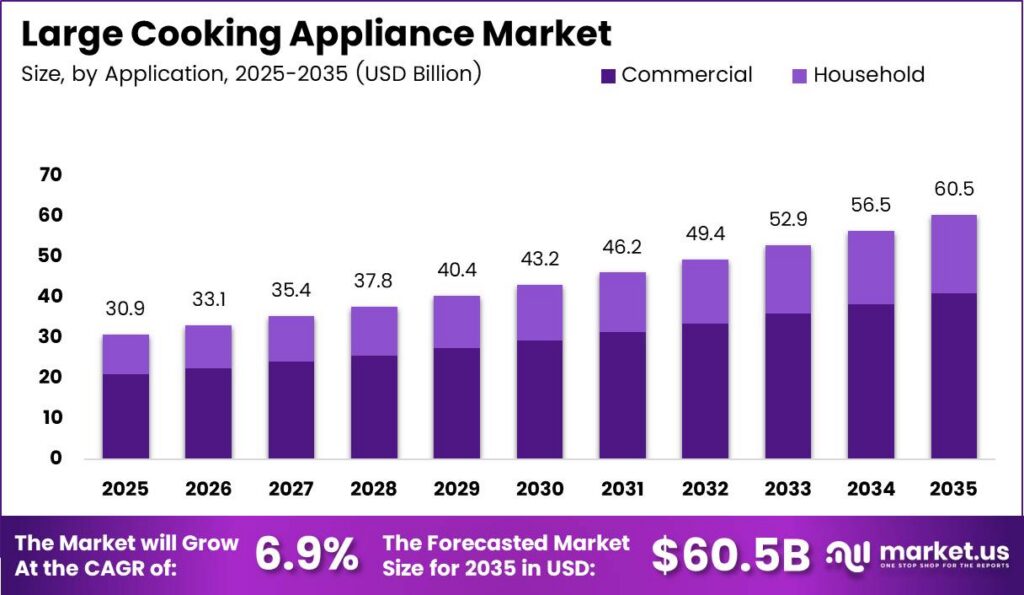
Global Large Cooking Appliance Market size is expected to be worth around USD 60.5 Billion by 2035 from USD 30.9 Billion in 2025, growing at a CAGR of 6.9% during the forecast period 2026 to 2035. Large cooking appliances comprise heavy-duty stoves, cooktops, range cookers, ovens, and fryers that apply thermal, electromagnetic, or steam energy to prepare food in residential and commercial kitchens. Consequently, these durable systems anchor modern food preparation infrastructure across households, restaurants, hotels, and institutional catering facilities worldwide.
Residential housing developers, commercial foodservice chains, and hospitality operators form the core buyer base for large cooking appliances. According to Eurostat, main cooking devices accounted for 6.4% of European Union household final energy consumption in 2024 out of 9.54 million terajoules of total residential energy use. Therefore, high thermal energy intensity forces institutional buyers and homeowners to prioritize insulated oven cavities and induction burners that lower utility overhead. Manufacturers must engineer lower-wattage cooking platforms to capture replacement sales.
Key Takeaways
- Global Large Cooking Appliance Market was valued at USD 30.9 Billion in 2025.
- Forecast revenue is projected to reach USD 60.5 Billion by 2035.
- Market revenue is set to expand at a CAGR of 6.9% during the forecast period from 2026 to 2035.
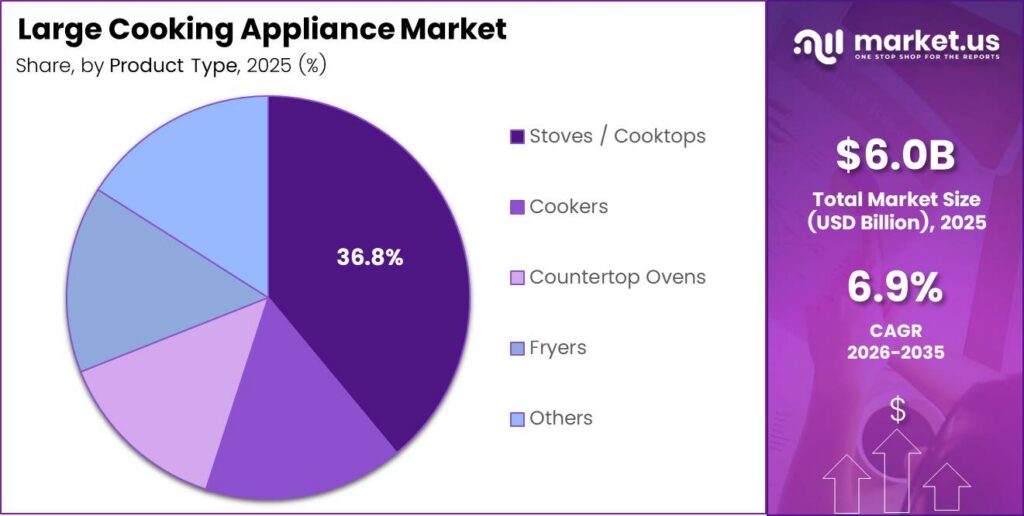
- Stoves / Cooktops led the Product Type segment with a 36.89% market share in 2025.
- Hypermarket & Supermarket dominated the Distribution Channel segment with a 45.77% share in 2025.
- Commercial end users led the Application segment with a 67.90% share in 2025 and represent the fastest growing application category.
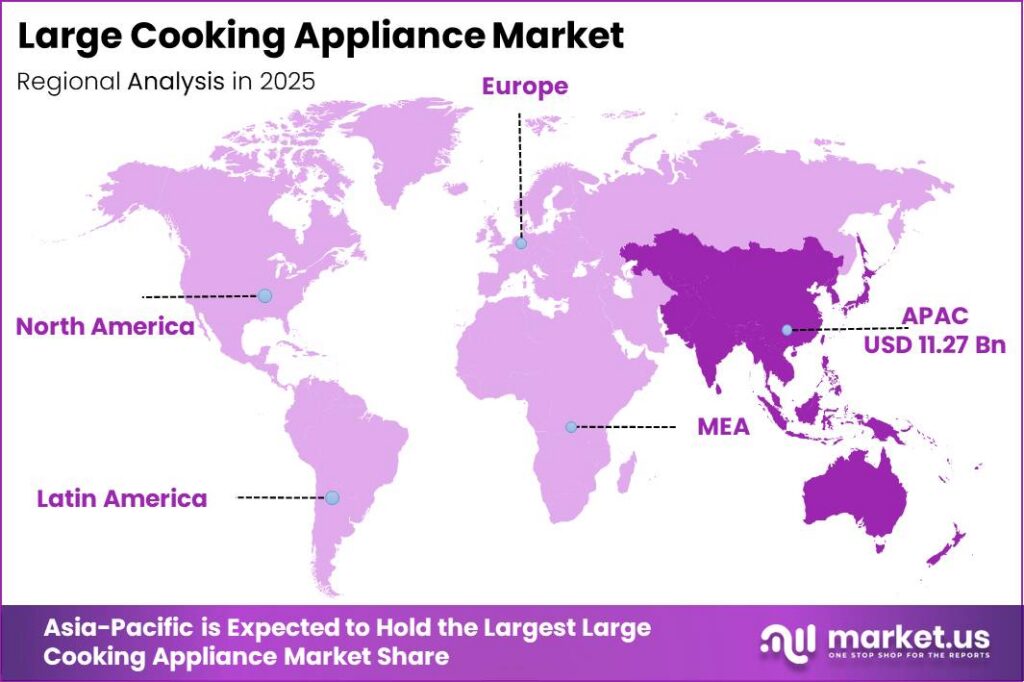
- Asia-Pacific dominated the regional landscape in 2025 with a 36.54% share, valued at USD 11.27 Billion, while Middle East & Africa is the fastest growing region.
Strict appliance efficiency mandates actively reshape product design and factory capital allocation across major markets. Data from U.S. Department of Energy (US DOE) shows that amended conservation standards set a maximum integrated annual energy consumption cap of 207 kWh per year for electric smooth cooktops, requiring compliance by January 31, 2028. As a result, appliance brands must phase out inefficient radiant heating elements and reallocate engineering budgets toward precision power electronics. Suppliers that miss this statutory threshold risk losing retail shelf space.
Commercial and residential equipment manufacturers are accelerating high-efficiency product rollouts to protect profit margins. In March 2026, Rational AG scaled commercial deployment of its 6-level iHexagon cooking system, which combines steam, convection, and microwave energy to cut cooking times by 30%, lifting annual revenue 6% to EUR 1.26 billion in 2025 and 8% to EUR 317.6 million in first-quarter 2026. This means commercial kitchen operators willingly pay premium prices for multi-energy appliances that compress batch turnarounds and reduce kitchen labor hours.
Asia-Pacific leads global demand and held a 36.54% market share in 2025, valued at USD 11.27 Billion. As reported by World Bank, IEA, and WHO in the Tracking SDG 7 report, global clean cooking access reached 75% of the population in 2024 after rising 18 percentage points since 2010, while 2.0 billion people still used polluting fuels. This reflects massive ongoing conversion from biomass stoves to modern liquefied petroleum gas and electric ranges across Asian urbanizing corridors. Appliance makers localizing entry-level cooktops in Asia capture sustained volume expansion.
Continuous research investment in connected thermal hardware separates tier-one cooking equipment producers from low-cost assemblers. In March 2026, BSH Home Appliances Group reported a 2.0% annual increase in global oven sales and a 2.6% gain in hob and extractor sales for 2025, supported by EUR 847 million in research spending, representing 5.6% of its EUR 15.0 billion turnover, alongside EUR 463 million in capital investments. Consequently, sustained capital commitment to automated cooking sensors allows manufacturers to defend gross margins against private-label competitors.
Product Type Analysis
Stoves / Cooktops dominates with 36.89% share in 2025 due to high daily meal preparation frequency.
In 2025, Stoves / Cooktops held a 36.89% share in the Product Type segment of the Large Cooking Appliance Market. Eurostat found that electricity supplied 52.2% of European Union residential cooking energy demand in 2024, whereas natural gas accounted for 31.8% and petroleum products covered 11.2%. Direct surface heating requires high-efficiency induction coils and glass-ceramic surfaces to transfer electrical energy directly into cookware without ambient heat loss. Consequently, manufacturers shifting production lines toward multi-zone electric cooktops secure higher average selling prices across urbanizing housing markets.
Freestanding and slide-in cookers integrate surface burners with below-counter baking cavities to serve households seeking unified kitchen footprints. Based on U.S. Energy Information Administration (US EIA) data, 89% of United States households own a combined range cooker, operating the cooktop component 8 times per week and the oven component 3 times per week on average. High mechanical duty cycles across dual heating chambers require heavy-gauge steel chassis, durable hinges, and dual-fuel valve assemblies. Therefore, brands offering modular burner and convection upgrades capture steady replacement revenue from high-frequency home cooks.
Countertop ovens represent the fastest growing product type as urban consumers and quick-service outlets prioritize compact, rapid-heating baking solutions. Figures from U.S. Energy Information Administration (US EIA) show that dedicated standalone wall ovens are installed in 13.9 million United States housing units, comprising 11.9 million electric units and 1.8 million natural gas units. High cabinet carpentry costs and electrical rewiring requirements for built-in wall ovens push space-constrained households toward plug-and-play countertop convection ovens. As a result, appliance vendors expanding smart countertop oven lines capture high-margin impulse and kitchen-renovation sales.
Distribution Channel Analysis
Hypermarket & Supermarket dominates with 45.77% share in 2025 due to physical inspection and bundled financing.
In 2025, Hypermarket & Supermarket held a 45.77% share in the Distribution Channel segment of the Large Cooking Appliance Market. According to Eurostat, calendar-adjusted European Union retail trade volume grew 1.0% year-over-year in July 2026, supported by a 1.3% rise in food, beverage, and tobacco superstore turnover and a 0.9% gain in non-food retail. High weekly foot traffic inside large-format superstores enables consumers to physically inspect oven cavity dimensions, burner grates, and enamel finishes while accessing instant point-of-sale credit. Therefore, appliance manufacturers must fund end-cap displays and in-store demonstrators to defend volume share.
Online platforms represent the fastest growing distribution channel as direct-to-consumer fulfillment and digital price comparison reshape durable appliance purchasing. As reported by U.S. Census Bureau, United States quarterly retail e-commerce sales increased 12.2% year-over-year to USD 340.2 billion in second-quarter 2026, representing 17.1% of total USD 1,986.5 billion retail sales. Automated warehouse sorting, scheduled two-person home delivery, and old-unit haul-away services remove the logistical friction that historically restricted heavy range purchases online. Consequently, brands investing in digital configuration tools and direct parcel logistics capture higher-margin direct sales.
Specialty stores anchor premium kitchen remodel specifications by pairing dedicated technical sales staff with live, connected cooking displays. Data from U.S. Census Bureau shows that monthly retail sales at United States electronics and appliance specialty stores (NAICS 443) reached USD 7,759 million in August 2026, rising from USD 7,570 million in July 2026. Custom built-in induction cooktops and commercial-grade ranges require precise cutout verification, ventilation matching, and electrical load consultation that general merchandisers rarely provide. This means premium appliance makers rely on specialty dealers to convert high-ticket kitchen renovation budgets.
Application Analysis
Commercial dominates with 67.90% share in 2025 due to high-volume foodservice equipment capital intensity.
In 2025, Commercial held a 67.90% share in the Application segment of the Large Cooking Appliance Market and represents the fastest growing application segment. National Restaurant Association (NRA) found that United States restaurant and foodservice sales are projected to reach USD 1.55 trillion in 2026 on 1.3% real growth, while workforce headcount expands by 100,000 jobs to reach 15.8 million workers. Continuous multi-shift meal output and tight kitchen labor availability force restaurants to purchase programmable combi-ovens, high-recovery fryers, and heavy-duty ranges. Consequently, commercial equipment vendors offering automated cooking presets secure multi-unit chain rollout contracts.
Global hospitality expansion and cross-border travel recovery directly drive commercial kitchen installation schedules across hotels, resorts, and airport catering hubs. Based on UNWTO (UN Tourism) data, international tourist arrivals increased 4% in 2025 to reach 1.52 billion overnight visitors, generating USD 1.9 trillion in tourism receipts, which rose 5% over 2024. High banquet turnover and all-day buffet service in hospitality properties require high-capacity convection ovens and modular cooking suites engineered for continuous thermal cycling. Therefore, manufacturers bundling preventive field-maintenance agreements with commercial cooking lines lock in recurring multi-year service revenue.
Household buyers generate steady baseline demand through replacement of aging stoves and kitchen upgrades tied to residential income stability. OECD indicates that real household disposable income per capita across member economies grew 0.2% in first-quarter 2026 following a 0.6% expansion in fourth-quarter 2025. Modest real income gains encourage homeowners to prioritize energy-saving induction cooktops and multi-cavity air-fryer ranges that reduce monthly electricity and gas bills over the appliance lifecycle. As a result, residential manufacturers must balance mid-tier promotional pricing with energy-efficiency rebates to sustain factory utilization.
Key Market Segments
By Product Type
- Stoves / Cooktops
- Cookers
- Countertop Ovens
- Fryers
- Others
By Distribution Channel
- Online
- Hypermarket & Supermarket
- Specialty Store
By Application
- Commercial
- Household
Regional Analysis
Asia-Pacific Dominates the Large Cooking Appliance Market with a Market Share of 36.54% in 2025, Valued at USD 11.27 Billion
Asia-Pacific held a 36.54% share of the Large Cooking Appliance Market in 2025, valued at USD 11.27 Billion. Figures from International Monetary Fund (IMF) show that real GDP in Emerging and Developing Asia is projected to expand by 5.1% in 2026, while the broader Asia and Pacific region grows by 4.7%. Rapid urban apartment construction, expanding quick-service restaurant networks, and dense domestic appliance manufacturing clusters in China, India, and South Korea accelerate stove and oven installations. Consequently, global appliance brands must localize component sourcing within Asian industrial parks to protect cost competitiveness.
Middle East & Africa represents the fastest growing region as demographic expansion, hospitality infrastructure investment, and localized appliance assembly accelerate across urban centers. According to International Monetary Fund (IMF), real GDP in North Africa and across the Africa region is projected to grow by 4.6% in 2026, while Middle East and Central Asia GDP is forecast to rebound by 6.5% in 2027. Tourism mega-projects in Gulf states and expanding municipal gas grids in North Africa spur procurement of wide-format range cookers and commercial ovens. Therefore, manufacturers establishing regional assembly plants bypass import tariffs and shorten dealer lead times.
Key Regions and Countries
North America
- US
- Canada
Europe
- Germany
- France
- The UK
- Spain
- Italy
- Rest of Europe
Asia Pacific
- China
- Japan
- South Korea
- India
- Australia
- Rest of APAC
Latin America
- Brazil
- Mexico
- Rest of Latin America
Middle East and Africa
- GCC
- South Africa
- Rest of MEA
Market Dynamics
Electrification mandates, commercial kitchen automation, and housing-cycle fluctuations govern capital allocation across the large cooking appliance value chain. As reported by International Energy Agency (IEA), global electricity demand increased by 4.3% in 2024, nearly double the 2.2% growth rate of total energy demand, propelled by building electrification and appliance load growth. Rising residential and commercial grid reliance pushes appliance producers to replace legacy gas assemblies with solid-state induction modules and smart thermal controls. Consequently, suppliers that master power-semiconductor integration and modular chassis design capture superior operating margins.
Drivers
Lower cooking-energy requirements push buyers from conventional gas stoves toward induction models, allowing manufacturers to compete on operating efficiency rather than unit price alone. ENERGY STAR reports approximately 85% heat-transfer efficiency for induction versus roughly one-third for gas, while certified electric cooking products average 18% higher efficiency than standard models. The IEA recorded global electricity-demand growth of 4.3% in 2024 and building electricity growth of 5%, supporting a +0.65 percentage-point CAGR contribution from induction substitution.
Across all four dynamic tables, percentages represent analyst-estimated percentage-point sensitivities to the 6.9% baseline CAGR from 2026 to 2035. Driver contributions total +2.10 percentage points, combined restraint and challenge sensitivities total -2.20 percentage points, and contingent opportunity upside totals +1.15 percentage points. Only full execution of untapped opportunities would lift the baseline toward an illustrative 8.05% trajectory. Consequently, investors should evaluate appliance manufacturers on their capacity to convert induction premiumization into durable gross-margin expansion.
| Driver | (~) % Impact on CAGR Forecast | Geographic Relevance | Impact Timeline |
|---|---|---|---|
| Efficiency-led induction substitution | +0.65% | Europe, North America, urban Asia-Pacific | Short term (≤ 2 years) |
| Essential end-of-life appliance replacement | +0.50% | Global; established appliance markets | Short term (≤ 2 years) |
| First-time ownership among emerging middle classes | +0.40% | India, Southeast Asia, Latin America | Medium term (2–4 years) |
| Multifunction oven premiumization | +0.30% | North America, Europe, affluent Asian markets | Short term (≤ 2 years) |
| Integrated kitchen specification uptake | +0.25% | Europe, China, urban India, Gulf states | Medium term (2–4 years) |
Restraints
Depressed housing turnover eliminates key purchase occasions for complete kitchen appliance packages because non-moving households postpone discretionary range, cooktop, and oven upgrades. The National Association of REALTORS recorded 4.06 million existing-home sales in 2024, the lowest annual total since 1995, while its September 2026 release reported an annualized pace of 3.99 million units. This housing bottleneck directly freezes renovation-linked appliance orders across mortgage-sensitive residential markets.
In a modeled sensitivity where transaction-linked purchases represent 15% to 20% of affected appliance demand and housing turnover stays 10% to 15% below normal planning levels, exposed unit demand falls by 1.5% to 3.0% before replacement offsets. This dynamic creates an estimated global CAGR drag of -0.45 percentage points. Therefore, manufacturers must trim speculative finished-goods inventory, prioritize mandatory replacement stock-keeping units, and defer factory capital expenditure tied to discretionary kitchen bundles.
| Restraint | (~) % Impact on CAGR Forecast | Geographic Relevance | Impact Timeline |
|---|---|---|---|
| Housing-transaction-linked purchase deferrals | -0.45% | North America, mortgage-sensitive European markets | Short term (≤ 2 years) |
| Exclusion from consumer purchase credit | -0.30% | Emerging markets, lower-income households globally | Short term (≤ 2 years) |
| Import-duty-driven retail price barriers | -0.25% | Import-dependent appliance markets | Short term (≤ 2 years) |
| Inadequate household electrical capacity | -0.20% | Older housing globally, infrastructure-constrained markets | Medium term (2–4 years) |
| Rental-property alteration restrictions | -0.15% | Urban rental markets globally | Medium term (2–4 years) |
Challenges
Bulky finished cooking appliances and dispersed electronic subassemblies expose manufacturers to ocean freight volatility even when end-market demand stays intact. UNCTAD reported that Suez Canal tonnage dropped roughly 70% by mid-2024 as container rates more than doubled from late 2023, while 2024 maritime volume grew 2.2% against ton-mile growth of 5.9% due to longer vessel routing. Extended transit distances tie up working capital and disrupt retail promotional calendars.
Under an operational planning scenario where affected shipping lanes add 10 to 14 transit days and require 2 to 3 extra weeks of safety stock, a 50% freight hike on products where shipping equals 3% to 5% of landed cost adds 1.5% to 2.5% to unit cost. This logistical friction imposes a -0.30 percentage-point CAGR drag, forcing appliance brands to regionalize final assembly and dual-source critical components.
| Challenge | (~) % CAGR Friction Drag | Geographic Relevance | Mitigation Horizon |
|---|---|---|---|
| Maritime Routing And Delivery Volatility | -0.30% | Asia–Europe corridors, import-dependent markets globally | Short term (≤ 2 years) |
| Electronic Component Qualification Complexity | -0.20% | Global manufacturing networks | Medium term (2–4 years) |
| Specialist Installation Workforce Shortages | -0.15% | North America, Europe, rapidly expanding cities | Medium term (2–4 years) |
| Connected Appliance Cybersecurity Maintenance | -0.10% | Europe, North America, connected-product markets | Long term (≥ 4 years) |
| Regional Testing Protocol Fragmentation | -0.10% | Global exporters, multi-jurisdiction manufacturers | Medium term (2–4 years) |
Opportunities
Commercial cooking manufacturers can unlock adjacent software and service revenue by pairing installed ovens and ranges with paid yield-optimization, batch-scheduling, and outcome-linked contracts. UNEP estimated 1.05 billion tonnes of consumer-stage food waste in 2022, with foodservice operations generating 28%. Capturing this white space requires verifiable kitchen-level food savings and new recurring subscription agreements rather than standard hardware sales alone.
Pilot commercial programs targeting 2% to 4% lower avoidable cooking losses and 5% to 8% less operator time per batch can achieve service gross margins of 45% to 55% after cloud and field support costs. At a 10% to 15% paid attachment rate across eligible commercial installations, early movers can expand blended gross margins by 0.5 to 1.0 percentage points and unlock +0.35 percentage points of market CAGR upside.
| Opportunity | (~) % Potential CAGR Upside | Geographic Relevance | Execution Window |
|---|---|---|---|
| Outcome-linked commercial cooking services | +0.35% | North America, Europe, developed Asia-Pacific | Medium term (2–4 years) |
| Certified remanufactured appliance channels | +0.25% | Europe, North America, organized urban resale markets | Medium term (2–4 years) |
| Accessible cooking systems for aging households | +0.20% | Japan, Europe, North America | Medium term (2–4 years) |
| Standardized institutional kitchen procurement platforms | +0.20% | India, Southeast Asia, Middle East, Africa | Long term (≥ 4 years) |
| Consolidation of fragmented regional service networks | +0.15% | Europe, Latin America, Southeast Asia | Medium term (2–4 years) |
Key Company Insights
Samsung Electronics Co. Ltd.
Samsung Electronics Co. Ltd. commands a premier global position in connected induction ranges, wall ovens, and built-in cooktops across North America, Europe, and Asia-Pacific through its Bespoke AI appliance ecosystem. Data from Samsung Electronics Co. Ltd. shows that full-year 2025 consolidated revenue reached KRW 333.6 trillion with operating profit of KRW 43.6 trillion, while its Visual Display and Digital Appliances division generated KRW 14.8 trillion in fourth-quarter 2025 revenue. Consequently, massive semiconductor and display scale allows Samsung to embed proprietary AI vision cameras into ovens at lower unit cost.
Samsung actively utilizes cross-border acquisitions to integrate residential kitchen appliances with commercial building thermal management systems. In November 2025, Samsung Electronics Co. Ltd. completed the acquisition of 100% of European HVAC and thermal-engineering provider FläktGroup from Triton for EUR 1.5 billion, reflecting an enterprise value of EUR 1.8 billion, according to Samsung Global Newsroom. This transaction strengthens Samsung’s B2B smart-building channel, enabling bundled bidding for commercial kitchen ventilation, heat-recovery, and connected appliance packages across institutional real estate developments.
LG Electronics Inc.
LG Electronics Inc. operates as a tier-one global manufacturer of slide-in induction ranges, combination wall ovens, and smart gas cooktops across premium retail and builder channels worldwide. LG Electronics Inc. found that full-year 2025 consolidated revenue reached a record KRW 89.2 trillion with operating profit of KRW 2.48 trillion, while its Home Appliance Solution Company achieved record division revenue of KRW 26.13 trillion and operating profit of KRW 1.28 trillion. Therefore, industry-leading appliance operating margins fund continuous upgrades to LG’s ThinQ smart kitchen platform and inverter heating modules.
LG is aggressively localizing production capacity in high-growth emerging regions to bypass tariff barriers and shorten retail replenishment cycles. In August 2026, LG Electronics Inc. inaugurated a USD 310 million, or BRL 1.5 billion, smart home appliance factory spanning 770,000 square meters in Paraná, Brazil, featuring an annual production capacity of 600,000 units, based on LG Global Newsroom data. Consequently, this localized South American manufacturing hub lowers landed distribution costs and strengthens LG’s competitive pricing across Latin American kitchen appliance retailers.
Key Players
- Samsung Electronics Co. Ltd.
- LG Electronics Inc.
- Morphy Richards
- Whirpool Corporation
- Hitachi Appliances Inc.
- AB Electrolux
- Haeir Group Corporation
- Robert Bosch GmbH
- Koninklijke Philips N.V
- Other Key Players
Recent Developments
2026
- October 2026: AB Electrolux partnership operationalized North American manufacturing and sales joint ventures with Midea Group alongside a SEK 4.0 billion cost-efficiency program while reporting third-quarter 2026 net sales of SEK 33,919 million and 3.5% organic growth according to AB Electrolux.
- September 2026: LG Electronics Inc. investment advanced construction of its INR 5,000 crore or USD 600 million home appliance plant spanning 247 acres in Sri City, India, doubling local annual appliance capacity from 14.5 million units to 29 million units according to LG Electronics India.
- June 2026: Arçelik A.Ş. and Whirlpool Corporation acquisition saw Arçelik agree to purchase Whirlpool’s remaining 25% stake in Beko Europe, which operates 11 plants with 24 million units of annual appliance capacity, for EUR 71.5 million or USD 82 million according to company regulatory filings.
- April 2026: Whirlpool Corporation capacity expansion committed USD 60 million to convert a Perrysburg, Ohio facility into its 11th United States plant creating 100 to 150 jobs, building on its USD 300 million Ohio manufacturing investment according to Whirlpool Corporation.
- April 2026: Hitachi Global Life Solutions Inc. and Arçelik A.Ş. acquisition signed a definitive agreement for Hitachi to buy Arçelik’s 60% stake in Arçelik Hitachi Home Appliances for USD 261 million, comprising USD 205 million cash and USD 56 million deferred payments according to official regulatory filings.
- March 2026: Versuni India (Koninklijke Philips N.V.) product launch introduced the Philips OneChef smart cooking and air fryer appliance in Mumbai with 33 integrated cooking functions priced at INR 19,995 according to Versuni India.
- March 2026: Haier Smart Home Co., Ltd. investment expanded global Kitchen Appliances segment revenue to RMB 41.54 billion within record 2025 group revenue of RMB 302.35 billion, up 5.71%, after surpassing 8 million kitchen units in first-half 2025 according to Haier Smart Home.
- February 2026: Haier Smart Home Co., Ltd. acquisition completed the ZAR 2.45 billion or RMB 980 million purchase of Electrolux South Africa’s Kwikot business and executed Haier’s official South Africa market launch according to Haier Official Release.
- January 2026: Electrolux Professional Group acquisition purchased the operating assets of United States commercial range, fryer, and oven manufacturer Royal Range, adding SEK 100 million in annual sales according to Electrolux Professional Group.
2025
- September 2025: Bajaj Electricals Ltd. (Morphy Richards) acquisition signed a definitive agreement to acquire Morphy Richards brand rights across India and 5 neighboring South Asian countries from Glen Dimplex Group for INR 146 crore with INR 141.4 crore base consideration according to Bajaj Electricals stock exchange filings.
- June 2025: BSH Home Appliances Group (Robert Bosch GmbH) capacity expansion opened its first African cooking stove factory in Cairo, Egypt with a EUR 50 million investment, 1,000 jobs, and annual capacity of 350,000 90-centimeter gas range cookers according to BSH Home Appliances Group.
- April 2025: Midea Group acquisition completed the EUR 175 million purchase of a 97.38% stake in European built-in oven and cooktop maker Teka Group, encompassing 10 factories and nearly 3,000 employees according to Midea Group.
Geopolitical Impact Analysis
Cross-border tariff shifts and maritime chokepoint disruptions directly alter landed component costs for large cooking appliance manufacturers. World Trade Organization (WTO) indicates that world merchandise trade volume grew 4.6% in 2025 as export value rose 7% to USD 26.26 trillion, while 2026 trade volume is forecast to expand 3.9%. However, figures from UNCTAD show that global seaborne trade volume grew 2.2% in 2024 while maritime ton-miles surged 5.9% from Cape of Good Hope rerouting, before volume growth slowed to 0.5% in 2025. Longer ocean voyages delay shipments of cold-rolled stainless steel sheets, Vitroceramic cooktop glass, enameling frit, and insulated gate bipolar transistor power modules moving from Asian foundries to European and North American range factories. Consequently, manufacturers must hold higher buffer stocks of induction power boards and establish near-shore assembly plants to prevent retail stockouts.
Macroeconomic inflation persistence and uneven rural energy infrastructure further complicate pricing and product-mix strategies across developing appliance markets. According to International Monetary Fund (IMF), global real GDP growth is projected to slow to 3.1% in 2026 before reaching 3.4% in 2027, while global headline inflation stands at 4.7% in 2026 and 4.1% in 2027. Meanwhile, as reported by World Bank, approximately 1.5 billion rural residents lacked clean cooking access and 666 million people lacked electricity access in 2023 despite global electrification reaching nearly 92%. Elevated inflation raises financing costs for copper induction coils, brass gas valves, and aluminized steel oven cavities, while rural grid gaps restrict electric range adoption. Therefore, appliance brands must engineer dual-fuel and bottled-gas cookers for rural distributors while reserving high-wattage induction lines for grid-stable cities.
Report Scope
| Report Features | Description |
|---|---|
| Market Value (2025) | USD 30.9 Billion |
| Forecast Revenue (2035) | USD 60.5 Billion |
| CAGR (2026-2035) | 6.9% |
| Base Year for Estimation | 2025 |
| Historic Period | 2021-2025 |
| Forecast Period | 2026-2035 |
| Report Coverage | Revenue Forecast, Market Dynamics, Market Opportunity Analysis, Technology and Innovation Landscape, Competitive Landscape, Recent Developments |
| Segments Covered | By Product Type (Stoves / Cooktops, Cookers, Countertop Ovens, Fryers, Others), By Distribution Channel (Online, Hypermarket & Supermarket, Specialty Store), By Application (Commercial, Household) |
| Regional Analysis | North America (US and Canada), Europe (Germany, France, The UK, Spain, Italy, and Rest of Europe), Asia Pacific (China, Japan, South Korea, India, Australia, and Rest of APAC), Latin America (Brazil, Mexico, and Rest of Latin America), Middle East and Africa (GCC, South Africa, and Rest of MEA) |
| Competitive Landscape | Samsung Electronics Co. Ltd., LG Electronics Inc., Morphy Richards, Whirpool Corporation, Hitachi Appliances Inc., AB Electrolux, Haeir Group Corporation, Robert Bosch GmbH, Koninklijke Philips N.V, Other Key Players |
| Customization Scope | Customization for segments, region / country-level will be provided. Additional customization can be done based on requirements. |
| Purchase Options | We have three licenses to opt for: Single User License | Multi-User License (Up to 5 Users) | Corporate Use License (Unlimited User and Printable PDF) |