


The growing demand for various products from the bioplastic packaging industry as a direct result of increasing awareness levels concerning its benefits are projected to create new market opportunities over the forecast period
Market.US announces publication of its most recently generated research report titled, “Global Hemp Bioplastic Market by Type (Hemp Cellulose-based Bioplastics, Composite Hemp-based Bioplastics, and Organic Bioplastics with Hemp) – Global Forecast to 2031”, which offers a holistic view of Global Hemp Bioplastic Market through systematic segmentation that covers every aspect of the target market.
Global Hemp Bioplastic Market is projected to be US$ 83.5 Mn in 2021 to reach US$ 290.7 Mn by 2031 at a CAGR of 13.6%.
Hemp-based plastics provide a real solution to maintaining the functionality of plastics. These bioplastics are affordable, naturally made from fiber composites that can be used to replace oil-based materials. Bioplastics are made from the stalks of the hemp plant as these stalks provide a high cellulose count required to make plastics. The hemp cellulose content (65–70%) is the highest when compared to wood (40%), flax (65–75%), and cotton (up to 90%). These stalks provide both durability and strength to plastics.
The main properties of hemp are that make it exceptional are, its low cultivation input and favorable growing characteristics. High CO2 absorbing power from the atmosphere, low pesticide requirements, fertilizers, and water are needed when compared to the other bioplastic sources, thereby making hemp a more superior resource for bioplastic than cotton and wood.
$ 83.5 Mn
13.6%
- By Type
- By Region
- By Application
$ 290.7 Mn
Currently, different grades of hemp bioplastics are made by infusing hemp fibers. Standard plastic reinforced with hemp fibers made up of 30–40% of hemp and 100% hemp plastics are currently being manufactured. These hemp bioplastics are five times stiffer and 2.5 times stronger than polypropylene. This infusion of fiber lowers its pollution levels, more durable, and biodegradable. Companies such as Kanesis and Zoeform highlight the use of hemp in the production of bioplastics.
Global Hemp Bioplastic Market Revenue (US$ Mn), 2021–2031

The growing demand for various products from the bioplastic packaging industry as a direct result of increasing awareness levels concerning its benefits are projected to create new market opportunities over the forecast period. Governments worldwide are eliminating or relaxing the ban on industrial hemp, and increasing health-related issues that stem from the burning of plastic, as well as the fact that individuals are now gradually becoming aware of the ills of using synthetic plastic. These factors are expected to bolster this global market’s revenue over the stipulated timeline.
The technology used to make bioplastics are expensive. Hemp is even more expensive than bioplastic made from soy and corn, both of which are heavily subsidized in the US. Moreover, individuals do not want to pay much more for sustainable solutions than they do for conventional plastics. This factor is slated to hinder this given market’s financial gains accordingly.
Global Hemp Bioplastic Market Attractiveness Analysis by Type, 2015–2031
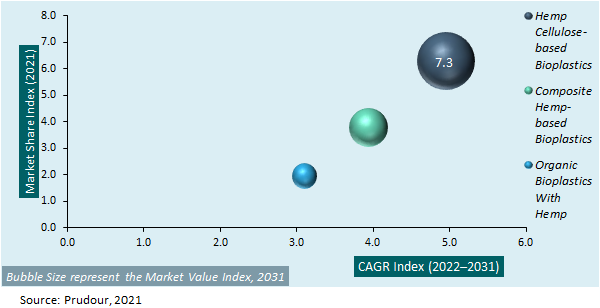
The global hemp bioplastic market is segmented on the basis of type, sales channel, and regions. The type segment is bifurcated into hemp cellulose-based bioplastics, composite hemp-based bioplastics, and organic bioplastics with hemp. Under the segmentation of type, hemp cellulose-based bioplastics is expected to account for the majority revenue share of this target market.
The sales channel segment is segmented into Business-to-Business (B2B), and Business-to-Consumer (B2C). On the basis of region, the Europe market is estimated to account for a major share of the global hemp bioplastic market, in terms of revenue, and is projected to maintain its respective market position over the forecast period.
The research report on global hemp bioplastic market includes profiles of some of the major companies such as Marval Industries Inc., Zeoform, Titan Bioplastics, Hemp, Inc., The Hemp Plastic Company, The Hempville, Sana Packaging Inc., Konopko Cooperative, and other key players.
Segmentation for Global Hemp Bioplastic Market Based on Type, Sales Channel, and Region
Based on Type:
- Hemp Cellulose-based Bioplastics
- Composite Hemp-based Bioplastics
- Organic Bioplastics with Hemp
Based on Sales Channel:
- Business-to-Business (B2B)
- Business-to-Consumer (B2C)
Based on Region:
- North America
- Europe
- Asia-Pacific
- South America
- Middle East & Africa
Based on Key Players:
- Marval Industries Inc.
- Zeoform
- Titan Bioplastics
- Hemp Inc.
- The Hemp Plastic Company
- The Hempville
- Sana Packaging Inc.
- Konopko Cooperative
- other key players.
For the Hemp Bioplastic Market research study, the following years have been considered to estimate the market size:
| Attribute | Report Details |
|---|---|
Historical Years |
2016-2020 |
Base Year |
2021 |
Estimated Year |
2022 |
Short Term Projection Year |
2028 |
Projected Year |
2023 |
Long Term Projection Year |
2032 |
Report Coverage |
Competitive Landscape, Revenue analysis, Company Share Analysis, Manufacturers Analysis, Volume by Manufacturers, Key Segments, Key company analysis, Market Trends, Distribution Channel, Market Dynamics, COVID-19 Impact Analysis, strategy for existing players to grab maximum market share, and more. |
Regional Scope |
North America, Europe, Asia-Pacific, South America, Middle East & Africa |
Country Scope |
United States, Canada and Mexico, Germany, France, UK, Russia and Italy, China, Japan, Korea, India and Southeast Asia, Brazil, Argentina, Colombia etc.Saudi Arabia, UAE, Egypt, Nigeria and South Africa |





































