Report Overview
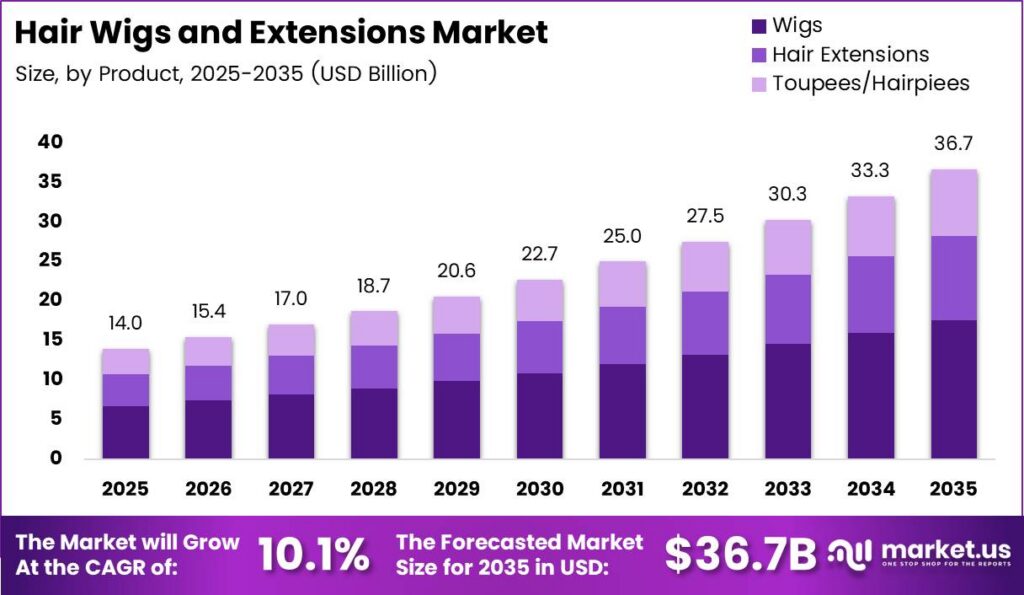
Global Hair Wigs and Extensions Market size is expected to be worth around USD 36.7 Billion by 2035 from USD 14.0 Billion in 2025, growing at a CAGR of 10.1% during the forecast period 2026 to 2035. Hair wigs and extensions are cosmetic and medical hairpieces crafted from natural human hair or synthetic polymers that conceal hair loss, add volume, and alter hairstyles without chemical damage. Consequently, beauty brands earn recurring margins across retail and clinical channels.
Global hairpiece supply chains connect raw hair collectors, polymer extruders, and ventilation workshops to professional salons, oncology clinics, and social commerce storefronts. According to UN Comtrade, China exported USD 5.41 Billion in wigs and hairpieces under HS Code 6704 globally in 2023, capturing 52% of its USD 10.3 Billion Chapter 67 export value. This concentration creates acute sourcing dependency on East Asian converters. Therefore, global distributors diversify assembly contracts across South Asian hubs to protect wholesale margins.
Key Takeaways
- The global Hair Wigs and Extensions Market stood at USD 14.0 Billion in 2025.
- Market valuation reaches USD 36.7 Billion by 2035 across the 2026 to 2035 forecast period.
- Global revenue expands at a compound annual growth rate of 10.1% from 2026 to 2035.
- Wigs led the product segment with a 47.67% market share in 2025, while hair extensions represent the fastest growing product category.
- Mid-range products captured a 43.45% share in 2025, whereas the premium tier represents the fastest growing price segment.
- Female consumers accounted for an 83.23% revenue share in 2025, while the male segment registers the fastest growth rate.
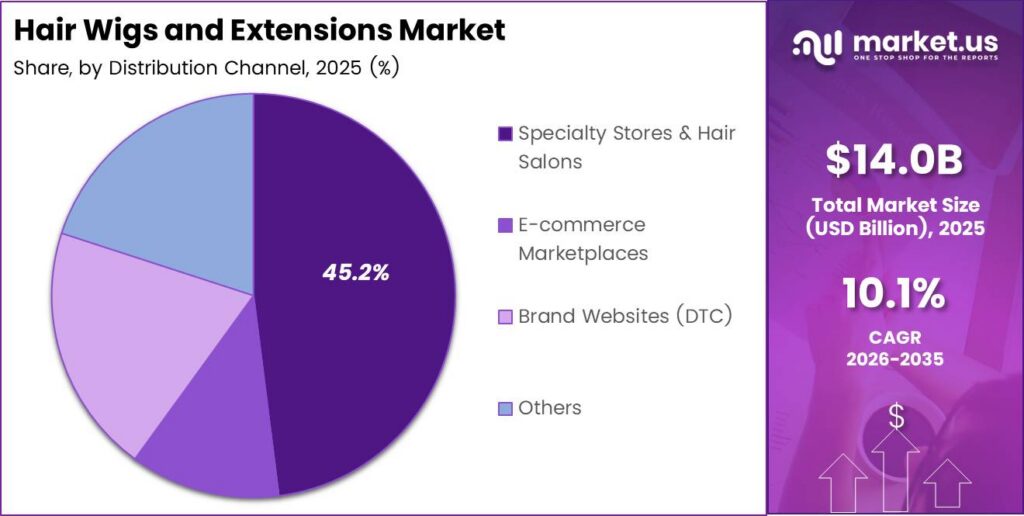
- Specialty stores and hair salons held a 45.2% share in 2025, while e-commerce marketplaces expand at the fastest pace.
- North America dominated global revenue in 2025 with a 38.56% share valued at USD 5.3 Billion, while Middle East and Africa grows fastest.
Federal product safety rules now enforce strict chemical transparency across beauty supply chains. Data from the U.S. Food and Drug Administration shows that mandatory active filings under the Modernization of Cosmetics Regulation Act reached 16,398 cosmetic facilities and 1,298,361 product listings by June 30, 2026. Higher traceability standards force synthetic fiber extruders and wig adhesive makers to verify toxicological safety before customs clearance. Consequently, compliant manufacturers capture shelf space from unverified gray-market importers.
Clinical consolidation and material science ventures are reshaping industry capital allocation. In July 2026, two major North American surgical and non-surgical hair restoration networks announced operational unification across more than 130 clinics serving over 1 Million cumulative clients . Earlier in May 2026, a science-led synthetic hair startup raised USD 4.5 Million in venture funding, lifting total backing to USD 10 Million for biotech fiber scale-up . This signals institutional investor shift toward integrated clinic networks and proprietary polymer IP.
North America holds the leading position with a 38.56% market share in 2025, supported by high per-capita beauty spending, insurance-backed cranial prostheses, and mature salon chains. By contrast, Western Europe anchors global premium salon styling standards. As reported by Cosmetics Europe, European cosmetics and personal care retail sales reached EUR 110 Billion in 2025, including EUR 20.3 Billion in hair care . Strong Western beauty retail spending sustains high average selling prices for virgin human hair suppliers.
Product Analysis
Wigs dominates with 47.67% share in 2025 due to immediate full-scalp cosmetic coverage.
In 2025, Wigs held a 47.67% share in the Product segment of the Hair Wigs and Extensions Market. World Health Organization found that global cancer diagnoses reached 20.6 Million new cases in 2024 and climb toward 35 Million annually by 2050. Chemotherapy regimens attack rapidly dividing hair matrix keratinocytes, causing total scalp alopecia that requires breathable full-cap cranial prostheses rather than strand attachments. Consequently, medical wig makers partnering with oncology insurers secure stable non-cyclical revenue.
Hair Extensions represent the fastest growing product category as consumers seek instant length and density without chemical relaxers or salon waiting times. Based on UN Comtrade data, India exported USD 763.4 Million in human hair globally in 2024, led by USD 574.4 Million in dressed and worked hair under HS 6703 . Aligned intact cuticles prevent mechanical friction and tangling when stylists bond or clip extension wefts onto natural hair shafts. Therefore, brands securing direct Indian temple-hair contracts protect gross margins.
Toupees and Hairpieces serve localized crown and hairline thinning through lightweight partial-base polyurethane membranes and lace toppers. Figures from Artnature Inc. Annual Filing show that its Men’s Business net sales of custom male hairpieces and non-surgical additions rose 1.5% year-over-year to JPY 23,167 Million in fiscal 2025 . Partial hairpieces mechanically anchor onto existing perimeter hair or medical-grade scalp adhesives without shaving full heads. This creates recurring maintenance and re-bonding subscription fees for specialized salon chains.
Price Tier Analysis
Mid-range dominates with 43.45% share in 2025 due to accessible human-hair blend value.
In 2025, Mid-range held a 43.45% share in the Price Tier segment of the Hair Wigs and Extensions Market. U.S. Census Bureau indicates that U.S. quarterly retail e-commerce sales hit USD 340.2 Billion in Q2 2026, capturing 17.1% of total retail sales . Digital checkout transparency and creator livestreams reward mid-priced machine-wefted Remy and heat-friendly hybrid wigs that balance 6-month durability with affordable impulse ticket sizes. As a result, direct-to-consumer brands concentrate inventory capital in mid-tier glueless SKUs.
Premium products expand as the fastest growing price tier because buyers prioritize single-donor virgin cuticles and undetectable Swiss or HD lace fronts. According to Evergreen Products Group HKEX Filing, company revenue from high-end human hair extensions jumped 67.7% year-over-year to HKD 36.48 Million in the first half of 2026. Intact unidirectional cuticles withstand repeated salon bleaching, flat-ironing, and re-taping cycles without protein degradation, lowering annual replacement cost per wear. Therefore, manufacturers shift loom capacity toward higher-margin virgin human hair bundles.
Economy hairpieces serve high-turnover protective braiding, festival styling, and entry-level synthetic wig buyers across mass beauty supply stores. As reported by Henan Rebecca Hair Products SSE Filing, the company generated CNY 371.24 Million from synthetic fiber braids and extensions alongside CNY 124.89 Million from synthetic wigs in fiscal 2025 . Extruded modacrylic and PVC filaments cost a fraction of raw human hair, enabling single-use braided styles under tight household budgets. Consequently, high-volume Asian producers compete on automated extrusion scale and low landed unit costs.
Gender Analysis
Female dominates with 83.23% share in 2025 due to protective and fashion styling frequency.
In 2025, Female held an 83.23% share in the Gender segment of the Hair Wigs and Extensions Market. Data from the National Institutes of Health shows that androgenetic alopecia affects approximately 30 Million women in the United States. Diffuse female crown thinning along the central part line makes surgical grafting harder than male hairline restoration, pushing women toward clip-in toppers and lace wigs. This means brands offering natural-density silk-top hairpieces win high lifetime customer retention.
Male consumers represent the fastest growing gender segment as younger demographics reject hair-loss stigma and adopt undetectable skin-base hair systems. National Institutes of Health found that androgenetic alopecia impacts 50 Million men in the United States, affecting over 50% of men aged 50 and older. Dihydrotestosterone miniaturizes male terminal follicles into vellus hairs, creating permanent bald zones where ultra-thin 0.03 mm polyurethane membranes bond directly to bare skin. Consequently, men’s salons generate predictable 4-week replacement cycles.
Clinical all-gender and unisex cranial prostheses address autoimmune, pediatric, and scarring hair-loss patients who require hypoallergenic medical cap constructions. Based on National Institutes of Health NCBI clinical assessments across more than 3,000 alopecia diagnoses, 73% involve non-scarring alopecia while 27% represent permanent scarring alopecia . Destroyed follicular ostia in cicatricial alopecia prevent biological regrowth and leave inflamed skin unable to tolerate standard wig glues or clips. Therefore, medical device suppliers invest in silicone vacuum caps eligible for health insurance reimbursement.
Distribution Channel Analysis
Specialty Stores & Hair Salons dominates with 45.2% share in 2025 due to professional fitting and color-matching needs.
In 2025, Specialty Stores & Hair Salons held a 45.2% share in the Distribution Channel segment of the Hair Wigs and Extensions Market. Figures from L’Oreal Annual Report show that its Professional Products Division salon channel sales grew 7.5% like-for-like to EUR 5.2 Billion in 2025 . Keratin pre-bonded, micro-ring, and hand-tied weft extensions require licensed stylists to section hair at precise tension so traction alopecia does not occur. Consequently, extension manufacturers fund stylist certification academies to lock in salon reorder loyalty.
E-commerce Marketplaces register the fastest channel expansion by aggregating thousands of global wig factories with verified buyer photo reviews and next-day fulfillment. Eurostat indicates that 78% of European Union internet users shopped online in 2025, while 45% of web-selling EU enterprises utilized third-party e-commerce marketplaces . Standardized pre-plucked, glueless elastic-band caps eliminate salon customization, allowing shoppers to compare lace transparency and hair density across marketplace listings instantly. This forces mid-tier suppliers to optimize marketplace search algorithms and local warehouse stock.
Brand Websites operating direct-to-consumer models capture higher average order values through virtual augmented-reality shade matching, installment financing, and loyalty subscriptions. According to Eurostat, 85.65% of web-selling European Union enterprises sold via their own websites or apps, generating e-commerce turnover over 5 times higher than marketplace-only sellers . Owning first-party buyer texture and cap-size profiles cuts third-party marketplace referral commissions of 8% to 15% per unit. Therefore, established hair brands invest in proprietary mobile apps to boost repeat gross margins.
Key Market Segments
By Product
- Wigs
- Hair Extensions
- Toupees/Hairpiees
By Price Tier
- Mid-range
- Premium
- Economy
- Luxury
By Gender
- Female
- Male
By Distribution Channel
- Specialty Stores & Hair Salons
- E-commerce Marketplaces
- Brand Websites (DTC)
- Others
Regional Analysis
North America Dominates the Hair Wigs and Extensions Market with a Market Share of 38.56% in 2025, Valued at USD 5.3 Billion
North America leads global revenue with a 38.56% share valued at USD 5.3 Billion in 2025, anchored by multicultural protective styling, oncology coverage, and social commerce adoption. As reported by the Personal Care Products Council, the U.S. personal care industry generated USD 495.6 Billion in economic output, contributed USD 242.4 Billion to GDP, and supported 2.65 Million jobs . Dense salon infrastructure and high disposable beauty budgets drive frequent consumer upgrades toward glueless HD lace wigs and Remy tape-in extensions. Consequently, global manufacturers prioritize U.S. onshore fulfillment hubs to protect delivery speed.
Middle East and Africa represents the fastest growing region as young urban populations, rising female workforce participation, and deep-rooted braiding and wig traditions accelerate unit volumes. Data from the International Monetary Fund shows that Sub-Saharan Africa real GDP grows 4.5% in 2026 and 2027 while North Africa expands 4.6% in 2026, outpacing 1.7% growth in advanced economies . Expanding urban incomes across Nigeria, South Africa, Kenya, and Gulf Cooperation Council states shift buyers from basic synthetic braids toward branded human-hair blends. Therefore, Asian exporters establish regional African assembly plants and distributor hubs to capture volume.
Key Regions and Countries
North America
- US
- Canada
Europe
- Germany
- France
- The UK
- Spain
- Italy
- Rest of Europe
Asia Pacific
- China
- Japan
- South Korea
- India
- Australia
- Rest of APAC
Latin America
- Brazil
- Mexico
- Rest of Latin America
Middle East and Africa
- GCC
- South Africa
- Rest of MEA
Market Dynamics
Rapid direct-to-consumer digital selling collides with raw human hair export controls and tightening chemical regulations across the global hairpiece value chain. European Chemicals Agency found that EU REACH Regulation 2023/2055 restricts synthetic polymer microparticles at or above 0.01% by weight, closing initial industrial reporting on May 31, 2026 ahead of 2027 to 2029 cosmetic bans . Stricter polymer and finish rules raise compliance costs for legacy synthetic braiding mills. Consequently, capital flows toward clean biopolymer filaments, ethical virgin hair sourcing, and automated cap production.
Drivers
Short-form video algorithms and native live-shopping checkouts dismantled legacy multi-tier wholesale distribution between 2024 and 2026. Active beauty storefronts across the United States and Western Europe nearly doubled from 29,000 to 56,000 during 2024 and 2025, while livestream conversion hit 53.4%. Factories in Henan and Shandong bypassed 2 to 3 distributor layers, cutting customer acquisition costs by 22% to 35% and shrinking inventory cycles from 85 days to under 21 days.
Replacing fixed salon slotting fees with variable creator affiliate commissions of 10% to 18% reshaped unit economics for mid-tier brands. Active buyers raised annual repeat purchases from 1.8 units to 3.4 units, unlocking 650 to 900 basis points of gross margin expansion. Sellers reinvest these margin gains directly into pre-styled, ready-to-wear glueless lace wig SKUs. For investors, brands mastering creator-led fulfillment capture faster working-capital turns than traditional wholesale competitors.
| Driver | (~) % Impact on CAGR Forecast | Geographic Relevance | Impact Timeline |
|---|---|---|---|
| Live-Video Social Commerce Proliferation | +2.9% | Global | Short term (≤ 2 years) |
| Clinical Alopecia & Oncology Incidence | +2.3% | North America, Europe, East Asia | Medium term (2–4 years) |
| Glueless HD Lace Adoption | +1.9% | North America, Sub-Saharan Africa, Western Europe | Short term (≤ 2 years) |
| Protective Styling Cultural Mainstreaming | +1.6% | North America, Europe, Africa | Medium term (2–4 years) |
| Non-Surgical Male Hair System Uptake | +1.4% | East Asia, Europe, Middle East | Medium term (2–4 years) |
Restraints
Export price floors on raw human hair and rising import tariffs restrict entry-level human hair unit volumes. On February 10, 2025, India implemented DGFT Notification No. 59/2024-25, prohibiting raw hair exports under HS codes 05010010 and 05010020 below a Free on Board floor of USD 65 per kilogram. Meanwhile, 2025 and October 2026 Chapter 67 tariff updates added 10% to 50% duties on Asian wigs alongside Canada’s 50% synthetic hairpiece tariff.
These combined trade barrierscut off cheap non-remy comb waste to East Asian sorting mills and inflated landed virgin and remy bundle costs by 28% to 42% per kilogram. Converter EBITDA margins contracted by 450 to 700 basis points as salon chains canceled bulk forward orders. Consequently, manufacturers delayed planned Southeast Asian weaving factory expansions by 12 to 18 months, forcing distributors to reprice catalogs or substitute synthetic blends.
| Restraint | (~) % Impact on CAGR Forecast | Geographic Relevance | Impact Timeline |
|---|---|---|---|
| Raw Human Hair Export Prohibitions & Import Duties | -2.2% | South Asia, East Asia, North America | Short term (≤ 2 years) |
| Forced-Labor Customs Detentions & Seizures | -1.5% | United States, China | Short term (≤ 2 years) |
| De Minimis Parcel Duty Surcharges | -1.2% | European Union, North America | Short term (≤ 2 years) |
| Discretionary Financing & BNPL Tightening | -0.9% | North America, Europe | Short term (≤ 2 years) |
| Chemical Hair-Processing Effluent Closures | -0.7% | China, Southeast Asia | Medium term (2–4 years) |
Challenges
Heightened toxicological testing on modacrylic, PVC, and chemically coated braiding fibers creates severe compliance and liability pressure for mass-market brands. Independent lab studies published in 2025 and February 2026 across 40 popular extension SKUs found lead above safety limits in 90% to 96.7% of samples. Testers also detected 50 volatile organic compounds, including benzene, methylene chloride, toluene, and acetone, off-gassing during hot-water sealing and heat styling.
Meanwhile, March 2025 EU REACH microplastics guidelines under Regulation 2023/2055 and December 3, 2025 perfluorinated limits of 0.025 mg/kg tightened chemical coating tolerances. Third-party gas-chromatography testing adds USD 0.45 to USD 1.15 per pack and extends SKU launch lead times by 6 to 10 weeks. Manufacturers must redirect 4% to 7% of annual capital budgets into polymer reformulation and heavy-metal scouring lines to avoid retail delistings and class-action lawsuits.
| Challenge | (~) % CAGR Friction Drag | Geographic Relevance | Mitigation Horizon |
|---|---|---|---|
| Synthetic Fiber Carcinogen & VOC Scrutiny | -1.6% | North America, European Union | Medium term (2–4 years) |
| Hand-Tied Ventilation Artisan Deficit | -1.3% | China, Southeast Asia | Long term (≥ 4 years) |
| Remy Cuticle Adulteration & Counterfeiting | -1.0% | Global | Medium term (2–4 years) |
| Cross-Border E-Commerce Return Losses | -0.8% | North America, Western Europe | Short term (≤ 2 years) |
| Modacrylic Petrochemical Monomer Volatility | -0.6% | East Asia | Medium term (2–4 years) |
Opportunities
Biodegradable plant-cellulose hair fibers made from banana pseudo-stems, collagen peptides, and regenerative biopolymers offer open commercial white space. Bio-based filaments currently represent under 1.5% of global extension volume due to small batch extrusion. Unlike petroleum-based kanekalon or PVC fibers, patented cellulose blends skip alkaline lye coatings and vinegar pre-soaks, tolerate heat up to 200 degrees Fahrenheit, and biodegrade in soil within 3 to 6 months.
Scaling continuous wet-spinning lines to 5,000 metric tons per year cuts raw biopolymer extrusion costs from USD 9.80 per kilogram to USD 4.10 per kilogram within 36 months. Early movers acquiring agricultural-fiber startups command 35% to 60% retail price premiums, selling 4-ounce bundles near USD 18 versus USD 6 to USD 11 for standard modacrylic. This unlocks 1,100 to 1,500 basis points of gross margin upside across sensitive-scalp consumers.
| Opportunity | (~) % Potential CAGR Upside | Geographic Relevance | Execution Window |
|---|---|---|---|
| Biopolymer & Plant-Cellulose Hair Fibers | +2.4% | North America, European Union | Medium term (2–4 years) |
| Direct-Billed Cranial Prosthesis Networks | +2.0% | United States, Western Europe | Short term (≤ 2 years) |
| 3D-Scanned Custom Lace Cap Automation | +1.6% | North America, East Asia, Europe | Medium term (2–4 years) |
| Authenticated Wig Refurbishment & Resale | +1.2% | North America, Sub-Saharan Africa, Europe | Medium term (2–4 years) |
| DNA & Isotope Virgin Hair Certification | +0.9% | Global | Long term (≥ 4 years) |
Key Company Insights
Aderans Co., Ltd.
Aderans Co., Ltd. leads the global custom hair restoration, medical wig, and fashion hairpiece sector across Japan, North America, Europe, and Asia. Based on Aderans Corporate Financial Filing data, the group generated consolidated net sales of JPY 79,359 Million in the fiscal year ended February 28, 2026, supported by 2,296 domestic and 3,487 overseas employees . Vertical integration across proprietary synthetic fiber spinning, Southeast Asian hand-tied factories, and direct clinics insulates Aderans from wholesale price compression.
Aderans actively monetizes male non-surgical volumizing services to lower first-time salon trial barriers. Figures from Aderans Official Newsroom show that in May 2026, the company launched its PINPOINT BOOSTER targeted male hair-volumizing system across salons nationwide in Japan, backed by a JPY 3,000 unlimited trial campaign running from May 20 to August 31, 2026 . Low-cost entry trials convert hesitant thinning-hair men into multi-year custom hairpiece maintenance contracts.
Evergreen Products Group Ltd.
Evergreen Products Group Ltd. ranks among the largest global manufacturers of human hair wigs, synthetic braids, lace closures, and high-end extensions serving North America, Europe, and Asia. Evergreen Products Group HKEX Annual Report indicates that full-year revenue rose 2.7% to HKD 1,044.3 Million in fiscal 2025, with its Bangladesh manufacturing complex producing 98.3% of total group turnover . Concentrating labor-intensive ventilation in Bangladesh shields North American shipments from Chinese tariff surcharges and forced-labor detentions.
Evergreen continues scaling automated weaving and hand-tying capacity to capture tariff-diverted orders from U.S. wholesalers and e-commerce brands. According to HKEX Interim Results Filing, in August 2026 the company reported deploying HKD 34.08 Million into property, plant, and equipment additions during the first half of 2026, more than double the HKD 16.61 Million invested a year earlier across its 6 Bangladesh production centers. Expanded non-China capacity strengthens Evergreen’s pricing power with Western buyers.
Key Players
- Aderans Co., Ltd.
- Evergreen Products Group Ltd.
- Great Lengths S.p.A.
- Rebecca Hair Products Co., Ltd.
- Artnature Co., Ltd.
- HairUWear Inc.
- Luxy Hair Co.
- Indique Hair
- Mayvenn Inc.
- Hairdreams Haarhandels GmbH
- So.Cap USA
- Donna Bella Hair
- Other Key Players
Recent Developments
2026
- November 2026: Taekwang Industrial capacity expansion approved a KRW 150 Billion investment to add 14,000 metric tons per year of modacrylic wig fiber capacity in Ulsan, reaching 26,000 tons annually by June 2028 to target a 33% global share according to Corporate Board Disclosure .
- August 2026: HairClub innovation and product launch debuted HairClub RX DNA-driven hair restoration analyzing 48 genetic variations across more than 100 North American clinics with over 2,600 prelaunch clients according to HairClub Official Press Release .
- June 2026: HairUWear Inc. product launch introduced the 19-inch Wavy Invisible Extension under its Hairdo brand alongside 4 professional salon micro-link and mannequin installation tools according to HairUWear Official Release .
- April 2026: BELLAMI Hair product launch unveiled its Halo PRO 100% Remy human hair extension kit featuring a 0.4 mm invisible wire across 4 weights from 120g to 170g priced at USD 320 to USD 530 according to BELLAMI Official Release .
2025
- December 2025: Artnature Inc. capacity expansion commenced commercial wig manufacturing at Artnature Bangladesh Ltd. backed by USD 2.4 Million in capital stock and JPY 535 Million in fiscal 2025 factory capital expenditure according to Artnature Financial Filing .
- November 2025: UNice Hair product launch and oncology initiative donated 100 free human hair wigs via its Pink Love campaign following the debut of its Bye-Bye Slip glueless wig featuring 3 cap-grip innovations according to PR Newswire.
- June 2025: Rebundle regulatory patent approval and funding secured a USPTO patent grant on June 17, 2025 for plant-fiber biodegradable braiding hair supported by USD 1.47 Million in cumulative grant and seed funding according to USPTO records .
- June 2025: Ecotrade Europe capacity expansion signed a lease for an 84,502 square foot UK distribution hub in Stockport, quadrupling fulfillment capacity by 4 times for Beauty Industry Group extension brands according to Logicor Official Release .
- June 2025: Aderans Co., Ltd. product launch introduced Fontaine VALAN PREMIUM evaporative-cooling women’s hairpieces VPE105 at JPY 187,000 and VPD101 at JPY 242,000 across 213 retail locations in Japan according to Aderans Official Newsroom .
2024
- December 2024: Deutsche Beteiligungs AG Fund VIII acquisition and investment acquired a majority stake in Great Lengths S.p.A. valued on annual output exceeding EUR 47 Million and a 93% international export share according to DBAG Official Release .
- December 2024: UNice Hair retail expansion opened its Velvet by UNice luxury salon flagship store in Manhattan featuring 3 professional Remy human hair extension lines across I-tips, tape-ins, and micro-links according to PR Newswire .
Geopolitical Impact Analysis
Escalating tariff protectionism and sovereign trade barriers are fracturing cross-border supply routes for raw human hair bundles, Swiss lace netting, and modacrylic synthetic fibers. Data from the World Trade Organization shows that global merchandise trade rose 7% in value to USD 26.26 Trillion and 4.6% in volume in 2025 on pre-tariff frontloading, before decelerating to 1.9% volume growth and 1.4% under energy shocks in 2026 . Meanwhile, UNCTAD found that governments enacted 1,229 new trade policy measures in 2025, slowing real goods and services trade growth from 4.4% in 2025 to 4.0% in 2026 . Consequently, wig converters face higher landed customs duties on Indian virgin hair and Chinese hand-tied lace caps, pushing assembly investments into duty-exempt Bangladesh and Southeast Asian export zones.
Maritime security disruptions and macroeconomic inflation simultaneously strain ocean freight timelines and petrochemical feedstock costs for synthetic braiding filaments. As reported by the World Shipping Council, ocean carriers transported over 280 Million containers in 2025 with 1,478 containers lost at sea, while 2026 Middle East maritime conflict exposed roughly 20,000 seafarers and forced vessel rerouting away from Red Sea corridors . Based on International Monetary Fund data, global real GDP growth moderates from 3.5% in 2025 to 3.1% in 2026 while global headline inflation reaches 4.7% . Longer Cape of Good Hope voyages extend transit times for acrylonitrile and vinyl chloride monomers shipped into Asian extrusion mills while tying up salon distributor cash in safety stock.
Report Scope
| Report Features | Description |
|---|---|
| Market Value (2025) | USD 14.0 Billion |
| Forecast Revenue (2035) | USD 36.7 Billion |
| CAGR (2026-2035) | 10.1% |
| Base Year for Estimation | 2025 |
| Historic Period | 2021-2025 |
| Forecast Period | 2026-2035 |
| Report Coverage | Revenue Forecast, Market Dynamics, Market Opportunity Analysis, Technology and Innovation Landscape, Competitive Landscape, Recent Developments |
| Segments Covered | By Product (Wigs, Hair Extensions, Toupees/Hairpiees), By Price Tier (Mid-range, Premium, Economy, Luxury), By Gender (Female, Male), By Distribution Channel (Specialty Stores & Hair Salons, E-commerce Marketplaces, Brand Websites (DTC), Others) |
| Regional Analysis | North America (US and Canada), Europe (Germany, France, The UK, Spain, Italy, and Rest of Europe), Asia Pacific (China, Japan, South Korea, India, Australia, and Rest of APAC), Latin America (Brazil, Mexico, and Rest of Latin America), Middle East and Africa (GCC, South Africa, and Rest of MEA) |
| Competitive Landscape | Aderans Co., Ltd., Evergreen Products Group Ltd., Great Lengths S.p.A., Rebecca Hair Products Co., Ltd., Artnature Co., Ltd., HairUWear Inc., Luxy Hair Co., Indique Hair, Mayvenn Inc., Hairdreams Haarhandels GmbH, So.Cap USA, Donna Bella Hair, Other Key Players |
| Customization Scope | Customization for segments, region / country-level will be provided. Additional customization can be done based on requirements. |
| Purchase Options | We have three licenses to opt for: Single User License | Multi-User License (Up to 5 Users) | Corporate Use License (Unlimited User and Printable PDF) |