


Report Overview
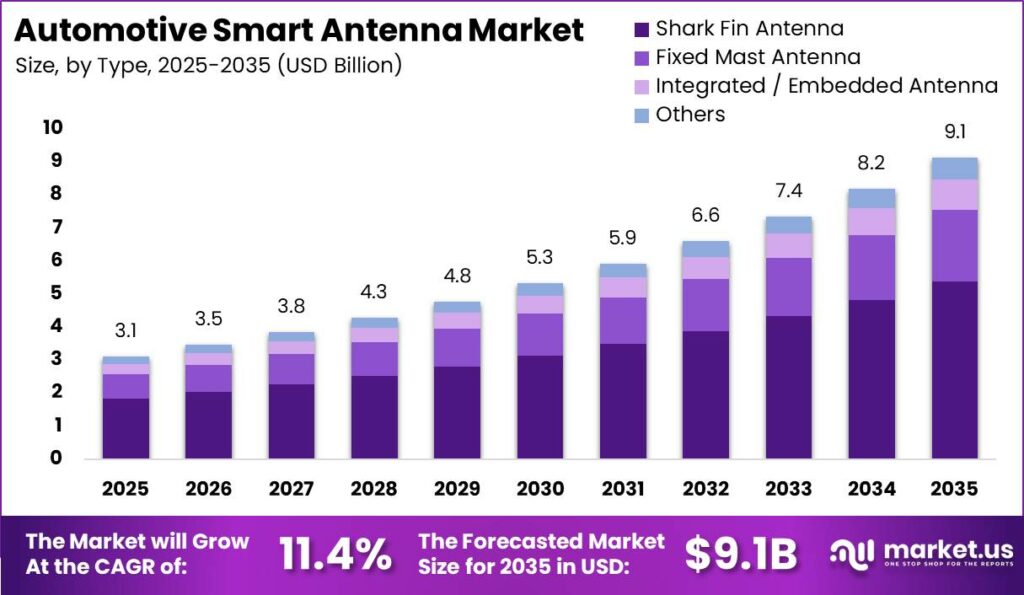
Global Automotive Smart Antenna Market size is expected to be worth around USD 9.10 Billion by 2035 from USD 3.10 Billion in 2025, growing at a CAGR of 11.4% during the forecast period 2026 to 2035. This growth trajectory reflects a near tripling of market value inside one decade. Investors entering early gain exposure before valuations catch up with demand.
An automotive smart antenna integrates multiple radio functions into one compact roof or body mounted unit. This structure replaces older single function whip antennas with modules covering radio, GPS, telematics and wireless data. Therefore, automakers reduce part count while adding connectivity features buyers now expect. This consolidation approach defines how the market is built today.
Key Takeaways
- Market size is projected to reach USD 9.10 Billion by 2035, up from USD 3.10 Billion in 2025.
- The market will expand at a CAGR of 11.4% between 2026 and 2035.
- Shark Fin Antenna leads the Type segment with a 58.80% share.
- Transceiver leads the Component segment with a 44.00% share.
- Very High Frequency leads the Frequency Band segment with a 45.90% share.
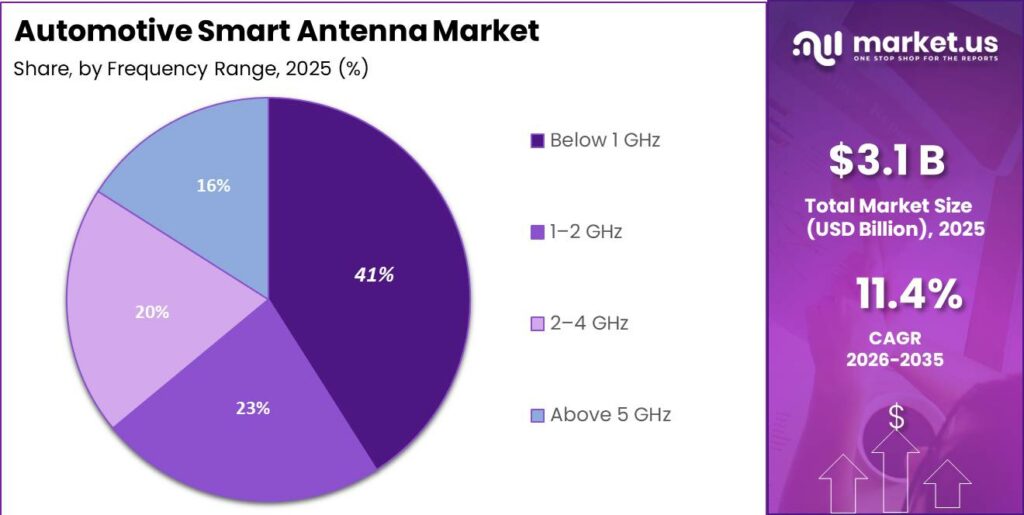
- Below 1 GHz leads the Frequency Range segment with a 41.00% share.
- AM/FM Radio leads the Application segment with a 32.50% share.
- Hatchback/Sedan leads the Vehicle Type segment with a 43.60% share.
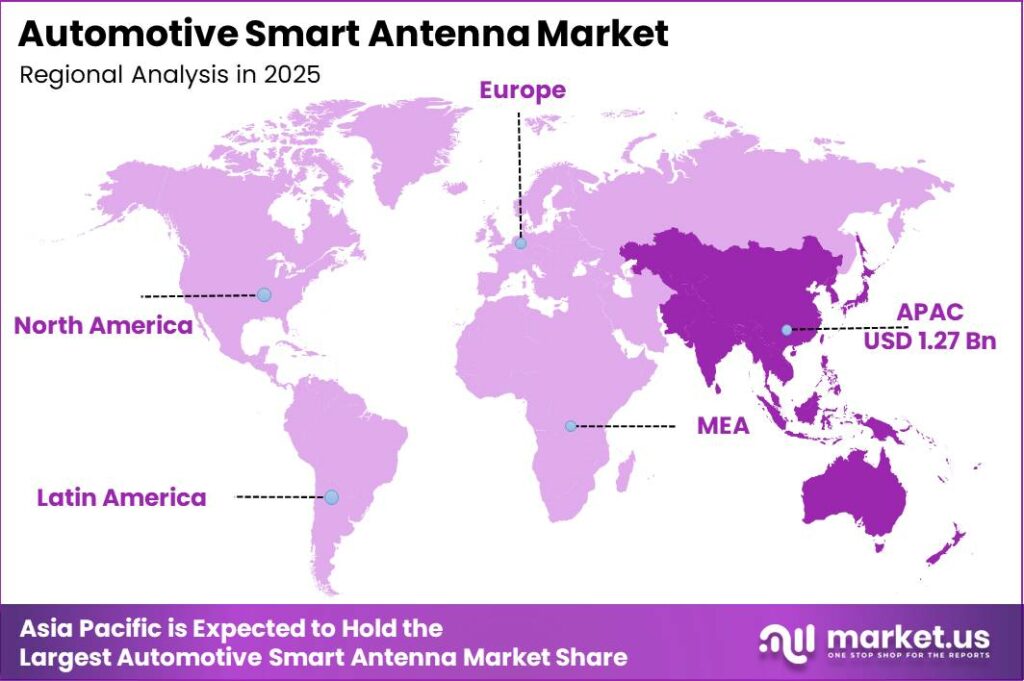
- Asia Pacific dominates the regional market with a 41.00% share, valued at USD 1.27 Billion.
Government transportation agencies are shaping demand through direct pilot investment. A 2025 Oakland County V2X field test found that traffic-signal priority reduced average intersection traversal time by approximately 10 seconds per passage. This measurable time saving gives fleet operators a concrete return on connected hardware. As a result, municipal buyers now treat V2X capable antennas as an infrastructure requirement rather than an optional upgrade.
Public funding models also reveal where near-term budgets concentrate. The Oakland County study calculated savings of approximately $0.25 per vehicle per equipped intersection from V2X traffic-signal priority, using a truck operating cost of $91.27 per hour. This creates a repeatable cost justification that commercial fleets use in procurement decisions. Consequently, antenna suppliers who can prove operational savings win larger municipal contracts. In April 2025, Airgain obtained Verizon commercial certification for its AirgainConnect Fleet all-in-one 5G vehicle gateway integrating cellular, GNSS and Wi-Fi connectivity. This carrier level validation shortens sales cycles for commercial fleet buyers seeking approved hardware.
Type Analysis
Shark Fin Antenna dominates with 58.80% due to compact multi function roof integration.
In 2025, Shark Fin Antenna held a dominant market position in the By Type segment of Automotive Smart Antenna Market, with a 58.80% share. Taoglas’ July 2025 Patriot vehicle antenna integrates up to 18 antenna elements in one enclosure, consolidating multiple connectivity functions into a single roof mounted unit. This design cuts installation labor for automakers. As a result, shark fin formats remain the default choice for new vehicle platforms.
Fixed Mast Antenna serves buyers prioritizing simple, low cost radio reception over integrated connectivity. The Patriot’s full configurations are available as 17-in-1 and 18-in-1 systems, showing how far integrated designs have moved beyond single element mast antennas. This means fixed mast demand now concentrates in budget vehicle trims. Suppliers serving this niche compete mainly on unit price.
Integrated and Embedded Antenna types appeal to automakers seeking flush, aerodynamic body designs. The 2025 Patriot enclosure measures 205 x 180 mm, with overall height varying from 60 to 164 mm depending on the installed whip, illustrating the packaging constraints embedded designs must solve. This creates engineering complexity that favors established antenna makers. However, it also raises barriers against new market entrants. Others, including window etched and body panel antennas, hold the remaining share collectively across smaller vehicle programs.
Component Analysis
Transceiver dominates with 44.00% due to core signal processing hardware role.
In 2025, Transceiver held a dominant market position in the By Component segment of Automotive Smart Antenna Market, with a 44.00% share. TE Connectivity’s January 2025 FP40 Ultra vehicle antenna series supports up to 14 ports and includes a 5-meter extension cable, reflecting the transceiver hardware scale modern modules require. This complexity raises component value per vehicle. Suppliers with proven multi port designs capture premium program awards.
ECU components coordinate signal routing between antenna elements and vehicle infotainment systems. This function determines how reliably connectivity features perform across driving conditions. Automakers therefore treat ECU integration quality as a key supplier selection criterion. Poor ECU calibration directly damages customer perceived connectivity performance.
Cables and Connectors carry signal between antenna elements and onboard modules without loss. The Texas connected bus project purchased 50 vehicle antennas alongside 10 Yunex and 43 Iteris onboard units, showing the scale of connector hardware needed per deployment. This means fleet scale rollouts drive steady connector replacement demand. Others cover mounting hardware and minor accessory parts collectively.
Frequency Band Analysis
Very High Frequency dominates with 45.90% due to legacy AM/FM radio compatibility.
In 2025, Very High Frequency held a dominant market position in the By Frequency Band segment of Automotive Smart Antenna Market, with a 45.90% share. The Patriot antenna supports LMR/TETRA communications across 380 to 400 MHz and 700 to 900 MHz, while its SDARS element operates at 2.3 GHz, showing how VHF anchored designs now bundle adjacent bands. This bundling protects legacy radio revenue. Consequently, VHF retains its lead despite newer band growth.
Ultra High Frequency band elements support cellular and short range wireless features buyers increasingly expect. TE’s 2025 5G Phantom vehicle antenna delivers more than 80% average efficiency up to 4,200 MHz and a maximum gain of 6.0 dBi. This efficiency level supports stable data connections at highway speeds. Suppliers who hit these benchmarks win 5G ready vehicle programs.
Super High Frequency elements remain a smaller share tied to emerging satellite and radar sensing functions. This positioning reflects early stage adoption rather than weak technical performance. Automakers piloting advanced driver assistance features drive most current SHF demand. Growth in this band depends directly on broader radar sensor rollout timelines.
Frequency Range Analysis
Below 1 GHz dominates with 41.00% due to broadcast radio and telematics reliance.
In 2025, Below 1 GHz held a dominant market position in the By Frequency Range segment of Automotive Smart Antenna Market, with a 41.00% share. TE’s 2025 vehicle whip portfolio covers 27 to 2,500 MHz and contains more than 100 model variations, reflecting the depth of low band configurations available to automakers. This variety lets suppliers match exact vehicle radio requirements. As a result, below 1 GHz hardware remains the volume leader.
The 1 to 2 GHz range supports GNSS and early cellular connectivity functions across most vehicle platforms. This range balances signal reach with compact antenna sizing. Automakers rely on this band for dependable navigation performance. Suppliers optimizing GNSS accuracy in this range gain a durable technical advantage.
The 2 to 4 GHz range increasingly carries Wi-Fi and mid band cellular data traffic. TE’s 2025 DBA6171 ruggedized 5G blade antenna operates from 617 MHz to 7,125 MHz, supporting a total stated bandwidth span of 6,508 MHz across this and adjacent ranges. This span lets one module replace several narrower band antennas. Above 5 GHz elements hold the remaining share collectively, tied mainly to short range in cabin sensing applications.
Application Analysis
AM/FM Radio dominates with 32.50% due to universal factory installed availability.
In 2025, AM/FM Radio held a dominant market position in the By Application segment of Automotive Smart Antenna Market, with a 32.50% share. In the 2025 Texas smart intersection deployment, vehicle onboard units transmitted Basic Safety Messages at 10 messages per second, showing how connected functions now layer onto traditional broadcast hardware. This layering protects AM/FM relevance inside multi function modules. Therefore, broadcast radio keeps its lead even as newer applications expand faster.
Satellite Radio delivers subscription based content without regional signal gaps. The Patriot’s Wi-Fi elements operate at 2.4 GHz, 5.8 GHz, and 7.1 GHz, supporting three separate Wi-Fi frequency bands from the same enclosure that also carries satellite reception. This consolidation reduces antenna count per vehicle. Automakers favor suppliers who can bundle satellite and Wi-Fi elements together.
GPS and Navigation applications depend on consistent multi band positioning accuracy. Multi band testing found that 802.11p over U-NII spectrum and Wi-Fi 802.11ac maintained stable V2X connectivity at distances of approximately 400 meters, a range that also supports dependable navigation handoff between roadside units. This reliability directly affects driver trust in autonomous features. Weak positioning accuracy remains a leading cause of feature disablement complaints.
Telematics and Remote Access applications generate recurring data revenue beyond the initial hardware sale. The 2025 Oakland County V2X vulnerable road user system achieved 48% mean average precision in its camera based detection tests, with average end to end latency near 1.8 seconds. In October 2025, Airgain obtained T-Mobile T-Priority certification for its AirgainConnect Fleet roof mounted 5G vehicle gateway, extending carrier grade telematics reach. This certification signals growing carrier reliance on antenna suppliers for network prioritization. V2X Communication and Wi-Fi & Bluetooth Connectivity hold the remaining share collectively, both scaling alongside connected infrastructure funding such as the Texas Stage 1 deployment, which cost approximately $1.9 million.
Vehicle Type Analysis
Hatchback/Sedan dominates with 43.60% due to highest global production volume base.
In 2025, Hatchback/Sedan held a dominant market position in the By Vehicle Type segment of Automotive Smart Antenna Market, with a 43.60% share. By March 2025, the Texas pilot had equipped 49 buses with V2X onboard units and deployed roadside units at 5 intersections, demonstrating fleet scale adoption patterns that passenger vehicle programs increasingly mirror. This volume advantage keeps sedan and hatchback platforms central to supplier planning. As a result, module pricing strategies target this segment first.
SUV platforms carry premium trim antenna modules supporting expanded connectivity feature sets. Buyers in this segment expect satellite radio, navigation and telematics bundled as standard equipment. This expectation raises average antenna content value per vehicle. Suppliers targeting SUV programs prioritize feature rich module designs over cost minimization.
Light Commercial Vehicles and Heavy Commercial Vehicles rely on antenna hardware for fleet tracking and safety messaging rather than entertainment features. Commercial operators value durability and message reliability over broadcast radio quality. This priority shift favors suppliers with proven ruggedized product lines. Fleet procurement cycles for these vehicle types tend to follow multi year municipal or corporate contracts.
Key Market Segments
By Type
- Shark Fin Antenna
- Fixed Mast Antenna
- Integrated / Embedded Antenna
- Others
By Component
- Transceiver
- ECU
- Cables & Connectors
- Others
By Frequency Band
- Very High Frequency (VHF)
- Ultra High Frequency (UHF)
- Super High Frequency (SHF)
By Frequency Range
- Below 1 GHz
- 1–2 GHz
- 2–4 GHz
- Above 5 GHz
By Application
- AM/FM Radio
- Satellite Radio
- GPS / Navigation
- Telematics & Remote Access
- V2X Communication
- Wi-Fi & Bluetooth Connectivity
By Vehicle Type
- SUV
- Hatchback / Sedan
- Light Commercial Vehicles
- Heavy Commercial Vehicles
Regional Analysis
Asia Pacific Dominates the Automotive Smart Antenna Market with a Market Share of 41.00%, Valued at USD 1.27 Billion
Asia Pacific leads global demand through its concentration of high volume vehicle manufacturing hubs. This scale gives regional suppliers direct access to production line integration decisions. Automakers headquartered in the region adopt smart antenna modules early to differentiate export vehicle trims. Therefore, Asia Pacific sets the pace for global feature adoption cycles.
North America shows the fastest growth trajectory as connected vehicle infrastructure investment accelerates. In May 2025, Airgain obtained AT&T FirstNet Trusted certification for its AirgainConnect Fleet 5G vehicle gateway, enabling prioritized connectivity for first responder vehicles. This certification strengthens antenna supplier positioning inside public safety fleet procurement. Consequently, North American demand increasingly ties to government connectivity mandates rather than consumer preference alone.
Europe, Latin America and the Middle East and Africa contribute smaller but steady shares tied to regional vehicle production and regulatory emergency call requirements. These regions adopt smart antenna technology more gradually than Asia Pacific or North America. However, regulatory alignment across these markets creates predictable long term demand. Suppliers with flexible regional certification processes gain an advantage across this combined territory.
Key Regions and Countries
North America
- US
- Canada
Europe
- Germany
- France
- The UK
- Spain
- Italy
- Rest of Europe
Asia Pacific
- China
- Japan
- South Korea
- India
- Australia
- Rest of APAC
Latin America
- Brazil
- Mexico
- Rest of Latin America
Middle East and Africa
- GCC
- South Africa
- Rest of MEA
Market Dynamics
Market Opportunity Analysis - Underserved regions and niche vehicle segments offer entry points for new suppliers
Above 5 GHz frequency range hardware remains a small niche inside the broader spectrum split led by Below 1 GHz at 41.00%. This gap signals limited current competition for radar and sensing focused antenna elements. New entrants targeting this narrow range avoid direct price competition against established VHF suppliers. Therefore, specialized high frequency module makers can build defensible technical positioning early.
Heavy Commercial Vehicles inside the Vehicle Type split, trailing Hatchback/Sedan at 43.60%, represent an underexploited buyer group. Fleet operators in this category prioritize durability over broadcast entertainment features. This creates room for suppliers offering ruggedized, safety focused antenna designs. Instead of competing on passenger vehicle volume, entrants can build steady margin through commercial fleet contracts.
Middle East and Africa, alongside Latin America, remain smaller regional contributors relative to Asia Pacific’s 41.00% lead. This reflects earlier stage vehicle connectivity infrastructure across both regions. Suppliers establishing local certification pathways now position themselves ahead of broader regional demand growth. This creates first mover advantage before larger competitors expand regional coverage.
Technology and Innovation Landscape - Multi element integration and carrier certification redefine competitive positioning
Multi element consolidation defines the current innovation frontier. Taoglas’ Patriot antenna integrates up to 18 elements in one enclosure, replacing what previously required several separate antenna modules. This reduces vehicle wiring complexity and installation cost. Manufacturers adopting consolidated designs gain a clear assembly line efficiency advantage over competitors using legacy multi antenna layouts.
Wide bandwidth module engineering is expanding what a single antenna can support. TE Connectivity’s DBA6171 blade antenna spans 617 MHz to 7,125 MHz in one ruggedized unit. This means fewer part numbers for automakers to manage across global vehicle platforms. Buyers benefit through simplified sourcing and more consistent connectivity performance across trim levels.
Carrier grade certification is becoming a competitive differentiator beyond raw hardware specification. In October 2025, Airgain obtained T-Mobile T-Priority certification for its AirgainConnect Fleet gateway. This certification validates network prioritization for commercial and public safety fleets. Investors should note that carrier certification now functions as a market access requirement, not simply a marketing claim.
Drivers
Regulatory pressure, not consumer demand, is driving the market forward. The Federal Communications Commission’s Second Report and Order set C-V2X rules effective 11 February 2025, with legacy DSRC roadside operations ending 14 December 2026. This forces a hardware refresh across every roadside unit still running the old standard, while parallel European and Chinese spectrum rules widen the demand window further.
Compliant roof modules must now carry 2 to 4 extra radiating elements for sidelink and dual GNSS, pushing per vehicle antenna content up roughly 180% against 2024 levels. This converts a one time hardware sale into a recurring, homologated subsystem. As a result, suppliers gain engineering recovery revenue and margin improvement of an estimated 250 to 400 basis points on new platform awards.
| Driver | (~) % Impact on CAGR Forecast | Geographic Relevance | Impact Timeline |
|---|---|---|---|
| Mandated C-V2X Spectrum Transition | +2.4% | North America, Europe, China | Short term (2 years or less) |
| Zonal E/E Architecture Consolidation | +1.7% | Global | Medium term (2 to 4 years) |
| Type-Approval Emergency Call Compliance | +1.3% | Europe, UK, Türkiye | Short term (2 years or less) |
| Dedicated EV Platform Launch Cadence | +1.0% | China, Europe, Korea | Medium term (2 to 4 years) |
| Premium and SUV Mix Enrichment | +0.8% | Asia Pacific, North America, Gulf | Short term (2 years or less) |
| Multi-Band GNSS For Hands-Off ADAS | +0.6% | Global | Medium term (2 to 4 years) |
Restraints
Trade policy is limiting supplier profitability across this market. Presidential Proclamation 10908 applied a 25% duty on listed automobile parts, including electrical components, from 3 May 2025. Because antenna assemblies source disproportionately from Asian and Mexican plants, this duty lands on landed cost. Tier one connectivity units report segment operating margins of just 5 to 8%, leaving little room to absorb the charge.
The import adjustment offset, worth 3.75% of assembled MSRP through 30 April 2026 and stepping down to 2.5% afterward, benefits vehicle assemblers rather than component suppliers. Purchasing teams have paused sourcing decisions pending Commerce Department rulings. Consequently, tooling capital of several million dollars per line is delayed by 9 to 18 months, and current shipments contract rather than merely slowing.
| Restraint | (~) % Impact on CAGR Forecast | Geographic Relevance | Impact Timeline |
|---|---|---|---|
| Section 232 Component Tariff Pass-Through | -1.3% | United States, Mexico, Canada | Short term (2 years or less) |
| Elevated Capital Cost Freezing Tooling | -0.9% | Global | Short term (2 years or less) |
| EV Program Deferrals And Cancellations | -0.8% | North America, Western Europe | Short term (2 years or less) |
| Domestic Content Localization Mandates | -0.5% | China, India | Medium term (2 to 4 years) |
| Entry Segment Cost Ceilings | -0.4% | India, ASEAN, Latin America | Short term (2 years or less) |
| Broadcast Tuner Content Deletion | -0.3% | North America, Europe | Medium term (2 to 4 years) |
Challenges
Material supply concentration threatens antenna production stability. Low loss PTFE and hydrocarbon ceramic laminates come from a handful of qualified plants in Japan, Taiwan, Korea and the US Northeast. Qualified laminate lead times have run 26 to 40 weeks against a pre-2020 norm near 10 weeks. Dual sourcing a substitute dielectric consumes 12 to 20 months and roughly 1.5 to 3.0 million dollars of engineering effort per platform.
Buffer stock carried against this exposure adds 1 to 2 percentage points of working capital drag. Suppliers respond by throttling new program intake and prioritizing high content premium awards over volume programs. This creates new revenue opportunity for suppliers who commit to long term take or pay laminate agreements and substrate agnostic antenna architectures that tolerate two dielectric constants without re-tuning.
| Challenge | (~) % CAGR Friction Drag | Geographic Relevance | Mitigation Horizon |
|---|---|---|---|
| Concentrated RF Laminate Supply | -0.8% | Global, Asia Pacific dependent | Medium term (2 to 4 years) |
| RF Validation Talent Deficit | -0.6% | Global | Long term (4 years or more) |
| Fragmented Homologation And Certification | -0.5% | Emerging markets, Gulf, Brazil | Medium term (2 to 4 years) |
| Multi-Radio Desense Interference | -0.4% | Global | Medium term (2 to 4 years) |
| Roof Module Thermal Derating | -0.35% | Gulf, India, Southern Europe | Medium term (2 to 4 years) |
| Cybersecurity Management Overhead | -0.3% | Europe, Japan, Korea | Long term (4 years or more) |
Opportunities
Satellite direct to vehicle antennas represent open white space rather than an active driver today. 3GPP froze transparent payload NTN specification with S-band allocations at 1980 to 2010 MHz uplink and 2170 to 2200 MHz downlink in Release 18 during 2024, with regenerative payloads arriving in Release 19 in 2026. Commercial narrowband direct to device service is only now entering live operation.
Adding a circularly polarised S-band element to an existing shark fin platform adds roughly 8 to 14 dollars of bill of materials but supports a module price uplift of 25 to 45 dollars. This implies gross margin expansion of about 400 to 600 basis points on the enriched variant. However, qualification and regulatory clearance in each market consume 18 to 30 months before first revenue.
| Opportunity | (~) % Potential CAGR Upside | Geographic Relevance | Execution Window |
|---|---|---|---|
| Satellite NTN Direct-To-Vehicle Antennas | +1.8% | Global, remote-coverage geographies | Medium term (2 to 4 years) |
| Connectivity Subscription Revenue Sharing | +1.2% | North America, Europe, China | Medium term (2 to 4 years) |
| Heavy Truck And Off-Highway Platforms | +0.9% | North America, Europe, Brazil | Medium term (2 to 4 years) |
| In-Cabin UWB And Radar Sensing | +0.7% | Europe, Japan, North America | Medium term (2 to 4 years) |
| Localized Manufacturing Roll-Ups | +0.5% | India, ASEAN, Morocco | Long term (4 years or more) |
| Antenna-As-Sensor And Pre-6G Arrays | +0.4% | Global | Long term (4 years or more) |
Key Company Insights
Continental AG holds a structural advantage through its broad tier one relationships across global vehicle platforms. This positioning lets the company embed antenna modules directly into vehicle electrical architecture programs early in design cycles. However, its scale also means slower pivots toward niche connectivity features. Smaller specialized suppliers can move faster on emerging satellite and radar sensing formats.
DENSO Corporation leverages deep integration with Japanese and broader Asia Pacific automakers to secure long term platform awards. This regional strength supports steady volume even during global demand fluctuations. Its manufacturing depth allows tight cost control on high volume shark fin and mast antenna production. The company faces exposure if Asia Pacific vehicle production growth slows relative to other regions.
Key Players
- Continental AG
- DENSO Corporation
- TE Connectivity Ltd.
- Ficosa International S.A. (Panasonic Group)
- Harada Industry Co., Ltd.
- Laird Connectivity
- HARMAN International Industries
- HELLA GmbH & Co. KGaA (Forvia)
- Hirschmann Car Communication GmbH
- KATHREIN SE (Kathrein Automotive)
- Yokowo Co., Ltd.
- Schaffner Holding AG
- MD ELEKTRONIK GmbH
- HUF Hülsbeck & Fürst GmbH & Co. KG
- Airgain, Inc.
Recent Developments
- February 2026: Airgain acquired the MegaFi 2 and MegaGo 2 high power user equipment product line assets from Nextivity, expanding its 5G vehicle connectivity portfolio.
- June 2025: TE Connectivity showcased its next generation FP20 Auto, FP40 Auto, FP40 Ultra and FPL Pro multi port vehicle antennas supporting UHF, LTE/5G, Wi-Fi 6E/7, GNSS and 2.4 GHz ISM connectivity.
- March 2025: HARMAN introduced Ready Connect, an automotive telematics control unit with integrated satellite communication capabilities and a modular upgrade path from 4G to 5G and satellite connectivity.
Geopolitical Impact Analysis
Trade tariffs are directly raising landed costs for antenna components sourced from Asian and Mexican plants. According to the World Trade Organization framework referenced in Proclamation 10908, a 25% duty applies to listed automobile electrical parts from 3 May 2025. As reported by supplier filings, the import offset of 3.75% benefits assemblers, not component makers. This gap squeezes antenna supplier margins directly.
Supply chain rerouting is extending lead times for critical RF materials. Data from national customs statistics shows qualified laminate lead times running 26 to 40 weeks, compared to roughly 10 weeks before 2020. This means antenna makers must hold larger inventory buffers to protect production schedules. Consequently, working capital costs rise across the entire component supply chain.
Report Scope
| Report Features | Description |
|---|---|
| Market Value (2025) | USD 3.10 Billion |
| Forecast Revenue (2035) | USD 9.10 Billion |
| CAGR (2026-2035) | 11.4% |
| Base Year for Estimation | 2025 |
| Historic Period | 2020-2024 |
| Forecast Period | 2026-2035 |
| Report Coverage | Revenue Forecast, Market Dynamics, Market Opportunity Analysis, Technology and Innovation Landscape, Competitive Landscape, Recent Developments |
| Segments Covered | By Type (Shark Fin Antenna, Fixed Mast Antenna, Integrated / Embedded Antenna, Others), By Component (Transceiver, ECU, Cables & Connectors, Others), By Frequency Band (Very High Frequency, Ultra High Frequency, Super High Frequency), By Frequency Range (Below 1 GHz, 1-2 GHz, 2-4 GHz, Above 5 GHz), By Application (AM/FM Radio, Satellite Radio, GPS / Navigation, Telematics & Remote Access, V2X Communication, Wi-Fi & Bluetooth Connectivity), By Vehicle Type (SUV, Hatchback / Sedan, Light Commercial Vehicles, Heavy Commercial Vehicles) |
| Regional Analysis | North America (US and Canada), Europe (Germany, France, The UK, Spain, Italy, and Rest of Europe), Asia Pacific (China, Japan, South Korea, India, Australia, and Rest of APAC), Latin America (Brazil, Mexico, and Rest of Latin America), Middle East and Africa (GCC, South Africa, and Rest of MEA) |
| Competitive Landscape | Continental AG, DENSO Corporation, TE Connectivity Ltd., Ficosa International S.A. (Panasonic Group), Harada Industry Co., Ltd., Laird Connectivity, HARMAN International Industries, HELLA GmbH & Co. KGaA (Forvia), Hirschmann Car Communication GmbH, KATHREIN SE (Kathrein Automotive), Yokowo Co., Ltd., Schaffner Holding AG, MD ELEKTRONIK GmbH, HUF Hülsbeck & Fürst GmbH & Co. KG, Airgain, Inc. |
| Customization Scope | Customization for segments, region / country-level will be provided. Additional customization can be done based on requirements. |
| Purchase Options | We have three licenses to opt for: Single User License | Multi-User License (Up to 5 Users) | Corporate Use License (Unlimited User and Printable PDF) |





































