Report Overview
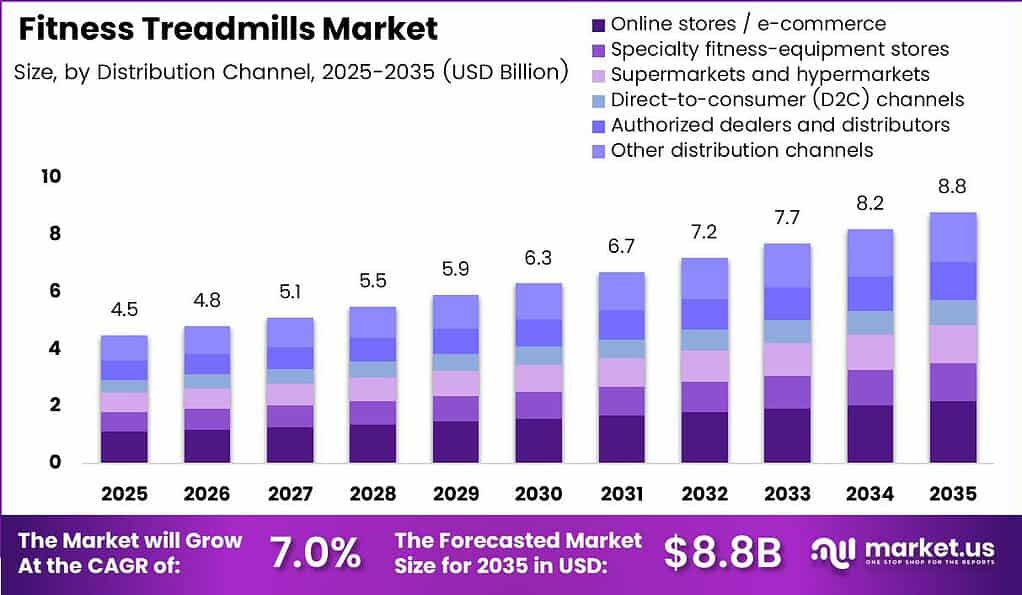
Global Fitness Treadmills Market size is expected to be worth around USD 8.8 Billion by 2035 from USD 4.5 Billion in 2025, growing at a CAGR of 7.0% during the forecast period 2025 to 2035. Fitness treadmills provide controlled walking and running exercise through motorized or self-powered belt systems. The market earns revenue from residential products, commercial fleets, connected subscriptions, installation, and service support.
Fitness treadmill suppliers serve home users, gyms, hospitality venues, sports facilities, and rehabilitation providers. According to the World Health Organization, 31% of adults were insufficiently active in 2022. This large inactivity base supports demand for indoor exercise equipment that fits routine use. Manufacturers that pair reliable hardware with simple programs can convert health concerns into recurring equipment and service revenue.
Commercial operators create an important demand channel because facility economics shape replacement budgets and equipment density. As reported by the Sports & Fitness Industry Association, consumer treadmill sales rose 10.1% in 2023. This signals sustained buyer willingness to purchase cardio equipment after pandemic-led demand normalized. Suppliers that offer clear price tiers can protect volume across entry-level, mid-range, and premium household segments.
Key Takeaways
- The Fitness Treadmills Market is valued at USD 4.5 Billion in 2025.
- The market is forecast to reach USD 8.8 Billion by 2035.
- The market will expand at a CAGR of 7.0% from 2025 to 2035.
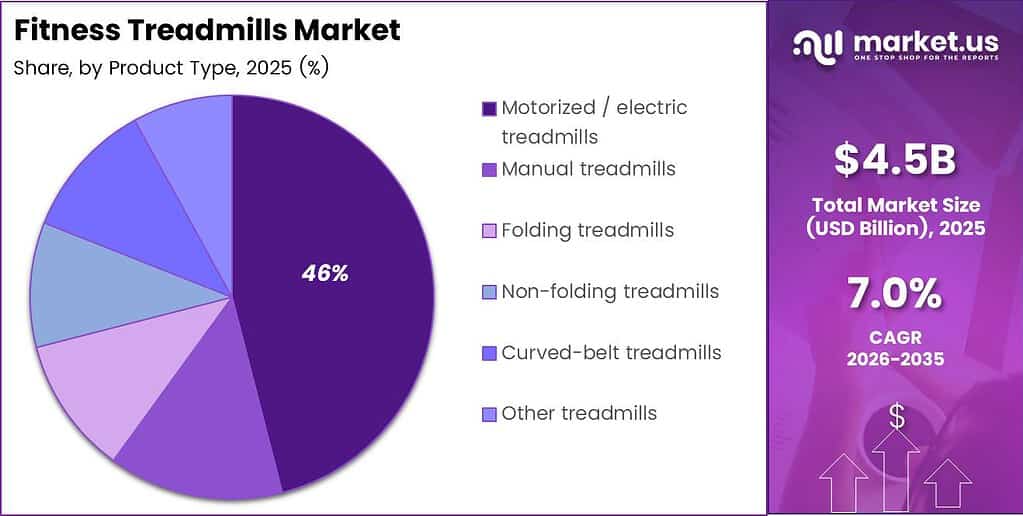
- Motorized/electric treadmills lead Product Type with a 46.0% share in 2025.
- Motorized incline leads Incline Type with a 49.0% share in 2025.
- Residential/home users lead End User with a 48.0% share in 2025.
- Mid-range leads Price Range with a 37.0% share in 2025.
- Online stores/e-commerce lead Distribution Channel with a 25.0% share in 2025.
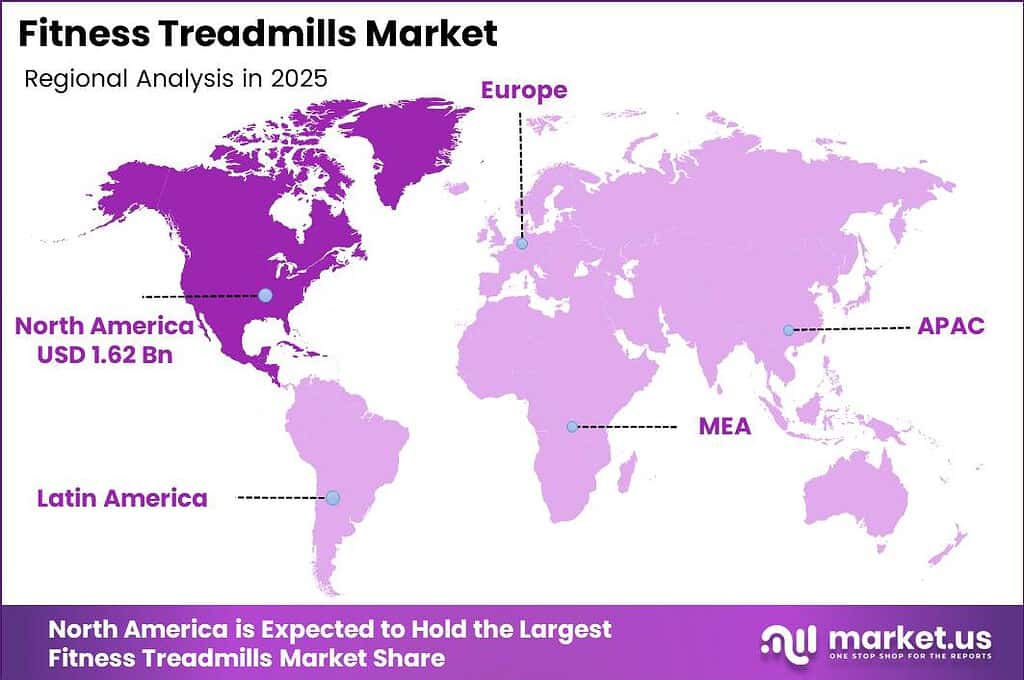
- North America leads with a 36.0% share and USD 1.62 Billion value in 2025.
- The forecast period runs from 2025 to 2035.
Life Fitness expanded the commercial offer in March 2025 through its four-machine Atmos cardio line. The Atmos treadmill includes a 4 HP AC motor, a 15% incline, and a maximum speed of 12 mph. This launch targets hospitality and compact commercial facilities that need proven performance within smaller spaces. Equipment suppliers can win institutional orders by combining compact footprints with serviceable commercial-grade components.
North America dominates the Fitness Treadmills Market with a market share of 36.0% in 2025, valued at USD 1.62 Billion. Health-club infrastructure, connected fitness adoption, and household spending support this position. The Health & Fitness Association recorded median operator revenue growth of 9.9%, membership growth of 5.5%, and retention of 66.4% in 2024. These economics sustain fleet replacement and favor suppliers with local service capacity.
BH Fitness introduced the HiitMill in January 2025 with 4 friction-based resistance levels. The self-powered curved treadmill serves performance-focused facilities seeking high-intensity cardio options without motor energy use. This reflects a broader product shift toward specialized training formats. Investors should favor companies that can segment their portfolios between conventional cardio, connected platforms, and performance-oriented manual equipment.
Product Type Analysis
Motorized/electric treadmills dominate with 46.0% share in 2025 due to controlled speed and incline training.
In 2025, motorized/electric treadmills held a 46.0% share in the Product Type segment of the Fitness Treadmills Market. Technogym indicates that its Run treadmill reaches speeds up to 25 km/h. Electric drive systems deliver controlled speed changes that support walking, interval work, and endurance training. Buyers therefore prioritize motor durability, console quality, and service access when selecting equipment for high-use home and commercial settings.
Manual treadmills suit users who prefer self-paced exercise and lower electrical dependence. Woodway found that its Curve Trainer uses an approximately 3% curved surface and manual speed control. The runner’s body position directly regulates belt movement, which removes motor wear and power requirements. Facility operators can use manual models to diversify performance zones, while manufacturers can earn premium margins through durable slat-belt engineering.
Folding treadmills address space limits within apartments and smaller homes. Peloton introduced the foldable Tread Flex at a listed price of USD 2,195 in September 2025. Folding frames reduce storage barriers that can delay purchase decisions in urban households. Sellers that simplify setup, transport, and vertical storage can widen their reachable consumer base without competing solely on entry-level pricing.
Incline Type Analysis
Motorized incline dominates with 49.0% share in 2025 due to automated terrain and intensity control.
In 2025, motorized incline treadmills held a 49.0% share in the Incline Type segment of the Fitness Treadmills Market. Technogym Run provides an electronically controlled incline range from 0% to 15%. Automated grade adjustment raises training intensity without forcing users to alter pace manually. Commercial buyers benefit because one machine can support varied fitness levels and program types across a shared cardio floor.
Manual incline treadmills serve training settings that value simplified mechanics and low maintenance needs. Woodway’s Curve Trainer uses approximately 3% curvature within a manually driven design. The fixed curved surface changes running mechanics without actuator systems, cables, or powered elevation controls. Buyers can reduce electrical requirements, while sellers can position these products for athletic training spaces that value durability and user-controlled intensity.
Decline and incline treadmills provide terrain variation that standard flat machines cannot replicate. NordicTrack offers products with settings from -3% decline to 12% incline. Downhill and uphill settings alter muscle loading and training feel across one workout. Connected brands can use these features to support immersive route content, improving subscription appeal and raising the value of premium equipment bundles.
End User Analysis
Residential/home users dominate with 48.0% share in 2025 due to private, convenient daily exercise access.
In 2025, residential/home users held a 48.0% share in the End User segment of the Fitness Treadmills Market. The Health & Fitness Association found that 81 million Americans belonged to a fitness facility in 2025, equal to 26.1% population penetration. This active consumer base supports hybrid routines that combine gyms with home cardio equipment. Brands should target members with compact products and connected programs that extend facility-style training into homes.
Commercial gyms and fitness centers purchase treadmills to support frequent member use and maintain cardio capacity. The Sports & Fitness Industry Association reported institutional treadmill sales increased 23.5% in 2023. High utilization accelerates replacement needs because motors, belts, rollers, and consoles face repeated loading cycles. Suppliers with preventive maintenance contracts and quick parts availability can secure recurring fleet revenue from operators.
Hotels and hospitality facilities use treadmills to improve guest fitness amenities without building large training spaces. Life Fitness specifies that the Atmos treadmill measures 82 by 32 by 61 inches, uses a 4 HP motor, and reaches a 15% incline. Compact commercial specifications help hotels balance guest expectations with restricted floorplans. Hospitality buyers will favor durable equipment that limits downtime and simplifies service scheduling.
Price Range Analysis
Mid-range dominates with 37.0% share in 2025 due to balanced performance and affordability.
In 2025, mid-range treadmills held a 37.0% share in the Price Range segment of the Fitness Treadmills Market. Health & Fitness Association data shows value gyms produced 56% of India’s fitness revenue in 2024. Value facilities also held 78% of memberships and 80% of facilities. Mid-range equipment fits operators seeking reliable performance without premium capital costs, creating volume opportunities for suppliers with disciplined product engineering.
Economy and entry-level treadmills attract households with tight upfront budgets and simpler training needs. Health & Fitness Association data shows nearly two-thirds of active Latin American consumers spent the equivalent of USD 10 to USD 50 monthly on health and fitness. Lower monthly wellness spending constrains major equipment purchases. Suppliers can improve conversion through basic durable models, installment options, and low-cost digital training access.
Premium treadmills compete through advanced displays, content ecosystems, stronger motors, and elevated design. Peloton priced its Tread+ Vision at USD 6,695, with a required USD 299 assembly charge. Premium buyers accept higher acquisition costs when hardware supports differentiated training experiences and status-driven home gyms. Brands must protect this margin pool through reliable service, unique content, and frequent software updates.
Distribution Channel Analysis
Online stores/e-commerce dominate with 25.0% share in 2025 due to broad selection and direct purchase access.
In 2025, online stores/e-commerce held a 25.0% share in the Distribution Channel segment of the Fitness Treadmills Market. The U.S. Census Bureau reported USD 732.0 Billion in retail and food-service sales during August 2025, up 5.0% from the prior year. Digital retail gives treadmill suppliers broad reach and rich product comparison tools. Brands must pair online sales with clear delivery, assembly, and warranty support.
Specialty fitness-equipment stores remain important for customers who want demonstrations and expert consultation before purchase. Peloton established experience zones in 3 MediaMarktSaturn stores during June 2025. Physical demonstrations reduce uncertainty around treadmill size, screen quality, and running comfort. Retail partnerships can increase conversion for premium connected products where buyers value hands-on trials before accepting higher price points.
Authorized dealers and distributors support commercial customers that require installation, service, and local procurement support. Peloton’s commercial network served more than 80,000 fitness facilities across over 60 countries after integrating Precor. Dealers translate manufacturer products into regional service capacity and institutional account coverage. Manufacturers that protect dealer training and spare-parts access can scale international commercial sales with lower direct infrastructure costs.
Key Market Segments
Product Type
- Motorized / electric treadmills
- Manual treadmills
- Folding treadmills
- Non-folding treadmills
- Curved-belt treadmills
- Smart / connected treadmills
- Rehabilitation treadmills
- Other treadmills
Incline Type
- Motorized incline
- Manual incline
- Decline and incline treadmills
- Non-incline treadmills
End User
- Residential / home users
- Commercial gyms and fitness centers
- Hotels and hospitality facilities
- Sports training facilities
- Other end users
Price Range
- Economy / entry-level
- Mid-range
- Premium
- Commercial-grade / professional
Distribution Channel
- Online stores / e-commerce
- Specialty fitness-equipment stores
- Supermarkets and hypermarkets
- Direct-to-consumer (D2C) channels
- Authorized dealers and distributors
- Other distribution channels
Regional Analysis
North America Dominates the Fitness Treadmills Market with a Market Share of 36.0% in 2025, Valued at USD 1.62 Billion
North America leads because established health-club networks and home-fitness spending support both commercial and consumer replacements. The Sports & Fitness Industry Association found that about 208 million Americans participated in fitness activities during 2023. This scale supports high utilization of cardio equipment across homes, gyms, hotels, and training sites. Manufacturers should prioritize regional service networks, connected features, and dealer coverage to defend market share.
Europe remains a major treadmill market because regular exercise participation supports demand for fitness facilities and home cardio products. Eurostat found that 44% of people aged 15 and older exercised at least once weekly in 2019. Regular participation increases the value of reliable equipment and structured workout options. Suppliers should emphasize energy efficiency, durable commercial builds, and compact designs suited to urban housing.
Asia Pacific presents important volume potential through rising fitness participation and expanding urban consumer markets. Health & Fitness Association data values India’s fitness economy at USD 1.9 Billion in 2024 and forecasts USD 4.5 Billion by 2030. This expansion supports mid-range and value-focused treadmill purchases across homes and facilities. Manufacturers need localized pricing, service partnerships, and financing to capture regional growth.
Key Regions and Countries
North America
- US
- Canada
Europe
- Germany
- France
- The UK
- Spain
- Italy
- Rest of Europe
Asia Pacific
- China
- Japan
- South Korea
- India
- Australia
- Rest of APAC
Latin America
- Brazil
- Mexico
- Rest of Latin America
Middle East and Africa
- GCC
- South Africa
- Rest of MEA
Market Dynamics
The market benefits from preventive-health behavior because indoor cardio equipment offers an accessible way to maintain regular activity. WHO indicates that insufficiently active people face a 20% to 30% higher risk of death than active people. This health outcome raises interest in structured daily exercise across homes, facilities, and rehabilitation settings. Treadmill providers can turn this need into sales by offering approachable programs, safe controls, and dependable maintenance.
Drivers
Commercial membership expansion increases treadmill procurement because operators need enough cardio stations to serve larger member populations. The Health & Fitness Association recorded 77 million U.S. facility members in 2024, membership growth of 5.6%, and nearly 96 million total customers. These indicators strengthen fleet replacement and new-site purchasing. Suppliers that offer installation, financing, and maintenance can secure higher-value contracts with expanding operators.
Connected coaching, established fleet replacement, compact home products, and omnichannel distribution broaden purchase reasons across buyer groups. A conservative sensitivity assigns commercial membership expansion a +0.55% CAGR effect, connected coaching +0.35%, and fleet replacement +0.30%. These effects remain embedded within the baseline forecast. Investors should favor suppliers that combine hardware quality, software engagement, and responsive distribution coverage.
| Driver | (~) % Impact on CAGR Forecast | Geographic Relevance | Impact Timeline |
|---|---|---|---|
| Commercial fitness membership expansion | +0.55% | Global; strongest evidence in North America | Short term (≤ 2 years) |
| Connected coaching adoption | +0.35% | North America, Europe, developed Asia-Pacific | Short term (≤ 2 years) |
| Established commercial fleet replacement | +0.30% | North America, Western Europe, Japan | Short term (≤ 2 years) |
| Compact home treadmill adoption | +0.25% | Urban Asia-Pacific, Europe, North America | Short term (≤ 2 years) |
| Omnichannel equipment distribution | +0.20% | Global; organized retail and e-commerce markets | Short term (≤ 2 years) |
Restraints
Financing affordability restricts treadmill sales when buyers cannot meet payment thresholds or pass credit screening. The Federal Reserve set the federal funds target range at 3.50% to 3.75% during December 2025. A 36-month purchase at 12% APR raises monthly payments by approximately 19.6% compared with interest-free terms. Sellers must balance conversion support against reduced equipment margins.
Import duties, safety restrictions, exercise substitution, and apartment constraints can delay purchases. An illustrative assessment assigns financing a -0.40% CAGR drag, import duties -0.30%, and safety-related restrictions -0.25%. Buyers may defer large equipment purchases when total ownership costs rise. Manufacturers can reduce these barriers through compliant designs, local inventory, quieter equipment, and clear installment offers.
| Restraint | (~) % Impact on CAGR Forecast | Geographic Relevance | Impact Timeline |
|---|---|---|---|
| Financing affordability and credit exclusion | −0.40% | Global; credit-dependent households and independent gyms | Short term (≤ 2 years) |
| Import-duty purchase-price barriers | −0.30% | United States and import-dependent markets | Short term (≤ 2 years) |
| Safety-related sales and resale restrictions | −0.25% | United States; affected products and channels | Short term (≤ 2 years) |
| Outdoor and equipment-free exercise substitution | −0.20% | Global; price-sensitive consumer segments | Medium term (2–4 years) |
| Apartment installation and noise restrictions | −0.10% | Dense urban residential markets | Medium term (2–4 years) |
Challenges
Last-mile service networks create cost pressure because treadmill delivery, installation, diagnosis, and repair require coordinated local resources. A manufacturer filing identified operations across 5 national markets and reliance on third-party delivery and installation providers. First-visit resolution falling from 90% to 80% increases expected visits by approximately 9.1%. Suppliers need regional parts inventory and technician training to limit downtime.
Component concentration, inventory errors, cyber exposure, and content licensing also pressure profitability. The illustrative assessment assigns last-mile service a -0.25% CAGR drag and component sourcing a -0.15% drag. Connected platforms increase exposure because user data and software require persistent security management. Manufacturers should improve demand forecasting, supplier diversification, and digital governance before these frictions weaken customer confidence.
| Challenge | (~) % CAGR Friction Drag | Geographic Relevance | Mitigation Horizon |
|---|---|---|---|
| Last-Mile Service Network Complexity | −0.25% | Global; dispersed and secondary-city installations | Medium term (2–4 years) |
| Concentrated Critical Component Sourcing | −0.15% | Global; outsourced manufacturing networks | Medium term (2–4 years) |
| Demand Forecasting Inventory Mismatch | −0.12% | Global; seasonal consumer equipment channels | Short term (≤ 2 years) |
| Connected Platform Cybersecurity Exposure | −0.10% | North America, Europe, connected-equipment markets | Long term (≥ 4 years) |
| Music Licensing Content Complexity | −0.08% | Multinational subscription-enabled equipment platforms | Medium term (2–4 years) |
Opportunities
Rehabilitation-specific treadmill platforms can extend suppliers into clinician-supervised training and recovery programs. WHO estimated that 2.4 billion people live with conditions that may benefit from rehabilitation. This population does not equal direct treadmill demand, yet it expands the addressable clinical context. Providers that build validated low-speed controls, gait protocols, and outcome tools can earn differentiated institutional business.
Circular procurement, energy efficiency, accessible design, and aggregated institutional purchasing create targeted upside. The sensitivity model assigns rehabilitation platforms a potential +0.40% CAGR uplift and certified circular procurement a +0.25% uplift. Early movers can lower customer ownership costs and meet public procurement needs. Manufacturers must support these offers with credible lifecycle data, service capability, and product certification.
| Opportunity | (~) % Potential CAGR Upside | Geographic Relevance | Execution Window |
|---|---|---|---|
| Rehabilitation-specific treadmill platforms | +0.40% | Global; rehabilitation providers and aging populations | Medium term (2–4 years) |
| Certified circular-equipment procurement | +0.25% | Europe, North America, emerging-market institutions | Medium term (2–4 years) |
| Fleet electricity-efficiency differentiation | +0.20% | High-electricity-cost commercial markets | Medium term (2–4 years) |
| Accessible adaptive treadmill designs | +0.18% | Public recreation, inclusive fitness, senior living | Long term (≥ 4 years) |
| Institutional procurement aggregation | +0.12% | Fragmented education and municipal purchasing markets | Medium term (2–4 years) |
Key Company Insights
Johnson Health Tech Co., Ltd.
Johnson Health Tech serves consumer and commercial fitness channels through brands that cover cardio, strength, and connected training equipment. Johnson Health Tech financial statements recorded NT$34.957 Billion in operating revenue during the first nine months of 2025, compared with NT$30.409 Billion during the same 2024 period. This scale supports broader product development and dealer service investment. The company remains positioned to compete across residential and institutional treadmill demand.
Johnson Health Tech launched connected BowFlex and Horizon treadmills in August 2024 with motorized inclines from 0% to 15% and speeds from 0.5 to 12 mph. The product rollout strengthens its appeal to consumers seeking programmed incline training. Connected hardware helps the company defend price realization while improving engagement through fitness-app compatibility.
Life Fitness, Inc.
Life Fitness supplies commercial cardio and strength equipment to health clubs, hotels, and multifamily facilities. Life Fitness offers a four-machine Atmos cardio range designed for compact fitness spaces. The Atmos treadmill reaches 12 mph, provides a 15% incline, and uses a 4 HP AC motor. These specifications support hospitality buyers that need commercial output within restricted equipment footprints.
Life Fitness secured a deployment agreement with Wellfit during August 2024 for a new Dubai Marina fitness center. Wellfit selected the four-machine Symbio cardio line for a 35,000-square-foot facility. The installation demonstrates demand for premium commercial cardio in destination fitness settings. Life Fitness can use such projects to strengthen regional references and promote full-line equipment contracts.
Key Players
- Johnson Health Tech Co., Ltd.
- Life Fitness, Inc.
- Technogym S.p.A.
- iFIT Inc.
- Peloton Interactive, Inc.
- Precor Incorporated
- Dyaco International Inc.
- Core Health & Fitness, LLC
- TRUE Fitness Technology, Inc.
- BowFlex Inc. / Nautilus Consumer Fitness
- BH Fitness / BH Group
- SHUA Sports Co., Ltd.
- Impulse (Qingdao) Health Tech Co., Ltd.
- Landice, Inc.
- Woodway USA, Inc.
Recent Developments
2025
- September 2025: Peloton product launch introduced 3 treadmills, Tread Flex, Tread Vision, and Tread+ Vision, while Tread+ Vision supports up to 300 pounds of Sled Mode resistance.
- September 2025: Technogym innovation launch began RUN X qualifying stages for the first world treadmill championship over a 5 km distance.
2025
- October 2025: Peloton product launch introduced the Peloton Pro commercial line and opened access to more than 50,000 instructor-led workouts.
- October 2025: Peloton product launch introduced a Cross Training Series covering 5 products, Bike, Bike+, Tread, Tread+, and Row+.
- May 2025: Peloton partnership created experience zones in 3 MediaMarktSaturn stores in Germany.
- April 2025: BH Fitness product launch displayed 2 HIIT additions, a high-performance rower and a curved treadmill, at FIBO 2025.
- March 2025: BH Fitness product launch introduced the RS2000 treadmill with 2 console options and 8 preset programs.
- March 2025: Peloton partnership began a global DJ residency with Armada Music across its 2 studios in New York and London.
2024
- November 2024: Technogym partnership secured the Milano Cortina 2025 Olympic and Paralympic supplier role, representing its 10th Olympic equipment experience.
- March 2024: Life Fitness product launch debuted the 4-machine Symbio cardio line at IHRSA 2024.
- October 2025: Peloton partnership introduced an 8-week menopause and post-menopause wellness program with Respin Health.
Geopolitical Impact Analysis
Trade policy uncertainty raises procurement risk for treadmill manufacturers that source motors, display modules, circuit boards, steel frames, and running belts across borders. The World Trade Organization estimated merchandise-trade growth of 2.4% for 2025 and only 0.5% for 2025. UN Trade and Development projected maritime-trade growth of 0.5% during 2025, after 2.2% growth in 2024. Slower freight expansion can mask route disruption, tariff exposure, and delivery timing risk. Manufacturers should diversify motor-controller suppliers and protect regional spare-parts stocks.
Shipping cost volatility affects treadmill prices because bulky equipment requires containers, warehouse space, local delivery, and installation teams. UN Trade and Development reported that the Shanghai Containerized Freight Index averaged 2,496 points in 2024, or 149% above 2023. The World Bank forecast global growth of 2.5% in 2025 after 2.9% in 2025. Weaker household budgets can delay premium treadmill purchases while logistics costs pressure distributor margins. Manufacturers should localize final assembly, negotiate multi-route freight contracts, and manage inventory near large fitness markets.
Report Scope
| Report Features | Description |
|---|---|
| Market Value (2025) | USD 4.5 Billion |
| Forecast Revenue (2035) | USD 8.8 Billion |
| CAGR (2025-2035) | 7.0% |
| Base Year for Estimation | 2025 |
| Historic Period | 2021-2025 |
| Forecast Period | 2025-2035 |
| Report Coverage | Revenue Forecast, Market Dynamics, Market Opportunity Analysis, Technology and Innovation Landscape, Competitive Landscape, Recent Developments |
| Segments Covered | Product Type, Incline Type, End User, Price Range, Distribution Channel |
| Regional Analysis | North America (US and Canada), Europe (Germany, France, The UK, Spain, Italy, and Rest of Europe), Asia Pacific (China, Japan, South Korea, India, Australia, and Rest of APAC), Latin America (Brazil, Mexico, and Rest of Latin America), Middle East and Africa (GCC, South Africa, and Rest of MEA) |
| Competitive Landscape | Johnson Health Tech Co., Ltd.; Life Fitness, Inc.; Technogym S.p.A.; iFIT Inc.; Peloton Interactive, Inc.; Precor Incorporated; Dyaco International Inc.; Core Health & Fitness, LLC; TRUE Fitness Technology, Inc.; BowFlex Inc. / Nautilus Consumer Fitness; BH Fitness / BH Group; SHUA Sports Co., Ltd.; Impulse (Qingdao) Health Tech Co., Ltd.; Landice, Inc.; Woodway USA, Inc. |
| Customization Scope | Customization for segments, region / country-level will be provided. Additional customization can be done based on requirements. |
| Purchase Options | We have three licenses to opt for: Single User License | Multi-User License (Up to 5 Users) | Corporate Use License (Unlimited User and Printable PDF) |