Report Overview
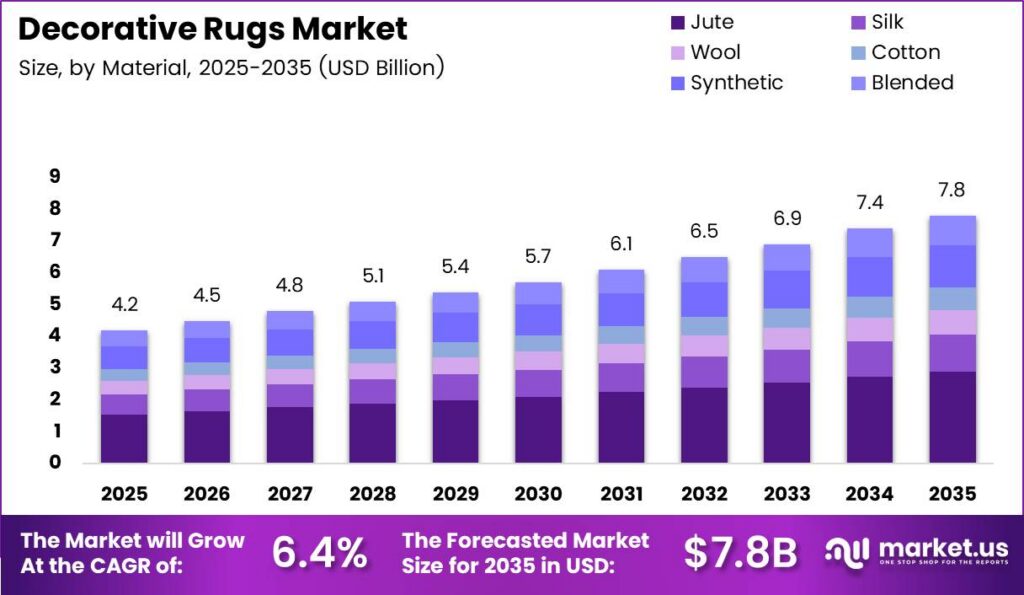
Global Decorative Rugs Market size is expected to be worth around USD 7.8 Billion by 2035 from USD 4.2 Billion in 2025, growing at a CAGR of 6.4% during the forecast period 2026 to 2035. Decorative rugs are woven, knotted, tufted, or printed textile floor coverings that anchor interior layouts, absorb ambient room noise, insulate hard flooring surfaces, and define visual zones across residential and commercial properties.
Cross-border weaving clusters in South Asia, North Africa, and Anatolia supply specialized importers serving residential homes, corporate offices, retail stores, and luxury hotels. According to UN Comtrade, global carpet and textile floor covering exports reached USD 17.09 Billion across 3.70 million metric tons from 148 reporting economies in 2023. Therefore, retail chains rely heavily on international maritime trade to maintain deep inventory assortments across diverse price tiers.
Key Takeaways
- The global Decorative Rugs Market was valued at USD 4.2 Billion in 2025.
- Market revenue will reach USD 7.8 Billion by 2035 during the 2026 to 2035 forecast period.
- Global sales expand at a compound annual growth rate of 6.4% from 2026 to 2035.
- Area Rugs led the Product Type segment in 2025 with a 33.67% market share, while Outdoor Rugs represent the fastest-growing product category.
- Oriental and Persian designs led the Style Type segment with a 37.56% share in 2025, whereas Traditional styles expand fastest.
- Jute captured the largest Material share at 36.78% in 2025, while Silk records the fastest material expansion.
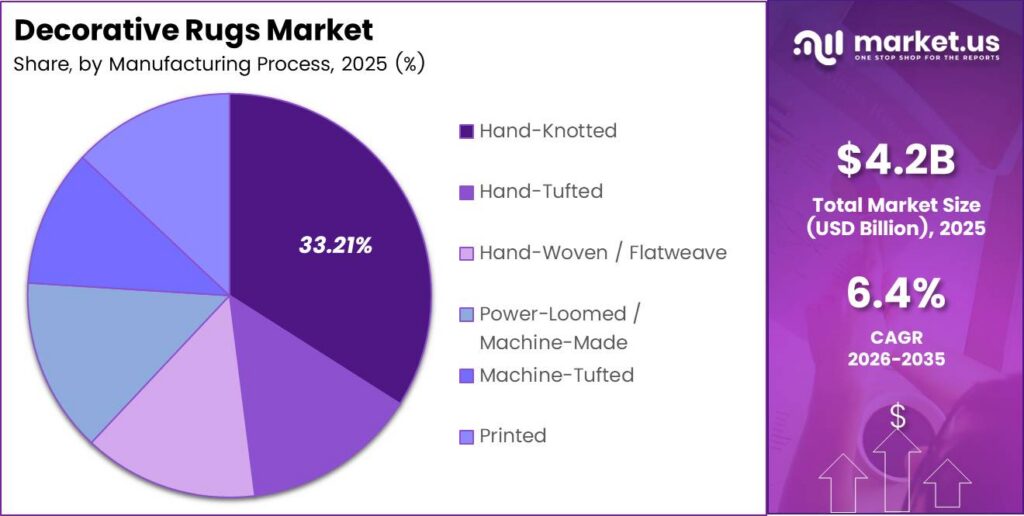
- Hand-Knotted construction led the Manufacturing Process segment at 33.21% in 2025, while Power-Loomed / Machine-Made lines grow fastest.
- Residential applications held a 62.34% share of End Use revenue in 2025, whereas Commercial buyers expand at the fastest rate.
- Offline stores accounted for 65.78% of Distribution Channel sales in 2025, while Online platforms grow fastest.
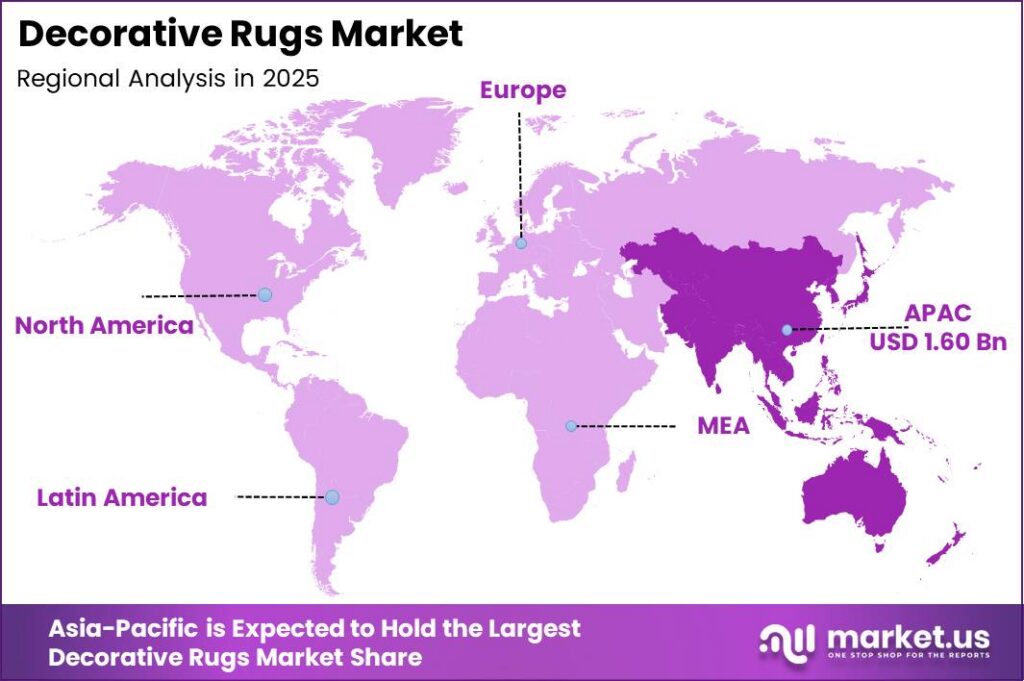
- Asia-Pacific dominated regional demand in 2025 with a 38.34% share valued at USD 1.60 Billion, while Middle East and Africa grows fastest.
National customs schedules, municipal textile waste laws, and housing renovation incentives directly govern landed importer margins and material selection. Data from CSIL shows global furniture and home furnishings production totaled USD 471 Billion in 2024, while cross-border trade climbed 2% to USD 174 Billion. Consequently, coordinated interior fit-out cycles pull decorative rug orders alongside upholstery and casegoods, rewarding suppliers that meet strict regional eco-design mandates.
Suppliers are committing fresh capital toward domestic fulfillment speed and custom sizing technology to protect retail margins. In December 2025, a major Texas rug distributor committed USD 20 million to build a distribution facility exceeding 1,000,000 square feet in Ennis, creating over 380 jobs . Similarly, a custom rug platform raised USD 20 million in March 2026 Series B funding to scale fabrication to 70,000 custom units annually across 30 showrooms by 2027.
Asia-Pacific leads global production and consumption, capturing a 38.34% revenue share in 2025. Dense raw fiber supply in India and China combines with rapid urban apartment handovers to sustain domestic retail absorption and export scale. Meanwhile, Western retail channels anchor global premium pricing. Figures from US Census Bureau show US floor covering stores generated USD 26.32 Billion in 2024 sales, giving Asian weavers high-margin export demand alongside domestic volume.
Product Type Analysis
Area Rugs dominates with 33.67% share in 2025 due to widespread hard flooring room zoning.
In 2025, Area Rugs held a 33.67% share in the Product Type segment of the Decorative Rugs Market. Based on Eurostat data, extra-EU imports of woven carpets and area rugs reached EUR 3.3 Billion across 493.8 million square meters between January 2022 and March 2026. Homeowners installing hardwood, laminate, and luxury vinyl planks require room-sized woven textiles to dampen footstep acoustics and protect subfloors from furniture abrasion. Consequently, retailers prioritize standard 5×8 and 8×10 area rug stock to maximize inventory turnover.
Runner Rugs serve narrow architectural transitions, including residential hallways, galley kitchens, entry foyers, and hotel corridors where broadloom installation wastes trim material. As reported by Ministry of Commerce and Industry , Indian exports of handloom cotton durries and flatweave runners grew at a 7.73% CAGR over 7 years to reach INR 151.00 crore in FY 2024 to 2025. High foot-traffic friction concentrated along narrow linear paths accelerates pile wear and forces frequent replacement cycles. Therefore, e-commerce brands bundle washable flatweave runners with matching area rugs to lift average order values.
Outdoor Rugs represent the fastest-growing product category as homeowners convert patios, balconies, and pool decks into furnished living extensions. According to Ministry of Commerce and Industry , Indian exports of 100% polypropylene tufted mats and indoor-outdoor rugs reached INR 229.65 crore in FY 2025 to 2026 following a 56.07% annual jump. Hydrophobic, solution-dyed polypropylene yarns resist ultraviolet fading, mildew colonization, and rain saturation without rotting. Responding to this shift, Momeni Inc. unveiled 4 new collections in April 2026 led by its weather-resistant Botany line , signaling higher margin potential in all-season performance SKUs.
Style Type Analysis
Oriental & Persian dominates with 37.56% share in 2025 due to enduring collector and heirloom value.
In 2025, Oriental & Persian held a 37.56% share in the Style Type segment of the Decorative Rugs Market. Eurostat indicates that extra-EU imports of knotted oriental carpets totaled EUR 491.5 million across 30.9 million kilograms between January 2022 and March 2026, led by India at 35.1% and Iran at 17.1%. Intricate medallion motifs and dense knot counts mask everyday soil accumulation while retaining secondary resale value for affluent buyers. This means specialty showrooms can command high retail markups on authentic knotted pieces despite slower unit velocity.
Traditional designs rank as the fastest-growing style category as younger homeowners adopt classic European borders, botanical damasks, and vintage distressed palettes. Figures from Ministry of Commerce and Industry show Indian exports of traditional hand-woven Kelem, Schumacks, and Karamanie rugs climbed 4.65% year-over-year to INR 185.72 crore in FY 2024 to 2025, creating an INR 185.07 crore trade surplus. Power-looming and flatweaving classic motifs in muted, pre-washed tones deliver antique visual warmth at mid-tier retail prices. As a result, mass-market merchants are expanding traditional SKU counts to capture renovation budgets.
Contemporary / Modern styles cater to minimalist urban apartments and open-plan corporate offices requiring abstract geometry, tonal textures, and neutral color blocks. Data from Eurostat shows extra-EU imports of contemporary tufted floor coverings reached EUR 2.8 Billion across 514.9 million square meters, alongside EUR 4.1 Billion in extra-EU exports. High-speed tufting guns and computer-guided jacquard looms translate rapid social-media color trends into finished geometric piles within weeks rather than months. Therefore, digital-native rug brands rely on contemporary collections to minimize design obsolescence and markdown risk.
Material Analysis
Jute dominates with 36.78% share in 2025 due to low fiber cost and sustainability.
In 2025, Jute held a 36.78% share in the Material segment of the Decorative Rugs Market. Based on Ministry of Commerce and Industry data , Indian exports of jute floor coverings expanded at a 13.89% CAGR over 7 years, rising from INR 340.85 crore to INR 743.67 crore in FY 2024 to 2025. Coarse bast fibers contain high lignocellulose stiffness and biodegradable tensile strength, allowing weavers to build thick, organic braided textures at low raw-material cost. Consequently, big-box retailers use natural jute rugs as affordable foundational layers for budget-conscious decorators.
Silk represents the fastest-growing material segment, anchoring ultra-luxury residential salons, executive boardrooms, and collector galleries. FAO found that global raw silk production increased 2.6% year-over-year to 93,988 metric tons across 20 producing nations, with China at 50,000 metric tons and India at 38,913 metric tons supplying 94.6% of world output. Fine protein filaments feature a triangular prism cross-section that refracts interior light while enabling ultra-high knot densities above 300 knots per square inch. Therefore, luxury design houses blend pure silk or bamboo-silk accents into wool piles to justify flagship showroom pricing.
Wool serves as the benchmark performance fiber for mid-to-premium hand-knotted, hand-tufted, and Axminster hospitality rugs. According to FAO , global greasy wool production totaled 1,695,974 metric tons across 97 countries in 2024, led by China at 364,481 metric tons and Australia at 281,000 metric tons. Natural keratin crimp gives wool fibers elastic crush recovery under heavy furniture loads, while epicuticle lanolin scales repel liquid spills and resist flame spread. This means commercial specifiers and affluent households continue paying a price premium for wool durability.
Manufacturing Process Analysis
Hand-Knotted dominates with 33.21% share in 2025 due to high unit ticket values.
In 2025, Hand-Knotted held a 33.21% share in the Manufacturing Process segment of the Decorative Rugs Market. As reported by Ministry of Commerce and Industry , Indian exports of handmade knotted wool and fine animal hair carpets rose 9.77% to INR 1,845.97 crore in FY 2024 to 2025, capturing 70.67% of sub-chapter value. Individual warp-and-weft hand tying eliminates synthetic latex backings, producing flexible, decades-lasting textiles that command multi-thousand-dollar retail prices per piece. Consequently, high per-unit revenue sustains segment value leadership even as artisan labor supply tightens.
Power-Loomed / Machine-Made construction is the fastest-growing manufacturing segment, supplying mass-merchandise chains and cross-border e-commerce marketplaces. Eurostat indicates that European Union external carpet imports climbed 46.7% over a decade to EUR 1,920.2 million in 2025, led by mechanized hubs in China at EUR 513.5 million, India at EUR 399.4 million, and Turkiye at EUR 383.7 million. High-speed Wilton and face-to-face Van de Wiele looms weave intricate multi-color patterns continuously with minimal labor per square meter. Therefore, manufacturers shifting capital into automated looms protect operating margins against rising artisan wages.
Hand-Tufted construction bridges the price gap between heirloom knotted pieces and mass-produced machine rugs for interior designers and boutique retailers. Data from Ministry of Commerce and Industry shows Indian tufted carpet and rug exports expanded at a 7.81% CAGR over 8 years to reach INR 6,672.48 crore in FY 2025 to 2026, representing 38.28% of Chapter 57 trade. Handheld pneumatic tufting guns punch yarn loops through primary canvas backings in days rather than months, cutting labor hours by over 70% versus hand knotting. This allows mid-market brands to test seasonal designer collaborations with low minimum order quantities.
End Use Analysis
Residential dominates with 62.34% share in 2025 due to household renovation and replacement cycles.
In 2025, Residential held a 62.34% share in the End Use segment of the Decorative Rugs Market. Figures from US Census Bureau show US privately-owned housing completions reached an annualized rate of 1,608,000 units in August 2025, spanning 1,090,000 single-family homes and 503,000 multifamily units. Every newly completed dwelling or room refresh triggers multiple rug purchases across living rooms, bedrooms, and dining spaces to soften hard floors. Capturing high-end residential remodelers, Momeni Inc. outfitted 6 designer spaces at the Brooklyn Heights Designer Showhouse in January 2026.
Commercial buyers represent the fastest-growing end-use category as corporate workplaces, boutiques, and clinics adopt residential-style “resimercial” interiors. Based on US Census Bureau data , US office construction spending reached an annualized USD 162.30 Billion in September 2026, alongside USD 122.94 Billion in commercial retail and service facilities. Open-concept collaborative offices and luxury retail flagships require heavy-duty decorative rugs to control reverberation noise and delineate lounge seating without erecting drywall partitions. Consequently, manufacturers offering commercial flame-retardant certifications and stain-resistant yarns win recurring corporate refurbishment contracts.
Hospitality properties including luxury resorts, boutique hotels, wellness spas, and cruise liners generate high-margin custom specification orders. UNWTO found that international overnight tourist arrivals rose 4% to reach 1.52 Billion globally in 2025, generating USD 2.2 Trillion in tourism export revenues and supporting 66% hotel occupancy. High guest footfall and rolling luggage abrade lobby and suite floor coverings rapidly, forcing hotels onto strict 5 to 7 year soft-goods refurbishment schedules. Therefore, mills with custom Axminster and hand-tufted hospitality programs secure predictable multi-property pipeline visibility.
Distribution Channel Analysis
Offline dominates with 65.78% share in 2025 due to tactile pile and color inspection.
In 2025, Offline held a 65.78% share in the Distribution Channel segment of the Decorative Rugs Market. According to US Census Bureau , US furniture and home furnishings stores recorded seasonally adjusted monthly sales of USD 10.56 Billion in August 2026. Shoppers buying wool or silk rugs above USD 1,000 physically inspect pile softness, knot density, and true dye undertones under showroom lighting before committing capital. Reinforcing physical wholesale trade, Safavieh expanded its High Point showroom by 4,000 square feet across 4 spaces in December 2024 to pair rugs with furniture vignettes .
Online platforms represent the fastest-growing distribution channel as visual search, augmented reality room visualizers, and roll-packed parcel shipping lower buyer friction. As reported by Eurostat , 78% of European Union internet users aged 16 to 74 shopped online in 2025, while 19% purchased furniture, home accessories, or gardening products online within 3 months. Lightweight foldable and machine-tufted rugs fit standard courier dimension limits, eliminating expensive white-glove freight surcharges on sub-USD 500 tickets. This signals that suppliers optimizing digital imagery and compression packaging capture disproportionate volume from millennial and Gen Z renters.
Omnichannel integration across Offline showrooms and Online configurators increasingly defines how specialty rug brands manage customer acquisition costs and product returns. Physicalswatch libraries and compact studio galleries allow interior designers to verify fiber sheen in person before placing drop-ship digital orders directly from mill warehouses. Eliminating full-inventory retail leases cuts fixed store occupancy overhead while slashing e-commerce color-mismatch return rates. Consequently, direct-to-consumer rug brands are opening small-format design studios in affluent metro hubs to capture high-ticket custom orders that pure web listings miss.
Key Market Segments
By Product Type
- Area Rugs
- Runner Rugs
- Outdoor Rugs
- Others
By Style Type
- Oriental & Persian
- Traditional
- Contemporary / Modern
- Transitional
- Others
By Material
- Jute
- Silk
- Wool
- Cotton
- Synthetic
- Blended
By Manufacturing Process
- Hand-Knotted
- Hand-Tufted
- Hand-Woven / Flatweave
- Power-Loomed / Machine-Made
- Machine-Tufted
- Printed
By End Use
- Residential
- Commercial
- Offices & Corporate Spaces
- Retail Stores
- Restaurants & Food Service
- Healthcare & Educational Institutions
- Hospitality
- Hotels & Resorts
- Spas & Wellness Centers
- Cruise Ships & Luxury Transport
By Distribution Channel
- Offline
- Online
Regional Analysis
Asia-Pacific Dominates the Decorative Rugs Market with a Market Share of 38.34% in 2025, Valued at USD 1.60 Billion
Asia-Pacific captured 38.34% of global revenue in 2025, reaching USD 1.60 Billion through unmatched artisan weaving clusters in India and mechanized loom capacity in China. Data from World Bank shows real GDP expanded 4.8% in China and 4.4% across developing East Asia and Pacific in 2025, with 4.4% annual expansion projected through 2028. Rising urban household incomes and high-rise apartment completions across India, China, and Southeast Asia convert traditional export mills into domestic retail suppliers. Therefore, regional manufacturers enjoy dual revenue engines across local middle-class housing and global wholesale exports.
Middle East & Africa is the fastest-growing region as Gulf tourism megaprojects, luxury villas, and airport expansions commission bespoke hospitality and residential carpets. World Bank indicates that regional GDP expansion accelerated from 2.3% in 2024 to 2.8% in 2025 and 3.3% in 2026, powered by 3.5% growth across Gulf Cooperation Council economies. Deep cultural affinity for ornate Persian and Anatolian floor textiles combines with tax-free luxury retail malls in Saudi Arabia and the UAE. Consequently, global luxury rug houses are prioritizing Dubai and Riyadh showroom partnerships to win high-margin hospitality tenders.
North America, Europe, and Latin America remain vital import destinations driven by e-commerce penetration and housing stock remodeling. Figures from US Census Bureau show US home furnishings retail e-commerce hit USD 4.80 Billion alongside USD 35.09 Billion in wholesale digital sales. In Europe, Eurostat found that 68% of households own their homes and allocate 19% of disposable income to housing, sustaining steady renovation demand. Meanwhile, based on UN ECLAC data, Latin American GDP grew 2.4% in 2025 with 2.3% projected in 2026, supporting gradual urban retail modernization in Brazil and Mexico.
Key Regions and Countries
North America
- US
- Canada
Europe
- Germany
- France
- The UK
- Spain
- Italy
- Rest of Europe
Asia Pacific
- China
- Japan
- South Korea
- India
- Australia
- Rest of APAC
Latin America
- Brazil
- Mexico
- Rest of Latin America
Middle East and Africa
- GCC
- South Africa
- Rest of MEA
Market Dynamics
Structural shifts in digital distribution, trade tariffs, artisan labor supply, and circular material mandates are reshaping profitability across the decorative rug value chain. According to ILO , global textiles and clothing supply chains employ more than 90 million workers worldwide, predominantly women, who face tightening compliance audits and wage pressures. While cross-border e-commerce and washable synthetic yarns lower unit distribution costs, import duties and rural weaver attrition squeeze traditional exporters. Consequently, capital is flowing toward automated power looms, recycled mono-material constructions, and direct-to-consumer digital configurators.
Drivers
Digital-first distribution is reshaping decorative rug retail because rollable, flat-packed rugs ship economically and photograph effectively for social commerce. Between 2024 and 2025, online channels captured 35% to 45% of US area-rug unit volume, while Indian exporters in Bhadohi-Mirzapur and Panipat bypassed wholesale markups worth 20% to 30% of landed cost. Brands digitally test 200 to 500 designs before weaving and use short runs to cut minimum order quantities by 40%.
Paid-social customer acquisition costs climbed 15% to 25% after 2024, and product return rates of 8% to 12% remain the primary unit-economics risk. However, direct-to-consumer gross margins of 55% to 65% far exceed the 40% to 45% earned in traditional wholesale, pulling steady investment into digital channels. Consequently, sellers deploying augmented-reality room previews and accurate size calculators protect net margins while scaling online market share.
| Driver | (~) % Impact on CAGR Forecast | Geographic Relevance | Impact Timeline |
|---|---|---|---|
| D2C E-Commerce & Marketplace Rug Sales | +1.6% | North America, Europe, India | Short term (≤ 2 years) |
| Residential Renovation & Home-Refresh Cycles | +1.2% | North America, Western Europe | Medium term (2–4 years) |
| Washable & Performance Rug Adoption | +0.9% | Global | Short term (≤ 2 years) |
| Urban Housing Completions in Asia | +0.8% | India, China, Southeast Asia | Medium term (2–4 years) |
| Hospitality & Commercial Fit-Out Recovery | +0.6% | Middle East, Asia Pacific, Europe | Medium term (2–4 years) |
Restraints
Escalating US import tariffs severely pressure cross-border rug trade, particularly for India, which ships 55% to 60% of its carpet exports to American buyers. Tariff hikes in 2025 pushed additional duties on Indian goods up to 50% alongside layered duties on Chinese textiles, hitting exporters operating on thin 8% to 12% net FOB margins. A 50% tariff on a USD 100 landed rug adds USD 50 upfront, lifting retail shelf prices by 25% to 35%.
Order cancellations triggered loom-utilization drops of 30% to 40% across Bhadohi and Panipat weaving clusters. American importers froze new SKU launches, trimmed safety stock to 6 to 8 weeks, and paused showroom expansions. Meanwhile, exporters endured receivable cycles exceeding 120 days and delayed loom and dye-house upgrades, forcing buyers to diversify sourcing toward lower-duty nations.
| Restraint | (~) % Impact on CAGR Forecast | Geographic Relevance | Impact Timeline |
|---|---|---|---|
| US Import Tariffs on Rug-Exporting Nations | -1.1% | United States, India, Turkey, China | Short term (≤ 2 years) |
| Elevated Mortgage Rates Suppressing Home Sales | -0.7% | North America, United Kingdom | Short term (≤ 2 years) |
| Hard-Flooring Preference Over Wall-to-Wall Textiles | -0.4% | Europe, North America | Long term (≥ 4 years) |
| Discretionary Spending Squeeze from Inflation | -0.5% | Global | Short term (≤ 2 years) |
| Child-Labour Compliance Import Holds | -0.3% | South Asia, Iran, United States, EU | Medium term (2–4 years) |
Challenges
Premium hand-knotted and hand-tufted rug production faces structural capacity shrinkage as rural artisan workforces age across India, Nepal, and Anatolia. Younger workers increasingly choose urban manufacturing, construction, and gig-economy roles paying 20% to 40% higher daily wages than piece-rate weaving, leaving over 50% of active weavers above age 40. Because a 100 to 150 knot-per-square-inch 8×10 rug requires 4 to 6 months on a loom, losing 10% of weavers extends lead times by 6 to 10 weeks.
Skilled labor scarcity pushes weaving labor costs up by 8% to 12% per square foot annually, eroding wholesale contract predictability. Manufacturers must shift volume mixes toward hand-tufted and machine-woven lines while funding wage-indexed retention programs and government-backed training academies. Consequently, luxury brands must reposition true hand-knotted collections as scarce, limited-edition heirloom pieces to preserve gross margins.
| Challenge | (~) % CAGR Friction Drag | Geographic Relevance | Mitigation Horizon |
|---|---|---|---|
| Artisan Weaver Workforce Attrition | -0.6% | India, Nepal, Iran, Turkey | Long term (≥ 4 years) |
| Wool & Fibre Price Volatility | -0.4% | Global | Medium term (2–4 years) |
| Ocean Freight Disruption Costs | -0.3% | Asia–Europe, Asia–US East Coast | Short term (≤ 2 years) |
| Design Counterfeiting & Copying | -0.2% | Global | Medium term (2–4 years) |
| Textile Waste Regulatory Compliance | -0.2% | European Union, California | Medium term (2–4 years) |
Opportunities
Recycled-PET and closed-loop circular rugs currently represent only 5% to 8% of decorative SKUs, leaving wide whitespace ahead of tightening European regulations. The EU Ecodesign for Sustainable Products Regulation enacted in 2024, mandatory separate textile collection starting January 2025, and upcoming extended producer responsibility fees directly penalize non-recyclable floor coverings. Replacing conventional latex-and-jute backings with mono-material PET faces and backings cuts end-of-life recycling costs by 25% to 35% per unit.
Although recycled-PET yarn costs 10% to 20% more than virgin polyester, certified circular rugs command a 15% to 30% retail price premium. Early movers combining recycled yarn procurement with take-back logistics can expand gross margins by 300 to 500 basis points. Therefore, manufacturers retooling for mono-material construction win preferred shelf placement with European retailers and qualify for green hospitality procurement tenders.
| Opportunity | (~) % Potential CAGR Upside | Geographic Relevance | Execution Window |
|---|---|---|---|
| Recycled-PET & Circular Rug Lines | +1.0% | European Union, North America | Medium term (2–4 years) |
| Custom & Made-to-Order Digital Configurators | +0.8% | North America, Europe, GCC | Short term (≤ 2 years) |
| Rug Rental & Subscription Models | +0.5% | Urban North America, Europe | Long term (≥ 4 years) |
| Export Diversification to EU, UK & GCC | +0.7% | India, Turkey, European Union, GCC | Short term (≤ 2 years) |
| Fragmented Workshop Roll-Up Consolidation | +0.4% | South Asia, Turkey | Medium term (2–4 years) |
Key Company Insights
Balta Group
Balta Group, operating as the flagship European and Turkish rug division within Victoria PLC, manufactures machine-woven indoor and outdoor polypropylene and recycled-yarn rugs for mass-market retailers across Europe and North America. As reported by Victoria PLC Annual Report and Accounts , the UK and Europe Rugs division generated FY2026 revenue of GBP 180.8 million across 40.7 million square meters of sold volume. Maintaining high-volume automated weaving scale allows the company to supply pan-European home improvement chains reliably.
Management is aggressively shifting production toward lower-cost manufacturing hubs to restore operating profitability against European wage and energy inflation. Based on Victoria PLC Annual Report 2026 data , the group completed a EUR 34.4 million sale-and-leaseback of its Belgian rugs distribution center in July 2026 while relocating 25 weaving looms to Turkiye and cutting roughly 500 Belgian roles. Consolidating weaving inside Turkiye lowers unit conversion costs while preserving Belgian logistics access for Western European retail accounts.
Mohawk Industries Inc.
Mohawk Industries Inc. operates as the world’s largest flooring manufacturer, marketing decorative area rugs, runners, and washable mats through Mohawk Home and Karastan across big-box stores, e-commerce platforms, and specialty dealers. Figures from Mohawk Industries Form 10-K Annual Report show consolidated FY2025 net sales reached USD 10.79 Billion with net earnings of USD 369.9 million, while Flooring North America generated 34% of total revenue. Domestic extrusion of recycled polyester and nylon fibers insulates Mohawk from imported yarn bottlenecks.
Leadership is repositioning its heritage rug labels upward into higher-margin wool and artisan constructions to counter budget import competition. According to Mohawk Home and RugNews , the company overhauled its Karastan Rugs portfolio in September 2025 by debuting 70 to 90 new luxury wool and handmade styles across 15 collections, refreshing 35% to 40% of its assortment at USD 1,500 to USD 5,000 retail prices. Targeting affluent designer showrooms lifts per-unit gross profit during sluggish mass-housing turnover.
Key Players
- Balta Group
- Mohawk Industries Inc.
- Oriental Weavers Group
- Nourison
- Capel Rugs
- Harounian Rugs International
- Loloi Inc.
- Milliken and Co.
- Momeni Inc.
- Agnella
- Other Key Players
Recent Developments
2026
- October 2026: Capel Rugs product launch introduced 5 hand-knotted 100% wool rug collections alongside 2 domestically made flat-braided lines priced below USD 1,699 for 5×8 sizes according to Capel Rugs .
- October 2026: Lavin Rugs capacity expansion opened a remodeled 5,500 square foot High Point IHFC showroom and debuted 54 new area rug designs according to Lavin Rugs .
- October 2026: Interface, Inc. product launch unveiled its Twist and Texture modular carpet tile collection featuring 7 woven-inspired styles across 18 colorways on a 3 week QuickShip schedule according to Interface, Inc. .
- April 2026: Nourison Home product launch rolled out 14 new area rug collections across Nourison Home, Reserve, and licensed DKNY Pure labels at High Point Market according to Nourison Home .
- April 2026: Harounian Rugs International product launch debuted 6 programmed area rug collections offering 3 to 4 distinct colorways per line at Showroom D431 according to Harounian Rugs International .
- March 2026: STARK Carpet capacity expansion announced a new luxury rug and custom broadloom trade showroom in Charleston building on over 85 years of bespoke operations according to STARK Carpet .
- January 2026: Ernesta capacity expansion opened 3 retail showrooms including a 1,250 square foot Michigan store and a 1,256 square foot Dallas space targeting 10 plus showrooms by year-end according to Ernesta .
2025
- December 2025: Ruggable partnership and product launch with Anthropologie Home introduced 7 all-in-one washable tufted area rugs starting at USD 139 and 3 doormats according to Home Accents Today .
- November 2025: STARK Carpet acquisition purchased New York bespoke hand-knotted silk atelier Fort Street Studio to distribute artisanal silk rugs across more than 25 domestic showrooms according to STARK Carpet .
Geopolitical Impact Analysis
Escalating tariff regimes and trade policy friction directly disrupt cross-border procurement of wool, jute, and synthetic yarns alongside finished hand-knotted and power-loomed rugs. According to WTO , global merchandise trade volume expanded 4.6% in 2025 to reach USD 26.26 Trillion, yet growth slows to 1.9% in 2026 or 1.4% under prolonged Middle East energy shocks. Similarly, Data from World Bank shows global output easing from 2.7% in 2025 to 2.6% in 2026, with US expansion moderating to 2.2% after early-2025 pre-tariff inventory frontloading. Steep bilateral import duties inflate landed costs on Indian hand-knotted wool rugs and Chinese polypropylene mats, forcing Western importers to renegotiate FOB factory prices and shift loom allocations toward Egypt and Turkiye.
Maritime chokepoint instability simultaneously extends transit lead times and working-capital lockup for roll-packed rug containers moving from Asian ports to European and US East Coast warehouses. UNCTAD found that global maritime trade reached 12,720 million metric tons in 2024, while Red Sea security diversions kept Suez Canal transits 70% below 2023 averages in May 2025 and drove a 17% jump in global ton-miles. Meanwhile, World Shipping Council indicates that liner shipping moves 60% of seaborne trade value exceeding USD 4 Trillion annually, with carriers committing over USD 180 Billion across 1,204 dual-fuel vessels. Longer Cape of Good Hope voyages add weeks to raw New Zealand wool, jute backing yarn, and finished rug deliveries, compelling distributors to hold deeper domestic safety stock.
Report Scope
| Report Features | Description |
|---|---|
| Market Value (2025) | USD 4.2 Billion |
| Forecast Revenue (2035) | USD 7.8 Billion |
| CAGR (2026-2035) | 6.4% |
| Base Year for Estimation | 2025 |
| Historic Period | 2021-2025 |
| Forecast Period | 2026-2035 |
| Report Coverage | Revenue Forecast, Market Dynamics, Market Opportunity Analysis, Technology and Innovation Landscape, Competitive Landscape, Recent Developments |
| Segments Covered | By Product Type (Area Rugs, Runner Rugs, Outdoor Rugs, Others), By Style Type (Oriental & Persian, Traditional, Contemporary / Modern, Transitional, Others), By Material (Jute, Silk, Wool, Cotton, Synthetic, Blended), By Manufacturing Process (Hand-Knotted, Hand-Tufted, Hand-Woven / Flatweave, Power-Loomed / Machine-Made, Machine-Tufted, Printed), By End Use (Residential, Commercial [Offices & Corporate Spaces, Retail Stores, Restaurants & Food Service, Healthcare & Educational Institutions], Hospitality [Hotels & Resorts, Spas & Wellness Centers, Cruise Ships & Luxury Transport]), By Distribution Channel (Offline, Online) |
| Regional Analysis | North America (US and Canada), Europe (Germany, France, The UK, Spain, Italy, and Rest of Europe), Asia Pacific (China, Japan, South Korea, India, Australia, and Rest of APAC), Latin America (Brazil, Mexico, and Rest of Latin America), Middle East and Africa (GCC, South Africa, and Rest of MEA) |
| Competitive Landscape | Balta Group, Mohawk Industries Inc., Oriental Weavers Group, Nourison, Capel Rugs, Harounian Rugs International, Loloi Inc., Milliken and Co., Momeni Inc., Agnella, Other Key Players |
| Customization Scope | Customization for segments, region / country-level will be provided. Additional customization can be done based on requirements. |
| Purchase Options | We have three licenses to opt for: Single User License | Multi-User License (Up to 5 Users) | Corporate Use License (Unlimited User and Printable PDF) |