Report Overview
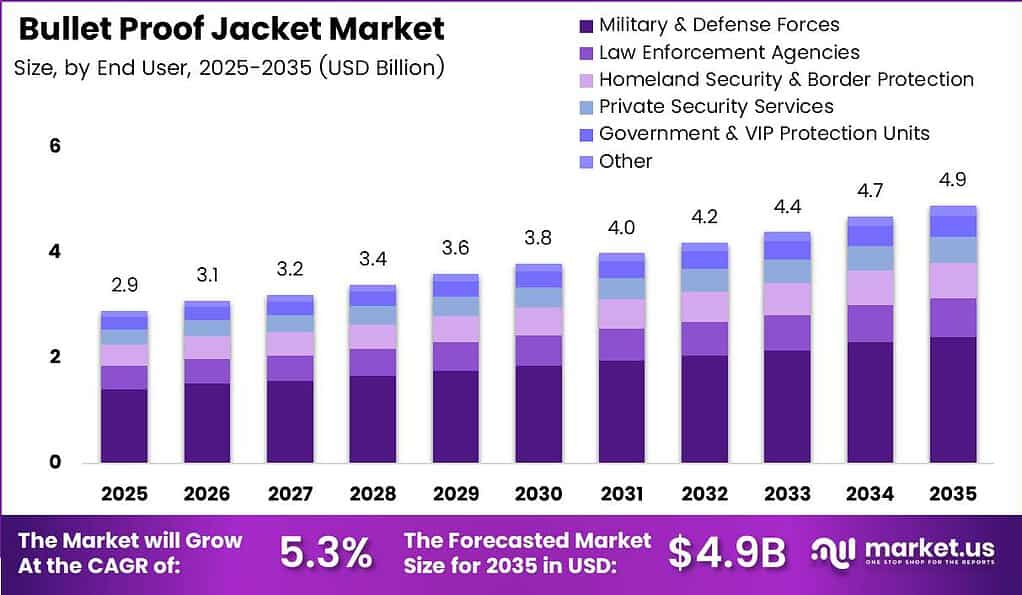
Global Bullet Proof Jacket Market size is expected to be worth around USD 4.9 Billion by 2035 from USD 2.9 Billion in 2025, growing at a CAGR of 5.3% during the forecast period 2026 to 2035. Bullet-resistant jackets combine protective panels and wearable carriers to reduce specified ballistic risks, making certified performance, fit and replacement support central to purchasing decisions.
Defense forces and public-security agencies anchor purchasing because protection failures carry direct human and operational costs. According to SIPRI, worldwide military expenditure reached USD 2.718 trillion in 2024, supporting a broader defense procurement base. This figure includes personnel and other spending, not simply equipment purchases. Manufacturers therefore need funded protective-equipment programs rather than headline defense budgets to justify production investments.
Key Takeaways
- The global market carries an estimated 2025 value of USD 2.9 Billion.
- The 2035 forecast value reaches USD 4.9 Billion.
- The forecast assumes a CAGR of 5.3% from 2026 to 2035.
- Soft Armor Bullet-Proof Jackets lead product types with an estimated 59.00% share in 2025.
- Level IIIA leads protection levels with an estimated 28.00% share in 2025.
- Military and Defense Forces lead end users with an estimated 49.00% share in 2025.
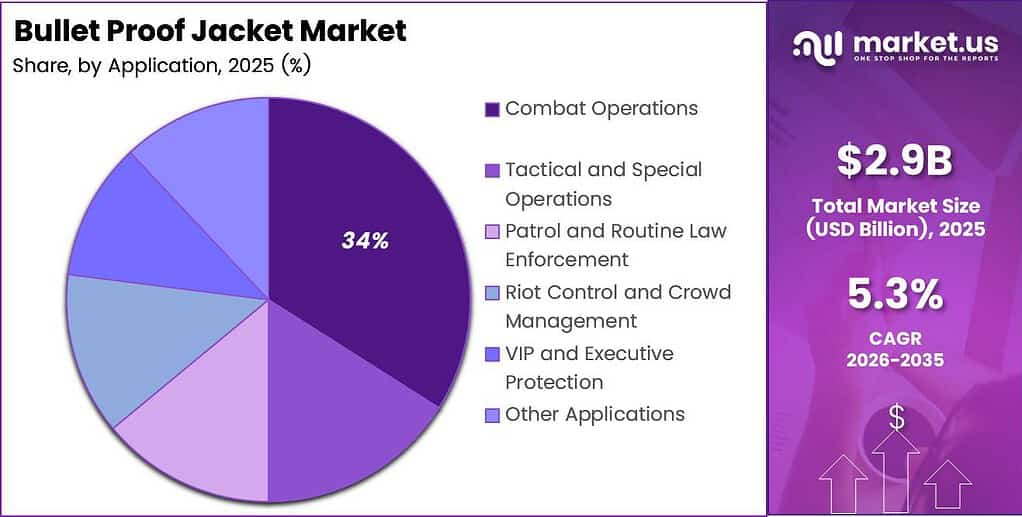
- Combat Operations lead applications with an estimated 34.00% share in 2025.
- Direct Government and Defense Contracts lead distribution channels with an estimated 48.00% share in 2025.
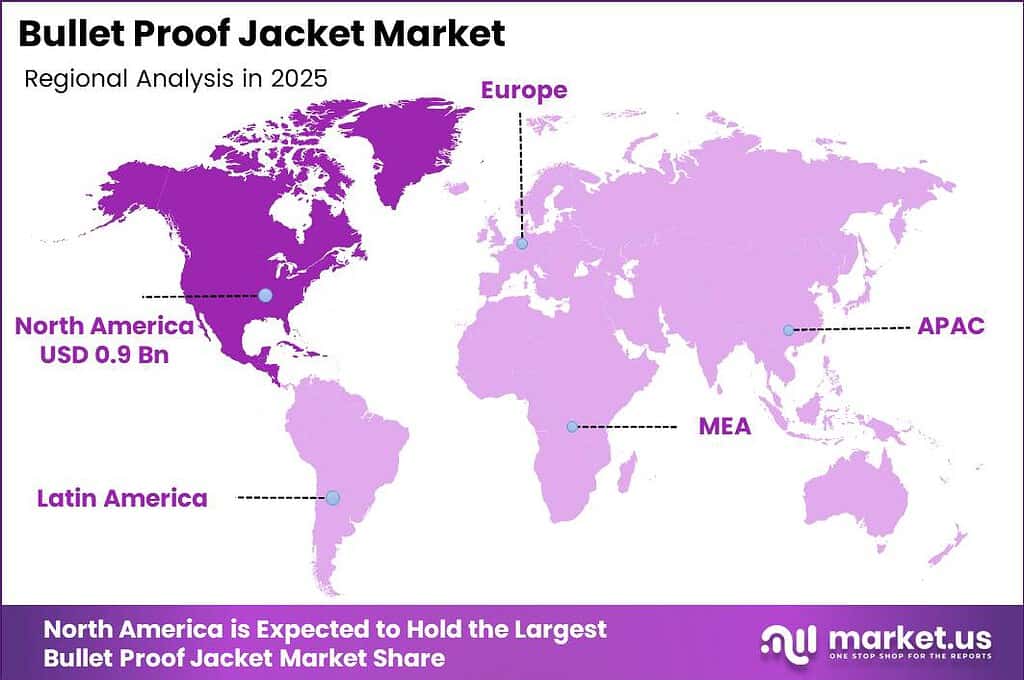
- North America leads regional estimates with a 34.00% share in 2025. Its stated USD 0.9 Billion revenue figure requires reconciliation with the global total.
- The base year is 2025, and the forecast period runs from 2026 to 2035.
Public-security spending follows a different purchasing logic from military procurement because agencies must balance protection, concealment and daily wear. As reported by UNODC, approximately 458,000 people suffered intentional homicide globally in 2021. The figure describes a security burden, not jacket purchases. Suppliers seeking police contracts must connect protection specifications to local threats, officer comfort and purchasing budgets rather than assume uniform buying behavior.
Government orders can convert protection needs into measurable factory workloads when buyers specify delivery schedules and equipment quantities. Data from SMPP shows contracts awarded in June 2025 exceeded INR 300 crore, covering 27,700 jackets and 11,700 helmets. These separate product quantities highlight coordinated soldier-equipment purchasing. Manufacturers that align materials, testing and delivery capacity can compete more effectively for time-sensitive military programs.
North America holds an estimated 34.00% market share in 2025, making procurement access and product qualification central commercial priorities. The region’s leadership should not imply that every supplier can enter its government channels on equal terms. Buyers evaluate documented protection, fit and delivery support. Investors should therefore assess contract eligibility and customer retention before treating regional scale as an automatic source of profitable expansion.
Conflict exposure broadens protection needs but does not guarantee dependable customer funding. The World Bank identified 39 fragile and conflict-affected economies in its 2025 analysis, illustrating the overlap between security pressure and financial weakness. Manufacturers serving these markets must separate operational urgency from payment capacity. Distributors that manage credit, export documentation and local support can offer greater commercial value than intermediaries focused only on order placement.
Product Type Analysis
Soft Armor Bullet-Proof Jackets lead with an estimated 59.00% share in 2025, reflecting the commercial importance of flexible, wearable protection.
In 2025, Soft Armor Bullet-Proof Jackets held an estimated 59.00% share in the Product Type segment of the Bullet Proof Jacket Market. Buyers prioritize flexible protection where personnel must wear equipment throughout routine duties. Fiber-based panels distribute impact energy while allowing movement, linking material performance directly to wearer acceptance. Manufacturers should compete on verified protection and fit rather than assume thinner construction alone commands a premium.
Hard Armor Bullet-Proof Jackets serve buyers that require rifle-threat protection beyond the intended scope of soft panels. According to NIJ, the current framework defines three rifle protection levels: RF1, RF2 and RF3. Their distinct threat requirements prevent buyers from treating all plates as interchangeable. Suppliers benefit when they match plate construction, carrier compatibility and test documentation to the customer’s exact operational specification.
Other product configurations require careful scope control because broader ballistic equipment does not automatically belong within torso-jacket revenue. NIJ indicates that its standard addresses body armor intended to protect the torso, establishing a clear boundary for product qualification. Manufacturers selling mixed protection portfolios should separate jacket revenue from unrelated equipment. Investors gain a more useful comparison when companies disclose product categories instead of presenting all protective equipment as equivalent.
Protection Level Analysis
Level IIIA leads with an estimated 28.00% share in 2025, reflecting the role of handgun protection in wearable torso armor.
In 2025, Level IIIA held an estimated 28.00% share in the Protection Level segment of the Bullet Proof Jacket Market. Buyers use the legacy category when specifying handgun protection, although procurement documents must distinguish older and newer standards. According to NIJ, HG2 replaces the former designation. Suppliers that explain the transition clearly can reduce tender confusion and avoid presenting different certification frameworks as identical.
Level III addresses rifle-protection purchasing where buyers require hard armor rather than handgun-rated panels alone. As reported by NIJ, RF1 replaces this legacy classification within the newer protection framework. Rifle threats place different demands on plate design, weight and supporting materials, making precise specifications commercially important. Manufacturers should demonstrate the relevant tested configuration instead of relying on a familiar legacy label to communicate every protection claim.
Level IV remains a familiar legacy category for buyers seeking protection against demanding specified rifle threats. Data from NIJ shows RF3 replaces this designation under the revised framework, requiring procurement teams to check the applicable standard. Buyers must distinguish independent laboratory testing from certification before accepting product claims. Manufacturers protect their credibility when sales documents state exactly which model and configuration passed the relevant evaluation.
End User Analysis
Military and Defense Forces lead with an estimated 49.00% share in 2025, reflecting the scale of organized force-protection purchasing.
In 2025, Military and Defense Forces held an estimated 49.00% share in the End User segment of the Bullet Proof Jacket Market. According to SIPRI, Japan’s military expenditure reached USD 55.3 billion in 2024, rising 21%. This broader budget expansion does not measure armor spending, but it supports examination of funded soldier-equipment programs. Suppliers need program-level visibility before committing capacity to military customers.
Law Enforcement Agencies buy protection around local threats, duty patterns and the practical burden of daily wear. Their purchasing decisions differ from military orders because concealment and comfort can influence routine compliance. Operational security measures should not substitute for evidence of funded vest procurement. Manufacturers that provide fitting, model documentation and replacement support offer buyers a stronger value proposition than suppliers competing only on an initial unit price.
Homeland Security and Border Protection buyers operate across inspection points, transport corridors and mobile deployments, creating varied protection requirements. Encounter totals describe operational activity but cannot establish jacket consumption without staffing and procurement evidence. Buyers must match protection to actual exposure rather than purchase a uniform specification for every task. Suppliers gain an advantage when they support mission-specific configurations and dependable replenishment across dispersed operating locations.
Application Analysis
Combat Operations lead with an estimated 34.00% share in 2025, reflecting the importance of protection in deployed military missions.
In 2025, Combat Operations held an estimated 34.00% share in the Application segment of the Bullet Proof Jacket Market. Combat buyers must balance ballistic protection against movement, heat and the burden of other equipment. Conflict counts alone cannot establish purchasing volumes or replacement schedules. Manufacturers should focus on tested protection and field usability, while investors should examine whether contracts fund complete systems or only selected replacement components.
Tactical and Special Operations require equipment that supports rapid movement while accommodating mission-specific protection and carried equipment. Arrest totals or database checks do not reveal the number of armor systems purchased for these units. Mechanical compatibility between panels, plates and carriers therefore provides a more direct procurement link than general enforcement activity. Suppliers can strengthen their position through configurable products, reliable sizing and documentation for each intended protective arrangement.
Patrol and Routine Law Enforcement favor protection that officers can wear consistently throughout daily assignments. According to Cadre Holdings, its broader safety products reach more than 100 countries, illustrating an established distribution footprint rather than patrol-armor market share. Geographic reach can support fitting, service and replenishment when local channels perform effectively. Investors should distinguish a company’s international presence from evidence that a specific vest dominates routine police procurement.
Distribution Channel Analysis
Direct Government and Defense Contracts lead with an estimated 48.00% share in 2025, reflecting the importance of formal institutional purchasing.
In 2025, Direct Government and Defense Contracts held an estimated 48.00% share in the Distribution Channel segment of the Bullet Proof Jacket Market. Large institutional tenders can define protection, acceptance tests and delivery obligations before production begins. Contract quantities require careful interpretation because estimates and ceilings do not equal completed purchases. Suppliers should evaluate funded orders and payment terms before using a framework agreement to justify additional factory capacity.
Direct Sales to Law Enforcement Agencies allow manufacturers to address fitting, procurement questions and replacement planning without an additional commercial intermediary. Buyers can benefit from direct technical accountability when the supplier provides dependable local support. Contract duration alone does not establish recurring revenue because agencies may retain discretion over order quantities. Investors should examine customer retention, delivery performance and servicing costs before assigning a premium to direct-sales exposure.
Authorized Distributors and Dealers connect manufacturers with buyers that need local procurement support and practical product assistance. A distributor’s value depends on documented authorization, fitting capability and reliable access to approved models. Master-agreement terms can simplify purchasing, but they do not guarantee sales throughout the stated period. Manufacturers should evaluate channel performance by customer access and service quality rather than count every authorized relationship as an active revenue source.
Key Market Segments
By Product Type
- Soft Armor Bullet-Proof Jackets
- Hard Armor Bullet-Proof Jackets
- Others
By Protection Level
- Level IIA
- Level II
- Level IIIA
- Level III
- Level IV
By End User
- Military and Defense Forces
- Law Enforcement Agencies
- Homeland Security and Border Protection
- Private Security Services
- Government and VIP Protection Units
- Civilian Users
- Other End Users
By Application
- Combat Operations
- Tactical and Special Operations
- Patrol and Routine Law Enforcement
- Riot Control and Crowd Management
- VIP and Executive Protection
- Training and Security Operations
- Other Applications
By Distribution Channel
- Direct Government and Defense Contracts
- Direct Sales to Law Enforcement Agencies
- Authorized Distributors and Dealers
- Security Equipment Retailers
- Online Retail / E-Commerce
- Other Distribution Channels
Regional Analysis
North America leads the 2025 regional estimate with a 34.00% share. The separate USD 0.9 Billion estimate remains unreconciled.
North America offers a large institutional market, but suppliers must convert access into funded purchases rather than rely on regional size alone. Buyers evaluate protection documentation, fit and dependable delivery when selecting torso armor. Manufacturers that align products with agency specifications can compete for repeat business without relying solely on lower prices. Investors should assess contract eligibility and customer relationships alongside the region’s estimated leadership position.
Europe’s procurement opportunity depends on national equipment programs rather than a single alliance-wide vest purchasing mechanism. NATO’s defense-spending commitment provides policy context, but a spending guideline does not itself award jacket contracts. Suppliers must identify local specifications, qualification processes and delivery requirements before projecting revenue. Manufacturers with established customer support can compete more effectively than exporters treating every national tender as an interchangeable route into the region.
Asia-Pacific requires a country-specific strategy because military procurement structures and local production preferences vary across national markets. Buyers may prioritize domestic supply, technical performance or delivery certainty in different combinations. Manufacturers should therefore assess each program’s qualification and production requirements before choosing an export or local-partner model. Investors gain a clearer risk picture when companies disclose actual contract exposure rather than describe the region as a uniform market.
Middle Eastern military expenditure reached an estimated USD 243 billion in 2024, rising 15%, according to SIPRI. These figures cover the Middle East, not Africa, and should not represent the combined region’s jacket revenue. Manufacturers must separate security need from customer funding and export eligibility. Distributors that manage end-user documentation and delivery obligations can reduce execution risk when serving approved regional customers.
Latin American market entry requires attention to the specific purchasing authority, product approval process and customer payment capacity. Enforcement-operation counts cannot establish a regional armor market size because operational activity and equipment procurement follow different measures. Suppliers should build forecasts around identifiable buyers and documented purchasing programs. Investors should favor evidence of repeat orders and local servicing capability over broad claims linking every security incident to new vest sales.
Key Regions and Countries
North America
- US
- Canada
Europe
- Germany
- France
- The UK
- Spain
- Italy
- Rest of Europe
Asia Pacific
- China
- Japan
- South Korea
- India
- Australia
- Rest of APAC
Latin America
- Brazil
- Mexico
- Rest of Latin America
Middle East and Africa
- GCC
- South Africa
- Rest of MEA
Market Dynamics
Military budget expansion supports the market’s purchasing context, but manufacturers capture value only when spending reaches funded protection programs. According to SIPRI, global military expenditure increased 9.4% in real terms during 2024. Armor suppliers must still compete against other defense priorities for actual allocations. Investors should track tender conversion, production readiness and cash collection rather than assume broader budget growth translates directly into proportional jacket revenue.
Drivers
Infantry modernization can expand protective-equipment purchasing when governments fund complete systems and replenishment rather than isolated emergency orders. Buyers evaluating soft panels, hard inserts and carriers together create opportunities for suppliers with coordinated product portfolios. Manufacturers should connect capacity decisions to funded delivery schedules instead of assume universal replacement-cycle changes. The principal investment advantage comes from dependable contract execution and customer support, not an unsupported forecast contribution.
Certification transitions and lighter protective configurations can influence which products qualify for future tenders. Buyers must still assess the relevant threat level, finished configuration and wearer requirements before replacing existing equipment. Suppliers that prepare documentation and production processes early can reduce procurement friction. The table below preserves analytical scenarios only; its figures do not establish independently measured additions to the market’s baseline CAGR or confirm uniform adoption timelines.
| Driver | (~) % Impact on CAGR Forecast | Geographic Relevance | Impact Timeline |
|---|---|---|---|
| NATO & Indo-Pacific Infantry Modernization | +1.9% | North America, Europe, Asia-Pacific | Short term (≤ 2 years) |
| NIJ Standard 0101.07 Compliance Transition | +1.3% | North America, Europe | Medium term (2–4 years) |
| UHMWPE Composite Plate Adoption | +1.1% | Global | Medium term (2–4 years) |
| Law Enforcement Tactical Vest Mandates | +0.7% | North America, Latin America, Europe | Short term (≤ 2 years) |
| Modular Quick-Release Carrier Proliferation | +0.5% | Global | Long term (≥ 4 years) |
Restraints
Export restrictions can delay or prevent an otherwise attractive transaction when product classification, destination or end-user requirements block authorization. Manufacturers must resolve those requirements before treating an international order as deliverable revenue. Buyers face execution risk when contracts omit clear responsibility for approvals and documentation. Suppliers should therefore evaluate export eligibility during bid preparation, while investors should distinguish approved commercial pipelines from opportunities that remain dependent on regulatory decisions.
Municipal budgets, purchasing restrictions and sourcing requirements can reduce the number of buyers a supplier can serve profitably. Their effects vary by jurisdiction, customer and product rather than follow a uniform global pattern. Manufacturers should price compliance and servicing costs into bids instead of assume every opportunity supports comparable margins. The table retains scenario assumptions only; its numerical effects and timelines are not verified measures of market restraint.
| Restraint | (~) % Impact on CAGR Forecast | Geographic Relevance | Impact Timeline |
|---|---|---|---|
| Export Control & ITAR Licensing Freezes | -1.2% | North America, Europe, Middle East & Africa | Short term (≤ 2 years) |
| Municipal Police Budget Reallocations | -0.8% | North America, Latin America | Short term (≤ 2 years) |
| Civilian Body Armor Purchase Bans | -0.5% | North America, Europe, Asia-Pacific | Medium term (2–4 years) |
| Domestic Berry Amendment Sourcing Mandates | -0.4% | North America, Europe, Asia-Pacific | Medium term (2–4 years) |
| Counterfeit Ballistic Gear Market Infiltration | -0.3% | Latin America, Middle East & Africa | Long term (≥ 4 years) |
Challenges
Ballistic-material procurement creates a production challenge when manufacturers cannot align qualified inputs with promised delivery schedules. Aramid, polyethylene and ceramic components serve different functions, so purchasing teams cannot assume simple substitution preserves finished-system performance. Suppliers must coordinate material qualification, inventory and manufacturing plans before accepting time-sensitive contracts. Investors should examine supply continuity and production discipline rather than rely on unverified claims about universal lead times or producer concentration.
Weight, mobility, environmental durability and liability exposure complicate the economics of product development because protection claims apply to specific finished configurations. Manufacturers must balance wearer needs with testing and production control rather than optimize a single material property. Buyers benefit from clear documentation covering the intended product and service conditions. The table’s numerical drag estimates remain unvalidated scenarios and should not replace company-specific evidence about costs, reliability or delivery performance.
| Challenge | (~) % CAGR Friction Drag | Geographic Relevance | Mitigation Horizon |
|---|---|---|---|
| Precursor Fiber & Ceramic Bottlenecks | -1.0% | Global | Medium term (2–4 years) |
| Armor Weight vs. Mobility Tradeoff | -0.7% | Global | Long term (≥ 4 years) |
| Ballistic Guarantee Recall Liability Exposure | -0.5% | North America, Europe | Medium term (2–4 years) |
| Hot-Humid Aramid Hydrolysis Degradation | -0.4% | Asia-Pacific, Middle East & Africa, Latin America | Medium term (2–4 years) |
| Sintering Kiln Energy Cost Volatility | -0.3% | Europe, Asia-Pacific | Short term (≤ 2 years) |
Opportunities
Female-specific armor offers a product-development opportunity where buyers need protection that fits different body shapes without compromising the intended protective configuration. Manufacturers should validate geometry, comfort and coverage rather than market a resized carrier as a complete solution. Buyers can evaluate these products through fit assessments and relevant performance evidence. Early investment creates commercial value when a supplier proves usability and procurement readiness, not merely when it announces a dedicated range.
Sensor integration, alternative commercial models and protection for additional occupational users create separate development paths with different qualification and servicing needs. Manufacturers should test customer willingness to pay before treating technical feasibility as a profitable market. Investors should examine certification progress, maintenance obligations and repeat purchasing potential for each offering. The table preserves unvalidated upside scenarios only; no listed premium, market penetration rate or forecast contribution represents a verified commercial outcome.
| Opportunity | (~) % Potential CAGR Upside | Geographic Relevance | Execution Window |
|---|---|---|---|
| Female-Specific Contoured Ballistic Armor | +1.4% | North America, Europe, Asia-Pacific | Short term (≤ 2 years) |
| Sensor-Integrated Smart Trauma Vests | +1.1% | North America, Europe | Long term (≥ 4 years) |
| Armor-as-a-Service Subscription Leasing | +0.8% | North America, Europe, Latin America | Medium term (2–4 years) |
| Shear-Thickening Fluid Soft Armor | +0.7% | Global | Long term (≥ 4 years) |
| EMS & Humanitarian Concealable Vests | +0.6% | Global | Medium term (2–4 years) |
Key Company Insights
Point Blank Enterprises, Inc.
Point Blank’s investment profile requires company-specific evidence on protective products, customer access and financial performance rather than comparisons built from another manufacturer’s accounts. Buyers should assess the exact models, support arrangements and delivery commitments attached to each offer. Investors need the same product-level discipline when evaluating competitive position. A private supplier’s presence in institutional channels does not, by itself, establish its revenue scale, profitability or market leadership.
Point Blank’s company profile does not include a transaction value or financial result because no such item was assigned to this section. Reusing a distributor agreement elsewhere would weaken the report’s single-use controls and confuse channel access with corporate performance. The commercial assessment therefore remains qualitative. Buyers can still evaluate technical suitability, while investors should require company-specific disclosures before drawing numerical comparisons with publicly reporting competitors.
The Safariland Group / Safariland, LLC
Safariland operates within Cadre Holdings, whose consolidated financial scale supports analysis of the parent rather than a standalone armor business. According to Cadre Holdings, 2025 net sales reached USD 610.3 million across its wider operations. That figure must not represent Safariland or jacket revenue. Investors should evaluate the brand’s strategic role alongside group resources without treating consolidated sales as evidence of its individual market share.
Cadre Holdings announced the completed TYR Tactical acquisition in February 2026, expanding its tactical protective-equipment capabilities. As reported by Cadre, announced consideration included USD 120 million cash, USD 24 million stock and up to USD 25 million contingent consideration. A separate property purchase carried USD 30 million consideration. Buyers gain a broader group portfolio, while investors must assess integration and distinguish announced terms from later accounting measurements.
Key Players
- Point Blank Enterprises, Inc.
- The Safariland Group / Safariland, LLC
- Armor Express, Inc.
- BAE Systems plc
- MKU Limited
- U.S. Armor Corporation
- EnGarde Body Armor
- ArmorSource, LLC
- Honeywell International Inc.
- DuPont de Nemours, Inc.
- Seyntex N.V.
- VestGuard UK Ltd.
- MARS Armor
- KDH Defense Systems, Inc.
- Mehler Vario System GmbH
Recent Developments
2026
- October 2026: Rostec / Oktava innovation introduced an Obereg GR prototype weighing about 5 kilograms with an integrated bleeding-control system. TASS attributed the announcement to Rostec and described testing as ongoing, separating prototype development from completed commercial qualification.
2025
- November 2025: Safe Pro Group investment update reported more than USD 20 million in strategic investments supporting several businesses, including ballistic products. The amount represents group funding, not a dedicated body-armor investment allocation.
- November 2025: Cadre Holdings / Med-Eng agreement announcement disclosed a five-year blast-exposure monitoring contract with a maximum value of USD 50 million. The award concerns sensors and software rather than jacket shipments, and the ceiling does not equal realized revenue.
- August 2025: HighCom product-expansion update scheduled 10 XTclave-manufactured products for release and reported more than 160,000 armor plates supplied to Ukraine. The company distinguished historical supply from planned launches, making commercial execution the next investment test.
- July 2025: HighCom Armor capacity expansion recommissioned its XTclave system with at least three production cycles per shift and estimated annual output up to 40,000 plates. The estimate describes manufacturing capability rather than a confirmed annual order book.
- April 2025: Cadre Holdings acquisition activity associated with Zircaloy contributed to net business-acquisition cash spending of USD 89.59 million. The transaction expands an adjacent safety business and should not represent direct investment in jacket production.
2024
- March 2024: Black Box Safety / Point Blank Enterprises agreement established a five-year California body-armor purchasing channel. Black Box Safety described access for state agencies and eligible local law-enforcement buyers, highlighting procurement access rather than guaranteed order volume.
- March 2024: Cadre Holdings acquisition of Alpha Safety carried a purchase price of USD 106.5 million, excluding specified adjustments. The nuclear-safety transaction illustrates parent-company diversification rather than direct consolidation of bulletproof-jacket manufacturing.
Geopolitical Impact Analysis
Trade-policy uncertainty affects armor manufacturers through imported materials and components rather than a direct relationship between world trade and vest sales. According to UNCTAD, global trade reached USD 33 trillion in 2024, increasing 3.7%. As reported by WTO, its October 2025 outlook forecast merchandise-trade volume growth of 2.4% for that year. Those measures describe different scopes and must not serve as interchangeable market-growth indicators. Armor producers sourcing aramid textiles, polyethylene laminates and ceramic components must assess tariffs and delivery routes for their actual supply chains. Buyers benefit when contracts assign responsibility for customs documentation, freight changes and material substitutions before production begins. Manufacturers should protect delivery commitments without treating broad trade expansion as evidence that qualified ballistic inputs will remain readily accessible.
Conflict also weakens the purchasing capacity of customers facing the greatest protection needs, creating a commercial tension between operational urgency and payment reliability. Based on World Bank data cited in the research record, fragile economies experienced average annual per-capita output contraction of 1.8% from 2020. The assigned analysis also associates high-intensity conflict with an approximately 20% cumulative per-capita output loss after five years. These macro figures do not quantify jacket orders, but they frame customer-credit risk when manufacturers commit qualified fiber, ceramic plates and finished inventory. Suppliers should therefore assess payment security before allocating scarce production slots to exposed buyers. Distributors can create value through documented end-user checks, approved delivery channels and disciplined credit terms rather than by accepting every urgent request.
Report Scope
| Report Features | Description |
|---|---|
| Market Value (2025) | USD 2.9 Billion |
| Forecast Revenue (2035) | USD 4.9 Billion |
| CAGR (2026-2035) | 5.3% |
| Base Year for Estimation | 2025 |
| Historic Period | 2021 to 2025 |
| Forecast Period | 2026 to 2035 |
| Report Coverage | Revenue Forecast, Market Dynamics, Market Opportunity Analysis, Technology and Innovation Landscape, Competitive Landscape, Recent Developments |
| Segments Covered | Product Type: Soft Armor Bullet-Proof Jackets, Hard Armor Bullet-Proof Jackets, Others. Protection Level: Level IIA, Level II, Level IIIA, Level III, Level IV. End User: Military and Defense Forces, Law Enforcement Agencies, Homeland Security and Border Protection, Private Security Services, Government and VIP Protection Units, Civilian Users, Other End Users. Application: Combat Operations, Tactical and Special Operations, Patrol and Routine Law Enforcement, Riot Control and Crowd Management, VIP and Executive Protection, Training and Security Operations, Other Applications. Distribution Channel: Direct Government and Defense Contracts, Direct Sales to Law Enforcement Agencies, Authorized Distributors and Dealers, Security Equipment Retailers, Online Retail / E-Commerce, Other Distribution Channels. |
| Regional Analysis | North America (US and Canada), Europe (Germany, France, The UK, Spain, Italy, and Rest of Europe), Asia Pacific (China, Japan, South Korea, India, Australia, and Rest of APAC), Latin America (Brazil, Mexico, and Rest of Latin America), Middle East and Africa (GCC, South Africa, and Rest of MEA) |
| Competitive Landscape | Point Blank Enterprises, Inc.; The Safariland Group / Safariland, LLC; Armor Express, Inc.; BAE Systems plc; MKU Limited; U.S. Armor Corporation; EnGarde Body Armor; ArmorSource, LLC; Honeywell International Inc.; DuPont de Nemours, Inc.; Seyntex N.V.; VestGuard UK Ltd.; MARS Armor; KDH Defense Systems, Inc.; Mehler Vario System GmbH. |
| Customization Scope | Customization for segments and region or country-level analysis, subject to publisher confirmation. |
| Purchase Options | Proposed license categories: Single User License | Multi-User License, up to 5 users | Corporate Use License. Availability and usage rights require publisher confirmation. |