Report Overview
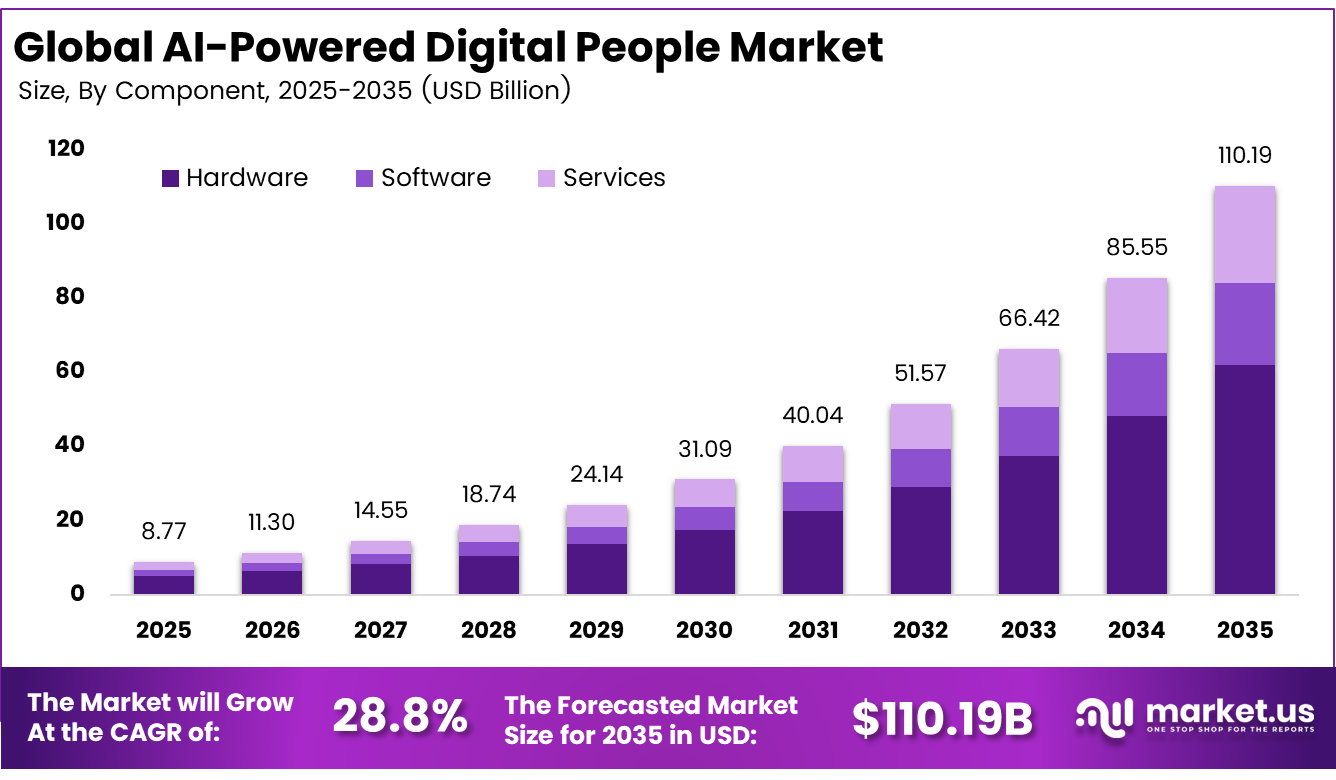
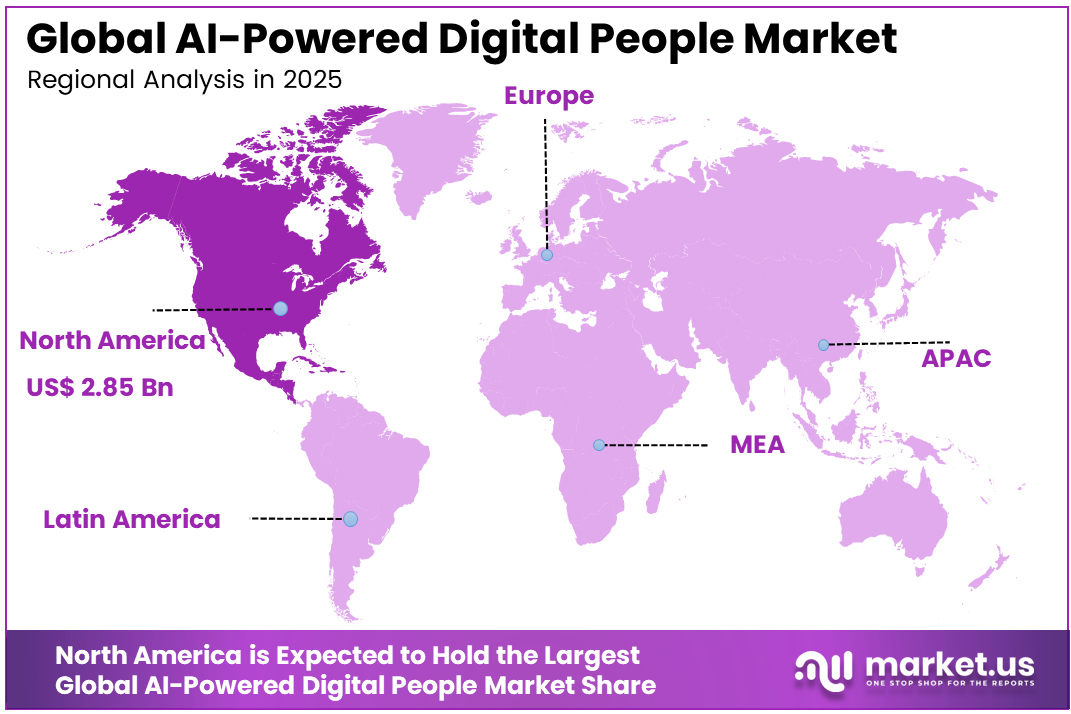
The Global AI-Powered Digital People Market size is expected to be worth around USD 110.19 billion by 2035, from USD 8.77 billion in 2025, growing at a CAGR of 28.8% during the forecast period from 2025 to 2035. North America held a dominant market position, capturing more than a 32.6% share, holding USD 2.85 billion in revenue.
AI-powered digital people act like virtual helpers that look and sound just like real humans, making business chats feel warm and personal. They handle tasks from online shopping guidance to staff training without tiring out. These tools blend smart tech to read faces and voices, offering quick help anytime. Over 70% of users prefer them for fast service over waiting on calls. Businesses love how they cut routine work, letting teams tackle bigger jobs. With rules pushing for clear use, they build trust while fitting into daily apps seamlessly.
Tech advances let digital people chat naturally, drawing businesses eager for better customer ties. 78% of firms now mix AI into daily tasks, craving smooth runs and happy clients. Folks demand instant help around the clock, and these avatars deliver without breaks. Rising needs in sales and support fuel the shift, as they mimic real talks better each year. A simple setup on websites attracts more users, making operations feel alive and responsive.
The market for AI-powered digital people is driven by the need for scalable, personalized customer engagement through virtual assistants and avatars. These tools provide 24/7 interactions with emotional awareness and real-time adaptation, easing human workloads in retail, banking, healthcare, and education. Businesses seek cost-effective ways to meet rising expectations for instant, tailored digital service amid remote work trends. Advances in natural language processing and generative AI enable lifelike responses that boost satisfaction and efficiency.
Demand grows as people seek natural talks over stiff bots in shops and help desks. 70% of service chats may soon use avatars, slashing waits and lifting joy. Users stay loyal when advice fits their style, boosting repeat visits. Stores see steady pull in busy online spaces, where personal touches win over crowds. This need spreads across services, driven by folks wanting quick, friendly fixes daily.
For instance, in March 2025, Reallusion Inc. rolled out AI-driven digital human simulations for digital twins and autonomous vehicle training. San Jose innovators boosted machine learning across security and manufacturing with hyper-realistic avatars that cut development costs.
Key Takeaway
- In 2025, the Hardware segment held a dominant market position, capturing a 56.2% share of the Global AI-Powered Digital People Market.
- In 2025, the Customer Service segment held a dominant market position, capturing a 37.2% share of the Global AI-Powered Digital People Market.
- In 2025, the On-Premises segment held a dominant market position, capturing a 62.8% share of the Global AI-Powered Digital People Market.
- In 2025, the Large Enterprises segment held a dominant market position, capturing a 71.9% share of the Global AI-Powered Digital People Market.
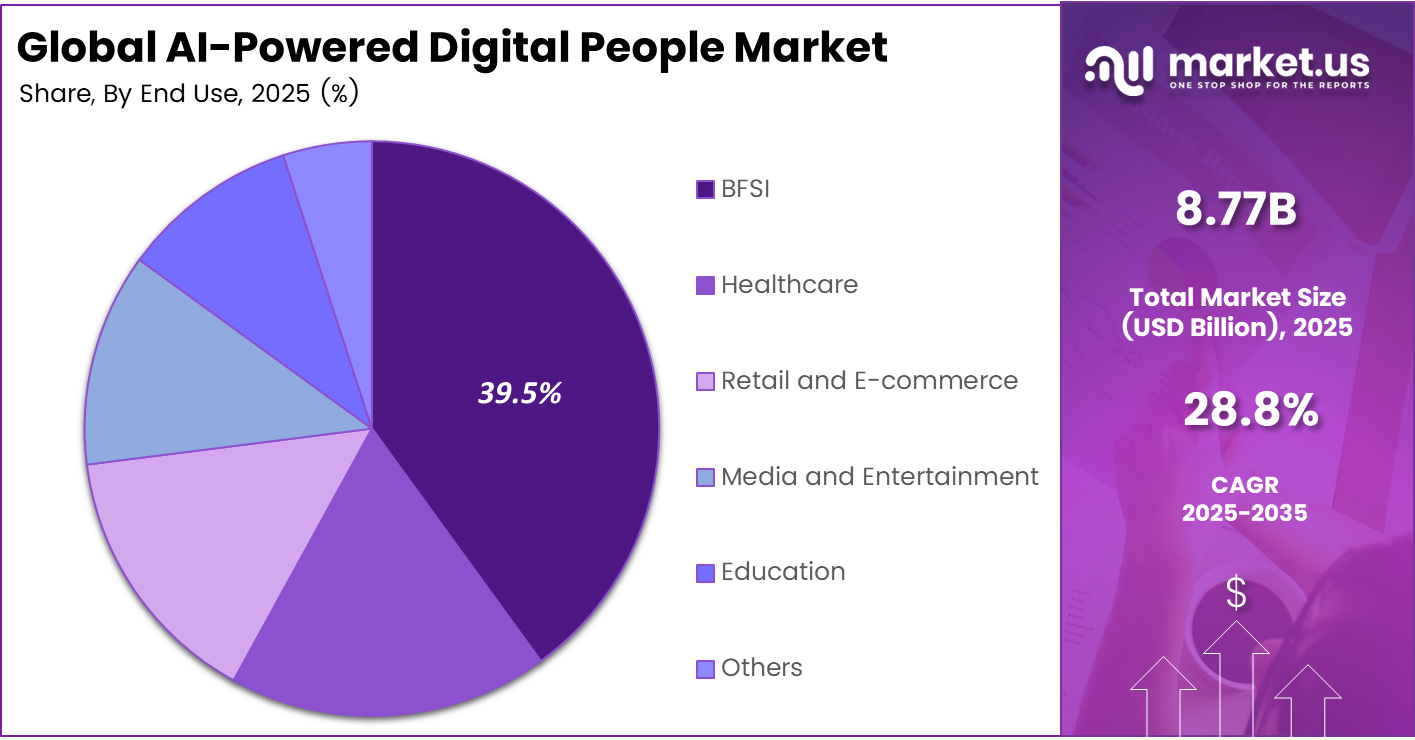
- In 2025, the BFSI segment held a dominant market position, capturing a 39.5% share of the Global AI-Powered Digital People Market.
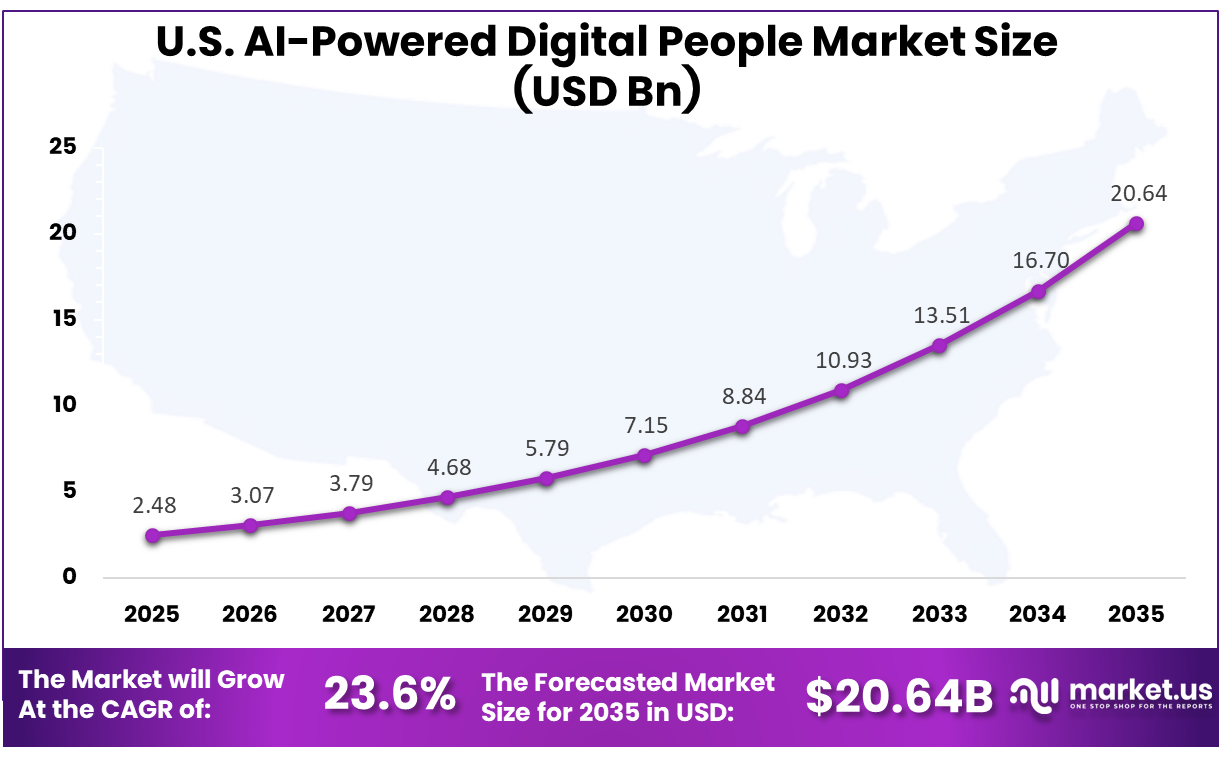
- The U.S. AI-Powered Digital People Market was valued at USD 2.48 billion in 2025, with a robust CAGR of 23.6%.
- In 2025, North America held a dominant market position in the Global AI-Powered Digital People Market, capturing more than a 32.6% share.
Role of Generative AI
Generative AI sits at the heart of digital people, crafting realistic faces, voices, and reactions that adapt in real time. It pulls from vast data to generate natural speech patterns and facial tweaks, making conversations feel genuine rather than scripted. Around 40% of adults in key markets now engage with these tools regularly, blending them into work chats and personal tasks.
Beyond looks, this tech handles context and emotion, letting avatars pick up on tone shifts or user frustration to respond with empathy. In training setups, it boosts retention by 30% as learners interact without judgment, practicing skills at their own pace. The result is a shift from static videos to dynamic partners that evolve with each exchange.
Investment and Business Benefits
Smart money goes into building these for customer help, training, and sales, where quick returns show up fast. Health talks and web stores hold big promise as tech drops in price. Mixing them into common apps opens fresh paths in eager markets. 75% of buyers dodge long lines for instant info, hinting at strong returns. Growth lies in simple tools that touch lives daily.
These helpers work 24/7, lightening staff loads and speeding routine answers. 75% of shoppers pick quick chats over calls for orders or facts. Teams shift to hard tasks, raising total output and smiles all around. Costs dip as they manage peaks solo, building steady client bonds. Output climbs with happy users sticking close.
Regional Analysis
In 2025, North America held a dominant market position in the Global AI-Powered Digital People Market, capturing more than a 32.6% share, holding USD 2.85 billion in revenue. This lead comes from early AI adoption, heavy enterprise investments, and top-notch digital infrastructure. Tech giants and startups push innovation in gaming, retail, and healthcare, where digital people enhance engagement and cut costs. Strong funding for AR/VR and a culture open to immersive tech speed up growth. Robust R&D funding and a mature ecosystem create quick deployment, outpacing other regions.
For instance, in January 2026, Syntiant unveiled full-stack embodied AI solutions at CES 2026, featuring edge AI for voice-controlled digital interactions and vision recognition. Irvine, California-based Syntiant drives North America’s edge in low-power AI digital people, enabling seamless human-device engagement in wearables and smart environments.
U.S. AI-Powered Digital People Market Size
The market for AI-Powered Digital People within the U.S. is growing tremendously and is currently valued at USD 2.48 billion. The market has a projected CAGR of 23.6%. The market is growing due to high demand for personalized customer experiences and scalable engagement tools. Advances in generative AI and real-time rendering make interactions feel natural, speeding adoption in retail and finance. Businesses cut costs with 24/7 support while boosting satisfaction, as digital people handle queries better than chatbots. Strong tech infrastructure and investments drive this shift, especially post-pandemic, for remote services.
For instance, in July 2025, Alethea AI launched EMOTE-1, a multimodal AI engine for real-time emotional digital avatars with facial expressions and gestures. The Los Angeles company solidified U.S. dominance in AI-powered digital people by enabling interactive, personality-consistent agents for education and entertainment.
Key Regions and Countries
North America
- US
- Canada
Europe
- Germany
- France
- The UK
- Spain
- Italy
- Russia
- Netherlands
- Rest of Europe
Asia Pacific
- China
- Japan
- South Korea
- India
- Australia
- Singapore
- Thailand
- Vietnam
- Rest of APAC
Latin America
- Brazil
- Mexico
- Rest of Latin America
Middle East & Africa
- South Africa
- Saudi Arabia
- UAE
- Rest of MEA
Component Analysis
In 2025, the Hardware segment held a dominant market position, capturing a 56.2% share of the Global AI-Powered Digital People Market. These parts, like sensors and processors, bring digital people to life with real-time responses and natural looks. Businesses rely on strong hardware to handle heavy tasks without lags. It forms the backbone for smooth user interactions every day. Quality hardware ensures digital people work well in busy settings. This focus helps companies build trust with users who expect quick and reliable service. Hardware keeps advancing to meet rising demands.
Hardware stands out because it powers the core features of digital people. From cameras that capture expressions to chips that process data fast, every piece matters. Firms pick durable hardware to cut downtime and boost performance. It supports complex actions like gesture recognition and voice modulation. Over time, better hardware means digital people can handle more users at once. This reliability draws in sectors needing constant uptime. Investments here pay off with better engagement rates.
For instance, in September 2025, Soul Machines advances hardware integration in digital people. Their Digital Workforce uses advanced sensors and processors for lifelike interactions. This boosts real-time responses in enterprise setups. The tech pairs patented Digital Brain with robust hardware for natural multimodal talks. Firms gain reliable performance for heavy daily use.
Application Analysis
In 2025, the Customer Service segment held a dominant market position, capturing a 37.2% share of the Global AI-Powered Digital People Market. Organizations are integrating digital humans into customer support workflows to provide consistent, 24/7 assistance that improves user satisfaction and resolves queries without the delays often associated with traditional support channels. This trend aligns with broader industry adoption of conversational AI tools that are designed to understand context and maintain continuity across interactions.
Many enterprises are finding that digital people in customer service can handle a wide range of tasks, from basic inquiries to more complex problem-solving that would otherwise require human agents. The ability of these systems to learn from interactions, recall user history, and personalize responses strengthens engagement and creates a more intuitive support experience.
For instance, in October 2025, Synthesia rolls out digital humans for customer support. These AI presenters handle FAQs with friendly faces, cutting ticket volumes. They guide troubleshooting and hand off complex cases smoothly. Quick creation from short footage enables fast deployment. Businesses see better engagement across channels.
Deployment Mode Analysis
In 2025, the On-Premises segment held a dominant market position, capturing a 62.8% share of the Global AI-Powered Digital People Market. In sectors such as finance, healthcare, and government, organizations often require solutions that reside within their own infrastructure to ensure sensitive information does not leave controlled environments. On-premises deployment supports this requirement by giving firms full ownership of data flows and system configurations.
Enterprises choosing on-premises setups also benefit from tighter integration with legacy systems and internal processes, which can be essential for seamless operations. While cloud alternatives offer scalability, the on-premises model helps mitigate concerns about third-party data access and latency.
For instance, in June 2024, UneeQ demos on-premises digital humans at Computex with NVIDIA. Their Synanim tech runs locally for secure, lifelike animations. It orchestrates AI without cloud risks, fitting strict compliance needs. Firms control data fully while enabling real-time chats.
Enterprise Size Analysis
In 2025, the Large Enterprises segment held a dominant market position, capturing a 71.9% share of the Global AI-Powered Digital People Market. These organizations often have complex engagement needs and high volumes of customer interactions, making digital human solutions attractive for reducing operational burden and improving service consistency. Their scale allows for experimentation with sophisticated AI tools that may be cost-prohibitive for smaller firms.
Additionally, large enterprises typically possess established data infrastructure and dedicated technology teams to support deployment, governance, and continuous improvement. This maturity enables them to extract deeper business value from digital people, translating advanced features into measurable outcomes across departments.
For instance, in September 2025, Soul Machines launches Digital Workforce for large enterprises. It deploys empathetic digital workers for HR, CX, and operations. Secure orchestration integrates with enterprise stacks seamlessly. Tailored roles, like onboarding agents, scale across teams.
End-User Analysis
In 2025, the BFSI segment held a dominant market position, capturing a 39.5% share of the Global AI-Powered Digital People Market. BFSI organizations are actively deploying digital personas to assist with customer inquiries, fraud support, account navigation, and financial guidance. These systems help extend service availability and make complex financial processes more approachable for clients.
BFSI’s focus on reliability and trust makes digital people particularly useful, as they can consistently apply compliance rules while interacting with users. This is valuable where precision and clarity are essential, such as in loan assistance, investment advice, or insurance queries.
For instance, in July 2024, DeepBrain AI deploys generative AI bank tellers at Shinhan Bank. Modeled on real staff, they offer personal service for accounts and loans. Real-time interactions boost customer satisfaction securely. This cuts routine tasks while keeping a human touch. Banks gain efficiency in high-volume finance ops.
Key Market Segments
By Component
- Software
- Hardware
- Services
By Application
- Customer Service
- Healthcare
- Education
- Entertainment
- Retail
- Others
By Deployment Mode
- On-Premises
- Cloud
By Enterprise Size
- Small and Medium Enterprises
- Large Enterprises
By End-User
- BFSI
- Healthcare
- Retail and E-commerce
- Media and Entertainment
- Education
- Others
Emerging Trends
One trend is hyper-realistic avatars that cross into lifelike territory, using advanced rendering to nail subtle expressions and body language. Real-time emotion detection lets them mirror user feelings, creating bonds in virtual meetings or therapy sessions. Adoption jumps 15% year on year in immersive spaces like the metaverse, where presence matters most.
Another wave blends these avatars with AR glasses and VR headsets for hands-on experiences, from virtual store walkthroughs to remote surgeries. Generative models claim 48.5% of the tech stack here, enabling chats that shift based on surroundings or user history. This opens doors for richer remote work and social links that feel close despite the distance.
Growth Factors
Businesses fuel growth by deploying avatars for nonstop service, handling routine queries so staff can tackle complex issues. In retail and healthcare, they deliver consistent help around the clock, cutting response times sharply. Usage climbs 34.6% annually in busy sectors as firms see the value in scalable, tireless support.
Advances in natural language and computer vision give avatars deeper awareness of context, preferences, and even cultural cues. This turns simple interactions into tailored exchanges that build trust and loyalty over time. Lower entry costs from cloud tech make it viable for smaller outfits too, spreading the benefits wider.
Market Dynamics
Drivers - Rising Demand for Scalable Engagement
Customers today expect quick help any time from businesses in retail, banking, healthcare, and education. AI-powered digital personas like virtual assistants offer round-the-clock support and tailor responses to individual needs, easing the load on human staff. This shift meets the call for fast digital service and boosts satisfaction across these fields.
These tools handle routine questions on balances, appointments, or product details, freeing workers for tougher tasks. Businesses gain better customer ties through constant availability and personal touches. Such demand grows as people rely more on instant online interactions in daily life.
For instance, in September 2025, Soul Machines rolled out Digital Workforce, featuring lifelike AI digital workers for healthcare and enterprise use. These agents handle customer talks with empathy and context awareness, easing staff burdens in sales, HR, and support. The launch fits rising needs for always-on, personal interactions that scale without extra hires. Firms integrate it smoothly for better response times and service quality.
Restraint - Data Privacy Concerns
Digital personas need lots of personal details to learn and respond well, sparking worries over safety and misuse. Rules like GDPR demand clear consent, purpose limits, and safeguards for sensitive information in AI use. Customers fear breaches or unwanted sharing, making firms cautious about rollout.
Enterprises face audits, records, and privacy checks to follow these laws, slowing down deployment. High-risk processing requires impact assessments to spot threats early. Such hurdles limit trust and wide uptake despite the tech’s promise.
For instance, in January 2025, Synthesia updated its privacy policy to handle biometric data for avatar creation with strict consent rules. It matches recordings to prevent misuse and meets laws on sensitive info like face geometry. Such steps highlight privacy hurdles in data-heavy AI personas, slowing trust and rollout.
Opportunities - Localization Customization
Tailoring digital personas to local languages, accents, and customs opens doors in regions like APAC, Africa, and Latin America with many online users. AI adapts content to fit cultural values and speech patterns, making interactions feel natural. This approach helps businesses connect deeper with diverse groups.
Human experts refine AI outputs for true relevance, blending tech speed with local insight. Firms reach overlooked areas by respecting traditions and idioms. Growth lies in serving global crowds through thoughtful regional fits.
For instance, in August 2025, Alethea unveiled Aura Framework for swarm agents on Solana, enabling collaborative AI with emotional depth. It supports multimodal chats in education and entertainment, adapting to regional styles. The tech unlocks customized personas for emerging markets.
Challenges - Ethical Risk Management
AI personas risk spreading bias from training data or giving wrong answers, harming trust and reputation. Firms need strict rules to check fairness, track decisions, and fix issues fast. Without care, unfair outcomes in key areas like service can lead to backlash.
Governance includes audits, clear guidelines, and team oversight for ethical use. Boards set policies on transparency and accountability to avoid harm. Ongoing watch ensures safe, reliable performance amid fast tech changes.
For instance, in September 2025, Soul Machines introduced Premium Integrations for its AI agents, linking to tools like Zapier for smooth workflows. The update highlights patented tech for human-like talks while building trust through context-aware, bias-checked responses. Governance ensures ethical deployment amid risks of errors or unfairness.
Key Players Analysis
One of the leading players in October 2025, Synthesia expanded its digital humans technology, enabling the creation of multilingual AI avatars in over 140 languages with precise lip-sync and emotional expressions. Companies now use these for global training, marketing, and support, cutting content localization time dramatically.
Top Key Players in the Market
- Soul Machines
- ObEN Inc.
- Synthesia
- Hour One
- Didimo
- Neon (Samsung Technology & Advanced Research Labs)
- Digital Domain
- Reallusion Inc.
- Pinscreen
- Eisko
- Cubic Motion
- Imperson
- Artie
- DeepBrain AI
- Magic Leap
- UneeQ
- Alethea AI
- Syntiant
- Quantum Capture
- FaceMe
- Others
Recent Developments
- In September 2025, Soul Machines unveiled its Digital Workforce platform, introducing lifelike AI-powered digital workers for healthcare, HR, and sales teams. This launch enables enterprises to deploy empathetic digital humans for personalized interactions, marking a key advancement in scalable AI interfaces that feel genuinely human.
- In October 2025, Synthesia expanded its digital humans technology, enabling the creation of multilingual AI avatars in over 140 languages with precise lip-sync and emotional expressions. Companies now use these for global training, marketing, and support, cutting content localization time dramatically.
Report Scope
| Report Features | Description |
|---|---|
| Market Value (2025) | USD 8.77 Billion |
| Forecast Revenue (2035) | USD 110.19 Billion |
| CAGR (2026-2035) | 28.8% |
| Base Year for Estimation | 2025 |
| Historic Period | 2020-2024 |
| Forecast Period | 2026-2035 |
| Report Coverage | Revenue Forecast, Market Dynamics, Competitive Landscape, Recent Developments |
| Segments Covered | By Component (Software, Hardware, Services), By Application (Customer Service, Healthcare, Education, Entertainment, Retail, Others), By Deployment Mode (On-Premises, Cloud), By Enterprise Size (Small and Medium Enterprises, Large Enterprises), By End-User (BFSI, Healthcare, Retail and E-commerce, Media and Entertainment, Education, Others) |
| Regional Analysis | North America (US and Canada), Europe (Germany, France, The UK, Spain, Italy, and Rest of Europe), Asia Pacific (China, Japan, South Korea, India, Australia, and Rest of APAC), Latin America (Brazil, Mexico, and Rest of Latin America), Middle East & Africa (GCC, South Africa, and Rest of MEA) |
| Competitive Landscape | Soul Machines, ObEN Inc., Synthesia, Hour One, Didimo, Neon (Samsung Technology & Advanced Research Labs), Digital Domain, Reallusion Inc., Pinscreen, Eisko, Cubic Motion, Imperson, Artie, DeepBrain AI, Magic Leap, UneeQ, Alethea AI, Syntiant, Quantum Capture, FaceMe, Others |
| Customization Scope | Customization for segments, region/country-level will be provided. Moreover, additional customization can be done based on the requirements. |
| Purchase Options | We have three licenses to opt for: Single User License, Multi-User License (Up to 5 Users), Corporate Use License (Unlimited Users and Printable PDF) |